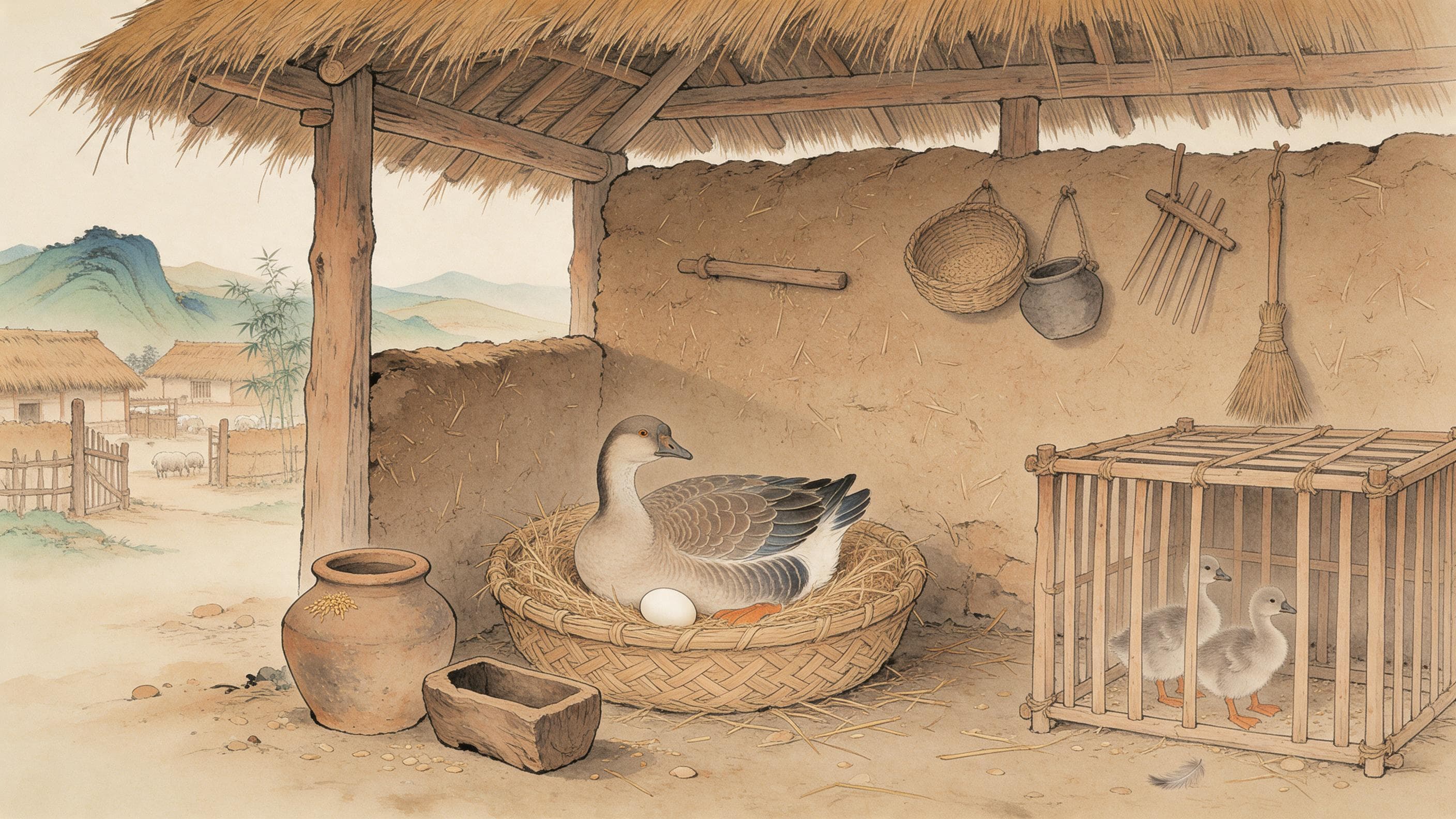
Under a shed, a goose is sitting on a nest of fine dry grass, and the thing beneath her is not an egg. It is a dummy carved from white wood. The manual says to carve one and put it in each nest "to cheat her", because without it the bird will not settle and will lay wherever she happens to be.
Three females to one gander
The breeding stock is chosen carefully: only birds that hatch twice a year are kept, because those that hatch three times lose chicks to the winter cold. The ratio is three female geese to one gander, five female ducks to one drake. A goose lays a dozen or so eggs in her first clutch, a duck several times that, and later clutches are smaller. "Always feed them the five grains in full, and they lay many eggs"; feed them short and they lay few.
The nests go under a shed roof, against pigs, dogs and foxes, and are lined thickly with fine grass for warmth, with the wooden egg set in each one. Eggs are taken away as soon as they are laid and kept somewhere warm under soft grass; left in the nest, the manual says, they freeze and the chick dies.
Twenty eggs under a duck
The setting numbers are fixed: ten eggs under a large goose, twenty under a large duck, fewer under a small bird, since more than that cannot all be covered. Birds that keep getting up are useless as sitters. The ones that will not get up at all need managing: every five or six days they must be given food and made to rise and bathe, because a bird that sits too long grows thin and cold and warms nothing.
Geese and ducks hatch in a month. In the last four or five days the yard has to be kept quiet: no drumming, no spinning wheel, no shouting, no pigs or dogs, no pounding of grain; no sprinkling of ash water, and no visit from a woman who has just given birth. Break the taboo, the manual says, and the chicks are killed inside the shell or die soon after hatching. That is what people then believed, not a biological finding; but the fact that it was written as a rule shows how seriously they took the risk of frightening a sitting bird.
The first meal: filling the crop
Newly hatched chicks go into a separate cage and are given rice gruel, one full meal that the text calls "filling the crop". After that come millet with chopped bitter greens and turnip tops. The water must be clean and changed when it clouds, since muddy water blocks the nostrils and the chick dies.
Water birds cannot do without water, but they must not be left in it: before the navel has closed, cold water seeps in and kills them. A bed of fine grass is laid in a high corner of the cage, and the chicks are kept in for fifteen days; let out early, they are weak, cold, and easy prey for crows and hawks.
Their food is not the same. Geese eat only the five grains, barnyard millet, grass and vegetables, and will not touch insects; ducks eat almost anything, and ripening water-barnyard millet fattens them best. For the kitchen, goslings are ready after a hundred days and ducklings at sixty or seventy, and older birds are tough. After six years geese and ducks stop breeding and should be culled.
The eggs that were never going to hatch
There was another route: salt the eggs. Keep only female ducks, no drake at all, and feed them well; a single duck will then lay a hundred eggs. Since no drake was involved they could never hatch, so they were safe to eat, with no wasted life to answer for. To preserve them, the bark of the vang tree, or failing that the root of Japanese knotweed or the plum-leaved buckthorn, was boiled and the liquid mixed at two dou to one sheng of salt. The brine had to be completely cold before the eggs went in, because a warm brine spoiled them. After a month they were ready, and once the salt had gone right through they floated. Households in the Wu region made them by the tens of dou, and they kept through the summer.
A goose on the grill
The roasting chapter gives the most detailed method for minced goose: two jin of fat young goose, chopped but not too fine, mixed with three ge of good vinegar, one ge of pickled melon, one ge of scallion white, half a ge each of ginger and orange peel, and twenty peppercorns crushed to powder. The mixture was packed onto a bamboo skewer; ten eggs were broken and the whites beaten and rubbed on to bind it, then the yolks painted over; and it was grilled over a fierce fire until it browned and the juices ran.
Another method used a whole fat gosling: cleaned, boiled half through, boned, chopped and mixed with rice vinegar, pickled melon, ginger, orange peel, garlic, fish sauce and pepper, then wrapped in minced white fish and grilled. For duck there was a simpler marinade: the fat duck boned and cut up, steeped for the length of one cooking in wine, fish sauce, ginger, scallion, orange peel and fermented bean juice, and then grilled.
The boundaries matter. The Qimin yaoshu is a farming manual: it records methods and standards, not menus. These dishes need vinegar, fish sauce, eggs and spices, which means a household with grain and a garden; the book gives no prices, no flock sizes for an ordinary farm, and no evidence of how often anyone ate goose. What it does show is a working knowledge of bird behaviour, a wooden egg to settle a nervous goose, a month of quiet, a first meal of gruel, alongside beliefs that a modern reader would not share.
Sources & further reading
- 賈思勰《齊民要術》卷第六·養鵝鴨第六十(Jia Sixie, Essential Techniques for the Common People, juan 6, chapter 60, "Geese and Ducks") — Breeding ratios of three female geese to one gander and five female ducks to one drake; nests under a shed with fine grass and a carved wooden egg to make the bird settle; ten eggs under a large goose and twenty under a large duck; the quiet required in the last days before hatching; rice gruel as the chicks' first meal, called 'filling the crop'; clean water and a raised bed of fine grass; goslings eaten after a hundred days and ducklings at sixty or seventy; and the method of salting duck eggs in a decoction of vang wood bark.
- 賈思勰《齊民要術》卷第九·炙法第八十(Jia Sixie, Essential Techniques for the Common People, juan 9, chapter 80, "Roasting") — Recipes using goose and duck: minced goose bound with egg white and grilled over a fierce fire; a whole parboiled goose minced with vinegar, pickled melon, ginger, orange peel and fish sauce, wrapped in minced white fish; and fat duck boned, cut up and marinated before grilling.