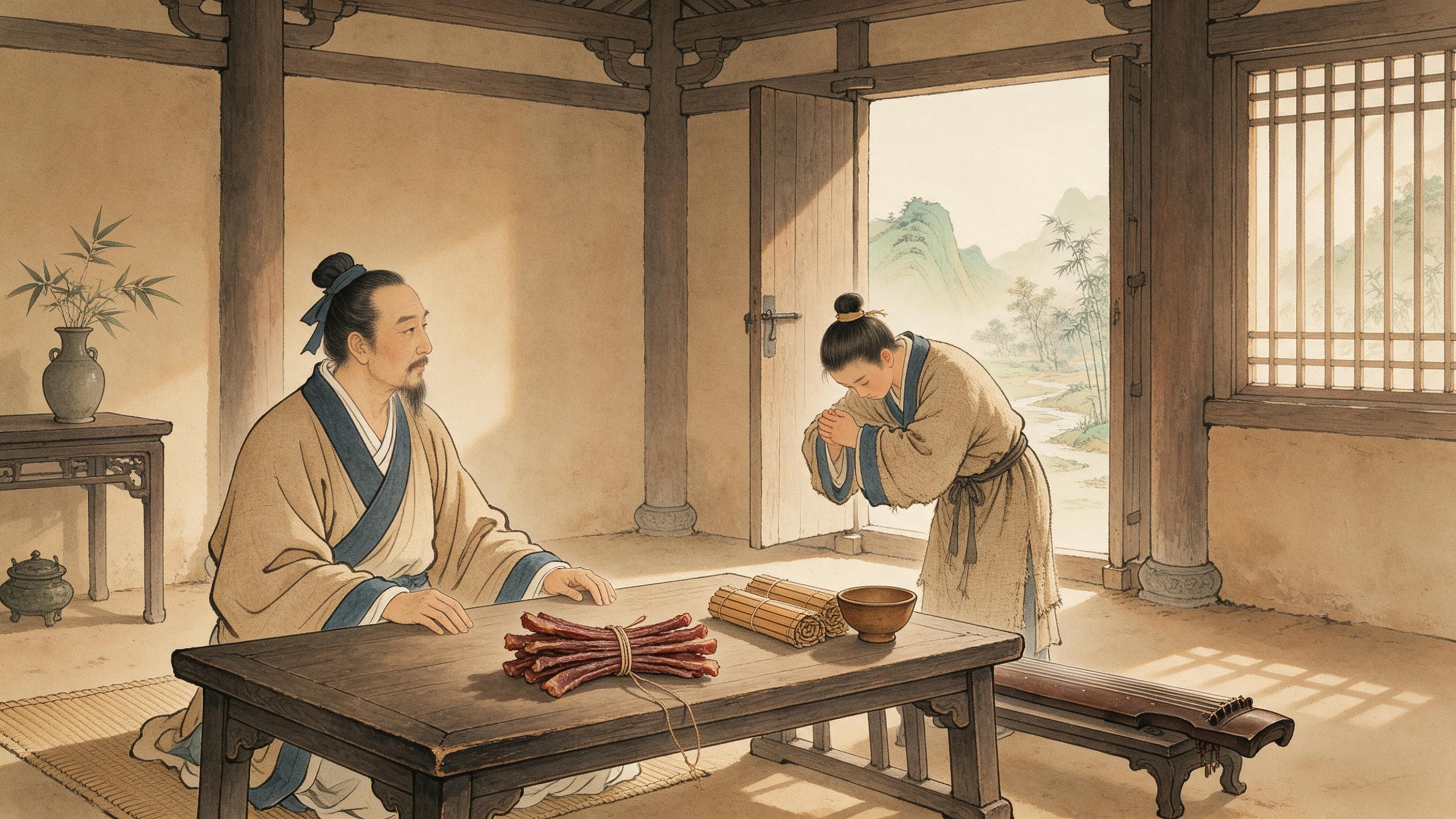
Ten strips of dried meat, tied into a bundle, set down at the door. That is what a student was expected to bring when he came to Confucius. In the Analects, book 7: 'From the man who brings a bundle of dried meat upward, I have never failed to teach anyone.' For two thousand years the line has been read as the origin of tuition fees. It says something smaller and more exact: a thin gift, and the fact of a man willing to walk over.
What a bundle of dried meat was
The two characters need taking apart. Zhu Xi, glossing the passage in the twelfth century, is blunt: 'Xiu means dried meat; ten strips make a bundle.' Then he places it in the rites: 'In antiquity, when people met, they had to bring a gift. A bundle of dried meat was the thinnest of such gifts.' So it was not a sum of money but a gift of introduction — the thing you carried so that your hands were not empty when you came before an elder. His reason is not sentimental: 'All men, being alive, share this pattern; so the sage, towards others, wishes only that they enter into goodness.' The gift is thin because the point is the entering, not the payment.
What the text does not give is more than what it gives. It does not say what ten strips were worth, how often in a year they were brought, how many years study lasted, or whether a poor student was excused and a rich one charged more. Nowhere in the Analects does Confucius quote a price, and no register of student payments survives. What is certain is the threshold: one bundle, brought by the student himself. 'Himself' puts the initiative on the student; 'upward' fixes the floor at one bundle.
Coming to learn, not going out to teach
Zhu Xi puts the weight of the sentence on the coming, not on the meat: 'If a man does not come to learn, there is no rite of teaching going out to him. So if he comes with the gift, there is no one whom one does not teach.' Teaching, in this ritual order, is something asked for, not something hawked. The bundle's real work is to turn 'I come to learn' into a visible act; the gift arrives, and there is no longer a reason to withhold instruction. The threshold is almost symbolic: ten strips of meat. The gift was what a man carried when he came before another, not a sum handed over for goods.
And what was taught? The same book is explicit: 'The Master taught four things: culture, conduct, loyalty and good faith.' The method is stated too: 'I do not open the way for one who is not struggling to understand; I do not help out one who cannot put it into words. If I hold up one corner and he does not come back with the other three, I say no more.' This is a teaching that runs on the student's own effort — a different logic from so many hours for so much money. The same book has him deny any hidden teaching: 'Do you think I hide anything from you? I hide nothing.' And he describes his own work as 'learning without flagging, teaching without wearying'.
Three thousand, seventy-two, seventy-seven
How many students? The Shiji's life of Confucius has the sentence everyone quotes: 'Confucius taught the Odes, the Documents, the rites and music; his disciples were perhaps three thousand, and those who mastered the six arts numbered seventy-two. Men like Yan Zhuozou received instruction and were very numerous.' Note the 'perhaps'. Three thousand is an estimate, not a roll call; the seventy-two who mastered the six arts are those who finished. The Shiji records the same frame in its own words: 'Confucius taught four things: culture, conduct, loyalty and good faith. He was free of four things: no preconception, no insistence, no obstinacy, no ego.'
In another chapter the same book says something else. The collective life of the disciples opens: 'Confucius said: those who received instruction and mastered it numbered seventy-seven, all men of unusual ability.' Seventy-two and seventy-seven, five apart. Both are Sima Qian's; the sources behind them differ, and the figures do not agree. Both are given here, neither averaged nor merged into one 'accurate' number — totals of this kind were estimates to begin with.
The account that cannot be balanced
What were ten strips of dried meat worth? The material has no price for meat and not one record of a named student handing over a bundle. So no tuition is computed here: no conversion into grain, no fraction of a farming family's income, no share of a harvest. Zhu Xi's 'thinnest' is a judgement within the order of gifts — the lightest item in the sequence — not a market price. Read it as a price and the rite collapses into a transaction. Nowhere in the two Shiji chapters used here does the bundle of dried meat appear again; the object lives in that one sentence of the Analects.
One more limit. This piece follows Zhu Xi in reading shuxiu as a bundle of dried meat, and does not offer that as the only possible reading. What can be stated flatly is the line in the Analects and what Zhu Xi made of it. Whether the term was read otherwise by other commentators is another article's business; here the boundary is simply marked. The line survives through a commentary tradition, and the reading above is Zhu Xi's, not the wording of a price-list.
A gesture
So the weight of the bundle is not in the meat. It turns apprenticeship into a gesture with a shape: the student walks over, carries a thin gift, the teacher accepts it and teaches. The thinner the gift, the lower the threshold — ten strips of meat, within reach of anyone willing to come to the door. 'I have never failed to teach anyone': the stress falls on 'never'. The rite has a direction: the student walks over with something in his hands; the teacher does not post a price and wait.
As for the three thousand, that is Sima Qian's estimate; seventy-two or seventy-seven are two ways of counting those who mastered the teaching. None of the figures is firm. What is firm is the threshold: one bundle, brought by the student. Two thousand years later 'shuxiu' has become a synonym for school fees, but in the original there is no account at all — only a gesture, and a sentence with no exception in it. What a later age made of the word — a synonym for school fees — is that later age's business.
Sources & further reading
- 《论语·述而第七》(维基文库本,含「自行束脩」章、「子以四教」章、「不愤不启」章) — The primary text: 'The Master said: From the man who brings a bundle of dried meat upward, I have never failed to teach anyone.' Also the four subjects (culture, conduct, loyalty, good faith) and the teaching rule about not opening the way to a student who is not struggling to understand.
- 《史记》卷四十七·孔子世家、卷六十七·仲尼弟子列传(西汉司马迁;维基文库本,两卷同书合并为一条,链接为卷四十七) — Juan 47: 'Confucius taught the Odes, the Documents, the rites and music; his disciples were perhaps three thousand, and those who mastered the six arts numbered seventy-two. Men like Yan Zhuozou received instruction and were very numerous.' Juan 67 (https://zh.wikisource.org/wiki/史記/卷067) opens differently: 'Confucius said: those who received instruction and mastered it numbered seventy-seven.' The two figures differ; both are given, neither is averaged.
- 朱熹《四書章句集註·論語集注》卷四(南宋;维基文库本) — Zhu Xi's gloss on the passage: 'Xiu means dried meat; ten strips make a bundle. In antiquity, when people met, they had to bring a gift. A bundle of dried meat was the thinnest of such gifts. But if a man does not come to learn, there is no rite of teaching going out to him. So if he comes with the gift, there is no one for whom he has no way of teaching.' This is a ritual reading, not a price list.