A temple in Luoyang used to be a prince's house. The third juan of the Luoyang Qielan Ji says so in three sentences: 高陽王寺,高陽王雍之宅也。在津陽門外三里御路西。雍為爾朱榮所害也,舍宅以為寺 — the Gaoyang Wang Temple was the mansion of Yuan Yong, Prince of Gaoyang, three li outside the Jinyang Gate west of the imperial road, and when Yong was killed by Erzhu Rong the house was given up and made a temple. Both volumes used here come from one book, and the entries are short; this article reads a few of them and asks what each one does and does not say.
Volume Three: The Prince of Gaoyang's House
The house was a palace in all but name. In the Zhengquang years Yong was Chancellor, with 羽葆鼓吹、虎賁班劍百人, a feather canopy, drums and a hundred sword-bearing guards; 貴極人臣,富兼山海, the most honoured of ministers and rich as the sea and mountains. The page then describes the dwelling: 居止第宅,匹於帝宮 — his house matched the imperial palace, which is the writer's comparison and not a measurement; 白殿丹楹,窈窕連亙,飛簷反宇; 竹林魚池,侔於禁苑. The comparison is the point. The house is measured against the palace, and the page never gives its size. The honours listed are the insignia of a very senior minister: a feather canopy and drums, and a hundred guards with swords.
The numbers in the same passage are part of the same writing. 僮僕六千,妓女五百: six thousand servants and five hundred entertainers. 一食必以數萬錢為限, a single meal capped at tens of thousands of coins. 陳留侯李崇 said 高陽一食,敵我千日, one meal of Gaoyang's equals a thousand days of mine, and Li Chong himself kept 僮僕千人. There is a joke at Li Chong's table too: 李令公一食十八種, eighteen dishes at one meal, which 李元佑 explained as 二韭一十八, two leeks, two nines, eighteen. These are the author's figures and a contemporary joke, not a household census. The pattern is the same each time: a large round number, and then a comparison that outdoes it — six thousand against Li Chong's thousand, five hundred against three hundred in the next juan.
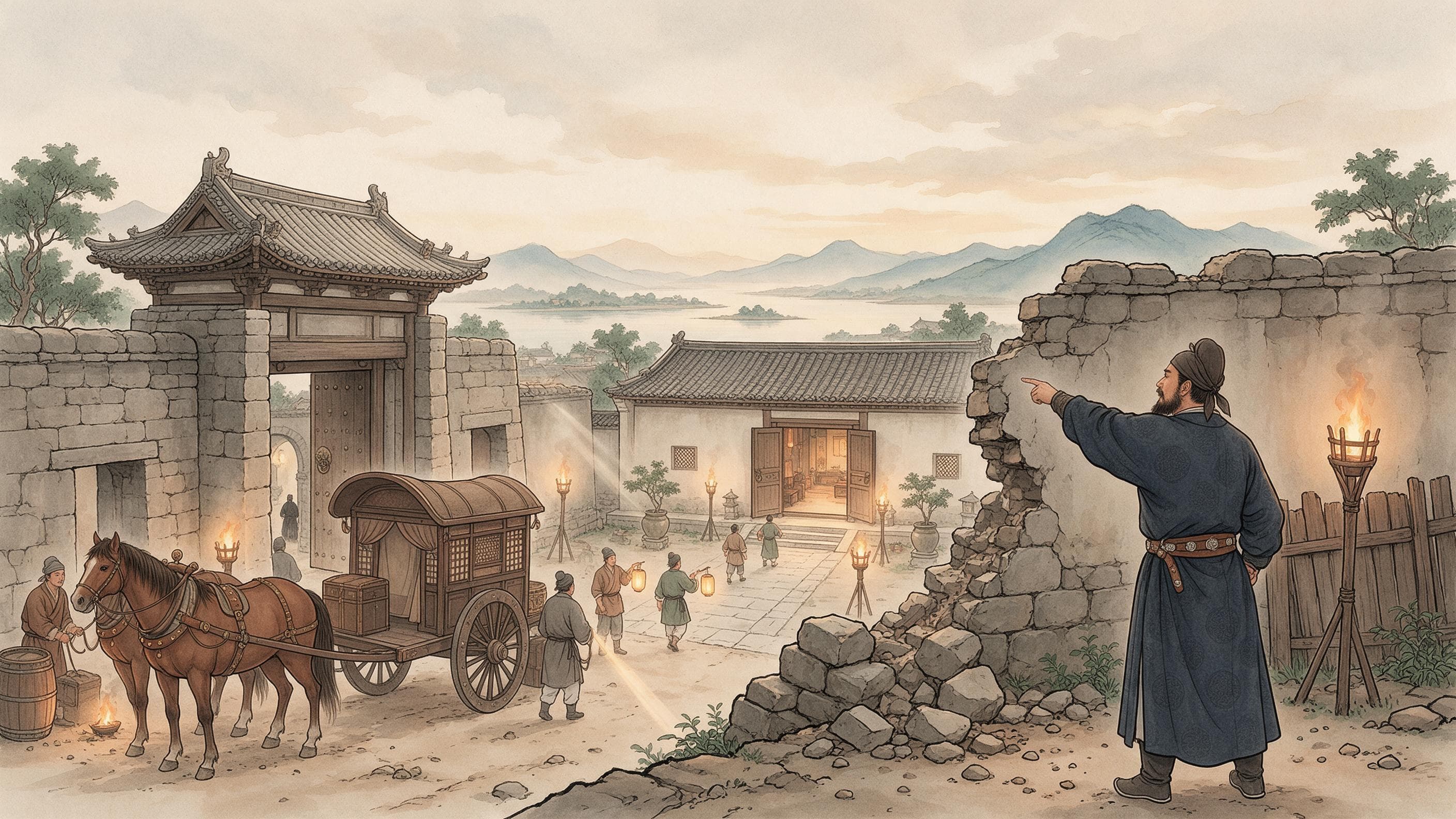
Then the entry turns: 雍為爾朱榮所害也,舍宅以為寺. The house became a temple because its owner was killed. The page never says that Yong had planned to give it away; it does not supply that motive, and this article does not add one. What follows is the household dispersing: 及雍薨後,諸妓悉令入道,或有嫁者 — after his death the entertainers were sent to become nuns, or else married. A house without its prince, and a temple instead. The entry has a shape worth noticing: the house first, then the death, then the temple, then what became of the household.
Volume Four: Other Houses
The 衝覺寺 entry: 衝覺寺,太傅清河王元懌舍宅所立也。在西明門外一里御道北. It gives no reason either. It does describe the house first: 第宅豐大,逾於高陽, larger even than Gaoyang's; a tower that 出淩雲臺 rises above the Cloud-Touching Terrace; below it 儒林館、延賓堂,形製並如清暑殿, built like the Qingshu Hall; and 土山釣池,冠於當世. Yuan Yi was killed in the early Zhengquang years by Yuan Cha, 薨懌於下省, and the temple entry still says only 舍宅所立. His death is recorded in the same entry, a few lines below the description of his house, and the two facts are left side by side: the mansion, the killing, the temple.
The 大覺寺 entry is the shortest and the most concrete: 大覺寺,廣平王懷舍宅所立也. Then one line about the conversion itself: 懷所居之堂,上置七佛 — in the hall where Yuan Huai lived, seven Buddhas were installed. Around it 林池飛閣,比之景明, woods, ponds and flying galleries compared to the Jingming Temple. Of all these entries this is the only one that says what was placed where. The detail is small and exact: the conversion is a matter of putting statues into a room that was already there.
The 宣忠寺 entry has the only stated motive. the Prince of Chengyang, 城陽王, whose name the page gives as 徽, vowed during the fighting that if he could get into Luoyang he would give his house as a temple: 徽願入洛陽,舍宅為寺. When the rebellion collapsed and the dynasty's fortunes turned, 遂舍宅焉, the vow was carried out. Here the gift follows a promise made in a war rather than a death, and the page dates it only by the reign period, 永安中. The entry is also the only one that gives a sequence inside the gift: the vow, the battle, the restoration, the transfer.
Shouqiu li, the Princes' Ward
Volume four fixes the quarter with four boundaries and two measurements: 自退酤以西,張方溝以東,南臨洛水,北達芒山,其間東西二里,南北十五里,並名為壽丘里,皇宗所居也。民間號為王子坊 — from Tuigu west to the Zhangfang Canal, south to the Luo and north to Mount Mang, two li east to west and fifteen li north to south, all of it called Shouqiu li, where the imperial clan lived; the people called it the Princes' Ward. These are the usable figures, and they are kept as written. The four boundaries are place names and the two measures are in li; the page gives no map and no plan.
The page then turns to the ward's habits: 帝族王侯,外戚公主…爭修園宅,互相誇競; 崇門豐室,洞戶連房,飛館生風,重樓起霧; 高臺芳榭,家家而樂;花林曲池,園園而有. The richest was 河間王琛, who 最為豪首 and 常與高陽爭衡, competing with Gaoyang. His 妓女三百人 against Gaoyang's five hundred, his saying 不恨我不見石崇,恨石崇不見我, and 章武王融, who saw his treasures and went home ill for three days — all of it is one kind of writing: rivalry, numbers, envy. It is not a survey of houses. The same writing goes on with 章武王融, who is said to have fallen ill from envy and stayed in bed for three days.
From House to Temple
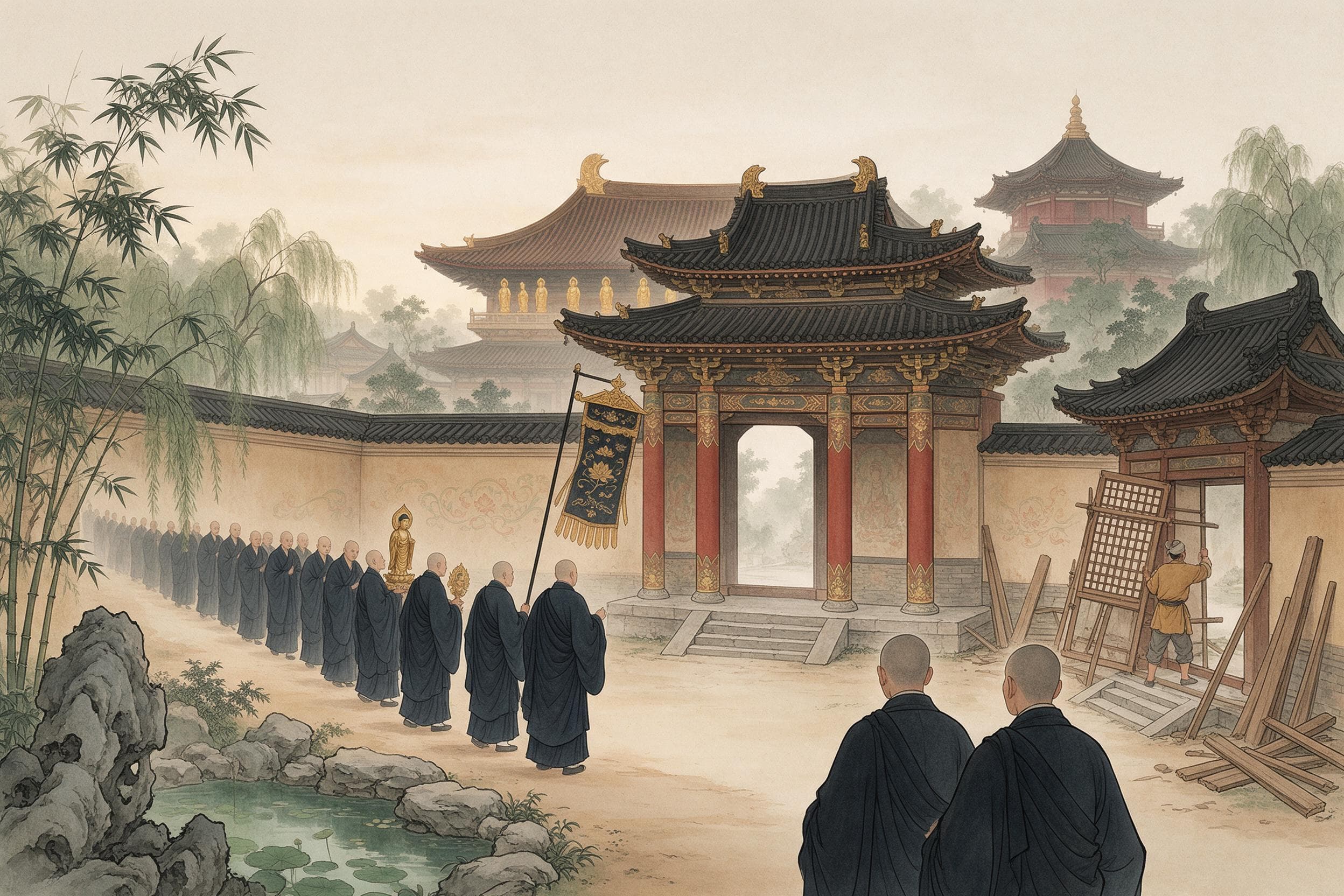
The book's own summary stands in the same juan: 經河陰之役,諸元殲盡,王侯第宅,多題為寺。壽丘里閭,列剎相望 — after the Heyin massacre, when the Yuan clan was destroyed, the princes' houses were mostly marked as temples, and in Shouqiu li the monasteries faced one another. That is the author's general sentence, and it stands beside the entries: one house after a killing (Gaoyang), one after a killing the entry does not mention (Chongjue), one after a vow made in a war (Xuanzhong). Each entry gives a line and no history; this article does not turn the summary into a movement. The summary sentence is a general statement made by the writer; the entries remain individual, and none is dated beyond a reign period.
What This Article Leaves Out
It does not write the flourishing of Buddhism under the Northern Wei, or the piety of princes, as general subjects: the material is a handful of entries and one summary sentence. It gives no measurements of the houses and no layout of the temples they became; the pages do not supply them, and a mansion's size cannot be recovered from 匹於帝宮, which is a comparison. The figures quoted — six thousand servants, five hundred entertainers, three hundred, two li by fifteen — are kept as the book writes them and are not counted. The five other Luoyang articles in this series, on the pagoda, on temple wealth, on the guest houses for foreigners, on court musicians and on the image procession, take other objects; this one is about the houses themselves. And the two volumes are one book, not two witnesses. What the pages give is a handful of houses, a few numbers and one general sentence, and this article stays with that.
Related reading:The Kunming Pool and the Tower Ships: Digging a Lake for River War · The Guest House: Where 'a Guest Arriving as If Coming Home' Came From · Huzi: A River Breaks Its Banks, and Nobody Closes It for Twenty Years
Sources & further reading
- 《洛陽伽藍記》卷三(北魏楊衒之撰;維基文庫本,頁面白文) — The 高陽王寺 entry: 高陽王寺,高陽王雍之宅也。在津陽門外三里御路西。雍為爾朱榮所害也,舍宅以為寺. It then describes the house: 居止第宅,匹於帝宮…僮仆六千,妓女五百…一食必以數萬錢為限, and the household after Yong's death: 及雍薨後,諸妓悉令入道,或有嫁者.
- 《洛陽伽藍記》卷四(北魏楊衒之撰;維基文庫本,頁面白文) — The 衝覺寺 (清河王元懌舍宅所立), 大覺寺 (廣平王懷舍宅所立,懷所居之堂,上置七佛) and 宣忠寺 (城陽王徽 徽願入洛陽,舍宅為寺) entries; the Shouqiu li passage 其間東西二里,南北十五里,並名為壽丘里,皇宗所居也。民間號為王子坊, the description of 爭修園宅 and 河間王琛, and the summary 經河陰之役,諸元殲盡,王侯第宅,多題為寺。壽丘里閭,列刹相望.