Begin with three sentences: 'at this time the Yue wished to fight Han with ships, so the Kunming Pool was greatly enlarged and viewing towers were ranged around it. Tower ships were built, more than ten zhang high, with banners and flags on them, very grand' (是時越欲與漢用船戰逐,乃大修昆明池,列觀環之。治樓船,高十餘丈,旗幟加其上,甚壯). One sentence gives the reason, one the works, one the ships. This piece writes only what is in those sentences, plus one more: who dug it.
One: the dismissed officials who cut thorns
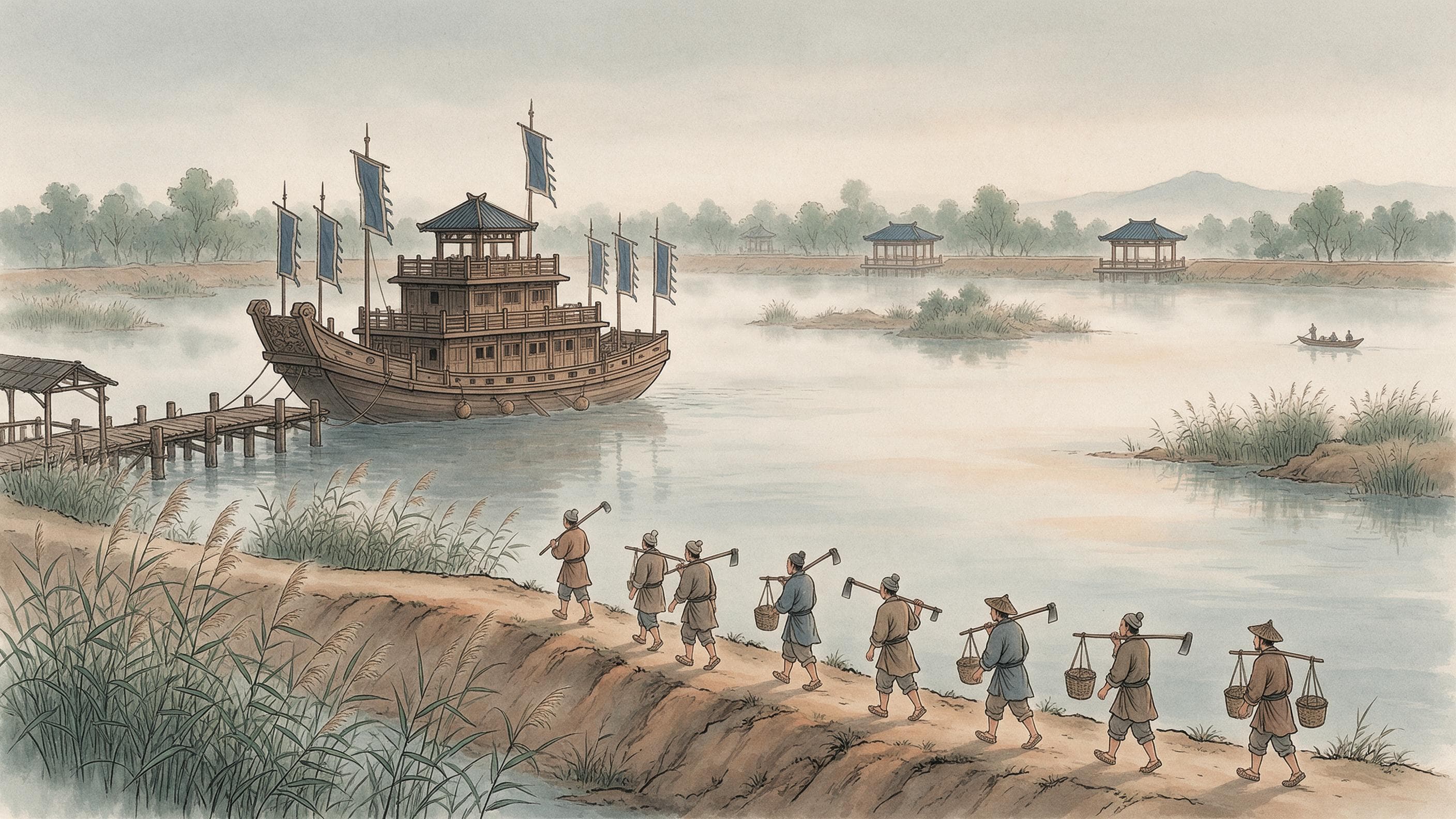
Who dug it is in another passage on the same page: 'the laws being made harsher, many officials were dismissed. Arms were often in motion, the people bought exemptions and the fifth rank, and men available for conscription grew few. So captains of a thousand and of the fifth rank were made officials, and those who did not wish it supplied horses; and the dismissed officials were all sentenced to cut thorns in Shanglin and to make the Kunming Pool' (故吏皆適令伐棘上林,作昆明池). The page says which men were sent; it gives no number, no duration and no cost, and this piece computes none.
Two: the reason, in one phrase
The reason is nearly identical in both books, with two characters different. The Shiji: 'the Yue wished to fight Han with ships, so the Kunming Pool was greatly enlarged and viewing towers were ranged around it' (越……列觀環之). The Han treatise: 'the Yue wished to fight Han with ships, so the Kunming Pool was greatly enlarged and lodges were ranged around it' (粵……列館環之). 越 and 粵 for the same people, 觀 and 館 for what stood around the water — the variants are set side by side and not harmonised. The explanation that the pool was dug 'in order to attack Kunming' is not on either page; both give the reason as fighting with ships. So this piece does not import that explanation and does not decide which is the 'real' cause. One more detail of the text: it says only 越 (or 粵), without saying which Yue — the pages do not locate them, and this piece does not either.
One layer must be marked: both pages put the pool inside a narrative of finance and of the imperial park, not inside a treatise on waterworks. What they give is a reason, an action and a ship; what they do not give is a source of water, a volume of earth moved, or any later use. The later uses — carrying grain, supplying water — are not on these pages and are not written here.
Three: the tower ships
The ships are copied too: 'tower ships were built, more than ten zhang high, with banners and flags on them, very grand' (高十餘丈,旗幟加其上,甚壯). 'More than ten zhang' is the text's own measure: this piece does not convert it into metres, does not estimate displacement, does not compute deck area. 'Very grand' is the history's own appraisal, and is marked as an appraisal. How many decks, how many men aboard, what timber, where they lay — neither page says, and none of it is supplied. The word 'tower ship' (樓船) occurs once on each page, in this sentence only; it is not described anywhere else in either book's passage.
The next sentence is worth keeping: 'the Son of Heaven was moved by it, and built the Bailiang terrace, several tens of zhang high. The building of palaces grew finer from this' (於是天子感之,乃作柏梁臺,高數十丈。宮室之修,由此日麗). The Han treatise writes 繇此 for the Shiji's 由此 — one variant, quoted as it stands. The page says the emperor 'was moved'; it does not say the two buildings are causally linked, and this piece does not link them.
Four: where the lake sits in the narrative
The passage before it runs: 'at first, the grand provisioner had many salt and iron offices and a water-balance office was set up, intending to manage salt and iron; then came Yang Ke's denunciation of taxable wealth, the goods in Shanglin grew many, and the water-balance office was made to manage Shanglin. Shanglin being full, it was further enlarged' (上林既充滿,益廣). Only then come the pool and the tower ships. So in these pages the lake is one item in the enlargement of the imperial park: it appears in a passage about the park and the treasury, not in a passage about water management. The two offices named just above it — the water-balance office and the grand provisioner — are there to manage salt, iron and the park's goods, not to manage water.
The same work appears twice on the page: once as 'the dismissed officials cut thorns in Shanglin and made the Kunming Pool', once as 'the Kunming Pool was greatly enlarged and viewing towers were ranged around it'. The two mentions are separated, the page gives no year for either, and this piece converts no reign year into a Western date. Whether the two are a first digging and a later enlargement, or one event recorded twice, the page does not say, and this piece does not guess.
Five: beyond these two pages
What the pages do not give: the lake's circumference, depth or source; the earth moved, the time taken, the number of labourers or the cost; the number of ships, their build or their crews; and whether the fleet was ever used, or fought at all. None of it is supplied, and no other book is brought in to fill it.
A boundary: the piece on this site about the Bian canal is about a grain-transport waterway, and the piece on Qi measures is about capacity standards; this one is about a lake, a kind of ship, and one stated reason. Nor does it argue about a Han navy or about hydraulic achievement — the pages give three sentences, not a history of engineering.
To close, the sentences can simply stand together: because there was to be a war of ships, the Kunming Pool was greatly enlarged and towers were ranged around it; tower ships were built, more than ten zhang high, with banners on them, very grand; the emperor was moved and built the Bailiang terrace; and the men sent to dig the lake were dismissed officials, cutting thorns in Shanglin. Sizes and numbers are quoted as written, converted into nothing; how large the lake was, neither page says. What the pages leave is a reason, a work, a ship and a labour detail — and, around them, a treasury being stretched.
Related reading:Huzi: A River Breaks Its Banks, and Nobody Closes It for Twenty Years · Zhuti: Gates and Clay Seals at a Han Commandery Town in the Southwest · A White Wall and an Awl's Inch: The City of Tongwan
Sources & further reading
- 司马迁《史记》卷三十〈平准书〉(维基文库本,未与点校本复核) — The two mentions of the pool. In the fiscal sequence, after the laws were made harsher and many officials were dismissed: 'the dismissed officials were all sentenced to cut thorns in Shanglin and to make the Kunming Pool' (故吏皆適令伐棘上林,作昆明池). Later, in the passage on the expansion of Shanglin: 'at this time the Yue wished to fight Han with ships, so the Kunming Pool was greatly enlarged and viewing towers were ranged around it. Tower ships were built, more than ten zhang high, with banners and flags on them, very grand. The Son of Heaven was moved by it, and built the Bailiang terrace, several tens of zhang high. The building of palaces grew finer from this' (是時越欲與漢用船戰逐,乃大修昆明池,列觀環之。治樓船,高十餘丈,旗幟加其上,甚壯……宮室之修,由此日麗). Sizes are quoted as written and converted into nothing.
- 《汉书》卷二十四〈食货志〉(维基文库本,未与点校本复核) — The parallel passage, with its own characters: 'at this time the Yue wished to fight Han with ships, so the Kunming Pool was greatly enlarged and lodges were ranged around it. Tower ships were built, more than ten zhang high, with banners on them, very grand… The building of palaces grew finer from this' (是時粵欲與漢用船戰逐,乃大修昆明池,列館環之。治樓船,高十餘丈,旗織加其上,甚壯……宮室之修,繇此日麗). The page differs from the Shiji in four characters — 粵 for 越, 列館 for 列觀, 旗織 for 旗幟, 繇此 for 由此 — which are set side by side and not harmonised here. It also carries the same sentence about dismissed officials 'cutting thorns in Shanglin and making the Kunming Pool' (故吏皆適令伐棘上林,作昆明池).