In the yuan guang reign the Yellow River broke at Huzi (瓠子): 東南注鉅野,通於淮、泗 — southeast into Juye and through to the Huai and Si. The first attempt to close the gap failed almost at once. Then the chancellor spoke, and the work stopped: 於是天子久之不事復塞也, 'for a long time the emperor did not take the matter up again'. More than twenty years passed before a second attempt, by which time the emperor came himself. Two pages carry it: the Shiji's chapter on rivers and canals (河渠書), whose author says he carried firewood at the closing, and the Book of Han's treatise on waterways (溝洫志), which follows the Shiji and continues to Wang Mang. Their variant readings are printed side by side here and not reconciled.
The Break, and the First Attempt
The chapter first records an earlier breach: 漢興三十九年,孝文時河決酸棗,東潰金隄,於是東郡大興卒塞之 — in the thirty-ninth year of the Han, under Emperor Wen, the river broke at Zaozhao, burst the Gold Embankment, and Dongjun raised troops in mass to close it. Then comes Huzi, and the two pages date it differently. The Shiji has 其後四十有餘年,今天子元光之中, 'more than forty years later, in the yuan guang reign of the present Son of Heaven'; the Book of Han has 其後三十六歲,孝武元光中. Both figures stand as the pages give them; neither is adjusted to the other.
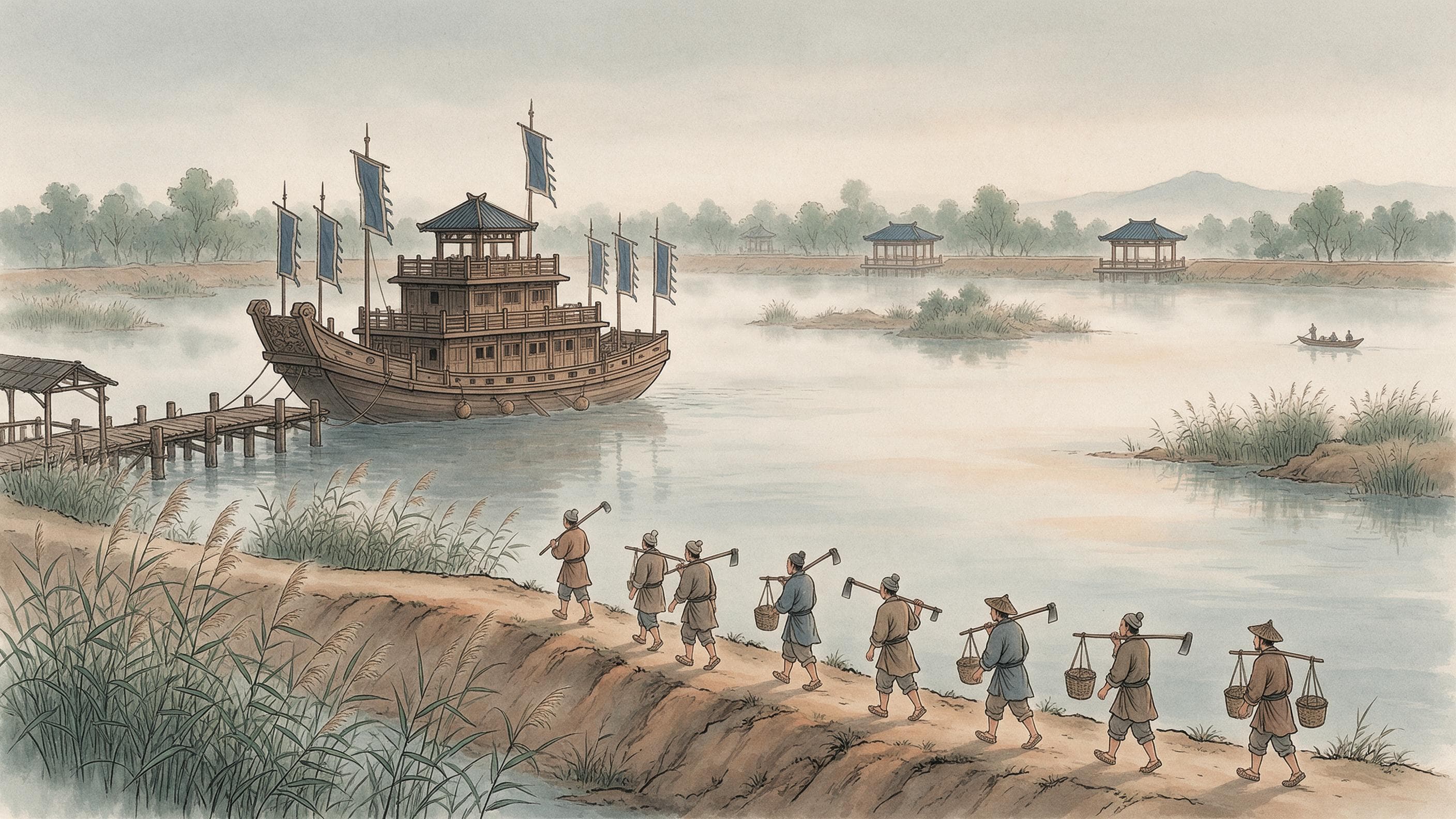
The first attempt is one sentence: 於是天子使汲黯、鄭當時興人徒塞之,輒復壞 — Ji An and Zheng Dangshi were sent to raise labourers and close it, and it broke again. What follows is the price paid over decades: 自河決瓠子後二十餘歲,歲因以數不登,而梁楚之地尤甚 — for more than twenty years after the breach the harvest failed repeatedly, worst in the lands of Liang and Chu. How much farmland was drowned, how many people moved, the pages do not say; they give 'repeatedly' and 'worst', and nothing is added.
'It Is Heaven's Doing'
The reason is written as a private interest, not an argument. 是時武安侯田蚡為丞相,其奉邑食鄃。鄃居河北,河決而南則鄃無水菑,邑收多 — Tian Fen, Marquis of Wuan, was chancellor, and his fief was the revenue of Shu; Shu lay north of the river, so a breach running south left it undamaged and its yield higher. Then the words he used: 蚡言於上曰:「江河之決皆天事,未易以人力為彊塞,塞之未必應天」 — breaches of rivers are all Heaven's doing, not easily forced shut by human strength, and a closure may not accord with Heaven. And 而望氣用數者亦以為然 — the men who read emanations and cast numbers agreed with him. The page then says only 於是天子久之不事復塞也. The text sets fief, words and delay in that order, never saying the first caused the second; that the fief weighed on the decision is an inference, marked as one.
Of those twenty-odd years the pages say almost nothing: no other voice argues for closing the breach, no cost is estimated, no repair is mentioned; the record steps from advice to delay. The Book of Han's wording differs slightly — 鄃無水災,邑收入多; 是以久不復塞也 — and is printed as it stands.
The Closing: White Horse, Jade, and Bamboo
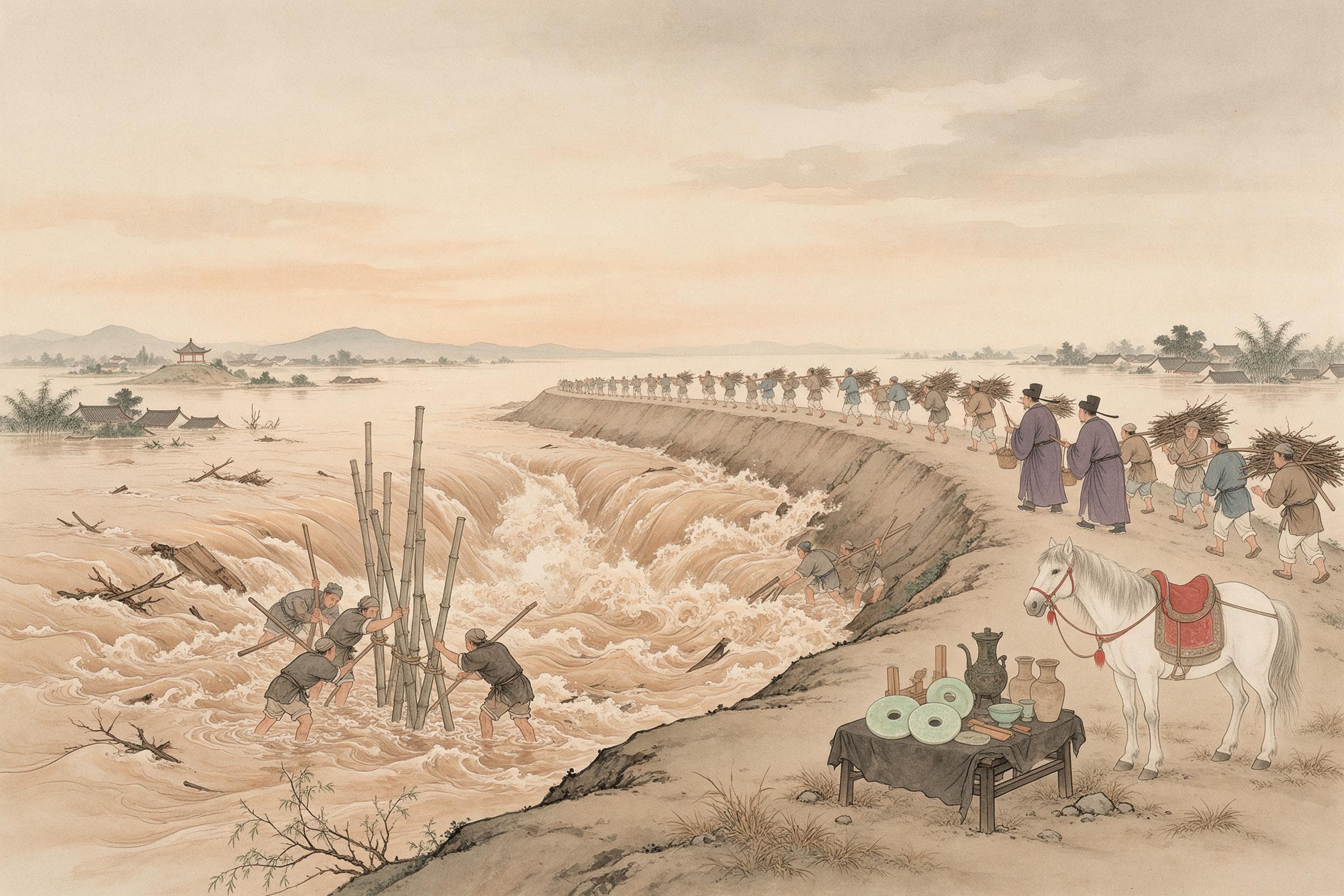
After the emperor had sacrificed at Mount Tai and toured the mountains and rivers, 其明年,旱,乾封少雨 — the next year brought drought and little rain at the Feng sacrifice. Then 天子乃使汲仁、郭昌發卒數萬人塞瓠子決 — Ji Ren and Guo Chang with tens of thousands of conscripts. 'Tens of thousands' is as far as the figures go; the pages give no total of men, no grain, no wages, no width for the gap. The emperor came himself: 於是天子已用事萬里沙,則還自臨決河,沈白馬玉璧于河 — after a rite at Wanli Sands he returned, stood at the broken river, and sank a white horse and jade discs into it. Then 令群臣從官自將軍已下皆負薪窴決河 — every officer from the generals down was made to carry firewood to fill the breach. And the material gave out: 是時東郡燒草,以故薪柴少,而下淇園之竹以為楗 — the grass of Dongjun had been burned off, firewood was scarce, and bamboo from the Qi garden was cut and driven in as piling. 楗 is generally understood as stakes or bamboo cribwork; the page has no note, so it is marked as a general understanding.
Two songs are quoted, both attributed to the emperor, made when he stood at the river and grieved that the work would not finish (天子既臨河決,悼功之不成,乃作歌曰). The first begins 瓠子決兮將柰何?皓皓旰旰兮閭殫為河 — 'the Huzi is broken: what is to be done? Vast and spreading, the villages are all river.' The second names the shortage: 搴長茭兮沈美玉,河伯許兮薪不屬。薪不屬兮衛人罪,燒蕭條兮噫乎何以御水 — the jade went down, the River Lord consented, and the firewood did not come. The songs are printed as given, not judged as literature. The Book of Han's variants — 浩浩洋洋,慮殫為河; 皇謂河公兮何不仁; 宣防 — stand beside them.
After the Closing: Xuanfang, and 'the Old Course of Yu'
於是卒塞瓠子 — at last the Huzi was closed — and 筑宮其上,名曰宣房宮: a palace was built on the embankment and named Xuanfang (the Book of Han writes 宣防). Then the channel: 而道河北行二渠,復禹舊跡,而梁、楚之地復寧,無水災 — the river was led north in two channels, 'restoring Yu's old course', and Liang and Chu were quiet again without flood. 'Restoring Yu's old course' is the phrase of the men who did it, not a survey; where Yu's channels ran, neither page says. One line closes the episode: 自是之後,用事者爭言水利 — after this, everyone in office had a water project to propose.
The chapter ends with its author on himself. In the section beginning 太史公曰 he finishes on two sentences: 余從負薪塞宣房,悲瓠子之詩而作河渠書 — 'I carried firewood at the closing of Xuanfang, grieved at the Huzi songs, and made the Book of Rivers and Canals.' That is Sima Qian on his own part, the only statement in either page about who was present. Everything here about the closing comes from a man who says he was there: a fact about the source, not a guarantee of the detail.
Afterwards: The Ledger, and a Plan Never Used
The Book of Han keeps the accounts. Under Emperor Yuan, 永光五年,河決清河靈鳴犢口,而屯氏河絕 — in the fifth year of Yongguang the river broke at Lingmingdu in Qinghe and the Tunshi channel was cut off. Under Emperor Cheng, after Xu Shang reported 方用度不足,可且勿浚 (money was short; the work could wait), 後三歲,河果決於館陶及東郡金隄 — three years later it broke at Guantao and the Gold Embankment. The figures: 凡灌四郡三十二縣,水居地十五萬餘頃,深者三丈,壞敗官亭室廬且四萬所 — four commanderies and thirty-two counties flooded, more than 150,000 qing under water, three zhang deep in places, some 40,000 official buildings and houses ruined. 徙民避水居丘陵,九萬七千餘口 — more than 97,000 people moved to high ground; the chief censor, judged careless, was rebuked and killed himself. Wang Yanshi closed the breach 以竹落長四丈,大九圍,盛以小石,兩船夾載而下之。三十六日,河隄成 — bamboo baskets four zhang long and nine wei around, filled with small stones, lowered between two boats; thirty-six days, and the embankment stood. The reign-title was changed because of it (其以五年為河平元年), and he was made a marquis and given a hundred jin of gold. 後二歲,河復決平原 — two years later the river broke at Pingyuan, doing half the damage of the earlier one; and at Hongjia 4, 勃海、清河、信都河水湓溢,灌縣邑三十一,敗官亭民舍四萬餘所. Qing, zhang, wei, jin and heads stand as given, not converted.
The treatise ends with a plan that was never carried out. Under Emperor Ai, Jia Rang submitted 治河有上中下策. His upper policy — 徙冀州之民當水衝者,決黎陽遮害亭,放河使北入海 — would move the people of Jizhou out of the river's path, break the dike at Zhehai Pavilion and let the river run north to the sea; his middle — 多穿漕渠於冀州地,使民得以溉田,分殺水怒 — cut channels across Jizhou to water the fields and divide the river's force; his lower — 繕完故隄,增卑倍薄,勞費無已,數逢其害,此最下策也 — merely repair the old dikes, raising the low and thickening the thin: endless expense, repeated disaster, 'the worst policy of all'. These are Jia Rang's arguments; neither page says any of the three was adopted, and the treatise closes 王莽時,但崇空語,無施行者 — under Wang Mang there was much empty talk and nothing done. So the two pages leave the river: one breach closed, a palace on the bank, a reign-title changed, a plan on paper. Zheng Guo's canal and the field drains are other subjects; this article stays with this breach.
Related reading:Zhuti: Gates and Clay Seals at a Han Commandery Town in the Southwest · A White Wall and an Awl's Inch: The City of Tongwan · Following the Ground: How the Qin Wall Was Built
Sources & further reading
- 《史记》卷二十九·河渠书(西汉司马迁撰;维基文库本,页面白文无注,未与中华书局点校本复核) — Sima Qian's chapter on rivers and canals, whose author says he carried firewood at the closing of the Huzi breach. Under Emperor Wu, in the yuan guang reign, the Yellow River breaks at Huzi and flows southeast into Juye, through to the Huai and Si; Ji An and Zheng Dangshi are sent to close it and it breaks again; Chancellor Tian Fen, whose fief lies north of the river, argues that river-breaks are Heaven's doing and not to be forced, and for a long time nothing is done; more than twenty years later Ji Ren and Guo Chang are sent with tens of thousands of men, the emperor comes in person, sinks a white horse and jade discs, makes every officer from the generals down carry firewood, and, the grass of Dongjun having been burned, cuts bamboo in the Qi garden for piling; two songs are quoted, one complaining that the firewood ran out; the breach is closed, a palace named Xuanfang built on the embankment, the river led north in two channels 'restoring Yu's old course'; the chapter closes with the Grand Historian saying he carried firewood at the closing of Xuanfang and grieved at the Huzi songs.
- 《汉书》卷二十九·沟洫志(东汉班固撰;维基文库本,页面白文无注,未与中华书局点校本复核) — Ban Gu's treatise on waterways: the early part follows the Shiji closely with variant readings (其後三十六歲 for 其後四十有餘年; 湛白馬玉璧; 寘決河; 揵; 名曰宣防; variant song lines), and the later part continues to Wang Mang with figures: under Emperor Cheng a breach floods four commanderies and thirty-two counties, more than 150,000 qing under water, three zhang deep in places, some 40,000 buildings ruined, more than 97,000 people moved; Wang Yanshi closes it in thirty-six days with bamboo baskets four zhang long and nine wei around, filled with small stones and lowered between two boats, and the reign-title is changed to Heping; two years later the river breaks at Pingyuan, and at Hongjia 4 it floods thirty-one counties and more than 40,000 houses; Jia Rang's three policies — move the people of Jizhou and let the river go north to the sea, cut channels to divide its force, or merely repair the dikes, 'the worst policy of all' — are argued and not carried out, and 'under Wang Mang there was much empty talk and nothing done'.