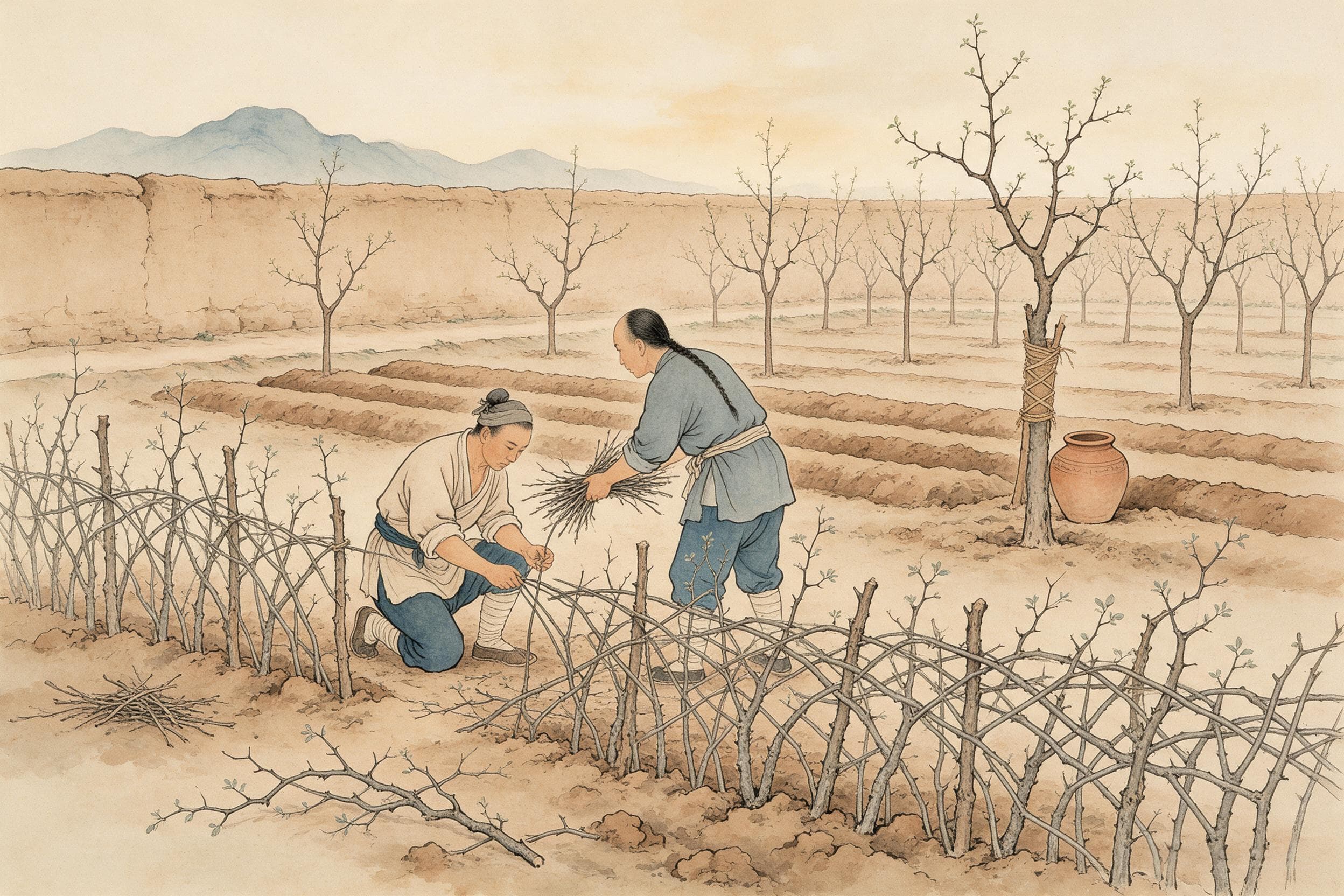
Start with a wall. Along its foot the ground is dug over, square and deep, and raised into three ridges two chi apart. In autumn, when the sour jujube ripens, the seed is picked and sown thick in the ridges; next autumn the weak seedlings are grubbed out and one stem is left every chi, in straight even rows; the spring after, the side branches are cut away and the stems braided into a fence. Three springs, and it stands seven chi high. It is the first instruction in juan 4 of the Qimin Yaoshu: 凡作園籬法, how to make a garden hedge.
One Book, Two Kinds of Page
The book is credited to Jia Sixie of the Northern Wei; the Wikisource title page names author, dynasty, and the Qing catalogue: ten juan, 後魏賈思勰撰, office governor of Gaoping. The catalogue notes the text ends with a chapter called The Five Grains, Fruits, Melons and Vegetables That Are Not Products of China — juan 10. So these two pages are one book, not two documents, and not the same kind of page: juan 4 gives seasons and quantities, juan 10 聊以存其名目, merely keeps the names. Main text printed large, notes small; the catalogue doubts those notes are Jia's own, since they quote the Tang commentator Yan Shigu, and calls them later work. Notes are marked as notes here.
A Hedge Is a Crop
The jujube is sown thick, thinned to one stem per chi, and cut every spring; every cut leaves a stub, because without one 侵皮痕大,逢寒即死, the bark is wounded wide and the cold kills it. The stems are then plaited — 編, to braid — and tied loosely, always loosely: 急則不復得長故也, tie them tight and they can grow no longer. Seven chi is high enough; anyone wanting it taller 亦任人意, may do as he likes. Willow serves the same way, one cutting per chi, set slanting and plaited at once. It ends with a line from the Book of Songs: 折柳樊圃, break willow to fence a garden.
Then instruction turns into boasting. Such a fence, the text says, sends thieves away ashamed and turns wolves back; travellers sigh and forget the road ahead. In a few years the stems press together, branches and leaves cross, and the thing is 特似房籠, rather like a house-frame. That is the author praising his subject; the page gives no garden size and no ditch depth.
The Rules Come First
The general rules are in a short chapter called Planting Trees. Mark a tree's sunny and shady sides and do not turn it: 陰陽易位則難生, change sun and shade and it hardly lives. A large tree is pollarded — 不髡,風搖則死, uncut it is shaken to death by wind. The pit is deep, the soil flooded to thin mud, the trunk shaken hard in four directions so the mud works in among the roots; unshaken roots stay hollow and most trees die. Earth is tamped in, the top three cun left loose, then water, then dry soil over the wet to hold it.
Time is given in farming months: the first is best for planting, the second middling, the third late. Trees signal their own moment — the jujube at 雞口, the chicken's mouth; the mulberry at 蝦蟆眼, the toad's eye — likenesses, the note says, of the leaf as it comes out. Frost has a remedy: manure is kept heaped in the orchard, and on a cold night after rain fires are lit for warm smoke. A food manual, the Shi Jing, adds a propagator's trick: set a five-chi shoot inside a taro corm and plant that; it beats a stone, which takes years longer to reach the same size.
Tree by Tree
Jujube gets the longest entry. Choose a tree with good fruit and move it as the leaves start, three steps apart, rows matched. The ground is not ploughed but trodden clean by cattle, because firm ground gives heavy fruit. On the first day of the first month the trunk is struck with the axe turned back, in mottled blows — the operation is named 嫁棗, marrying the jujube — or it flowers and sets nothing. When the big silkworms go up to the frames the branches are beaten to knock off the wild flowers. Pick only when fully red, shaking the fruit down day by day. Drying: clean ground, reeds, fruit turned twenty times a day, left out at night for dew.
Peach is planted by burying whole ripe fruit, flesh and all, in manured ground; in ordinary soil it will not come up, and a seedling left in the rich bed bears small, bitter fruit. It fruits at three years, is old at seven or eight, dead at ten, so it is replanted yearly; after four years the bark is so tight it must be slit with a knife. Plum stands two steps apart, lives thirty years, and is made to bear by laying a brick in its fork. For mei and apricot the page says only that planting is as for peach and plum.
Pear is the grafting chapter. A ripe pear buried whole comes up next spring, but only two seeds in ten bear pears; the rest give wild stock. The stock is 棠 or 杜 — the note ranks 棠 first, 杜 second; one as thick as an arm will take, a big one five grafts, a small one three or two. The grafter winds hemp cord ten turns round the stock, saws it off five or six cun up, drives a bamboo splint a cun into the join of bark and wood, and slips in a five-cun shoot of the good pear, wood to wood, bark to bark. Then mud, earth, water: 百不失一, not one in a hundred fails. A stock split crosswise fails nine in ten.
The short chapters are informative. Chestnut is planted, never transplanted, so the nuts winter in damp earth indoors and the saplings wrap in straw each October for three years. Nai and its kin are layered, not sown, because seed fruit is poor. Persimmon: plant a small one, or graft onto a {木耎} jujube root — and there the page prints 插柿法〈闕〉, the method missing. Pomegranate: thumb-thick branches eight or nine to a bundle, lower ends burned, in a round pit one chi seven cun deep. Pepper is sown one seed to three cun. Grape is buried every October and lifted out in the second month, or it dies.
Juan 10: Merely to Preserve the Names
Juan 10 is another animal. The whole juan is one chapter on things not produced in China, and it opens by setting its own terms: 聊以存其名目,記其怪異耳, merely to keep the names and record what is strange; whatever grows in hills and marshes and can be eaten, not planted by human labour, is appended there too. What follows is not advice but quotation, each entry tagged by book: the Shanhai Jing, the Guangzhi, the Linhai Yiwuzhi, the Nanfang Caomuzhuang. Headings run through grains, fruits, vegetables, bamboo, tea. No seasons, no spacing, no soil.
Three entries show how it works. Rice: 一歲夏冬再種,出交趾, in Jiaozhi it is sown twice a year, summer and winter. Sugarcane: the cane of Jiaozhi is best, sweet from end to end; crushed for syrup called 糖, sugar, then boiled down until it sets like ice and breaks like a chess piece — 時人謂之石蜜, people called it stone honey. Betel palm: its nature cannot bear frost, it cannot be planted in the north. The vegetable section gives a line apiece: a Hepu vegetable called 優殿 with bean sauce, a water vegetable to pickle. Nothing says any grew in a northern garden; the chapter's note says the opposite. So juan 4 recommends practice, not a census of what households did; its measurements — two chi, one chi, seven chi — are the page's units, unconverted. This site has written about a Northern Wei meal, silk, fish ponds and ducks — kitchen, silkworm shed, fish pond, poultry; this piece is only an orchard.
Related reading:Giving Up the House: When Luoyang's Princes Turned Their Mansions into Temples · Four Kinds of People, Kept Apart: How Guan Zhong Divided a City · The Kunming Pool and the Tower Ships: Digging a Lake for River War
Sources & further reading
- 賈思勰《齊民要術》卷第四「園籬第三十一」至「種茱萸第四十四」(北魏;維基文庫本,繁體白文,未與中華書局點校本複核) — Fourteen chapters in one juan, 31 to 44: the hedge (於牆基之所,方整深耕;作三壟,中間相去各二尺;相去一尺留一根), the general rules for planting (記其陰陽;正月為上時), and entries for jujube, peach, plum, mei and apricot, pear, chestnut, nai, persimmon, pomegranate, quince, pepper and dogwood, each with spacing, grafting, harvest and storage. Main text printed large, interlinear notes small in 〈〉. Persimmon's grafting method is printed as 插柿法〈闕〉 — missing.
- 賈思勰《齊民要術》卷第十「五䅽果蓏菜茹非中國物產者」(北魏;維基文庫本,繁體白文) — The whole of juan 10 is one chapter on things not produced in China, opening 聊以存其名目,記其怪異耳…非人力所種者悉附於此. Not instructions but excerpts tagged by source book (山海經、廣志、臨海異物志、南方草物狀、交州記), running through grains, fruits, melons, vegetables, bamboo, shoots and tea; rice twice a year in Jiaozhi, sugarcane boiled to 石蜜, betel palm 性不耐霜,不得北植.
- 《齊民要術》書首:作者題名與清《四庫全書總目》提要(維基文庫本) — Gives 作者:賈思勰 北魏 and quotes the Qing catalogue: ten juan, 後魏賈思勰撰, his office 高平太守, the preface claiming 九十二篇, the present text ending with 《五穀果蓏非中國物者》, and the doubt that the interlinear notes are the author's own (多引及顏師古者; 今本之註,蓋孫氏之書).