The classic is a sentence and a half: 'On the rong day of Gao Zong, there was a crowing pheasant' (高宗肜日,越有雊雉). The whole chapter of the Documents is about 130 characters, and it begins with that day and that bird. This piece keeps three layers: the day and Zu Ji's instruction in the classic, the narrative in the history, and the three readings Han scholars gave the bird.
One: the classic
The text is short enough to quote in full: 'On the rong day of Gao Zong, there was a crowing pheasant. Zu Ji said: Let the king first be corrected, and set his affairs right. Then he instructed the king: Heaven oversees the people below and presides over their righteousness. The years it sends down are sometimes long and sometimes not; it is not Heaven that shortens men's lives — men cut their own lives short. When men do not follow virtue and do not listen to their guilt, Heaven has already charged them to correct their virtue, and they say, What can we do? Alas! The king's business is to reverence the people; all are Heaven's descendants; in the regular sacrifices do not be lavish toward your near kin' (王司敬民;罔非天胤,典祀無豐于昵).
The page's limits must be marked: what a rong day was, it does not say; why a pheasant counted as a portent, it does not say; the date, the place, the recipient of the sacrifice and the number present are all absent. So this piece writes 'not stated' and does not fill the gap with later explanations — the Han treatise's system is itself a Han reading, not a Shang one.
Two: the history's version
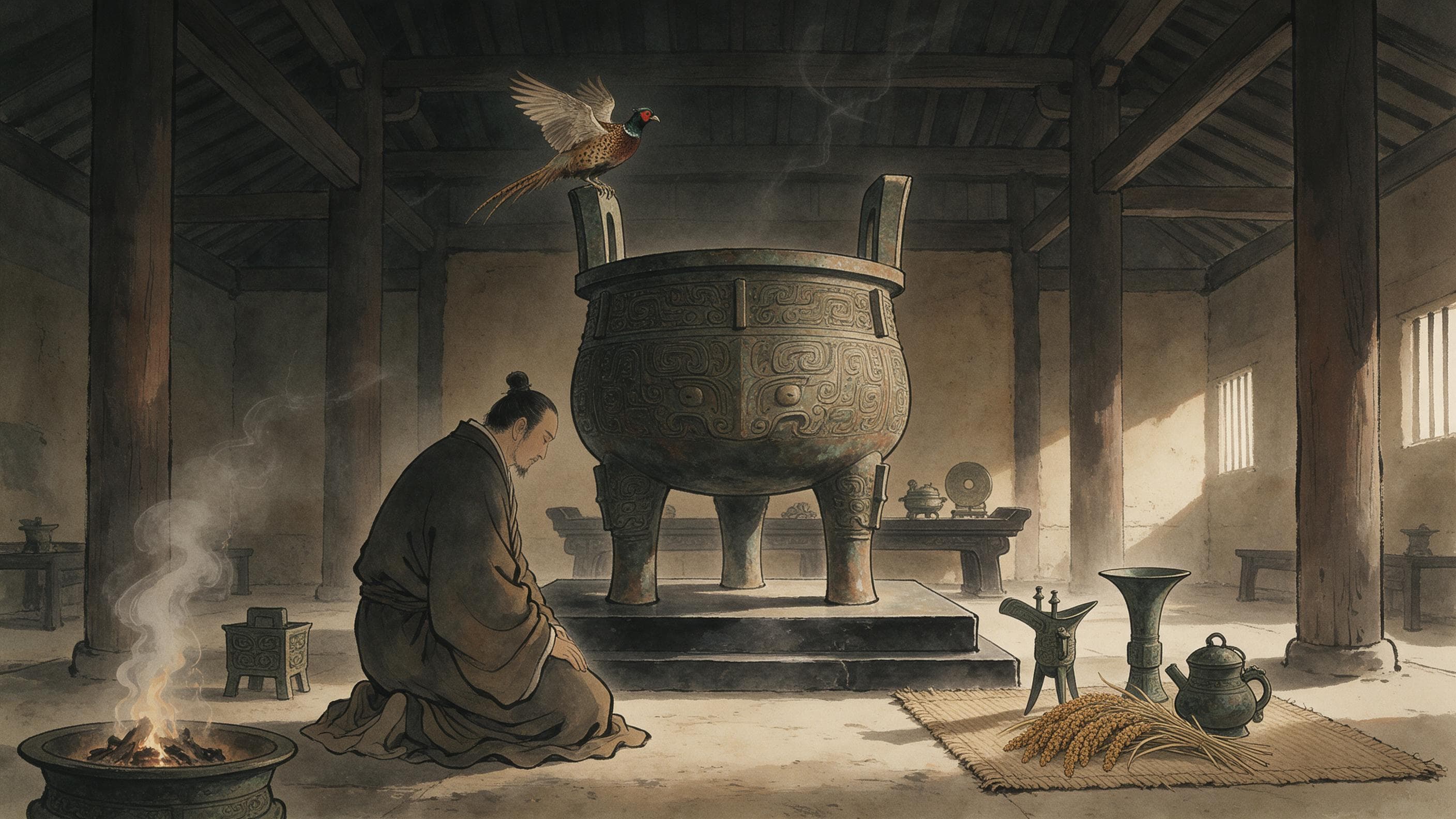
The Shiji turns the day into an event: 'Emperor Wu Ding sacrificed to Cheng Tang; the next day a flying pheasant came down on the ear of a cauldron and crowed, and Wu Ding was afraid. Zu Ji said: Let the king not worry; first put the government in order' (帝武丁祭成湯,明日,有飛雉登鼎耳而呴,武丁懼). Compared with the classic there are three differences: the classic has 雊雉 (a crowing pheasant), the history has a flying pheasant on the cauldron's ear; the classic has no 'next day'; the history names Cheng Tang as the recipient. The wording of the instruction also differs between the two books (the history has 'in the regular sacrifices do not be lavish toward the abandoned way' 常祀毋禮于棄道). Both are quoted side by side, not merged.
The history also explains where the chapter came from: 'Wu Ding put the government in order and practised virtue; all under Heaven rejoiced and the Yin way revived'; and 'Zu Ji admired Wu Ding for making the auspicious pheasant a matter of virtue, set up his temple and called him Gao Zong, and then made the Gao Zong Rong Ri and the Instruction' (祖己嘉武丁之以祥雉為德,立其廟為高宗,遂作高宗肜日及訓). This is the Shiji's account of the chapter's origin, marked as such; 'auspicious pheasant' (祥雉) is the history's own word.
Three: three Han readings of one bird
The Han treatise on the five phases first quotes the Preface: 'The Preface to the Documents also says: Gao Zong sacrificed to Cheng Tang, and a flying pheasant came down on the ear of a cauldron and crowed' (有蜚雉登鼎耳而雊) — a third graph for the same bird, beside the classic's 雊雉 and the history's 飛雉. The readings are attributed: 'Liu Xiang held that a crowing pheasant is male and takes red as its master; in the Changes, li is the pheasant, the pheasant is the south, so it is near to a red portent. Liu Xin held it to be a plague of feathered creatures' (劉向以為……近赤祥也。劉歆以為羽蟲之孽). Two readings, side by side, not decided here.
Then the cauldron is read, and this too is the Han treatise's interpretation, not a Shang idea: 'in the Changes there is the hexagram ding; the ding is a vessel of the ancestral temple, and the one who holds the vessel and serves the temple is the eldest son. A wild bird comes from outside and enters as master of the temple vessel — this is the heir about to change' (是繼嗣將易也). And an alternative: 'the ding has three legs, the image of the three ducal offices, and it moves by its ears; a wild bird perching on the ding's ear means a petty man about to occupy a ducal seat and ruin the temple sacrifices' (一曰……敗宗廟之祀). Both are copied, neither merged with the other.
The treatise closes the case on Wu Ding: 'Wu Ding was afraid and took counsel with the loyal and worthy, cultivated virtue and set affairs right; within, he raised Fu Yue and gave him the government; without, he attacked the Guifang to pacify the Xia lands; so he was able to drive off the omen of wood and bird and attain a hundred years of life' (攘木鳥之妖,致百年之壽). This is the Han treatise's causal narrative, marked as such; the campaign against the Guifang is not in the Shiji's passage and is not used to fill it in.
Four: three graphs, one unexplained word
The textual layer can be laid side by side: the classic has 雊雉, the history has 飛雉…呴, the Han treatise quoting the Preface has 蜚雉…雊. Three graphs, all copied, none corrected. Whether the bird was a ring-necked pheasant or some other kind the two Han pages do not settle, and this piece does not name a species. As for rong day, no page explains the name of the sacrifice: the classic says only 'the rong day of Gao Zong', the history only 'sacrificed to Cheng Tang', the treatise only quotes the Preface. So this piece defines nothing and does not fill the term with the Han system of omens.
Five: beyond these pages
A boundary: the piece on the Shang sacrifice songs is about music and ritual; the piece on the tortoise shells is about where divination shells came from; this one is about a single bird, a single instruction, and three later readings. Nor is it a piece on the origin of cosmic correspondence: the three pages give a classic, a history and a Han interpretation, not a history of thought. What they do not give: any oracle-bone record, the detail of the sacrifice on the day, the species of the bird, or the ritual of a rong day. None is supplied. What is left is a bird on a cauldron's ear, one sentence — the king's business is to reverence the people — and three ways of reading it.
Related reading:The Great Exorcism: Driving Pestilence Out of the Palace on the Year's Last Night · The Fifth-Day Bath: One Day in a Han Official's Life · Guo Pu's Divinations: A Horse, Beans, and a Donkey-Rat
Sources & further reading
- 《尚书·高宗肜日》(维基文库本,未与点校本复核) — The whole chapter, about 130 characters: 'On the rong day of Emperor Gao Zong, there was a crowing pheasant' (高宗肜日,越有雊雉). Zu Ji says, 'let the king first be corrected, and set his affairs right' (惟先格王,正厥事), and then instructs the king: 'Heaven oversees the people below and presides over their righteousness; the years it sends down are sometimes long and sometimes not; it is not Heaven that shortens men's lives — men cut their own lives short. When men do not follow virtue and do not listen to their guilt, Heaven has already charged them to correct their virtue, and they say, What can we do? Alas! The king's business is to reverence the people; all are Heaven's descendants; in the regular sacrifices do not be lavish toward your near kin' (王司敬民;罔非天胤,典祀無豐于昵). The page carries one editorial bracket, 孚(付), which is a transcriber's note and is quoted as the main text. The page does not say what a rong day was, why a pheasant counted as a portent, or what was being sacrificed.
- 司马迁《史记》卷三〈殷本纪〉(维基文库本,未与点校本复核) — The narrative version: 'Emperor Wu Ding sacrificed to Cheng Tang; the next day a flying pheasant came down on the ear of a cauldron and crowed, and Wu Ding was afraid. Zu Ji said: Let the king not worry; first put the government in order' (帝武丁祭成湯,明日,有飛雉登鼎耳而呴,武丁懼。祖己曰:王勿憂,先修政事). It then gives its own wording of the instruction ('Heaven oversees the people below and presides over righteousness… in the regular sacrifices do not be lavish toward the abandoned way' 常祀毋禮于棄道), and the sequel: 'Wu Ding put the government in order and practised virtue; all under Heaven rejoiced and the Yin way revived' (武丁修政行德,天下咸驩,殷道復興). Finally the origin of the chapter: 'Zu Ji admired Wu Ding for making the auspicious pheasant a matter of virtue, set up his temple and called him Gao Zong, and then made the Gao Zong Rong Ri and the Instruction' (祖己嘉武丁之以祥雉為德,立其廟為高宗,遂作高宗肜日及訓).
- 《汉书》卷二十七〈五行志〉(维基文库本,未与点校本复核) — The Han scholars' readings, quoted with their authors. 'The Preface to the Documents also says: Gao Zong sacrificed to Cheng Tang, and a flying pheasant came down on the ear of a cauldron and crowed' (有蜚雉登鼎耳而雊). Then: 'Liu Xiang held that a crowing pheasant is male and takes red as its master; in the Changes, li is the pheasant, the pheasant is the south, so it is near to a red portent' (劉向以為雉雊鳴者雄也,以赤色為主……近赤祥也); 'Liu Xin held it to be a plague of feathered creatures' (劉歆以為羽蟲之孽). 'In the Changes there is the hexagram ding; the ding is a vessel of the ancestral temple, and the one who holds the vessel and serves the temple is the eldest son. A wild bird comes from outside and enters as master of the temple vessel — this is the heir about to change' (野鳥自外來,入為宗廟器主,是繼嗣將易也). And an alternative: 'the ding has three legs, the image of the three ducal offices, and it moves by its ears; a wild bird perching on the ding's ear means a petty man about to occupy a ducal seat and ruin the temple sacrifices' (一曰……小人將居公位,敗宗廟之祀). The treatise closes the case with Wu Ding's reform, the promotion of Fu Yue, the campaign against the Guifang, and 'driving off the omen of wood and bird, and attaining a hundred years of life' (攘木鳥之妖,致百年之壽).