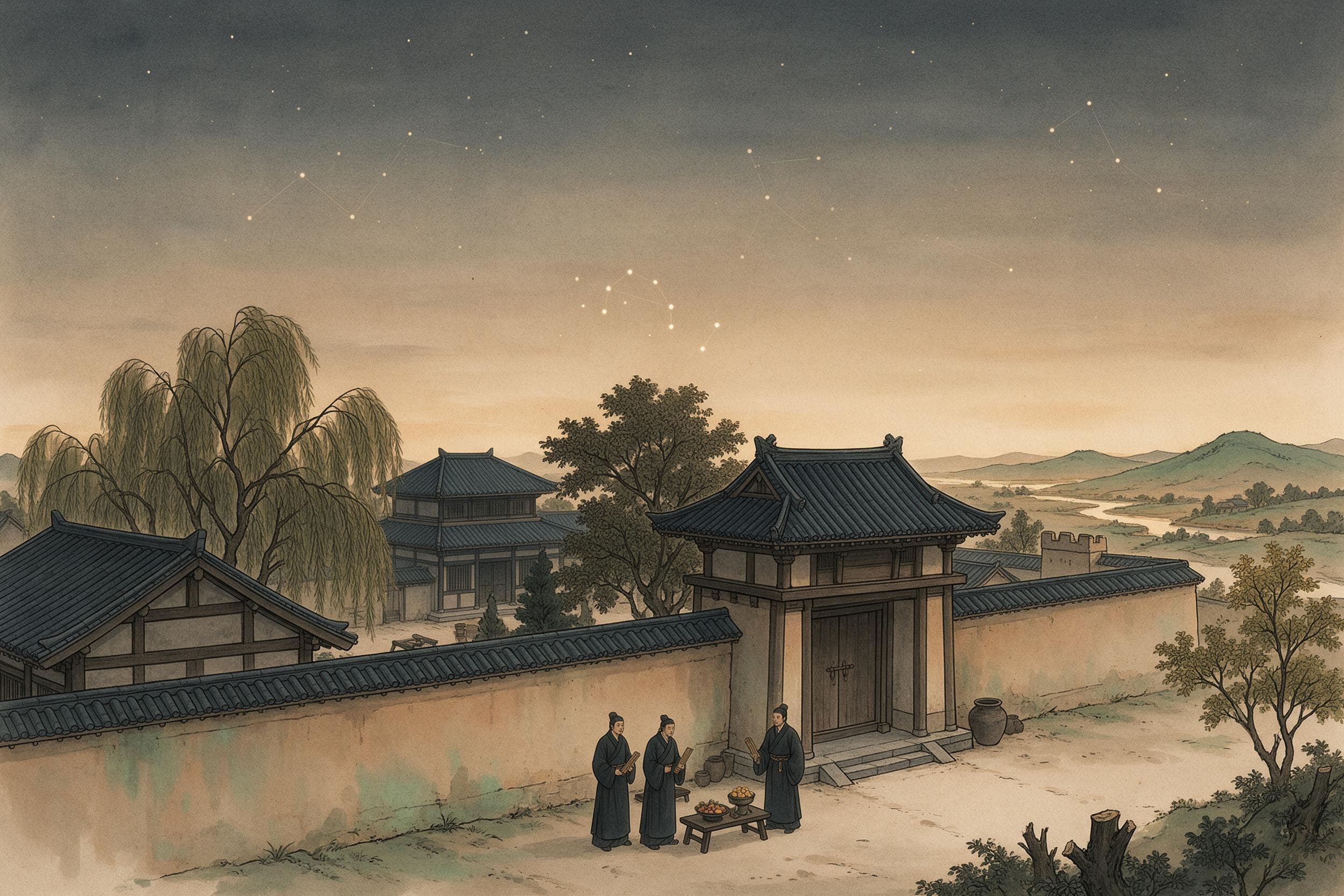
The treatise on astronomy in the Hanshu opens with an inventory: 凡天文在圖籍昭昭可知者,經星常宿中外官凡百一十八名,積數七百八十三星,皆有州國官宮物類之象 — of the fixed stars and lodges, of the offices within and without, there are one hundred and eighteen names in all, and their accumulated number is seven hundred and eighty-three stars, each with its image of province, state, office, palace and kind. The two figures have to be kept apart: 118 counts names, 783 counts stars. Dividing one by the other gives nothing, because a single name may cover one star or a whole group. This article keeps the two figures as written: no adding, no dividing, no average.
The second half of the sentence — 皆有州國官宮物類之象 — is the Hanshu's own words, and it is this article's subject: the sky is laid out like a government. One often-quoted sentence does not belong to the text it is usually credited to: 天文有五官。官者,星官也。星座有尊卑,若人之官曹列位,故曰天官 — astronomy has five palaces; a guan is a star office; the constellations have rank, like the rows of officials in a bureau, hence tian guan. On the Shiji page this sits inside 【索隱】, the commentary of the Tang scholar Sima Zhen; the sentence quoted there from Zhang Heng, 在野象物,在朝象官,在人象事, sits inside 【正義】. Neither is Sima Qian's text. The Shiji's text names stars; the commentary explains the word office.
One: five blocks of sky
The Hanshu divides the sky into five blocks, each with a name and its lodges. 中宮天極星,其一明者,泰一之常居也,旁三星三公,或曰子屬。後句四星,末大星正妃,餘三星後官之屬也。環之匡衛十二星,藩臣。皆曰紫宮。 Then 東宮蒼龍,房、心; 南宮朱鳥,權、衡。衡、太微,三光之廷; 西宮咸池,曰天五潢。五潢,五帝車舍; 北宮玄武,虛、危. Five blocks, each with its lodges and its names. The word 五官 — five palaces — does not appear in this text: dividing the sky into five is the Hanshu's own arrangement; calling them five palaces is something later writers say.
The central block is the densest. The brightest star at the middle is the constant abode of Taiyi; three beside it are the Three Dukes; four behind, the last and largest the Principal Consort and the other three the palace women; twelve encircling them are the Feudal Ministers — a whole ring of courtiers. The Dipper is written as the emperor's carriage: 斗為帝車,運于中央,臨制四海。分陰陽,建四時,均五行,移節度,定緒紀,皆繫於斗. Beside the handle a star called 輔星: 明近,輔臣親彊;斥小,疏弱 — bright and near, the supporting minister is close and strong; small and far, distant and weak. At the handle's end two stars, one the 矛, 招搖, one the 盾, 天蜂.
Two: two bureaus, Wenchang and Taiwei
Six stars carried on the Dipper's bowl are called the Wenchang Palace: 一曰上將,二曰次將,三曰貴相,四曰司命,五曰司祿,六曰司災 — Grand General, Next General, Noble Minister, Master of Destinies, Master of Emoluments, Master of Calamities: six star names, six office names, word for word. Below the bowl, six stars paired two by two are the 三能: 三能色齊,君臣和;不齊,為乖戾 — when their colours match, lord and minister are in accord; when they do not, there is discord.
The southern palace's Taiwei is drawn like a plan of a government compound: 衡、太微,三光之廷。筐衛十二星,藩臣:西,將;東,相;南四星,執法;中,端門;左右,掖門。掖門內六星,諸侯。其內五星,五帝坐。後聚十五星,曰哀烏郎位;旁一大星,將位也 — west the general, east the minister, four stars to the south the law officers, in the middle the upright gate, to left and right the side gates; inside the side gates six stars, the feudal lords; inside those five, the throne of the five emperors; behind, a cluster of fifteen stars called the array of gentlemen; beside them one great star, the seat of the general. West of the court's palisade, four stars called 少微, the scholar-officials.
Three: prisons, a market, and troops
The sky has prisons too. Inside the Dipper's bowl sits the 貴人之牢, the Noble Man's Prison; under the handle 有句圜十五星,屬杓,曰賤人之牢。牢中星實則囚多,虛則開出 — fifteen curved stars belong to the handle and are called the Base Man's Prison; when the stars in the prison are full the prisoners are many, when empty they are let out. There is a market: 東北曲十二星曰旗。旗中四星曰天市。天市中星眾者實,其中虛則耗. There are troops: 房南眾星曰騎官, the cavalry officers south of Fang; 其南有眾星,曰羽林天軍。軍西為壘,或曰戉。旁一大星,北落; 危東六星,兩兩而比,曰司寇 — the six stars east of Wei, paired two by two, are the Minister of Crime. North of the Herdsman is the 河鼓, its great star the Grand General, left and right the Left and Right Generals. Beside Bi a small star is the 附耳, the Ear at the Side: 附耳搖動,有讒亂臣在側 — when it shakes, a slanderous minister is at the ruler's side.
Four: the offices above rule provinces below
The field-allotment passage assigns lodges to provinces: 角、亢、氐,沇州。房、心,豫州。尾、箕,幽州。斗,江、湖。牽牛、婺女,揚州。虛、危,青州。營室、東壁,并州。奎、婁、胃,徐州。昂、畢,冀州。觜觿、參,益州。東井、輿鬼,雍州。柳、七星、張,三河。翼、軫,荊州 — thirteen entries. The ten stems are allotted too, and the treatise itself gives two sets: 甲乙,海外,日月不占。丙丁,江、淮、海、岱。戊己,中州河、濟。庚辛,華山以西。壬癸,常山以北, followed by 一曰,甲齊,乙東夷,丙楚…… Both are left standing. The passage ends with what stars are: 星者,金之散氣,其本曰人。星眾,國吉,少則凶 — stars are the dispersed vapour of metal, and their root is man; many stars, the state is fortunate; few, and it is not.
Five: what the two pages give, and do not
- The two sources are closely related: the Hanshu's treatise follows the Shiji's Book of Heavenly Offices at length, so they count as one body of material written twice. This article quotes the Hanshu and uses the Shiji only for commentary and variants, never as a second witness.
- 118 and 783 are two different counts: names and stars. They are not added, not divided, and no 'stars per office' is computed.
- Commentary is not text. The much-quoted 天文有五官。官者,星官也…… stands in the Shiji page's 【索隱】, the Tang commentary of Sima Zhen, and Zhang Heng's 在野象物,在朝象官,在人象事 stands in 【正義】. Neither is in the Shiji's own text; this article marks them as commentary wherever it uses them.
- Star names are copied as written, without pronunciation and without any modern sky-map: 天棓, 招搖, 天蜂, 觜觿, 北落, 旄頭, 封豨, 句圜 stay as they are. No constellation is identified with a modern one, and no coordinates or magnitudes are given.
- Variants stand side by side: the Jiange has 十七星 in the Hanshu and 六星 in the Shiji; 天棓 has 右四星 against 右五星; Wenchang's fifth and sixth are 司祿、司災 in one book and 司中、司祿 in the other; also 四海/四鄉 and 匡衛/匡衞.
- Omens are not unfolded one by one: only the few that hang on an office name are quoted, such as the prison's 星實則囚多. The rest of the omen stock is left out, and no omen is treated as a historical cause. Lines kept apart: the articles on the rain sacrifice and on portent dress deal with disaster and human affairs; this one deals with star names and their establishment. No general talk of Heaven-and-man correspondence, and no verdict either way on Han astronomy.
What the two pages leave is a register: five blocks of sky, a ring of courtiers, one Wenchang, one Taiwei, two prisons, a market, some troops, and thirteen provinces' worth of allotments. The numbers are 118 and 783; the names are offices and titles moved upstairs. When those names began, and who fixed them, neither page says — they only carry a government into the sky and give every group of stars its seat.
Related reading:Xiao: A Battle Where Nobody Listened to the Old Men, and an Oath Written After · Renden: A Chapter of Men Who Broke the Rites · Twenty Mouths, Twenty Servants, Ten Qing of Land: A Family Manual's Household Budget
Sources & further reading
- 《汉书》卷二十六〈天文志〉(维基文库本,白文无注,页头未标 textquality,未与中华书局点校本复核) — The treatise opens with an inventory: 凡天文在圖籍昭昭可知者,經星常宿中外官凡百一十八名,積數七百八十三星,皆有州國官宮物類之象。Then the frame: 此皆陰陽之精,其本在地,而上發于天者也。政失於此,則變見於彼,猶景之象形,鄉之應聲. The five blocks: 中宮天極星,其一明者,泰一之常居也,旁三星三公,或曰子屬。後句四星,末大星正妃,餘三星後官之屬也。環之匡衛十二星,藩臣。皆曰紫宮。/ 東宮蒼龍,房、心 / 南宮朱鳥,權、衡。衡、太微,三光之廷 / 西宮咸池,曰天五潢。五潢,五帝車舍 / 北宮玄武,虛、危. The Dipper: 斗為帝車,運于中央,臨制四海。分陰陽,建四時,均五行,移節度,定緒紀,皆繫於斗. The Wenchang six: 斗魁戴筐六星,曰文昌宮:一曰上將,二曰次將,三曰貴相,四曰司命,五曰司祿,六曰司災. The prisons: 在魁中,貴人之牢; 有句圜十五星,屬杓,曰賤人之牢。牢中星實則囚多,虛則開出. Taiwei: 衡、太微,三光之廷。筐衛十二星,藩臣:西,將;東,相;南四星,執法;中,端門;左右,掖門。掖門內六星,諸侯。其內五星,五帝坐。後聚十五星,曰哀烏郎位;旁一大星,將位也. The field-allotment table: 角、亢、氐,沇州……翼、軫,荊州 (thirteen entries), the two sets of stem-allotments (the second introduced by 一曰), the twelve branches, and the five states' observations. The closing note on what stars are: 星者,金之散氣,其本曰人。星眾,國吉,少則凶.
- 《史记》卷二十七〈天官书〉(西汉司马迁撰,南朝宋裴骃集解、唐司马贞索隐、张守节正义夹于正文;维基文库本,页头标 Textquality 25%,未与中华书局点校本复核) — The same sky in an earlier text, with commentary thick around the text. Used here only for comparison. The central palace passage runs 中宮天極星,其一明者,太一常居也;旁三星三公……環之匡衞十二星,藩臣。皆曰紫宮, and the Wenchang six are 一曰上將,二曰次將,三曰貴相,四曰司命,五曰司中,六曰司祿 — differing from the Hanshu at the fifth and sixth names. The Jiange passage has 後六星絶漢抵營室,曰閣道 where the Hanshu has 十七星, and 右五星曰天棓 where the Hanshu has 四星. Two much-quoted sentences on this page are commentary, not text: 天文有五官。官者,星官也。星座有尊卑,若人之官曹列位,故曰天官 stands inside 【索隱】, the Tang scholar Sima Zhen's sub-commentary, and 在野象物,在朝象官,在人象事 is quoted by Zhang Heng inside 【正義】, Zhang Shoujie's commentary. The Shiji's own text contains neither sentence.