One sentence in the omens treatise of the Book of the Later Han lists five things that women in the capital were doing in the 元嘉 years of Emperor Huan: 愁眉、啼粧、堕馬髻、折要步、齲齒笑 — sorrowful brows, tear makeup, the falling-horse bun, the bent-waist step, the toothache smile. After the list the treatise explains each name in one short clause, and then tells the reader what the whole set meant. A second page names the same five things and says something else about them. This article is about the two pages and the gap between them.
The Entry in the Omens Treatise
The page is juan 103 of the Book of the Later Han, 志第十三, 五行一, the first of the treatises on the Five Phases. Its frame is a scheme in which unusual dress is one of the responses to a fault in the ruler's bearing. The treatise takes the scheme from the 五行傳: 貌之不恭,是謂不肅, a careless bearing; its fault is 狂, its punishment 恒雨, and among the responses 時則有服妖. The commentator 鄭玄 glosses 服 as 貌之飾也, the ornament of bearing. 服妖 is a category in a list of omens, not a word for fashion — the volume's own table of contents runs 貌不恭、淫雨、服妖、雞禍、青眚、屋自壞、訛言、旱、謠、狼食人. The entries are short: a thing seen, a verdict, a consequence. Ours is one of them.
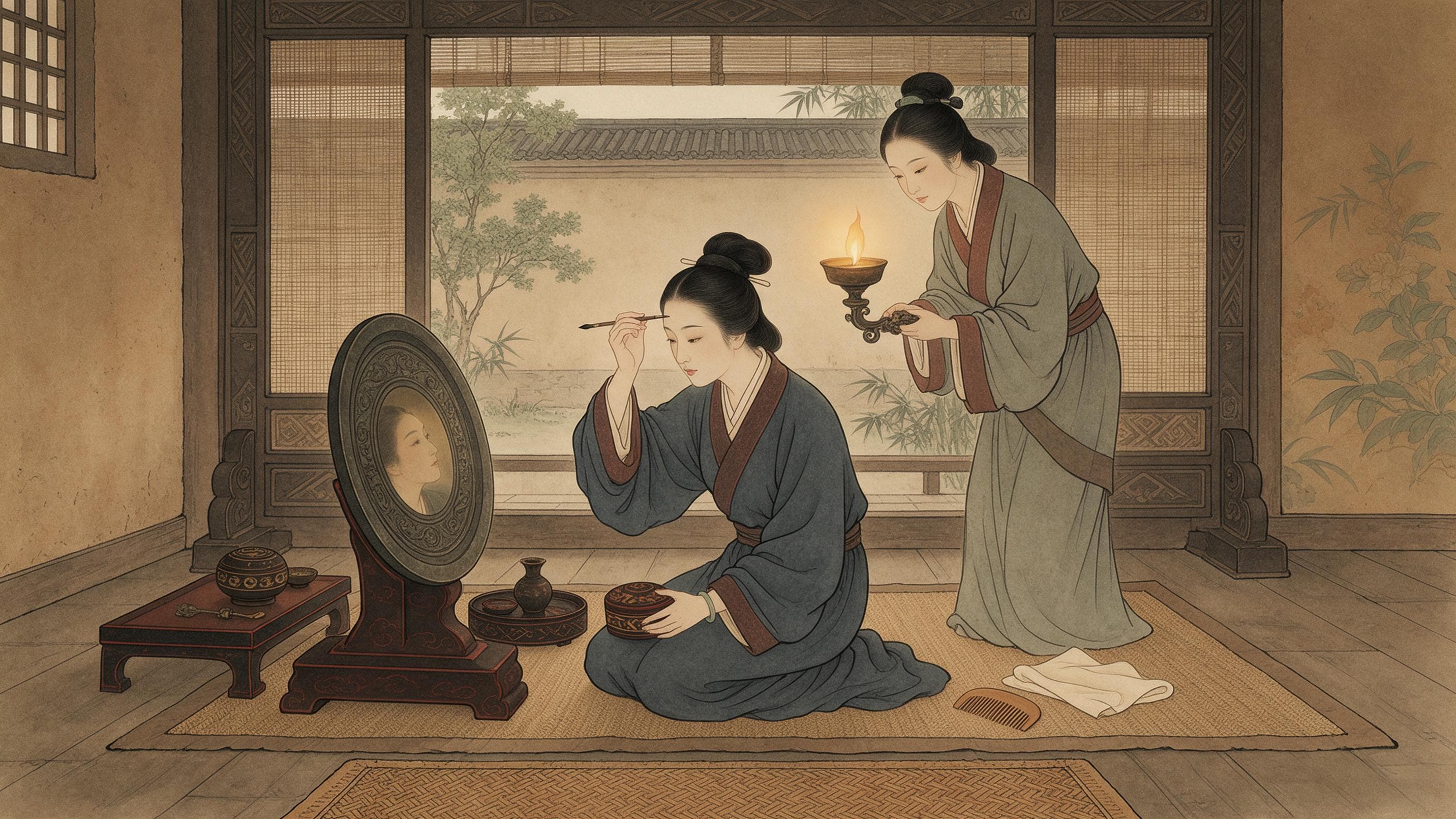
The entry: 桓帝元嘉中,京都婦女作愁眉、啼粧、堕馬髻、折要步、齲齒笑。 Then the explanations: 所謂愁眉者,細而曲折。啼粧者,薄拭目下,若啼處。堕馬髻者,作一邊。折要步者,足不在體下。齲齒笑者,若齒痛,樂不欣欣. Five names, five short clauses, the treatise's own gloss and not a quotation. On how any of them was done the page says nothing more — no measurements, no procedure, no picture; this article adds none. The page's five clauses are all it offers; a reader who wants more is asking for something the page never set out to give.
A note in smaller type interrupts the list at the third name: 梁冀別傳曰:「冀婦女又有不聊生髻。」 A lost biography of Liang Ji is quoted for a sixth hair-style, 不聊生髻, which the treatise's own list does not carry. The page gives six names only if you count the note; the sixth belongs to the note, not to the list.
What the Treatise Says It Meant
After the five clauses the treatise makes three moves. First, origin and spread: 始自大將軍梁冀家所爲,京都歙然,諸夏皆放效 — it began with what was done in the household of the Great General Liang Ji, the capital took it up, and the provinces copied it. No numbers, no dates, no account of how it travelled: this is the page's assertion, and the article reports it as an assertion. Second, the verdict, hedged: 此近服妖也, 'this comes close to being a 服妖', with 近 doing the hedging — the sentence does not say the styles were an omen, only that they came near the category. Third, the omen reading.
The omen reading is written as a speech the heavens might have made: 天誡若曰:「兵馬將往收捕,婦女憂愁,踧眉啼泣,吏卒掣頓,折其要脊,令髻傾邪,雖強語笑,无復氣味也。」 Soldiers coming to make arrests; women's grief; brows knit and tears; officers shoving them; waists bent; buns knocked crooked; forced laughter with no savour in it. Each of the five names is read back into that scene. The entry closes at 到延熹二年,舉宗誅夷 — in the second year of Yanxi the whole clan was destroyed. The Liang family's politics is another page and another article; it is quoted here only because the treatise reads the five styles against it.
The page's other 服妖 entries keep the same shape. The one just before ours: 更始諸將軍過雒陽者數十辈,皆帻而衣婦人衣繡擁蕭 — officers of the Gengshi regime passing through Luoyang in women's clothes — and then 時,智者見之,以爲服之不中,身之災也,乃奔入邊郡避之。是服妖也。其後更始遂爲赤眉所殺。 A sight, a verdict, a consequence. Ours is longer only because it adds an origin and a heavenly speech; the shape is the volume's form, not a property of the clothes.
The Same Five Names in a Biography
The second page is juan 34, the 梁統列傳, in the section on Liang Ji. There the same five things belong to one woman: 壽色美而善爲妖態,作愁眉,啼妝,墮馬髻,折腰步,齲齒笑,以爲媚惑. Sun Shou, 冀妻孫壽, named a few lines above: fair, given to 妖態, making these five 以爲媚惑, to charm. The biography passes no verdict of 服妖, gives no reading of omens, and has no heavenly speech. It does not say how the five were received at the time; it records what she did and what it was for.
The two pages copy the names with different characters: 啼粧 in the treatise and 啼妝 in the biography; 堕馬髻 and 墮馬髻; 折要步 there and 折腰步 here; 愁眉 and 齲齒笑 the same in both. The treatise's subject is 京都婦女, women of the capital; the biography's subject is one wife. Neither page quotes the other, and nothing on either says which sentence came first.
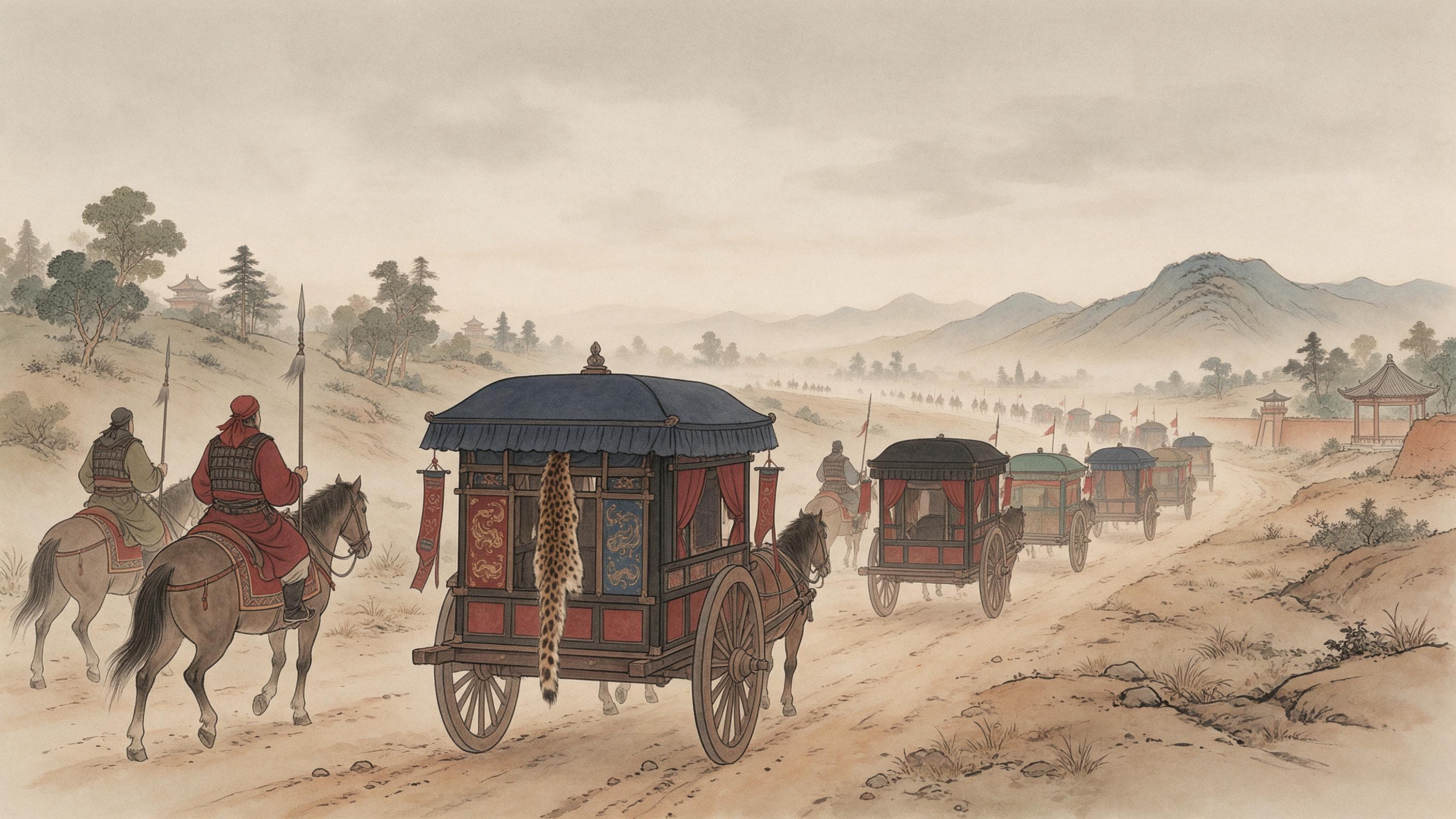
The biography's next sentence turns to the husband: 冀亦改易輿服之制,作平上軿車,埤幘,狹冠,折上巾,擁身扇,狐尾單衣 — a carriage, a cap, a narrow crown, a folded scarf, a close-fitting fan, a single fox-tail garment. The five women's names sit beside a list of a man's changes to carriage and dress, and the biography comments on neither.
Two Pages, One Set of Names
Side by side: the treatise is a catalogue entry — a category (服妖), an origin (the Liang household), a spread (capital and provinces), a hedged verdict (近服妖), an omen reading, an ending. The biography is a passage inside a life — a wife, five things she did, a purpose, then her husband's own changes of carriage and cap. The treatise explains the names and draws a moral; the biography names a person and offers no meaning. Neither describes the making. The five clauses in the treatise are the only description of the styles that either page gives, and they are the treatise's explanation, not instructions. The treatise's only date for the styles is 元嘉中; the biography gives none at all. The category also decides what the entry is for: a style is recorded not for its own sake but as a sign, and an entry that opens with a sight has to end with a consequence, which here is a destroyed clan.
What This Article Does Not Do
Four limits. It does not write a history of fashion or a theory of how styles spread: the pages give one claim of origin and one claim of imitation, and no evidence beyond the claims. It does not turn the omen reading into social fact: 天誡若曰 is the treatise's device, and 踧眉啼泣 is its reading of a style, not a record of anyone's face. It does not add the Liang family's politics, which another article may take; the treatise's own endpoint, 舉宗誅夷, is quoted only because the five names are read against it. And it does not touch the material side of cosmetics — face cream and rouge are objects, and another page has them. Nor are the volume's dates treated as evidence: 元嘉中 at one end, 延熹二年 at the other, and no sentence between them except the omen reading. The great exorcism, the rain prayer and a later book's 服妖 entries are other entries in the same way of writing; this article stays with one entry and its double. Nor is the treatise's reading checkable from these pages: nothing here says the styles were unusual in themselves, or that the women who wore them came to any harm.
Related reading:Portents in Dress: The White Qia, the Embroidered Cap, and Two Ways of Writing One Thing · Ice: Cut in Winter, Given Out in Summer, and Used to Bathe the Dead · Caps of the Yin: Xu, Zhangfu, and the Names of Three Dynasties
Sources & further reading
- 《後漢書》卷一百零三·志第十三「五行一」(南朝宋范曄撰;維基文庫本,頁面白文附劉昭注,頁頭自評 textquality 25%,未與點校本複核) — The treatise's scheme includes 時則有服妖, glossed by 鄭玄 as 服,貌之飾也. Under the 服妖 entries stands the item 桓帝元嘉中,京都婦女作愁眉、啼粧、堕馬髻、折要步、齲齒笑, with five one-line explanations, a note quoting 梁冀別傳 for a sixth hair-style (不聊生髻), the origin-and-spread sentence 始自大將軍梁冀家所爲,京都歙然,諸夏皆放效, the hedged verdict 此近服妖也, the 天誡若曰 speech, and the closing 到延熹二年,舉宗誅夷. The entry before it, on Gengshi's officers in women's clothes, has the same three-part shape. The page carries a {{textquality|25%}} self-rating at its head; the readings used here were taken from the page text and should be checked against a critical edition.
- 《後漢書》卷三十四·梁統列傳第二十四(南朝宋范曄撰;維基文庫本,頁面白文,頁頭自評 textquality 25%,未與點校本複核) — In the section on Liang Ji: 壽色美而善爲妖態,作愁眉,啼妝,墮馬髻,折腰步,齲齒笑,以爲媚惑 — Sun Shou, 冀妻孫壽, is named a few lines above. The next sentence turns to her husband: 冀亦改易輿服之制,作平上軿車,埤幘,狹冠,折上巾,擁身扇,狐尾單衣. The page gives no verdict of 服妖 and no omen reading, and it uses 啼妝 / 墮馬髻 / 折腰步 where the treatise has 啼粧 / 堕馬髻 / 折要步. The page carries a {{textquality|25%}} self-rating at its head; the readings used here were taken from the page text and should be checked against a critical edition.