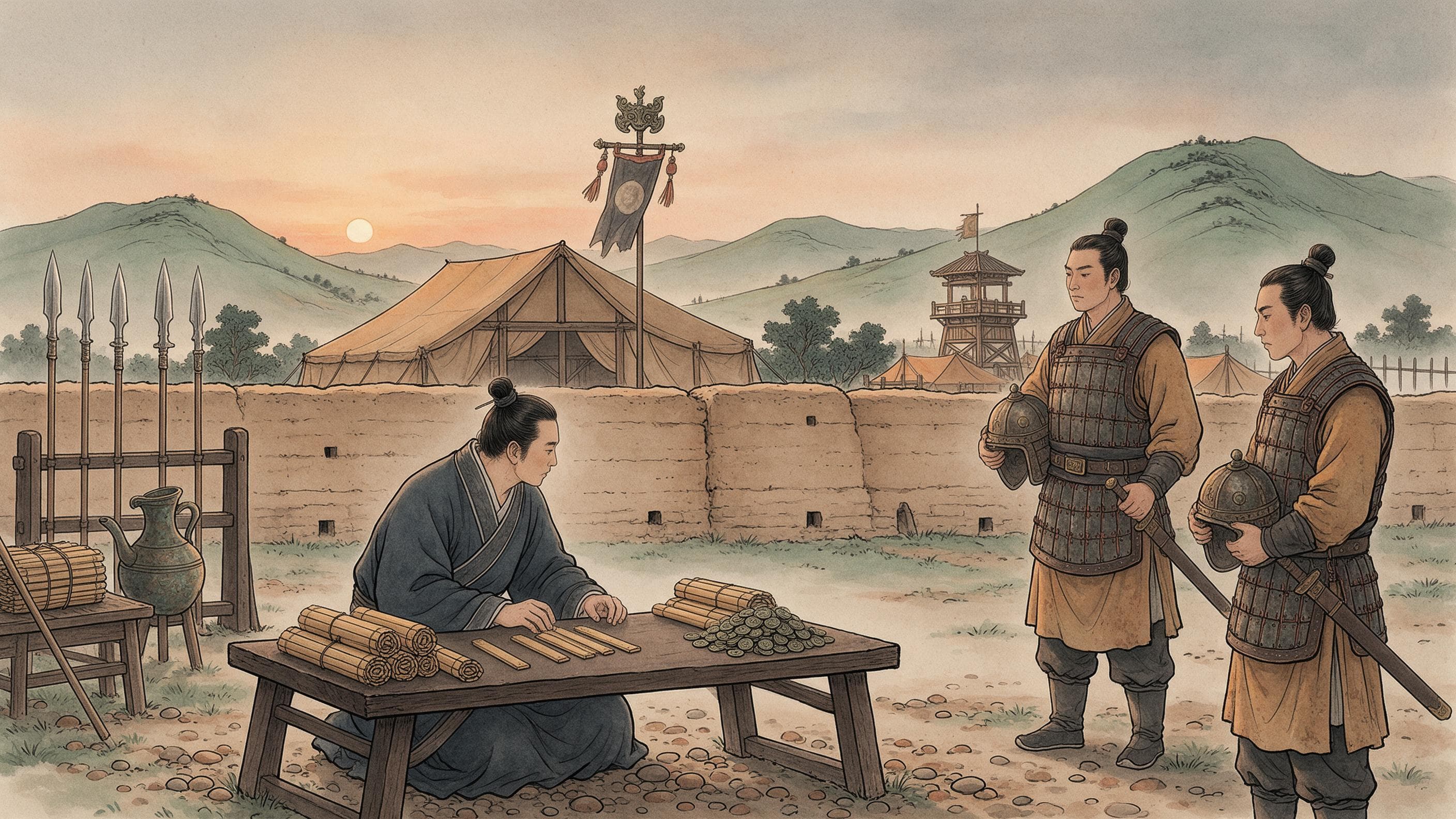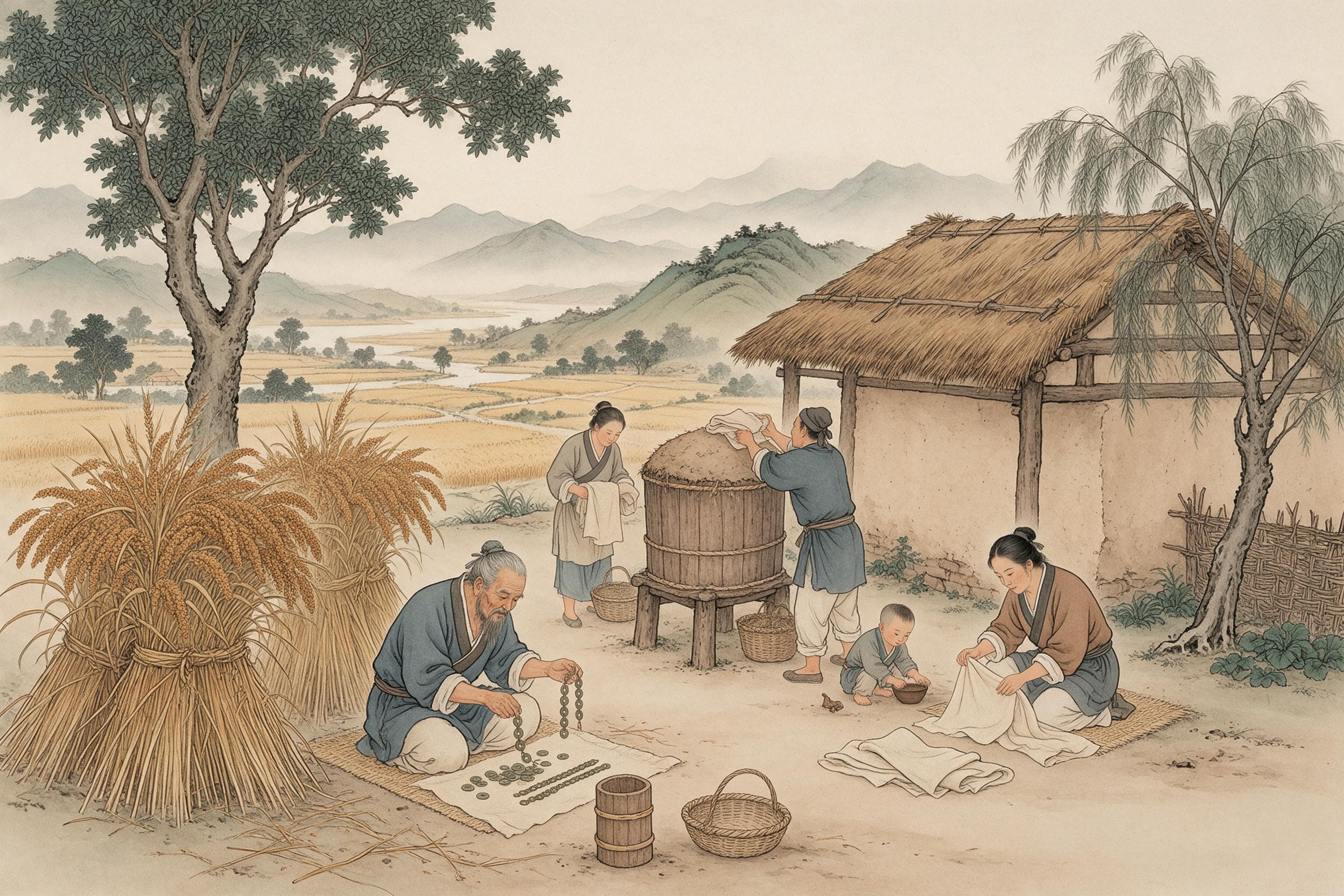
Start with the arithmetic. A household of five farms a hundred mu at one shi and a half per mu: a hundred and fifty shi of millet. A tenth goes in tax, fifteen shi, leaving a hundred and thirty-five. Five people eat a shi and a half a month each, ninety shi a year, leaving forty-five. At thirty cash a shi those forty-five are worth 1,350 cash; take away 300 for the village offerings of new grain and the spring and autumn sacrifices, and 1,050 remain. Clothes at 300 a head for five people come to 1,500 — four hundred and fifty short. Illness, funerals and the levies above are not counted yet.
A Man with Five Mouths
The passage is from the Han shu's treatise on food and money, and it reports a programme Li Kui drew up for Marquis Wen of Wei: 'exhaust the land's strength.' It reads like a household ledger and is not one. Five mouths, a hundred mu, a shi and a half per mu, a tenth in tax, a shi and a half per person per month, thirty cash a shi, three hundred a head for clothes: every figure is a round number, no county is named, no year is given, and no household was ever audited this way. It is the state doing arithmetic, and the sum it reaches is that at this yield and this price the farmer works all year and still comes up short.
The pivot of the whole account is the thirty. It is the rate that turns the leftover forty-five shi into cash, which is what allows the clothing and sacrifice lines to be subtracted at all; change the price and the shortfall changes. Li Kui never says that grain was selling at thirty. He uses thirty as a fixed assumption. It is a baseline inside a model, not a quotation from a market, and what it is there to prove is that cheap grain hurts the farmer — arithmetically, not anecdotally.
Too Dear and Too Cheap Hurt Alike
A policy follows the ledger. Buying in, Li Kui says, hurts the people if grain is dear and hurts the farmers if it is cheap; if the people are hurt they scatter, if the farmers are hurt the state is poor, so 'too dear and too cheap do the same damage' (甚贵与甚贱,其伤一也). The remedy is the equalizing purchase, pingdi: read the year as an upper, middle or lower harvest — the upper 'fourfold, with four hundred shi left over', the middle 'threefold, three hundred', the lower 'double, one hundred' — and in a great harvest the state buys three parts and leaves one, in a middle harvest two, in a lower harvest one, 'so that the people have just enough, and it stops when the price is level' (使民适足,贾平则止). In a small, middle or great famine the grain bought earlier is released by grade.
The other half of the programme sits in the same passage: farm diligently and each mu yields three sheng more; farm carelessly and it yields three sheng less; across a hundred li square, the difference between diligence and carelessness is 'a million and eight hundred thousand shi of millet'. More grain and steadier prices are two ends of one policy — one to raise what the farmer brings in, one to keep the price from collapsing. Both ends stay inside the model: three sheng and 1,800,000 shi are projections, not measurements.
Ji Ran's Eighty and Thirty
Another book has another set of numbers. The Shiji's chapter on wealth and trade says that when King Goujian of Yue was besieged at Kuaiji he employed Fan Li and Ji Ran, and Ji Ran laid out a doctrine of prices: 'six years of plenty, six of drought, and every twelve years a great famine'; 'selling grain out, twenty harms the farmer, ninety harms the trader'; 'if the top does not pass eighty and the bottom does not fall below thirty, farmer and trader both profit' (上不过八十,下不减三十). Level selling, equalizing goods, so that the passes and markets are not lacking — that, he says, is the way to govern a state.
The nature of these figures matters. Twenty and ninety are the lines at which damage begins; eighty and thirty are the edges of the band in which both sides can live. They are not a price list. Ji Ran is telling the state where to buy and sell, not what a shi fetched in the market. He adds two harder rules: 'when dearness reaches its height it turns cheap, and when cheapness reaches its bottom it turns dear' (贵上极则反贱,贱下极则反贵), and 'sell dear grain as if it were dung, buy cheap grain as if it were pearls and jade' (贵出如粪土,贱取如珠玉). That is the rule of the speculator and the rule of the stabilizer at once.
Two Accounts, Not One Price Series
The two passages are often set side by side as though they made a single grain-price line for the Warring States. They do not. The Han shu is an Eastern Han work reporting a minister of Marquis Wen of Wei in the early Warring States; the Shiji is a Western Han work reporting an adviser to King Goujian at the end of the Spring and Autumn. Two periods, two states, two books centuries apart, each carrying its own doctrine — neither is a statistic for the other. Nor are the two schemes one system: Li Kui's pingdi gives the shares to buy in, Ji Ran's pingtiao gives the upper and lower limits of price.
The numbers are also of different kinds. Li Kui's thirty is an accounting rate that converts millet into cash; Ji Ran's thirty and eighty are the ends of a policy band that tells the state when to act. One is an assumption inside a budget, the other an intervention threshold. Neither book supplies a series of prices by year or by place, and neither says who ever traded at these figures. To treat the two thirties as one market price is to mistake one kind of number for another.
What Is Not Here
No dates, no places, no single transaction. No price for wheat or beans, no famine quotations — only grades such as 'great famine' and 'middle famine'. Li Kui's shi and a half per mu is an assumption, and in the same passage he says diligence can add three sheng, which concedes that yields move. Ji Ran's six years of plenty and six of drought is a claim about cycles, not a calendar record. None of it can be converted into modern purchasing power: the size of a shi, the buying power of cash and the weight of levies beyond the tax are all left open.
So what a shi of millet should sell for gets two answers in these pages, and neither is a market price. Li Kui says: at thirty cash a shi a household of five is still four hundred and fifty short, and therefore the state must act. Ji Ran says: keep it under eighty and above thirty, and farmer and trader can both live. One is an account, the other a boundary. The price actually paid is recorded in neither.
Related reading:One Head, One Rank: The Arithmetic of Qin Merit · Six Names for One Banknote: How Jin China Kept Renaming Its Paper Money · Counting Heads: The Han Poll Tax on Adults, Children and Service
Sources & further reading
- 班固《汉书》卷二十四·食货志上(东汉;维基文库本,未与点校本复核) — An Eastern Han treatise quoting a Warring States programme: 'Li Kui made the teaching of exhausting the land's strength for Marquis Wen of Wei.' It gives a model household — a man with five mouths, a hundred mu, one shi and a half per mu, a hundred and fifty shi of millet — then deducts a tenth in tax (fifteen shi), a shi and a half per person per month for food (ninety shi), and values the remaining forty-five shi at thirty cash each: 1,350 cash, less 300 for village and seasonal offerings, leaving 1,050 against 1,500 for clothes at 300 a head — a shortfall of 450. It then sets out the equalizing purchase (平糴): watch whether the harvest is upper, middle or lower; in a great harvest buy three parts and leave one, in a middle two, in a lower one, and stop when the price is level. Every figure is a round assumption; the passage names no place, year or actual transaction.
- 司马迁《史记》卷一百二十九·货殖列传(西汉;维基文库本,未与点校本复核) — A Western Han chapter that puts a grain-price doctrine in the mouth of Ji Ran, adviser to King Goujian of Yue: 'six years of plenty, six of drought, and every twelve years a great famine'; 'selling out grain, twenty harms the farmer, ninety harms the trader'; 'if the top does not pass eighty and the bottom does not fall below thirty, farmer and trader both profit — level selling, equalizing goods, so that passes and markets are not lacking, is the way to govern.' It adds that when dearness peaks it turns cheap and when cheapness bottoms it turns dear, and advises selling dear grain as if it were dung and buying cheap grain as if it were pearls. These are thresholds for state buying and selling, not quotations from a market; no date, place or transaction is given.