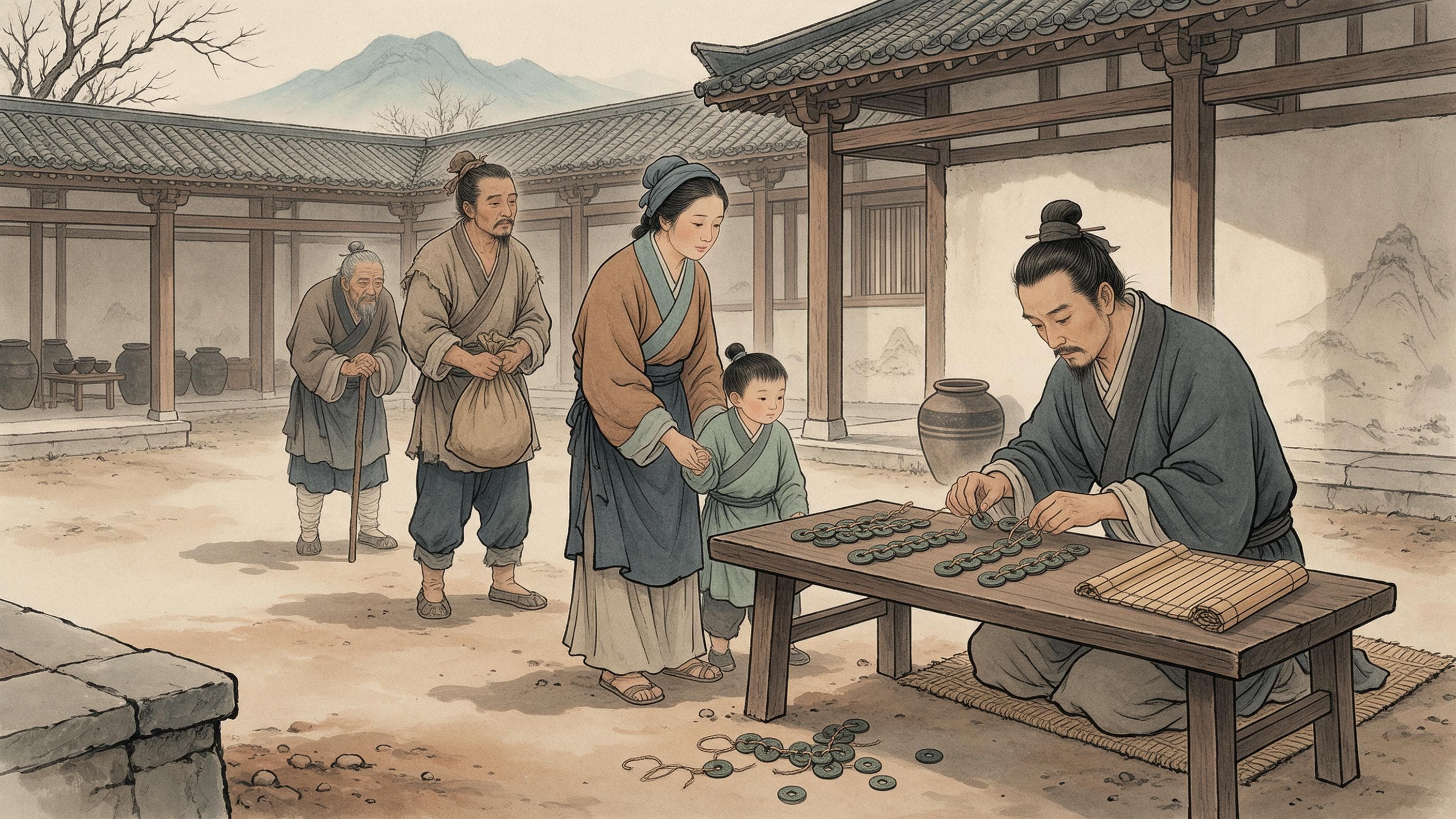
The tax began, for one person, at seven. From seven to fourteen a child owed twenty-three cash a year; from fifteen to fifty-six the same person owed one suan, a unit of account worth 120 cash. Both the ages and both sums come from the Han yi zhu, a commentary on the Han statutes as the Tang compendium Tongdian quotes it. They describe a rule, not a receipt: no household's annual bill survives. But they fix the shape of the thing — a levy counted by head, paid in cash, running from childhood to late middle age.
One suan: 120 cash
The Tongdian dates the adult levy to the eighth month of the fourth year of Gaozu, 203 BCE: 'first made the suan levy'. The statute commentary explains it: people from fifteen up to fifty-six paid 120 cash per suan, 'for the making of armaments, chariots and horses'. The same statutes doubled it for merchants and slaves — 240 cash. This is the arithmetic of a statute book, not a census return: nothing here says how many people were put on the register, or how many actually paid.
The rate moved. Wendi set the payment at 40 cash and gave able-bodied men one term of service in three years; a commentator explains the cut by a large population — the standing charge was 120 a year with one term of service. Xuandi in 52 BCE 'reduced the people's suan by thirty'; Chengdi in 31 BCE 'reduced the empire's cash levy by forty per suan', which a note works out as 120 down to 80. Remissions are recorded like weather: reign, year, amount. No annual totals.
The child levy: 23 cash
Children were charged separately. From seven to fourteen the levy was 23 cash a year: twenty 'to feed the Son of Heaven', three added by Emperor Wu 'to supplement the horses and chariots' — the Han yi zhu again. In 74 BCE the child levy was cut, the officials proposing a reduction of three tenths, which was granted. Twenty-three cash looks small beside 120; it is also the sum a poor household might not find.
Gong Yu, a minister under Yuandi, turned the child levy into an argument. In his reading the ancients had no poll or head levy at all: it began when Emperor Wu, fighting on four sides, taxed heavily, so that 'when a child was three the household paid the child levy, and families were hard pressed, until they came to kill infants at birth — deeply pitiable'. He asked that the levy start at seven, when a child's teeth fall out, and the adult suan at twenty. The emperor sent it down for discussion: 'he ordered that households pay the child levy only when the child was seven, and from this it began.' The age of twenty is not recorded as adopted.
Five suan for an unmarried daughter
A penalty sat inside the same arithmetic. In 189 BCE Hui di ordered that women from fifteen to thirty who were not married pay five suan. With a suan at 120 cash that is 600 cash a year — five times an adult's rate, and a fine wearing the clothes of a tax. The note on the passage says the Han statutes charged one suan of 120 cash and doubled it for merchants and slaves, and that the five-fold charge was 'a punishment'. The 600 is multiplication from a statute; no register of unmarried women survives.
Commuting service: three days for 300 cash
Service could be bought out, and the prices are recorded. The Han had three forms: zu geng, a month's duty taken in turn; jian geng, where a man paid another 2,000 cash a month to serve in his place; and guo geng, where instead of the three days of frontier duty owed by everyone — even a chancellor's son was liable — a man paid 300 cash into the office, which passed it to those who went. In 77 BCE a decree forgave geng levies unpaid from the three years before. Three days for 300 cash, a month for 2,000: one system, two prices for time. A note adds that this was Han practice following Qin law, and that it later changed: only men sentenced to exile served a year at the frontier.
Exemptions were counted head by head as well. In 140 BCE those of eighty and over were remitted two suan, those of ninety the armour-bearer's duty; under Jingdi a ninety-year-old's household got one son excused labour, an eighty-year-old's household two suan remitted. After the restoration Guangwu remitted three years' suan to households that had a child. Wang Mang went the other way, levying 3,600 cash for each slave held by nobles and high officials; criticising the Han system he had inherited, he said its land tax was light but the geng levy never stopped and even the old and infirm paid the head levy. Age for service was a separate line again: in 155 BCE Jingdi ordered men registered for duty at twenty, where the old rule was twenty-three — a line for labour, not for the levy. Exemption and surcharge both work person by person, which is what a head tax is.
What the figures can support
What these numbers support is ratio, not total. A suan is 120 cash, a child's levy 23, five suan 600, a merchant's or slave's suan 240: they can be set against one another. A year's collection, or one household's bill, is not in the material. So this piece does not compute a family's annual tax, does not convert cash into grain or into a share of a harvest, and does not call the burden heavy or light. The sources give rates, age lines and remissions.
The remissions are themselves evidence of how the levy worked. Thirty per suan under Xuandi, 120 down to 80 under Chengdi, the child levy cut by three tenths in 74 BCE, three years free for households with a newborn under Guangwu — each is a dated, quantified decision. A government adjusts a charge one clause at a time when it means to collect it every year from every counted head. In the same pages the levy is also argued over, as Gong Yu argued it, and bought out, as the frontier duty was.
Put the pieces in order and the tax is a line drawn across a life: nothing at birth, 23 cash a year from seven, 120 a year from fifteen, double for a merchant or a slave, five times for an unmarried daughter between fifteen and thirty, and the line ending at fifty-six. What is missing is the other half of any tax history — how many people stood on that line, and what they had left afterwards. The Han left the statute book and the remissions; it did not leave the ledger. This piece stays with the statute book.
Sources & further reading
- 杜佑《通典》卷四·食货四·赋税上(唐;维基文库本,内含所引《汉仪注》《汉律》及旧注) — Tang compendium, not a Han document: the 120-cash suan, the ages fifteen to fifty-six, the doubling for merchants and slaves, the 23-cash child levy for ages seven to fourteen, the five-fold charge on unmarried women, and the three forms of service commutation are all quoted here from the Han yi zhu and Han lü, i.e. from Han statute commentary as a Tang scholar had it. It also records the dated remissions: Gaozu's first suan levy in 203 BCE, Hui di's five suan in 189 BCE, Wendi's 40 cash, Xuandi's cut of thirty in 52 BCE, Chengdi's cut of forty in 31 BCE, Zhaodi's 74 BCE reduction of the child levy, and the 77 BCE remission of arrears.
- 《汉书》卷七十二·王贡两龚鲍传·贡禹(东汉班固;维基文库本,未与点校本复核) — Gong Yu's memorial: the ancients had no poll or head levy; it began when Emperor Wu taxed heavily for his wars, so that 'when a child was three the household paid the child levy' and families came to kill infants at birth; he asked that the levy begin at seven and the adult suan at twenty. The chapter records the emperor's decision: households were ordered to pay the child levy only from age seven, and 'from this it began'. No adoption of the age of twenty is recorded here.