Two sentences are all these two books offer about wine in Han China. One is a calculation: in the great cities and thoroughfares, 'a wine-seller does a thousand brewings in a year.' The other is a decree: 'the wine monopoly office was abolished; the people were permitted to declare and pay tax according to law, and to sell wine at four coins a sheng.' One is a merchant's arithmetic, the other a court order; between them lie the things we can and cannot say.
A thousand brewings
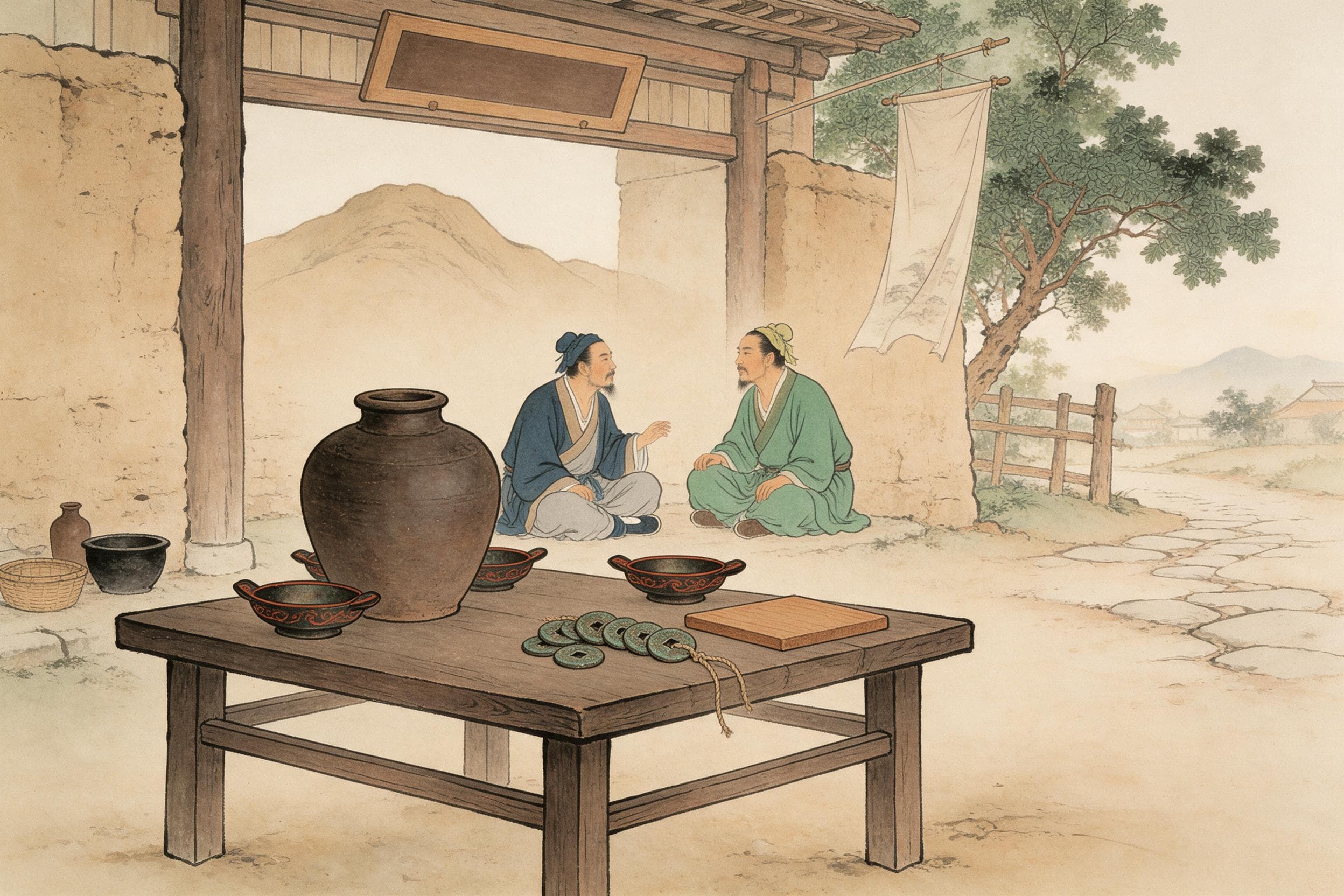
The passage in the Shiji's chapter on merchants is a list: 'In the great cities and thoroughfares, a wine-seller does a thousand brewings in a year; a thousand jars of vinegar and sauce; a thousand measures of syrup; a thousand hides of cattle, sheep and pigs…' The list runs on, and closes: 'This too is comparable to the house of a thousand chariots; such is the rough measure.' So the thousand brewings are a scale assumed in a model of merchant wealth, not a production statistic, and certainly not a price. The words 'rough measure' mark the whole list as an estimate.
What the figure gives is an order of magnitude: a big-city wine business was conceived as running to a thousand brewings a year. What it does not give is the size of a brewing, the ingredients, the selling price, or the empire's output. Not one item on the list is a price, and not one is a total. The 'thousand' is a notch on a model, not an entry in a ledger. Nor is the list about one merchant's books: it is a scale by which a reader could judge a fortune, the way the same chapter reckons orchards and fish ponds against the income of a marquis.
The decree
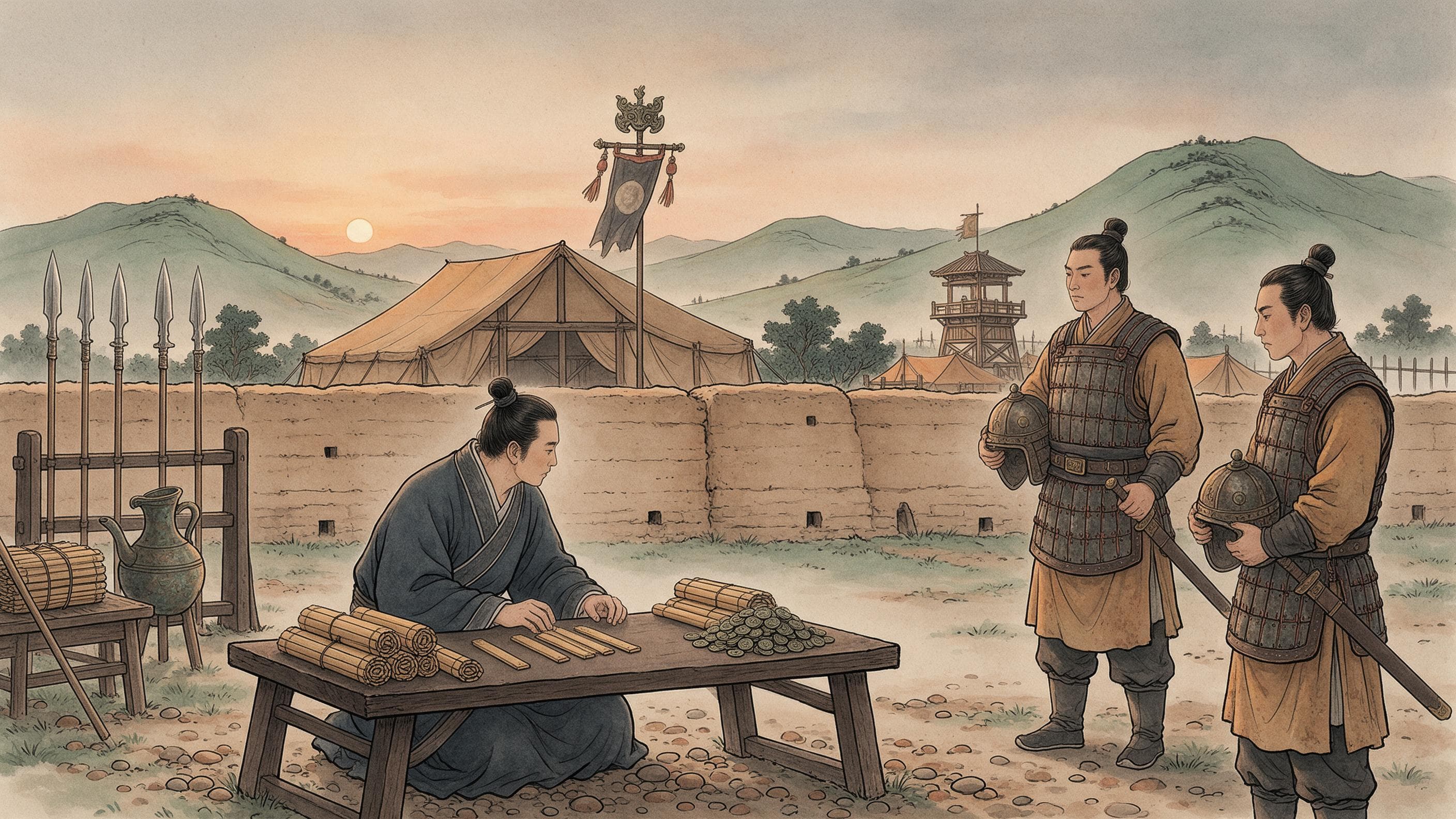
The Han shu's annals of Emperor Zhao record the other event cleanly. In the second month of the sixth year of Shiyuan (81 BCE) an edict 'had the officers question the worthy and literary men recommended by the commanderies and kingdoms about the hardships of the people. The abolition of the salt, iron and wine monopolies was discussed.' In the seventh month 'the wine monopoly office was abolished; the people were permitted to declare and pay tax according to law, and to sell wine at four coins a sheng.' Debated in the second month, done in the seventh.
The four coins are not explained. The text does not say whether they are a selling price — one sheng for four coins — or a tax of four coins on each sheng. Both readings fit the sentence, and this page cannot settle it. So both are kept here, and the line is not written as 'Han wine cost four coins a sheng'.
The Han shu's appraisal of the reign compresses the whole thing into one clause: 'He raised worthy and literary men, asked about the hardships of the people, discussed salt and iron, and abolished the wine monopoly.' That is an Eastern Han summary of what the reign was remembered for; it shows the weight of the act, but it adds no detail.
What the decree implies
First, before 81 BCE there was a wine office — the abolition presupposes one. Second, what was abolished was the office, not the tax: the next clause allows people to 'declare and pay tax according to law', which is not exemption. So ending the monopoly did not end the taxation of wine; it ended the state's own running of the trade. The decree is thinner than it looks, too: it names no rate for the declared tax, no officer, no penalty and no term. Third, the trade continued: the decree itself says wine was to be sold at four coins a sheng, which fixes a figure (of price or tax) rather than banning the drink.
This line must be kept apart from others. Salt and iron are a separate account: the same sentence says the court discussed abolishing salt, iron and wine together, but salt and iron were not abolished the way wine was, and this piece does not follow them. The Three Kingdoms' prohibition of brewing is a ban, not a tax; the Zhou 'Pronouncements on Drink' are exhortation, not Han administration.
Two ledgers
The thousand brewings and the four coins cannot be converted into each other. One is a notch in a wealth model in the Shiji, written in the Western Han, about how rich a merchant could be; the other is a figure in a decree in the Han shu, written in the Eastern Han, about how the state collected. They are a century apart, and they differ in genre, purpose and unit. Even if the size of a brewing were known, the four coins might be a tax rather than a price; even if they were a price, the 'thousand' is an assumed scale, not a measured output. So this piece gives no price series, no national production figure and no revenue total. That is the whole economic picture these pages allow: a trade worth modelling, and a tax regime changed once.
Put together, the two pages give an outline: wine in the great cities was a trade large enough to be listed among the models of a thousand-chariot fortune; the state at one point ran the trade through an office; in 81 BCE it abolished the office, let people declare tax, and named a figure of four coins a sheng. Whether that figure was price or tax, the text does not say; how far the trade grew after the office was gone, it does not say either.
The missing end
This piece has only the 81 BCE end. When did the monopoly begin? These two pages do not say. Its beginning is recorded in the Han shu's annals of Emperor Wu, but that page is not one of the two sources used here: this piece did not verify it, and therefore gives no year for the start and no span such as '98 to 81 BCE'. Supplying the unverified end would be invention. Also missing: wine revenue totals, national output, a price series, and the basis on which 'declared tax' was assessed. So the two pages give two sentences in two registers. A model says a great-city wine-seller ran a thousand brewings a year, worth a thousand-chariot house. A decree says the office is gone, the people may declare tax, and wine sells at four coins a sheng. The model shows how large the trade could be; the decree shows the state stepping out of running it while staying to tax it. What neither page gives is what a cup cost — or whether four coins bought a sheng.
Sources & further reading
- 司马迁《史记》卷一百二十九·货殖列传(西汉;维基文库本,未与中华书局点校本复核) — A model of mercantile returns, not a statistic. In the list of businesses in 'great cities and thoroughfares', a wine-seller's 'thousand brewings in a year' stands beside a thousand jars of vinegar and sauce, a thousand measures of syrup and a thousand hides of cattle, sheep and pigs; the paragraph closes by reckoning such a man 'comparable to the house of a thousand chariots — such is the rough measure'. No price, no batch size and no total output are given. The chapter is a Western Han essay on wealth and merchants, not a register of production.
- 班固《汉书》卷七·昭帝纪(东汉;维基文库本,未与点校本复核) — In the second month of the sixth year of Shiyuan (81 BCE) an edict had the officers question the worthy and literary men recommended by the commanderies on the people's hardships, and the abolition of the salt, iron and wine monopolies was discussed; in the seventh month 'the wine monopoly office was abolished; the people were permitted to declare and pay tax according to law, and to sell wine at four coins a sheng.' The chapter does not say whether the four coins are a selling price or a tax; the appraisal of the reign later summarises it as 'discussing salt and iron and abolishing the wine monopoly.' The chapter gives no starting date for the monopoly itself (that belongs to the annals of Emperor Wu, which this piece did not use).