One clause in Qin's new law reads strangely: 'whoever denounces a culprit is rewarded as for cutting off an enemy's head.' Turning in a criminal paid the same as taking a head in battle. The other half of the clause is harsher: 'whoever fails to denounce one is cut in two at the waist.' Reward and punishment are both measured against the enemy head, which tells you what a head was in this system: a unit convertible into other things.
Turning Merit into Heads
The Shiji's list of Shang Yang's laws runs clause by clause: households grouped into fives and tens, collectively liable; failure to denounce a culprit punished by cutting in two at the waist; denouncing rewarded as for an enemy head; sheltering a culprit punished as for surrendering to the enemy. Only then comes military merit: 'those with military merit each received a high rank according to the rate; those who fought private brawls were punished according to the gravity of the case.' Public war and private quarrel are separated — one earns rank, the other earns punishment. What the rate was, this passage does not say. It says only 'according to the rate' (各以率).
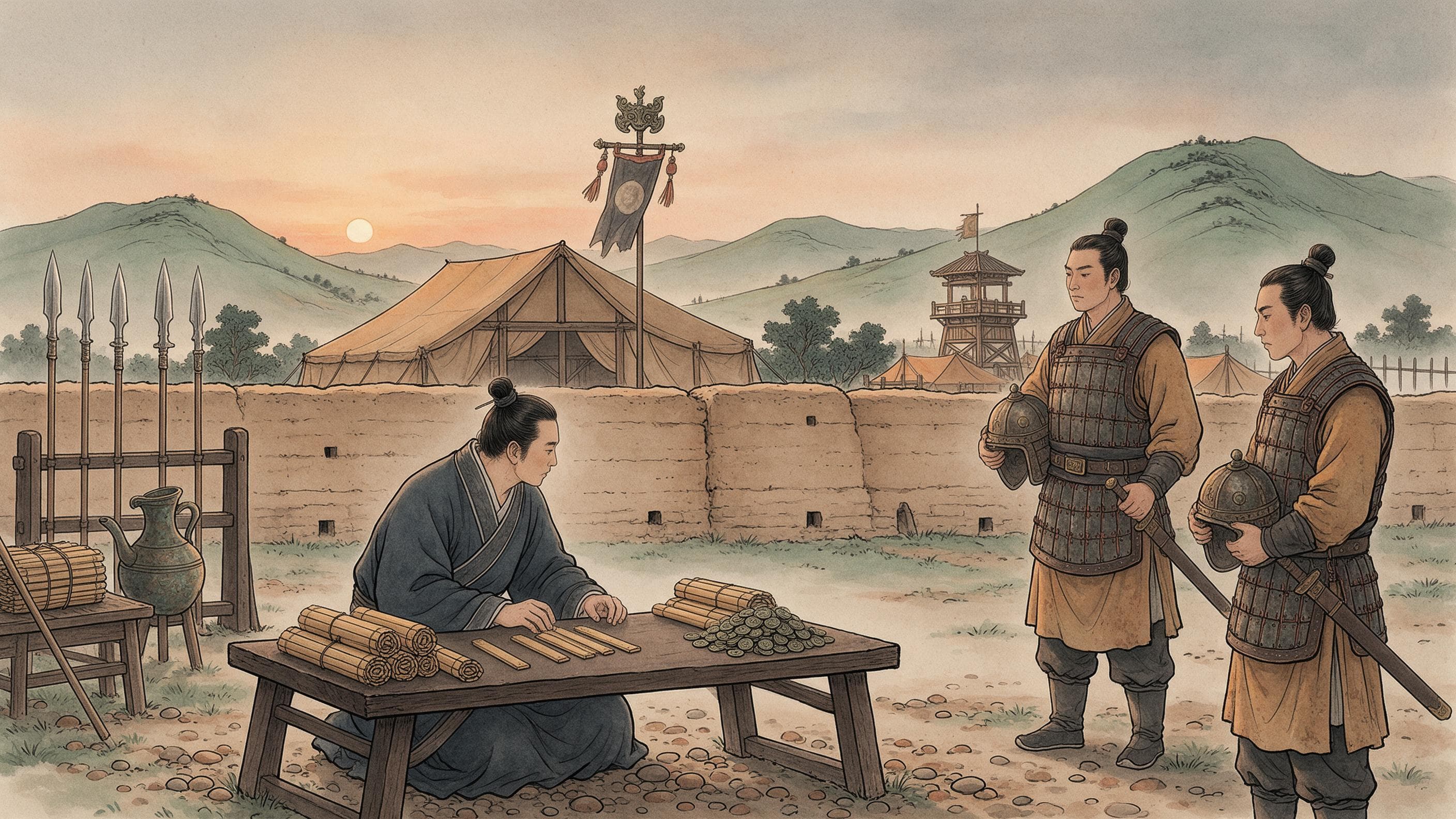
The rate is in another book. The Han Feizi quotes it: 'the law of Lord Shang said: he who cuts off one head is granted one rank of nobility, and if he wants office, an office of fifty shi; he who cuts off two heads is granted two ranks, and if he wants office, an office of a hundred shi.' Then the summary: 'promotion in office and rank matched the merit of heads cut off' (官爵之迁与斩首之功相称也). One head, one rank; two heads, two. Beside rank there is a side road: if you want an office, fifty shi or a hundred. The law is built so that a man can spend his heads either way, on rank or, if he prefers, on an office. Shi here is a way of reckoning an office; neither page explains what it measures.
What Rank Governed
Rank was not an empty title. The same Shiji passage says: 'the distinctions of noble and base, of rank and stipend, were made clear; land, houses, servants and clothing were registered to each household by its grade. The meritorious were honoured and displayed; the meritless, however rich, had no finery.' Rank was tied to things you could see — land, houses, people, clothes. How much of each went with each grade, the passage does not set out. The same list also pays for grain: 'those who apply themselves to farming and weaving and bring in much grain and cloth are freed of service' (戮力本业,耕织致粟帛多者复其身), while those who chase secondary profit, or are idle and poor, are taken with their households. Merit had two currencies here, heads and grain.
One clause in the same law governs the ruler's own people: 'members of the ruling clan who had no military merit to be assessed could not remain on the clan register.' That puts merit in front of blood. Whether it was enforced, and how far, neither page says.
Why Han Fei Wrote It Down
It matters that the Han Feizi quotes this law in order to attack it. Han Fei offers an analogy: if a law said 'let those who cut off heads be made physicians and carpenters,' houses would not be built and illnesses would not be cured — the carpenter works with his hands, the physician mixes medicine, and appointing men for heads taken does not match their ability. Then the step: 'administering an office requires intelligence; cutting off a head is what courage and strength supply. To govern an office of intelligence with what courage supplies is to make head-takers into physicians and carpenters.'
So the quotation stands where it stands: as a target. Han Fei's conclusion is that 'neither of the two masters was complete in method and law' — Shang Yang incomplete in law, Shen Buhai in method. He does not deny that the law existed or that the arithmetic was clear. He argues that the arithmetic prices the wrong thing: the clearer the account, the more exactly it is wrong. That argument sits outside the quotation, and it should not be dropped when the quotation is used.
Where the Two Pages Part
The relation between the pages needs fixing first. The Shiji is a Western Han narrative of the reforms and gives the principle: merit receives high rank by a rate; clan members without merit lose the register; rank orders land and clothing. The Han Feizi, generations later, gives numbers: one head one rank, two heads two, fifty and a hundred shi. One gives no rate, the other gives a rate; they do not contradict, but they cannot be stitched into one statute — the Shiji has no rate, and the Han Feizi has no allocation of land and servants.
What is missing matters more. Neither page lists the ranks: what the first grade was called, how many there were, what each carried, is left blank. The full ladder usually reconstructed from later, Han-era material is not in these two pages, and this article does not supply it. Nor is there any account of how a head was verified — who counted, who recorded, who checked for false claims. There are no totals of heads taken and no count of men ennobled. What can be written here is the conversion — one head, one rank — and the fact that rank governed land, houses, servants and clothes; not a complete system of military nobility.
A Clear Account, Reckoning the Wrong Thing
Put the two pages together and a system appears that made merit countable: heads counted by the piece, pieces converted into grades of rank, rank converted into land, houses, servants and clothing, with even a denunciation priced as a head. The numbers are small and the chain is long, and every link needs someone to record it and someone to check it. The recording and the checking are exactly what the pages leave out: they give statutes and arguments, not the slips in the counting office.
Two loose ends remain. One is institutional: if clan status depended on heads and rank on heads, what happened to men who never got to a battlefield? Neither page says. The other is philosophical: Han Fei raises the conversion to show that 'matching' can itself be the error — if there is an equation between a head and an office, the two sides of the equation are not the same kind of thing. Qin's account of merit was clear. Han Fei's question is what, exactly, that account was keeping track of.
Related reading:Thirty Cash a Shi: One Family's Budget and One Price Band · Six Names for One Banknote: How Jin China Kept Renaming Its Paper Money · Counting Heads: The Han Poll Tax on Adults, Children and Service
Sources & further reading
- 《韩非子·定法》(战国末韩非撰;维基文库本,未与点校本复核) — A Warring States dialogue, written generations after Shang Yang, in which Han Fei quotes the law in order to attack its principle: 'the law of Lord Shang said: he who cuts off one head is granted one rank of nobility, and if he wants office, an office of fifty shi; he who cuts off two heads is granted two ranks, and if he wants office, an office of a hundred shi. Promotion in office and rank matched the merit of heads cut off.' Han Fei then argues that administering an office needs intelligence while taking a head needs courage and strength, so appointing head-takers to offices is like making them physicians and carpenters — and concludes that neither Shen Buhai nor Shang Yang was complete in method. The rate therefore survives inside a critique, not as a statute text, and the page says nothing about how heads were verified or what a noble rank carried.
- 司马迁《史记》卷六十八·商君列传(西汉;维基文库本,未与点校本复核) — A Western Han narrative of Shang Yang's reforms under Duke Xiao of Qin. Its list of the new laws includes: households grouped into fives and tens with collective liability; failure to denounce a culprit punished by cutting in two at the waist; denouncing rewarded as for cutting off an enemy's head, sheltering punished as for surrendering to the enemy; 'those with military merit each received a high rank according to the rate' (各以率受上爵); private brawling punished by gravity; 'members of the ruling clan without merit to be assessed could not remain on the clan register'; ranks and stipends made to order land, houses, servants and clothing by household grade; and 'the meritorious were honoured, the meritless however rich had no finery'. It gives no rate, no list of ranks and no figures of any kind.