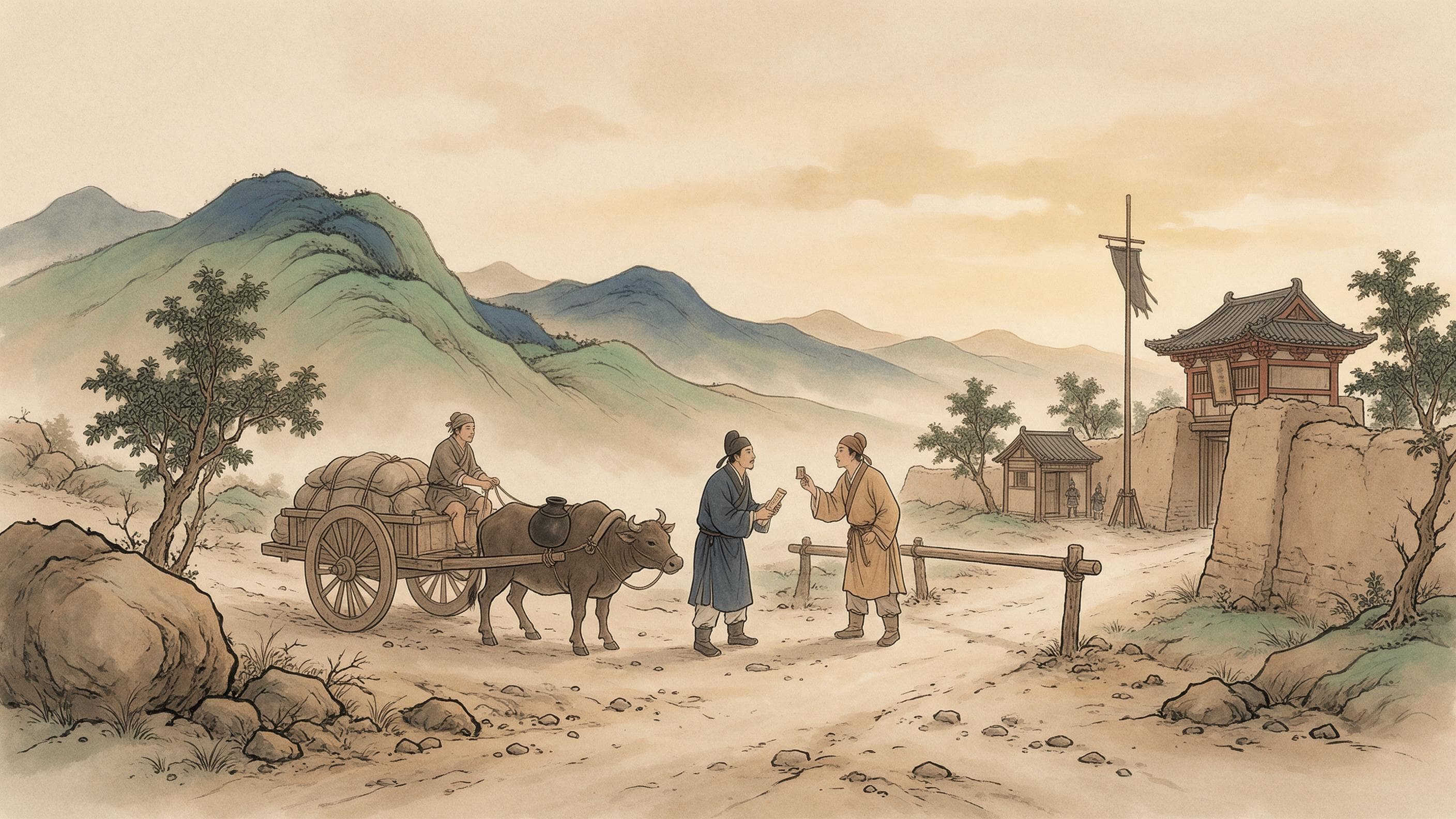
A road narrows to a pass: an earthen wall, a gate tower, a pole laid across the track. In the Zhou li an officer stands there. He looks at the tally a merchant holds up, checks that the goods match the document, takes a levy on what passes and on the space it occupies, and if the merchant has tried to go around, seizes the goods and punishes the man. On the same road, in another book, the true king's pass takes nothing at all: goods are inspected, and that is the end of it. Two texts describe the same gate and disagree about what should happen at it.
Inspect, but do not levy
In the Mencius, King Xuan of Qi asks about kingly government, and Mencius answers with the government of King Wen at Qi. Among its features is the line 'at the passes and markets, inspect but do not levy' (关市讥而不征). To inspect (讥) is to check people and goods against prohibitions; to levy (征) is to take a share. The phrase puts the two verbs in one sentence precisely in order to separate them: check what should be checked, take nothing. The compound 'passes and markets' is a rhetorical pair, not a single office.
Elsewhere in the same book the line becomes a way of drawing people in: at the market, tax the stalls but not the goods; at the pass, inspect but do not levy — and then 'all the merchants under heaven will be pleased and wish to store their goods in his market', 'all the travellers under heaven will be pleased and wish to come out on his roads'. The argument is about traffic, not revenue: the ruler who does not take gains the road. It is still a program. 'If a ruler truly practised these things, the people of neighbouring states would look up to him as to parents' — a promise about what would follow, not a report of what any state was doing.
In the last book of the Mencius the tone changes: 'The passes of old were made to ward off violence; the passes of today are made to commit it.' This is not institutional description, but it is the hardest evidence in the book: if the passes of his own day could 'commit violence', they were taking something. Mencius is attacking a practice that existed — and he still gives no figure.
The Zhou li's pass
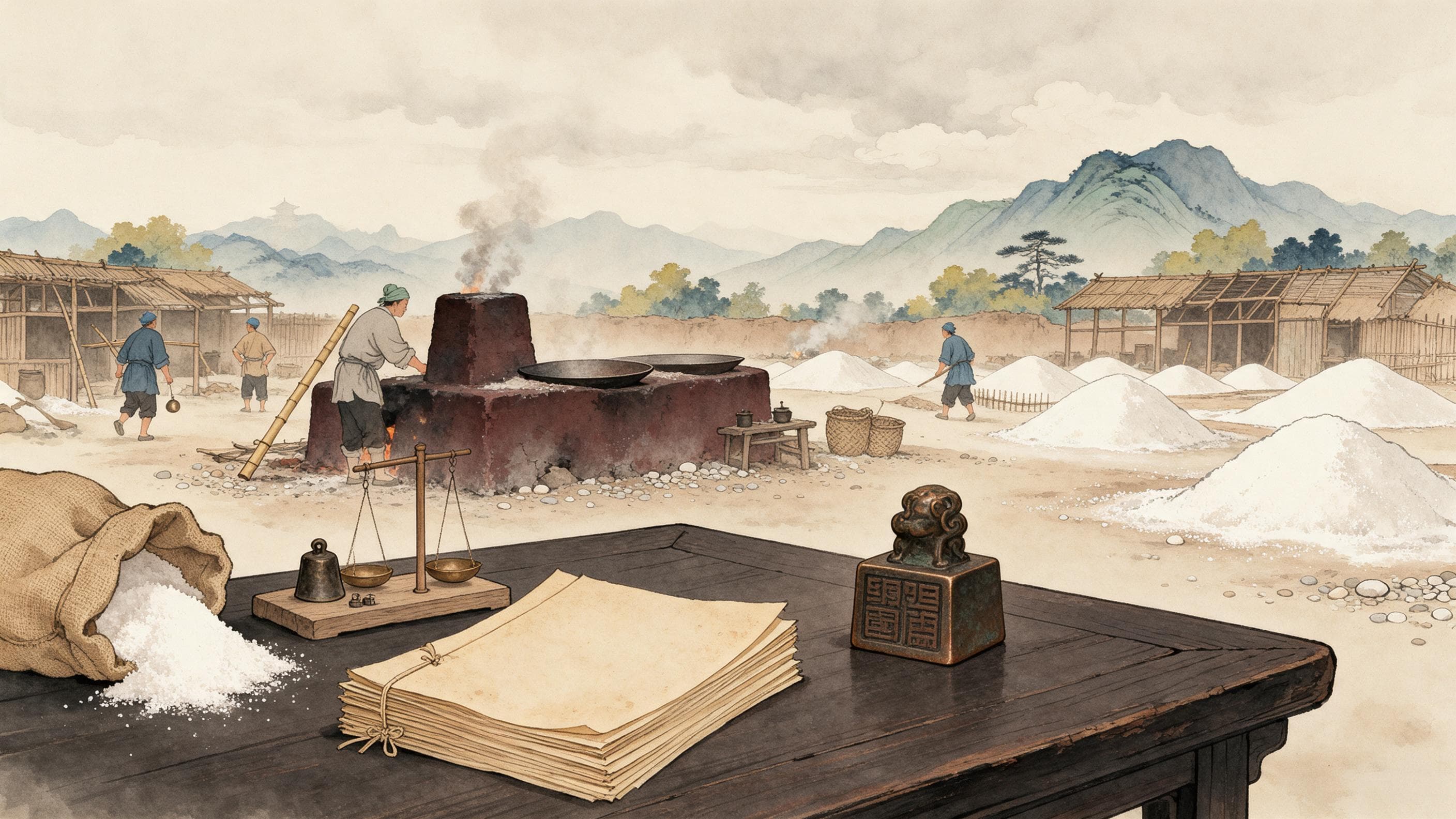
The Zhou li's Officer of the Pass has a concrete brief: 'He controls the tallies for the goods of the state, and thereby links the gates and the markets. He supervises the goods and valuables that go out and in, and controls their prohibitions and their levy on goods and storage (征廛). Goods that do not pass through the pass he seizes, and punishes the man. Goods that are to be forwarded he lets out with a tally and a pass. In a year of famine or pestilence there is no levy at the gates and passes, but there is still inspection.' The last sentence is the telling one: what is suspended is the levy, what remains is the inspection. Mencius wants to drop the taking; the Zhou li keeps both looking and taking, and knows they are different acts.
The documents are the skeleton of the design. The Keeper of Tallies assigns 'the fu-tally for gates and passes, the seal tally for goods, the banner tally for roads', each with a term at which it is returned, and adds: 'anyone who travels through the world must have a tally, with a pass to support it; those without a tally, if there is an inspection, do not get through.' The Officer of the Gate has a different post: 'He controls the keys and bars, to open and close the city gate. He inspects those who go out and in with things they should not have, and corrects the goods and valuables; property that violates prohibitions he seizes.' So the same trade route has separate checkpoints — pass, city gate, market — each with its own officer and its own document. That division is itself proof that the pass and the market were not one institution.
What the market side took
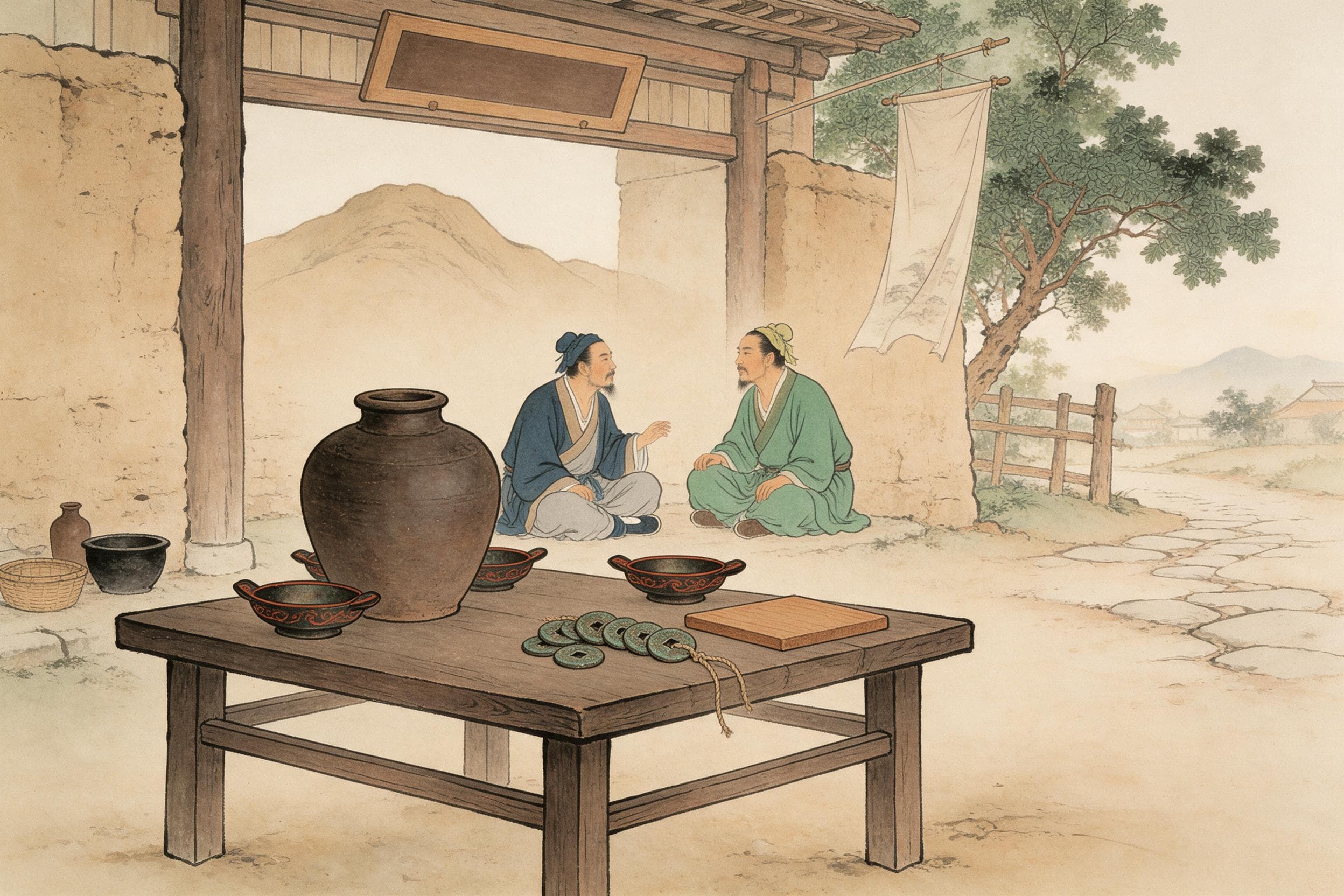
The market is another office altogether. The Master of the Market governs its order, its measures and its prohibitions; the stall officer collects the market's named levies — the ci, zong, zhi, fa and chan cloths — and delivers them to the treasury office, which uses 'the market's levy-cloth' to buy what has not sold. The market has its own levy names; the pass has the levy on goods and storage. Two sets, two offices. Mencius joins 'passes and markets' into one phrase when he talks about generous government; the Zhou li splits them into separate posts when it talks about administration. This piece is about the pass; the market's internal order is another subject.
The design also puts something else at the pass. The Relief Officer, says the text, keeps 'the stores at the gates and passes, to feed the old and the orphaned'. And the same book's list of famine measures includes 'removing the inspections' (去几) — while the Officer of the Pass, in famine, keeps the inspection and drops only the levy. Two passages in one book pull different ways. That is a good sign that the Zhou li is a compiled design rather than a working code: it can hold both.
No rate anywhere
The silence is the point. Mencius says the levy should not exist, so he has no rate to give. The Zhou li names officers, documents, penalties and levies, but never a proportion, an amount, a quota or a receipt. Nothing in these two passages can be turned into 'the Warring States tariff was this much'. The Zhou li's date is disputed; it is an anonymous institutional text, probably compiled over a long period, describing an ideal bureaucracy, and it cannot be read as one state's tax law. The Mencius is rhetoric addressed to rulers and recorded by disciples, with King Wen as an idealised model. Neither is a ledger.
What the pair does establish is narrower. The vocabulary separated inspection from levy, and both books keep that line. The Zhou li's design assumes levies at passes and markets, with documents and penalties and a famine exemption. Mencius argues that the levy should be abolished and attacks contemporary passes as instruments of violence, which shows that taking was real. Neither text says what a merchant actually paid. The sources support a debate about whether the pass should take, not a schedule of what it took.
How to read the two books
The Mencius is Warring States speech, addressed to rulers, with its ideal placed in King Wen. The Zhou li is an anonymous design of government, of disputed date, describing the offices that ought to exist. Both books are later than the order they describe, and neither is a gate officer's account book. Set side by side, they let us hear an argument: the king's pass looks and does not take; the designed pass both looks and takes; in famine the taking may be suspended, the looking may not. As for the merchant standing at the gate with his seal tally, and what the officer asked him for — on that, both books are silent.
Sources & further reading
- 《孟子》·梁惠王下、公孙丑上、尽心下(战国孟子及其弟子;维基文库本) — Warring States text, speeches of Mencius recorded by his disciples. Liang Hui Wang II puts 'the passes and markets inspect but do not levy' (关市讥而不征) among the features of King Wen's government, in an answer to King Xuan of Qi about kingly government. Gong Sun Chou I makes the same promise a program: inspect at the pass, do not levy, and travellers will come. Jin Xin II turns from ideal to attack: 'the passes of old were made to ward off violence; the passes of today are made to commit it.' The other two chapters are at https://zh.wikisource.org/wiki/孟子/公孫丑上 and https://zh.wikisource.org/wiki/孟子/盡心下. The book is rhetoric addressed to rulers, not a record of any state's receipts.
- 《周礼》·地官司徒(司关、掌节、司门、司市、廛人、泉府、遗人、大司徒荒政;作者与成书年代有争议;维基文库本) — Anonymous institutional text of disputed date, describing an ideal bureaucracy. The Officer of the Pass (司关) controls the tallies for goods, links gates and markets, controls prohibitions and the levy on goods and storage (征廛), seizes and punishes goods that bypass the pass, and in famine or pestilence suspends the levy while keeping inspection. The Keeper of Tallies (掌节) assigns the fu-tally to gates and passes, the seal tally to goods and the banner tally to roads, with a term for returning each; without a tally one does not pass an inspection. The Officer of the Gate (司门) keeps the keys and inspects goods at the city gate. The market side has its own office and its own named levies collected by the stall officer (廛人) for the treasury office (泉府). The Relief Officer (遗人) keeps stores at gates and passes for the old and orphaned, and the famine measures of the Grand Minister include 'removing the inspections' (去几). No rate, amount, quota or receipt appears anywhere.