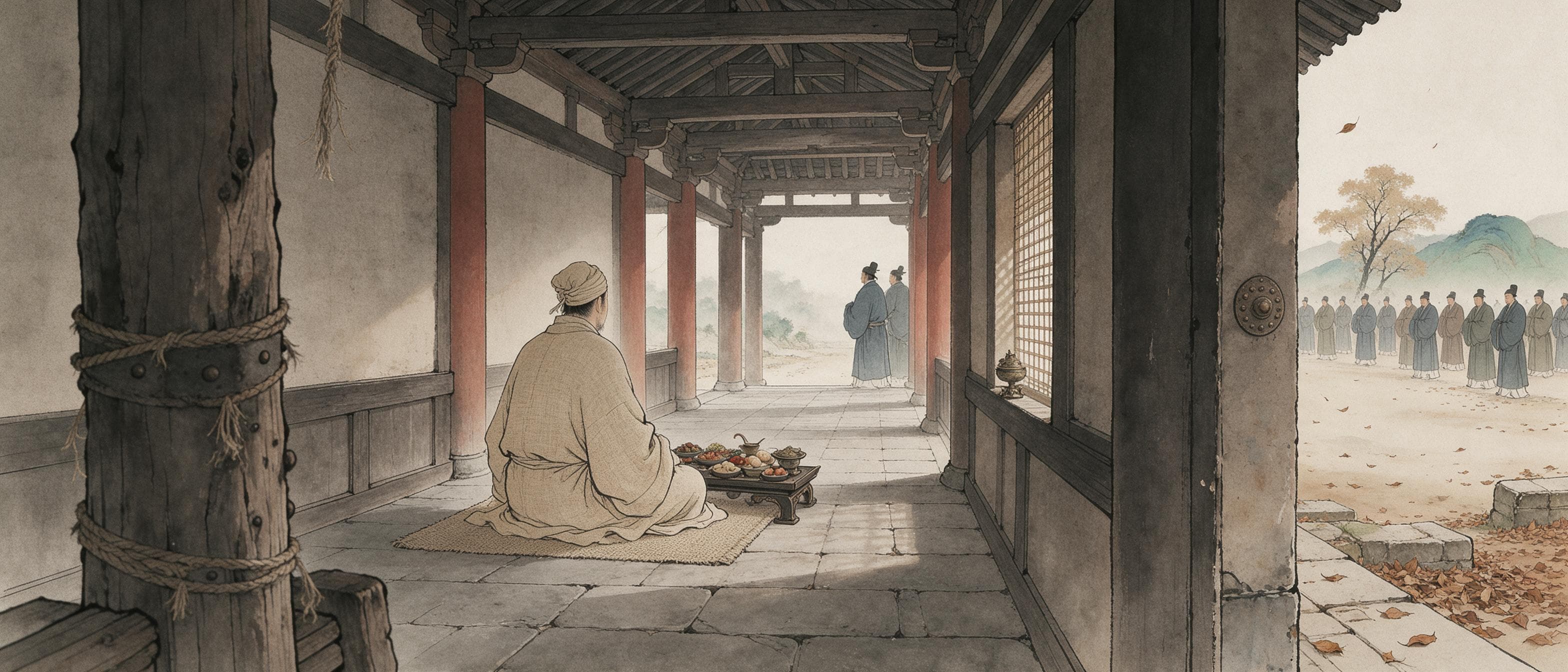
The evening before, the family is still wailing at the coffin when an officer comes to ask the master for the date of opening the chamber. Before dawn they are up: a basin for washing hands is set outside the gate of the ancestral temple, the tripods are arranged as they were at the coffin, and two candles wait outside the gate of the 殯 where the coffin has lain. A 夷床, the low frame the coffin is set on, is laid ready between the steps (夷床饌于階間).
Opening the Chamber
The men bind up their hair and let the mourning bands hang loose; the women stop wailing; the master bows to the guests, enters and bares his arm. The invocator (商祝) takes a cloth of ash-washed hemp, goes up the west stairs, stops at the top without entering the hall, and does what the text records in six words: 'three sounds, three openings, orders the wailing' (聲三,啟三,命哭). The candles go in. The name banner is taken down and set on the 重, the wooden spirit-stand; the invocator wipes the coffin with the cloth and covers it with a shroud.
Zheng Xuan's commentary says what the six words are for: 'three sounds — three times making a sound — to keep the spirit present; three openings — three times saying open — to announce to the spirit' (聲三,三有聲,存神也。啟三,三言啟,告神也). And on the question asked the evening before: 'As the burial approaches, the coffin is to be moved to the ancestral temple, and the officer asks the master for the time of opening the 肂, so that the guests may be told' (將葬,當遷柩于祖,有司於是乃請啟肂之期於主人以告賓). The temple in question is a small one: '祖 is the grandfather; for a lower knight grandfather and father share one temple' (祖,王父也。下士祖禰共廟). The chamber is opened, in other words, in order to move the coffin.
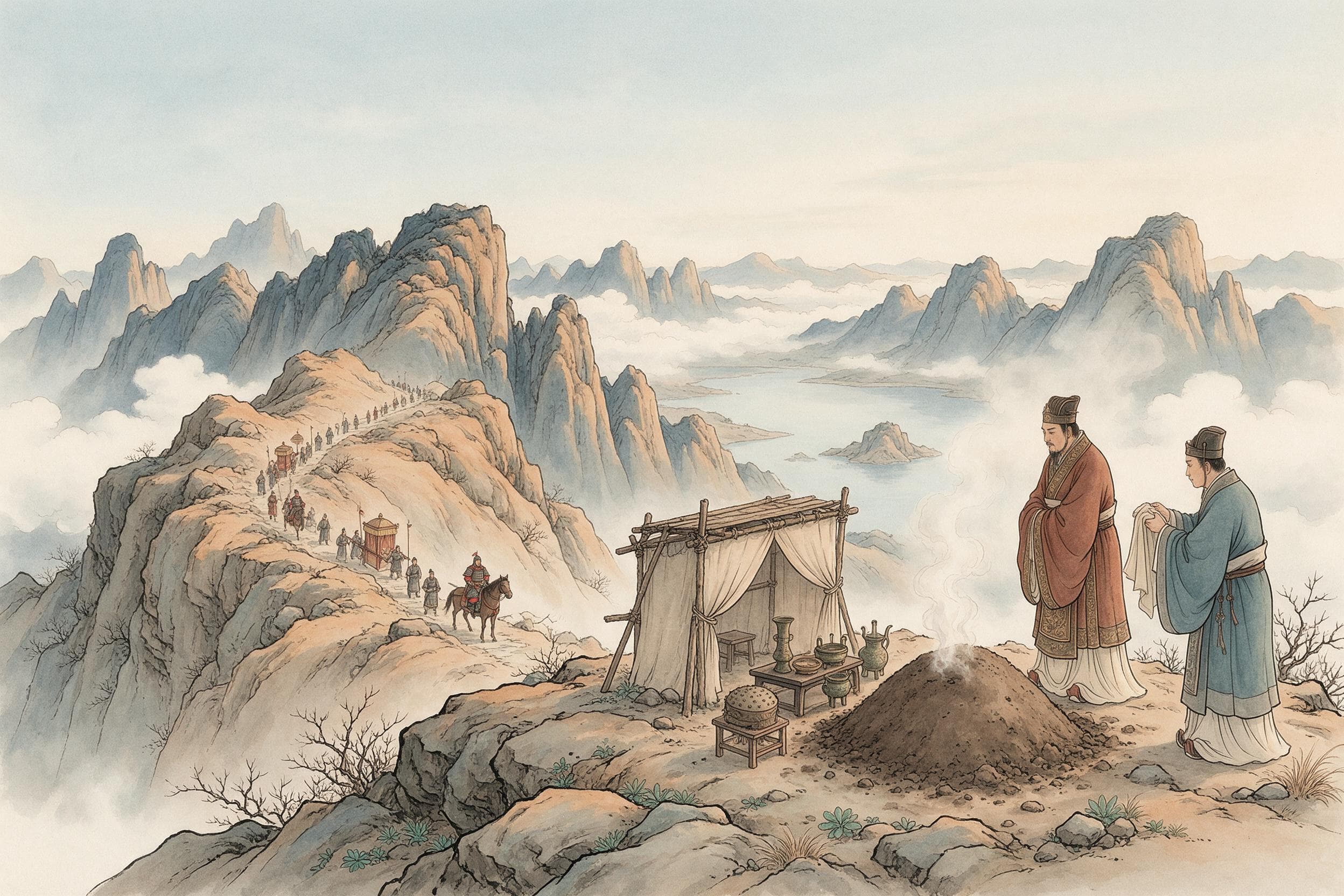
The move is made with a roller: 'the 重 first, the offerings following, the candles following, the coffin following, the candles following, the master following' (重先,奠從,燭從,柩從,燭從,主人從). Up the west stairs, the coffin is set between the two pillars on a 夷床; a carriage is presented at the east eave; horses are presented and led through the gate with three tassels each, reins crossed, two grooms holding them and a driver standing behind with his whip (纓三就,入門,北面,交轡,圉人夾牽之。御者執策立於馬後); at full daylight the candles are put out.
Laying Out the Grave Goods
An officer asks for the hour of the 祖, and the answer is 'the sun's decline' (日側). The coffin is loaded and its trappings put on — 'one 池 ornament, cords in front red and behind black, three colours at the top, no shells' (一池,紐前䞓後緇,齊三采,無貝) — the pull-bands fixed, the ropes attached. West of the carriage lie the grave goods: a 折 laid crosswise and face down; 抗木, three across and two lengthwise; three 抗席 over them; a mat of coarse cloth for the coffin to rest on (茵); two 苞; three 筲 holding millet, panicum and wheat; three 甕 with vinegar, pickle and spice; two 甒 with sweet wine and wine; the use-goods — bow and arrows, plough and spade, two grain vessels, two bowls, a basin and a ewer; the service-goods — armour, helmet, shield, quiver; and the personal goods — a staff, a rain-hat, a fan. The set is called 明器, vessels for the dead; the 记 says the mat is stuffed with rushes (茵著,用荼,實綏澤焉).
The Last Morning
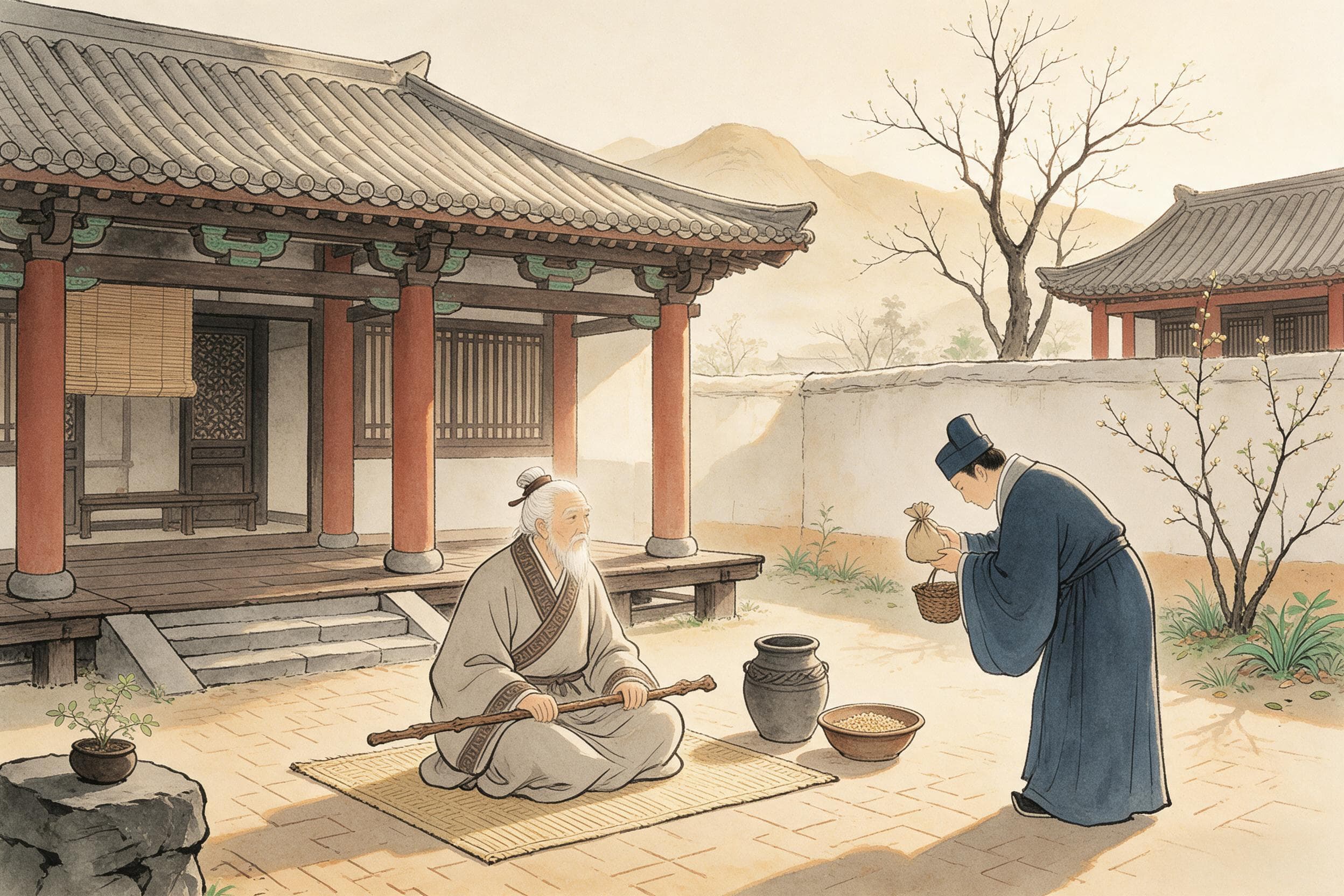
At dawn the next day five tripods are set outside the gate, the torches are put out, and the last offering is made. Then the lists are read. The master's historian asks to read the list of gifts, tally-sticks in hand; the duke's historian reads the list of things sent off with the dead, from the west, ordering silence, and neither master nor mistress may weep until the reading is done (命毋哭); then weeping is ordered, the candles are put out, and the readers go out. The lists are written: the gifts on a board, nine, seven or five lines to it; the things sent with the dead on slips (書賵于方,若九,若七,若五。書遣于策). The night before, wailing had been taken up in relays and a fire lit inside the gate on the right (乃代哭,如初。宵,為燎于門內之右).
Out of the Gate, Down into the Pit
The invocator takes the hemp cloth and leads the coffin; the bearers take the pull-bands; the master bares his arm, and they go. At the palace gate the master wails and then puts on his robe again. At the city gate the duke's steward brings dark and red cloth; the master lays down his staff, does not weep, and receives the order from the left while the envoy delivers it from the right.
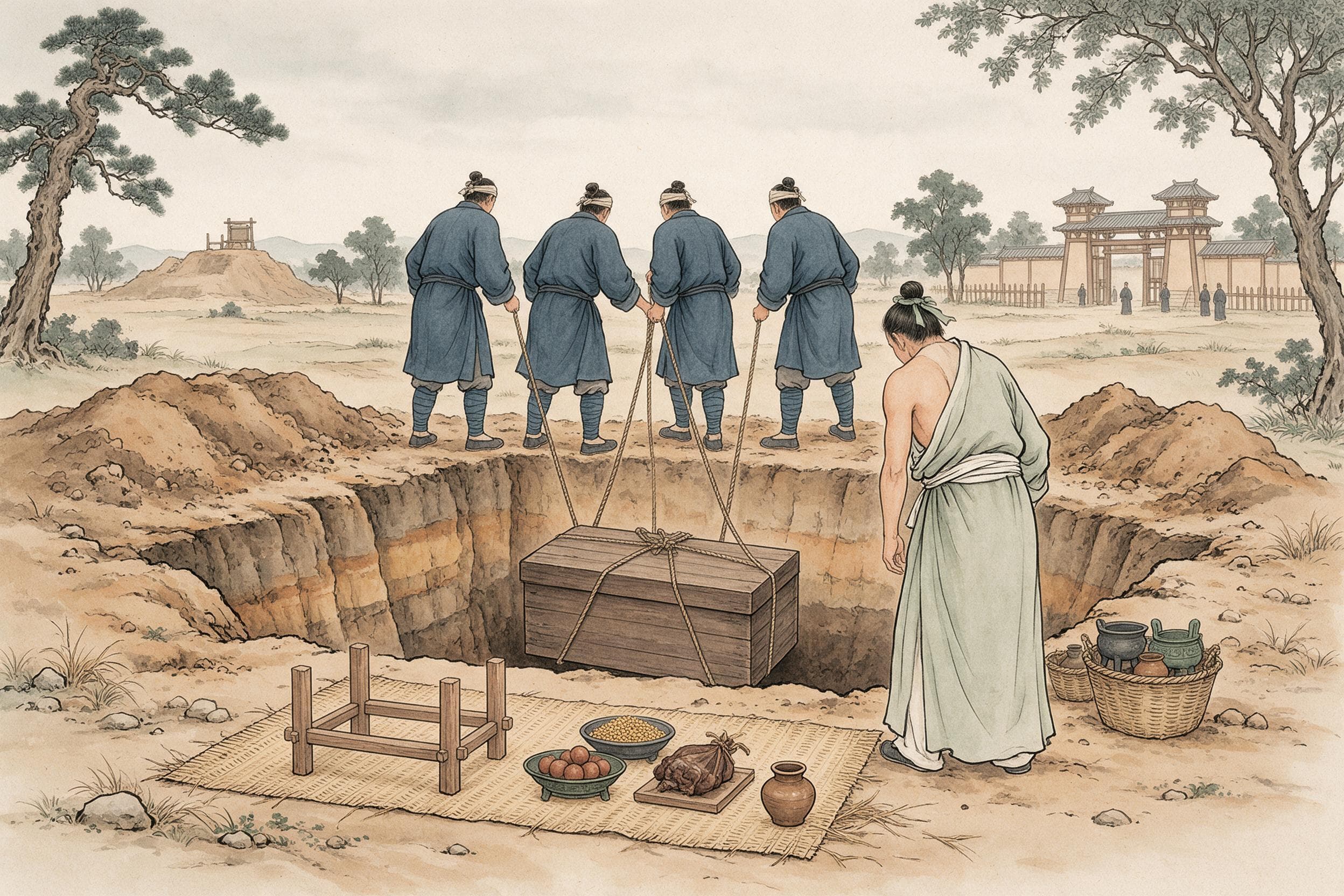
At the pit the grave goods are set out east and west of the path; the mat goes in first and the ropes are made fast. The master bares his arm; the other masters face west and the women face east; all are silent: 'then the coffin is lowered' (乃窆). Zheng Xuan's note on the word: '窆 is lowering the coffin' (窆,下棺也). The master wails without count, offers the bundle of dark and red cloth, bows with his head to the ground.
The goods go in beside the coffin, and the coffin-cover is put on so that the coffin is no longer seen — 見, the coffin's trappings, 'with this added the coffin is seen no more' (加此則棺柩不復見矣); the 苞 and 筲 are stored beside it; the 折 is added and turned face down, the 抗席 spread over it, the 抗木 laid on top; earth is thrown in three times. Then the master bows to the men of his village, and Zheng Xuan notes why: 'thanking them for their labour' (謝其勤勞).
The Return
Then the return to weep (反哭). They enter the ancestral temple and go up the west stairs, facing east; the other masters stand below in the hall facing east; the women enter, the men wail, and the mistress goes up by the east stairs into the room and wails, then comes out to her place and wails three times in turn with the men. A guest comes up the west stairs and says, 'What is to be done!' (如之何); the master bows with his head to the ground. The guests leave and are seen out; then they go to the 殯 palace and do as they did at the opening, wailing three times in turn; the doors are closed, and the master bows to the other masters and goes to his mourning hut.
Zheng Xuan fixes what the return is: 'the return to weep is at the ancestral temple, not at the east steps facing west; the west is the place of the spirits' (反哭者,於其祖廟,不於阼階西面。西方,神位). The sub-commentary puts it plainly: the mourners 'return home to weep, entering the temple and going up the west stairs to weep facing east' (反還家哭,於廟入升西階東面哭). The day's record adds two rules: 'when the lowering is finished, they go home without hurrying the horses' (卒窆而歸,不驅), and only a command from the ruler may stop the coffin on the road (唯君命,止柩于堩), and the 记 fixes four bearers a side for the pull-bands (執披者,旁四人) while saying that no rule governs the gifts left at the grave (凡贈幣,無常). None of these texts gives the size of the pit or the coffin cart, the hours it took, or how much rope or earth was used; and the 虞 sacrifice that follows is another chapter. What is left is one day's sequence of hands: open, carry, lower, return.
Related reading:Fifty Get a Staff: Old Age in a Ritual Book and an Edict · At the Ancestral Sacrifice: Drums, Pipes, Chimes and the Wan Dance · Jade, Silk and Horses: What an Envoy Carried
Sources & further reading
- 《仪礼·既夕礼》第十三(战国至汉初成书;维基文库本,未与点校本复核) — The burial, day by day: the evening question about opening the chamber, the opening at dawn with three sounds and three words, the move to the ancestral temple, the trappings and the grave goods, the last morning with the lists read aloud, the carrying out, the lowering of the coffin at the pit, the storage of the goods, earth thrown in three times, and the return to weep at the temple. The chapter stops before the 虞 sacrifice. It gives no dimensions for the pit or the cart.
- 《仪礼注疏》卷三十八·既夕礼(汉郑玄注、唐贾公彦疏;维基文库本,未与点校本复核) — Zheng Xuan on the opening: the date is asked so that guests may be told, because the coffin is to be moved to the ancestral temple; the three sounds keep the spirit present and the three words announce the opening to it. The sub-commentary explains the setting and order of the move.
- 《仪礼注疏》卷四十·既夕礼(汉郑玄注、唐贾公彦疏;维基文库本,未与点校本复核) — Zheng Xuan on the two words that end the descent and start the return: '窆 is lowering the coffin'; and the return to weep is at the ancestral temple, facing east at the west stairs, because the west is the place of the spirits. The sub-commentary adds that the mourners come home and weep in the temple before going on to the 殯 palace.