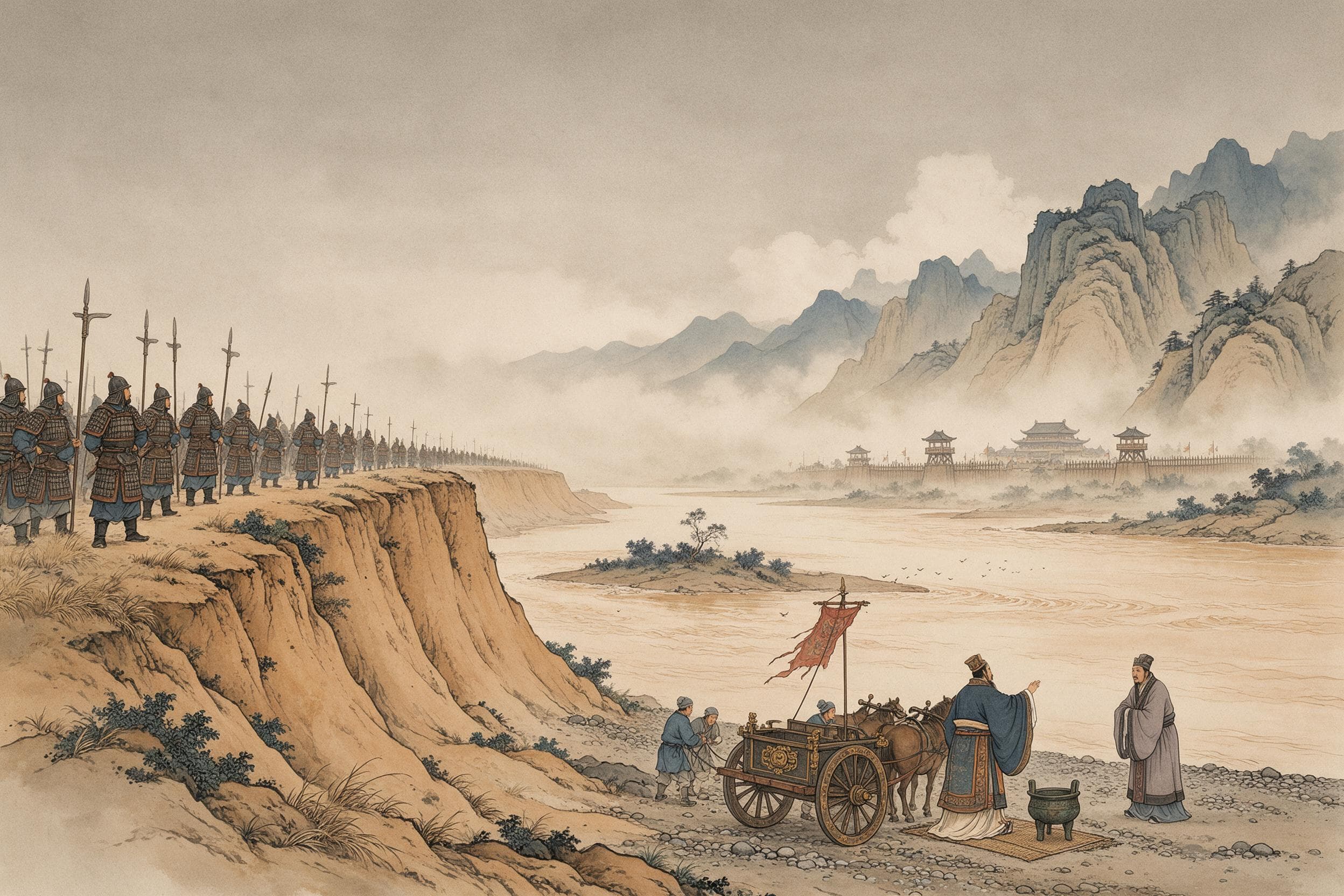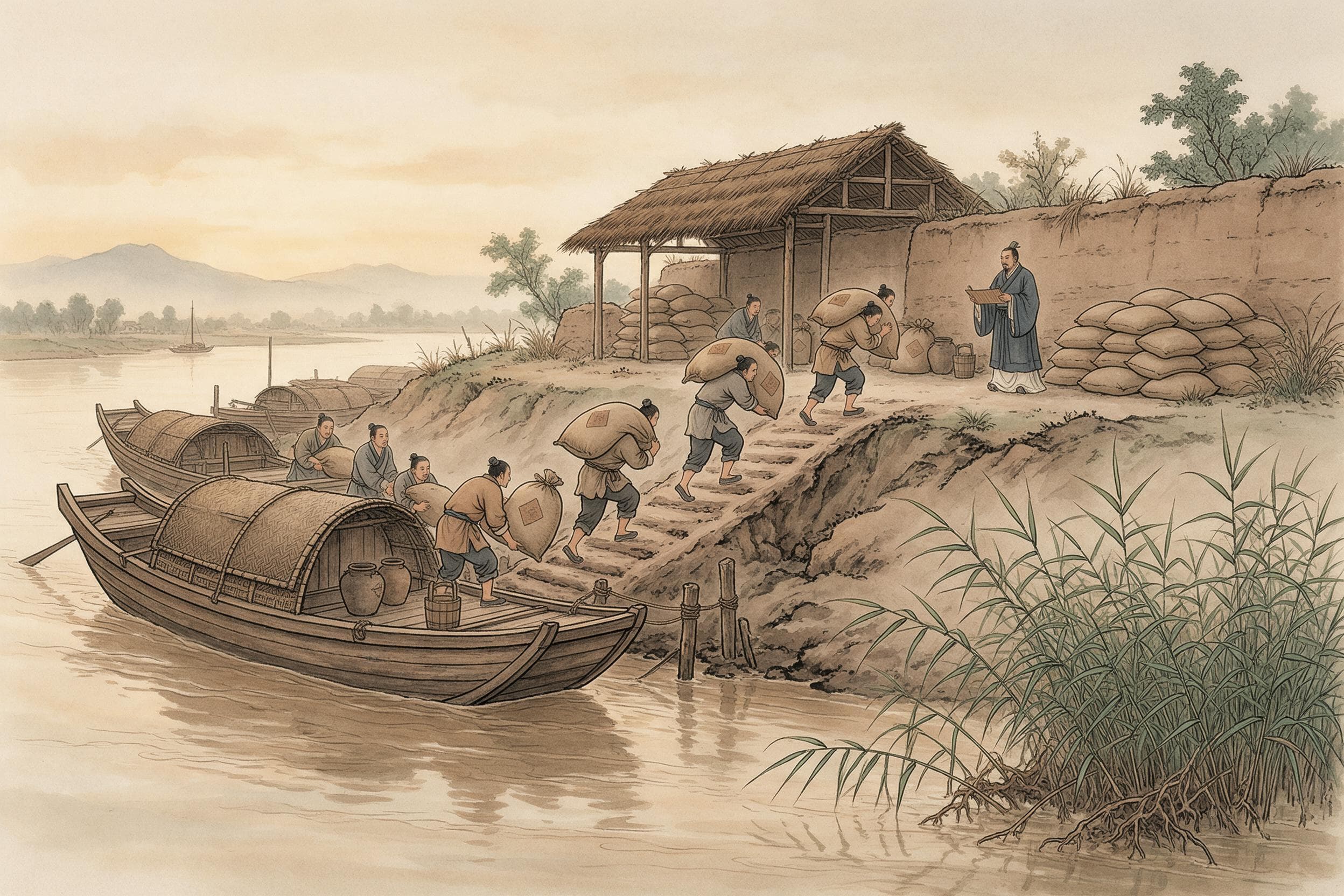
That winter the supply line was a river. In the thirteenth year of Duke Xi of Lu (647 BCE) the state of Jin ran short of grain and sent to Qin to beg a purchase. Qin agreed, and the grain went from Yong to Jiang, 'following one another' (自雍及絳相繼). The Zuo zhuan gives the operation a name: the boat-ferrying service, fan zhou zhi yi. That sentence is the whole record of it.
One Event, A Few Sentences
The passage is a discussion before it is a shipment. Jin 'was again short of grain' (晉薦饑) and 'sent to beg a purchase from Qin' (使乞糴于秦). The Qin ruler first asks his minister Zisang whether to give. Zisang weighs the return: 'If we bestow heavily and they repay it, what more could you want? If we bestow heavily and they do not repay, their people will turn from them; turn from them and attack, and without a following they will surely be beaten' (重施而報,君將何求?重施而不報,其民必攜,攜而討焉,無眾必敗). He asks Baili, who speaks differently: 'Natural disaster comes and goes; every state has its turn. To relieve disaster and pity one's neighbour is the Way; one who walks the Way has blessing' (天災流行,國家代有。救災恤鄰,道也。行道有福). Pizheng's son Bao is in Qin and asks to attack Jin instead. The ruler answers him in one line: 'Their ruler is hateful; what crime have their people?' (其君是惡,其民何罪). Then the grain moves.
The record stops there. No number of boats, no measure of grain, no days on the water, no route: the name says boats, and says nothing more. No route is given either — only the two endpoints, Yong and Jiang. One further detail matters: the Classic for that year lists a northern incursion, a funeral, a meeting, a drought sacrifice and an envoy; it does not mention grain. The story is only in the Commentary.
The Reverse, on the Same Page
A year later the same chapter records the mirror image: 'In winter Qin was short of grain and sent to beg a purchase from Jin. The men of Jin refused' (冬,秦饑,使乞糴於晉。晉人弗與). Qing Zheng argues against the refusal by naming four failures: 'To turn one's back on a kindness destroys kinship; to rejoice in another's calamity is inhuman; to grudge what one loves is inauspicious; to anger a neighbour is unjust' (背施無親,幸災不仁,貪愛不祥,怒鄰不義). Guo She answers with an image: 'If the hide is gone, where will the hair attach?' (皮之不存,毛將安傅) — Jin had already defaulted on the lands it promised Qin, so there is no kindness left to repay. Qing Zheng is not heard. He withdraws and says the ruler will regret it.
The Commentary then draws the line itself: 'Jin was short of grain and Qin shipped grain to it; Qin was short of grain and Jin closed its purchase; therefore the Earl of Qin attacked Jin' (晉饑,秦輸之粟;秦饑,晉閉之糴,故秦伯伐晉). In the fifteenth year the armies meet at Hanyuan and the Jin ruler is taken. And in the same entry comes the strangest line of all: Jin is short of grain again, and the Qin ruler sends grain once more — 'I resent their ruler but I pity their people' (吾怨其君而矜其民). Three decisions in three years: a shipment, a refusal, another shipment.
Mencius: A Boast
Mencius's King Hui of Liang begins with a boast: 'In my dealings with my state, I have done all that was in my heart. If Henei has a bad year, I move its people to Hedong and move grain to Henei; when Hedong has one, I do the same' (河內凶,則移其民於河東,移其粟於河內). The two movements run opposite ways: people out of the hungry district, grain into it. He then complains that neighbouring populations do not shrink and his does not grow, though no neighbour is as attentive as he is.
Mencius does not deny that he moves them. He answers with the battlefield image — fifty paces laughing at a hundred (五十步笑百步) — and then sets a different standard: do not take the farming seasons, do not use fine nets in the pools, take timber from the hills in season, until 'the people can nourish the living and bury the dead without regret; that is the beginning of the kingly way' (養生喪死無憾,王道之始也). At the end of the same speech he names the failures in two verbs: 'Dogs and pigs eat the food of men and no one checks it; on the roads lie the bodies of the starved and no one opens the granaries' (狗彘食人食而不知檢,塗有餓莩而不知發). And the excuse he puts in the ruler's mouth: 'It was not me, it was the year' (非我也,歲也).
Another Ruler, Another Argument
A second passage puts the harder case. Zou quarrels with Lu, and Duke Mu of Zou complains that thirty-three of his officers died while none of his people died for them. Mencius answers with a famine: 'In a bad year, a famine year, of your people the old and weak tumbled into the ditches and the strong scattered to the four quarters, several thousand of them; yet your granaries were full and your treasuries stocked, and none of your officers reported it. That is negligence above and cruelty below' (凶年饑歲,君之民老弱轉乎溝壑,壯者散而之四方者,幾千人矣;而君之倉廩實,府庫充,有司莫以告,是上慢而殘下也).
Both passages are arguments, not records. In the first, the moving of people and grain is the king's own claim, which Mencius reduces to a soldier's excuse; in the second, a famine already past is evidence in a case about why commoners would not die for their officers. The 'several thousand' is a number said to a ruler's face, not a count.
Between the Two Pages
The two pages are centuries apart. The shipment belongs to a year the Zuo zhuan dates to 647 BCE; Mencius is speaking to rulers centuries later, and his book was put together later still. Nothing joins them — no office, no regulation, no line of precedent running from the boat-ferrying service to moving people and grain. Read together as a history of famine relief, the middle is supplied by the reader. What these pages give is one shipment, one refusal, and two arguments in which a famine is a case being made.
Nor is there a quantity anywhere: no grain, no boats, no days, no price, no standard for who receives what. Mencius cites no institution and no rule; his two verbs are 'check' and 'open', and his charge is that neither was done. The one sentence in the Zuo zhuan that sounds like a principle is a minister's maxim — relieve disaster, pity the neighbour, walk the Way — and it is advice, not statute.
A famine year moves two things, grain and people, and the two pages take one each: the Commentary follows grain from Yong to Jiang, Mencius follows people from Henei to Hedong. One moves by boat, the other by speech. Who decides, how much moves, and when a granary should be opened appear on neither page — only a few men saying sentences to a ruler.
Related reading:How Many Strokes for Smuggling Salt: A Ming Statute, Its Sub-Statutes, and a Quota Table · How a Tang Judgment Was Written: Structure, Allusion, and the Space Between Law and Feeling · From Beijing to Nanjing: A Huizhou Merchant's Road Book
Sources & further reading
- 《春秋左氏传·僖公十三年》(含十四、十五年;维基文库本,未与点校本复核) — The one event and its reversal: in the thirteenth year Jin is short of grain and begs a purchase from Qin; the ministers Zisang and Baili argue whether to give, Bao asks to attack instead, and the Qin ruler answers 'their ruler is hateful, what crime have their people'; the grain then goes 'from Yong to Jiang following one another' and the operation is named the boat-ferrying service (汎舟之役). The Classic for that year records no grain transfer; only the Commentary tells it. The fourteenth year has Qin short of grain and Jin refusing (晉人弗與), with Qing Zheng's four failings and Guo She's hide-and-hair image; the fifteenth year states the sequence and its outcome (晉饑,秦輸之粟;秦饑,晉閉之糴,故秦伯伐晉), the battle at Hanyuan, and Qin feeding Jin grain once more, 'resenting their ruler but pitying their people'.
- 《孟子·梁惠王上》(维基文库本,未与点校本复核) — King Hui of Liang's boast that he moves people to Hedong and grain to Henei in a bad year, and that no neighbour is as attentive; Mencius's answer — fifty paces laughing at a hundred, then the kingly way's beginning in not taking the farming seasons (養生喪死無憾,王道之始也), and at the end the two failures 'no one checks' and 'no one opens' (狗彘食人食而不知檢,塗有餓莩而不知發) together with the excuse 'it was not me, it was the year'.
- 《孟子·梁惠王下》(维基文库本,未与点校本复核) — The Zou-Lu quarrel: Duke Mu of Zou complains that thirty-three officers died and no commoner died for them; Mencius answers with the famine year — old and weak tumbling into ditches, the strong scattering, several thousand of them — while the granaries were full and the treasuries stocked, and 'none of the officers reported it; this is negligence above and cruelty below' (有司莫以告,是上慢而殘下也). Also Zengzi's 'what comes out of you returns to you'.