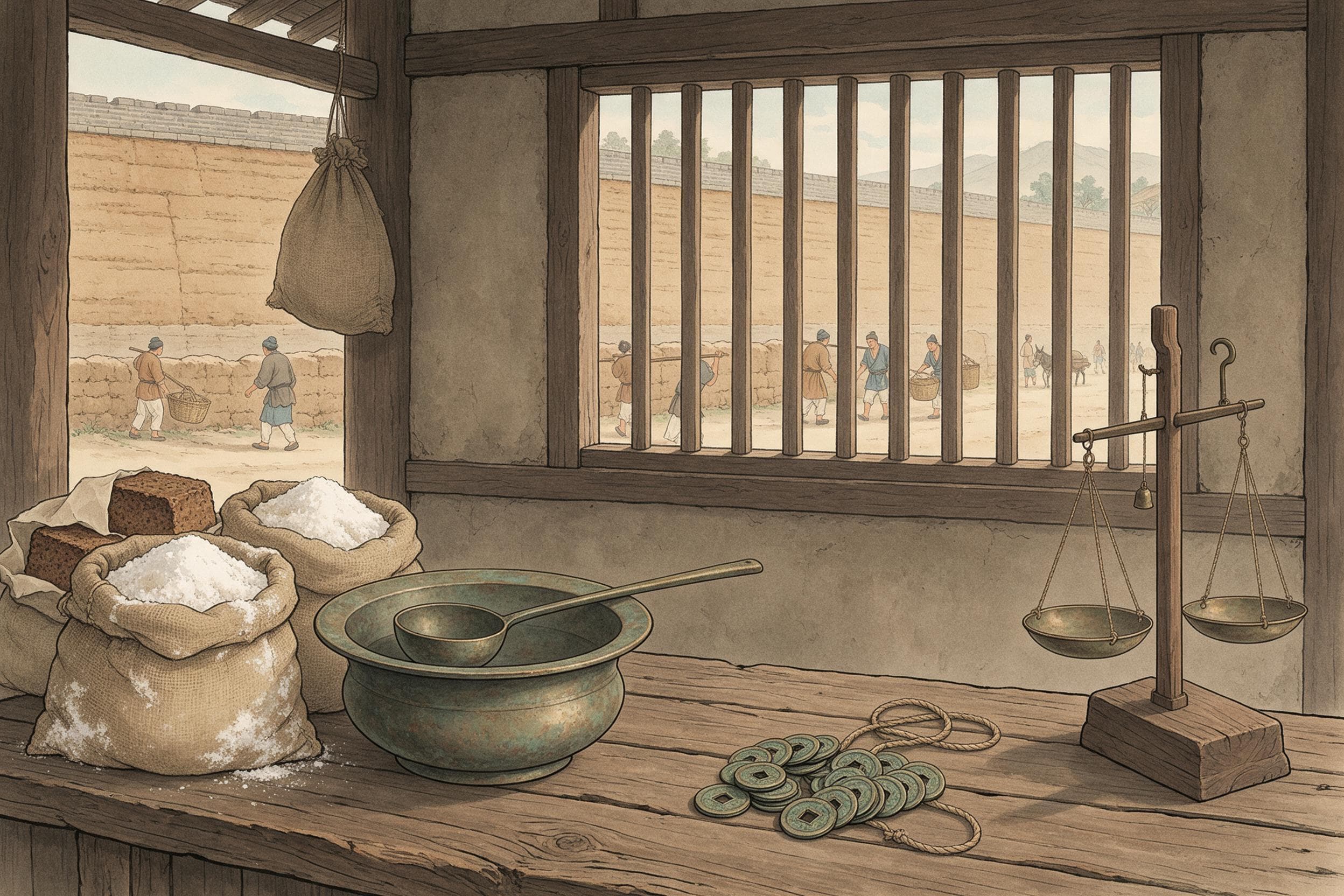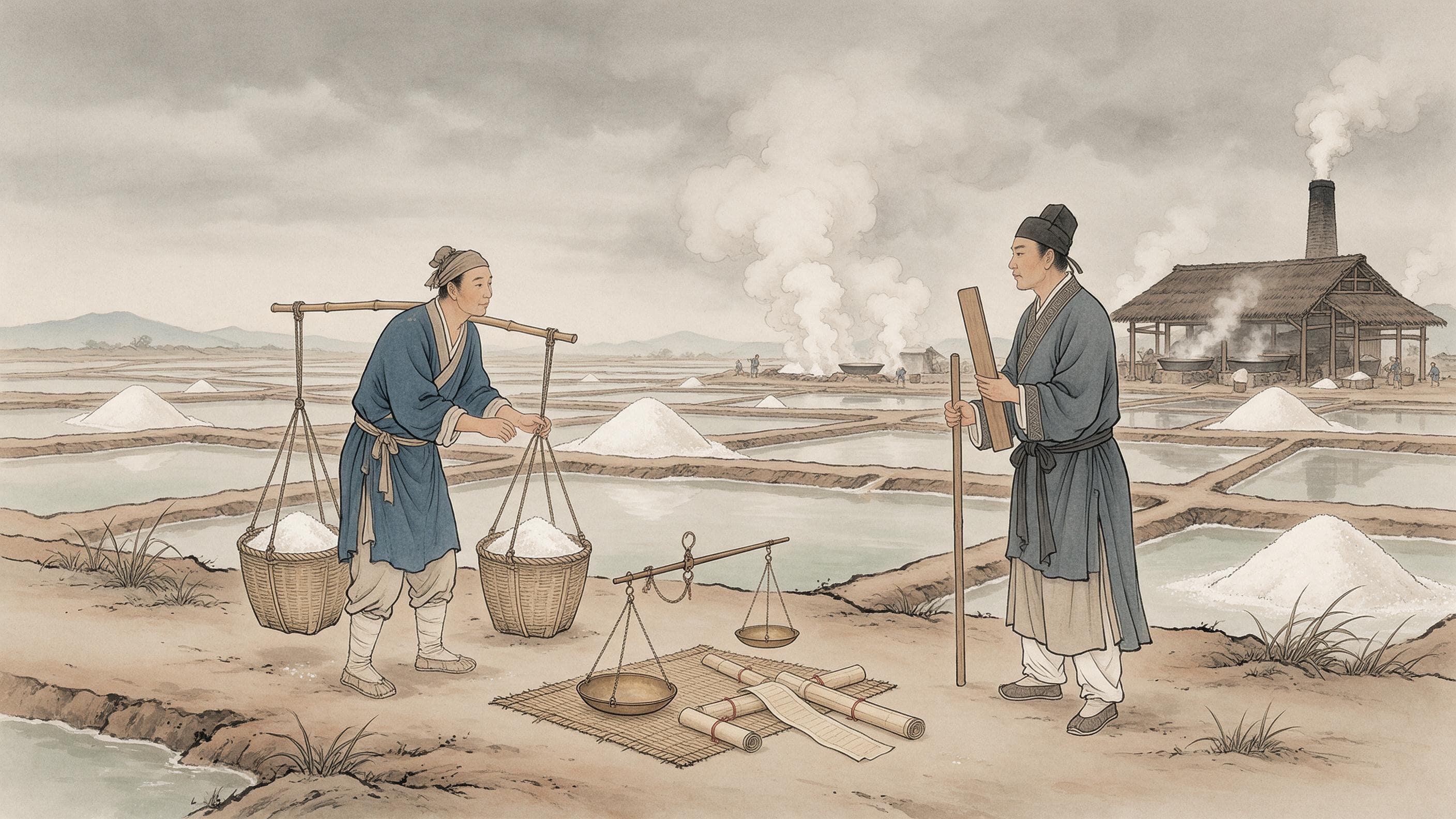
The first sentence of the Ming statute on salt reads: 'Whoever commits the offence of private salt shall be given a hundred strokes and three years of penal labour.' Eleven characters, and the sentence is not complete: whether he carried weapons, whether he falsely accused an innocent person, whether he resisted arrest — each step raises the penalty. Behind the statute in the same juan sits a layer of 'sub-statutes for adjudication', which add the weights. Read the statute first, then the sub-statutes, then the size of the official salt trade.
The steps of one statute
The statute is tidy: private salt, 'a hundred strokes and three years'; 'if he has weapons, one degree more'; 'if he falsely accuses an innocent person, three degrees more'; 'if he resists arrest, beheading'. Four steps, from penal labour to death. The text says 'one degree more' and 'three degrees more' and stops there; this piece quotes those words and does not convert them into specific sentences, because the statute itself does not say where each degree ends.
One offence pulls in more than one man. The same article adds: the salt, the cart, the boat and the head of stock are all confiscated; 'the go-between who leads him in, and the man who harbours or stores the goods, ninety strokes and two and a half years'; 'the man who carries it on a pole or a pack animal, eighty strokes and two years'; 'anyone not a constable who informs and captures shall be given the confiscated salt as a reward'; 'anyone who confesses shall be pardoned and rewarded likewise'. Each role has its own sentence. A separate clause covers the salt-field households: keeping back surplus salt or boiling and selling it privately 'is punished as private salt'.
The sub-statutes put in the quantities
The statute gives the penalty, the sub-statute gives the line. One sets a figure: 'anyone carrying official salt across a border to sell, to the amount of three thousand catties or more, shall be sent to a nearby garrison for military service; if he is from a garrison in the interior, to a frontier garrison.' At three thousand catties the punishment changes from penal labour to exile in the army. The same clause catches the buyer: 'merchants who buy up surplus salt and seek to have it certified, to three thousand catties or more, shall be sent away under the same sub-statute.' Why three thousand, the sub-statute does not say; the figure simply stands in the text.
The other line is not by weight but by men and boats: 'where powerful salt dealers gather ten or more men, pole a large boat, fly a flag and use weapons or sounding instruments, the patrol and salt officers shall seek them out and arrest them; if they resist and kill or wound, all shall be beheaded and their heads displayed.' Ten men, a big boat, a flag, weapons — with those together the nature of the case changes; and once blood is drawn, the sentence is public beheading.
One gap left open
The sentence most worth reading is this: 'poor soldiers and civilians who carry private salt on shoulder poles and on their backs to exchange for rice need not be arrested.' Three thousand catties means exile; a shoulder pole for rice is to be let pass. Law and livelihood give way to each other here. It must be read beside the three-thousand line: the big opening is for large-scale trafficking, and the small carrier is let through. The sub-statute does not say why, nor how to tell 'trading for rice' from 'trafficking'; that line was left to the patrols and the courts. It is one sentence, and the only one in the whole article that looks at the carrier rather than the cargo.
Statute and sub-statute must be kept in their layers. The statute was fixed in the Hongwu reign; the sub-statutes were added later and revised several times under Hongzhi and Jiajing, and the same juan also carries commentary, code extracts and further additions. To say 'the Ming required' one must say which layer. The text used here is a combined edition with commentary and sub-statutes, not the 1370 original printing.
The size of the official trade
How large the official trade was, the Ming code gives in a table. Liangzhe: thirty-five salt yards, 'annually 220,457 yin and 200 catties over'; Fujian: seven yards, '104,572 yin and 300 catties over'; Shandong: nineteen yards, '143,387 yin and 150 catties over'; Huainan and Huaibei: twenty-nine yards, '352,576 yin and 100 catties over'. Those four commissions were the backbone of the official salt quota in the mid-Ming.
The founding rate was one part in twenty. The Ming History: 'When the founder rose, he at once established the salt law, set up offices and officials, and had merchants sell it, taking one part in twenty to fund the army. It was then doubled, and on Hu Shen's advice restored to the original.' The framework was six salt transport commissions and seven salt bureaux. Two cautions: the code's figures are annual quotas written into a book, not receipts; and the yin is both a measure and a certificate whose weight varied by period, with no uniform conversion given here. Nothing is converted into catties or tons. No conversion is offered because the weight of the yin changed over time.
Law and quantity
Some limits. No salt price is given: none of the three sources states a price per catty. No case is given: there are no files, names, dates or places, and a sub-statute is a rule, not a case. No claim is made about corruption in the salt administration, which would need accounts. No social history of the salt households is attempted: the sources give one institutional sentence, that keeping back surplus salt is punished as private salt. And three thousand catties is not the line for all private salt, only for carrying salt across a border or buying up surplus; the shoulder-pole carrier has his own clause. Nor is there any record of how the patrols worked: the sub-statute says boats with flags are to be hunted down, and that the poor carrying poles need not be arrested, but how a constable was to tell one from the other is written down nowhere in these three sources.
Back to the first sentence: a hundred strokes and three years. Read on, and it is one degree more, three degrees more, beheading; further on, three thousand catties of exile and ten men of beheading; and at the end, 'those who carry it on a pole to trade for rice need not be arrested.' The statute gives the penalty, the sub-statutes give the line, the table gives the size of the trade — and only at the last layer does one see the narrow gate between law and livelihood.
Sources & further reading
- 《大明律》卷八·户律·课程·盐法(明官修;维基文库集解附例本) — The statute and the sub-statutes printed together, which is why the layers must be separated: the basic offence of private salt, a hundred strokes and three years of penal labour, one degree more with weapons, three more for falsely accusing an innocent person, beheading for resisting arrest; the go-between, the receiver and the porter punished in their own degrees; the reward to an informer and pardon on confession. The sub-statutes add the quantities: 3,000 catties and more for carrying official salt across a border or buying up surplus salt, military service far from home; the poor carrying salt on a shoulder pole to trade for rice 'need not be arrested'; ten or more men with boats, flags and weapons are to be hunted down, and killing in resistance means public beheading. A combined edition, not the 1370 original printing.
- 《明史》卷八十·食货志四·盐法(清初修;维基文库) — Qing compilation. The founding system: salt offices set up at once, merchants licensed to sell, one part in twenty taken for the army, briefly doubled and then restored; six salt transport commissions and seven salt bureaux.
- 《明会典》卷三十五·户部·盐法一(明官修;四库全书本,维基文库;四库本无标点,引文按文义加标点,未与点校本复核) — The annual quotas, which are fixed figures in a code, not receipts: Liangzhe 35 yards and 220,457 yin plus 200 catties; Fujian 7 yards and 104,572 yin plus 300 catties; Shandong 19 yards and 143,387 yin plus 150 catties; Huainan and Huaibei 29 yards and 352,576 yin plus 100 catties. The yin is a unit of account and a certificate; its weight varied, and no conversion is supplied here.