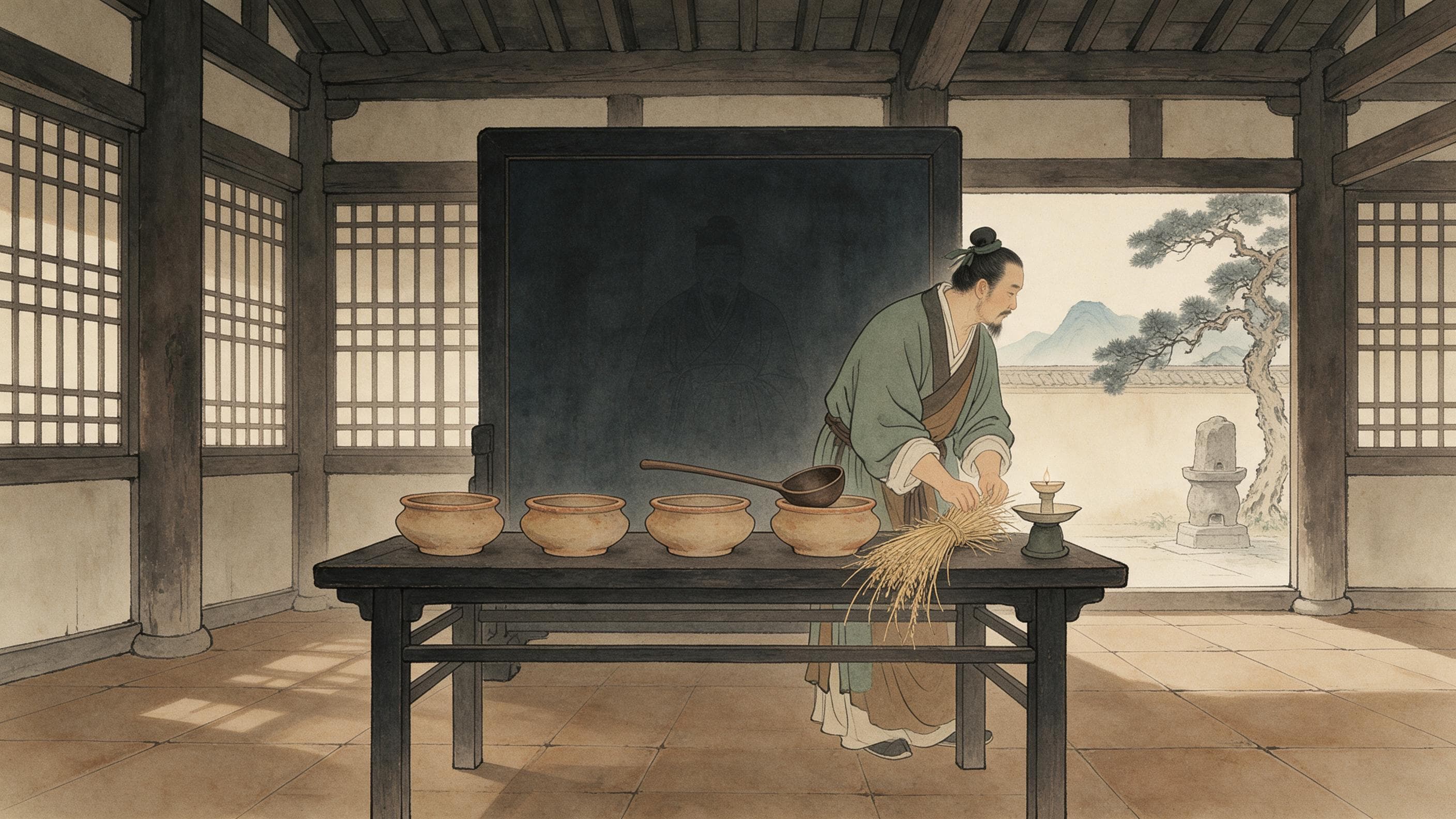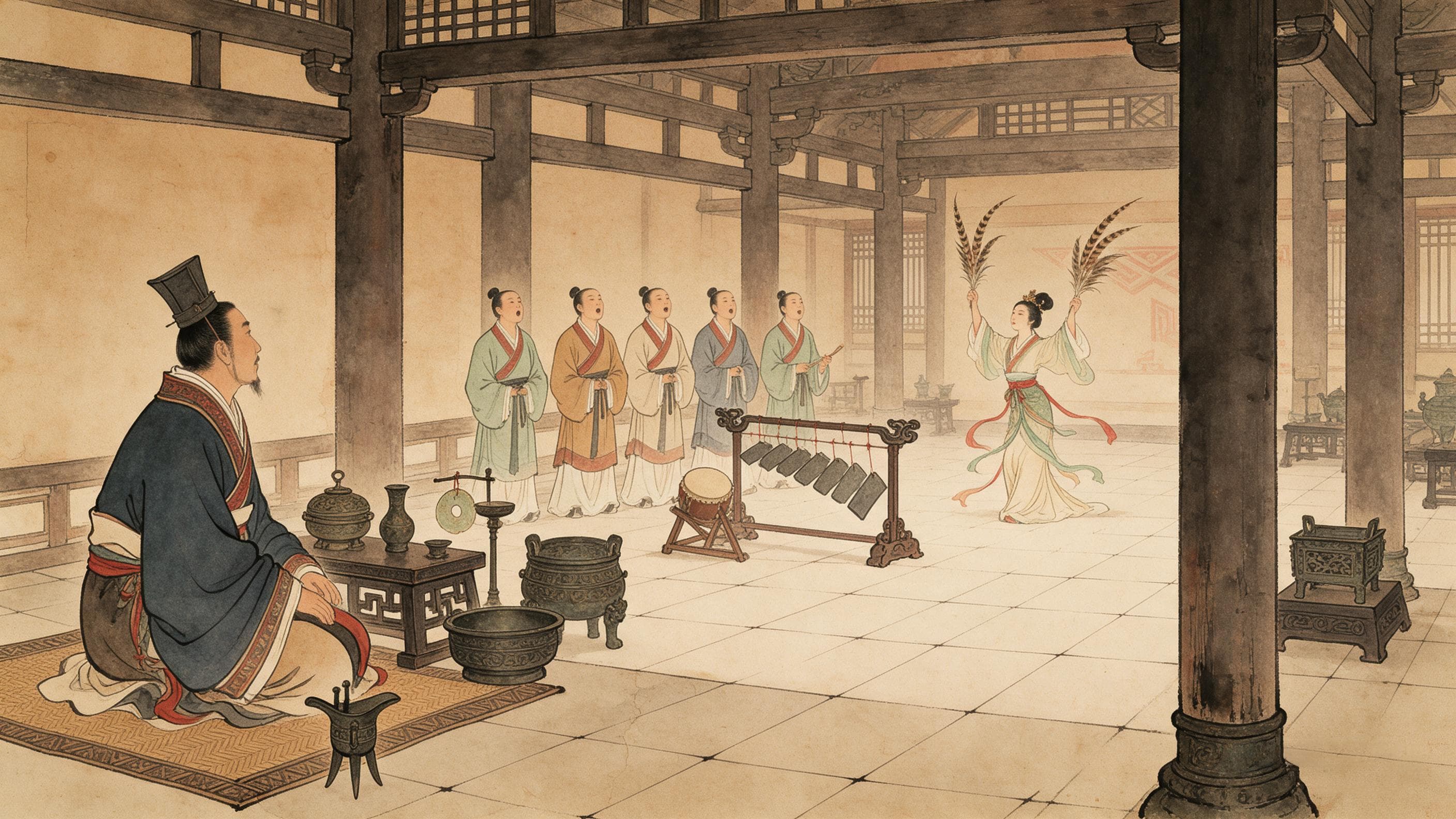
The shortest entry is six characters: 'in the third year, spring, royal second month, on the jisi day, the sun was eaten' (三年,春,王二月,己巳,日有食之). That is the Annals for the third year of Duke Yin: spring, the royal second month, the jisi day, and the sun eaten. 'The sun was eaten' (日有食之) is the formula for the event. This piece has two layers: what was done on an eclipse day (with the classic and the commentary kept apart), and how a leap month was placed (a third month intercalated in the first year, and a leap month without the announcement in the sixth).
One: the classic and the commentary
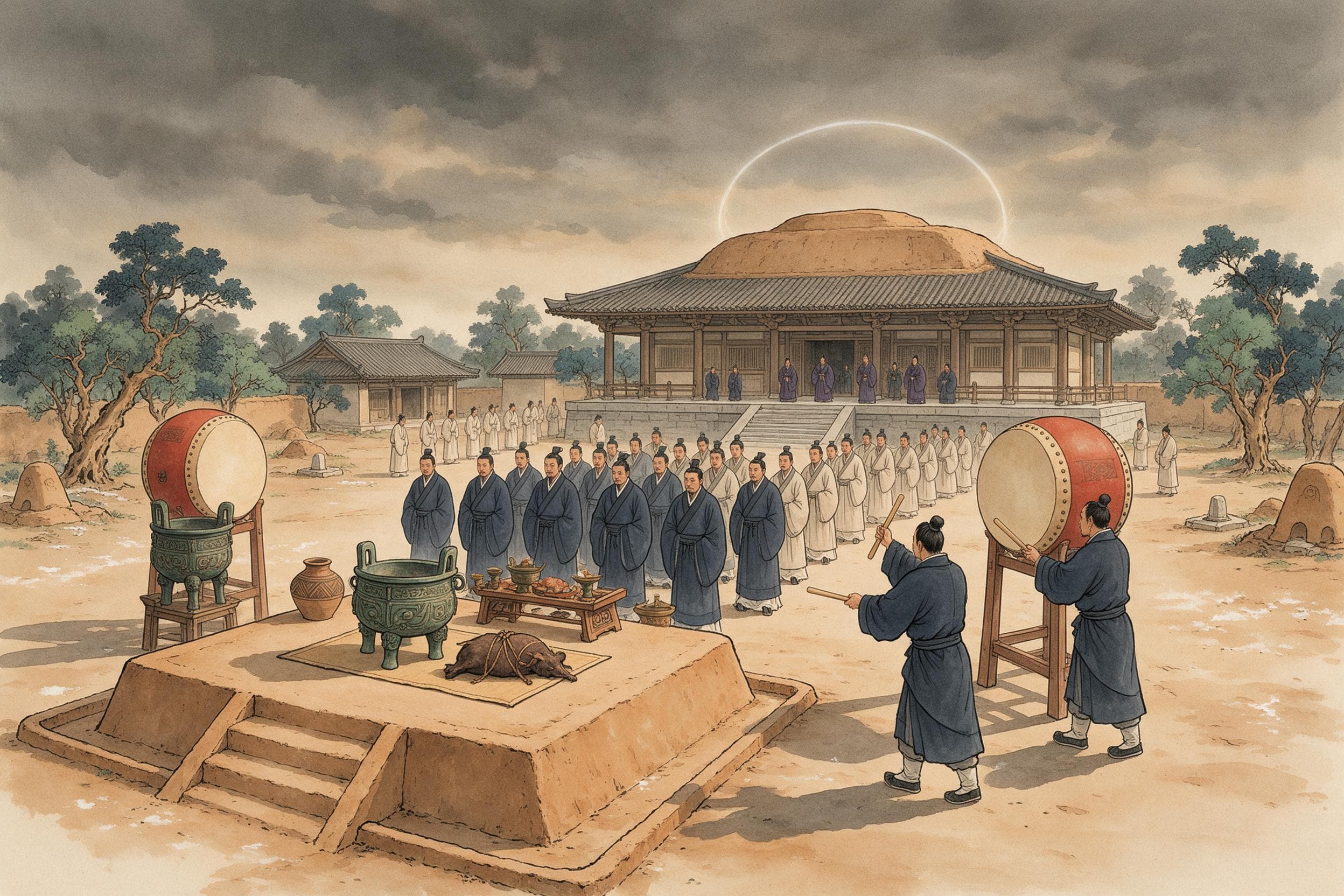
Two entries from the classic first. Duke Yin, third year: 'in the third year, spring, royal second month, on the jisi day, the sun was eaten' — only a date and a phenomenon. Duke Wen, fifteenth year: 'in the sixth month, on the xinchou day, the first of the month, the sun was eaten; drums were beaten and victims offered at the altar of soil' (六月,辛丑,朔,日有食之,鼓用牲于社) — this one adds the word 'first of the month' and an action: drumming, and a victim at the altar of soil. The classic records; it stops where it stops, and it neither explains nor judges.
The commentary judges, and gives the division of duties: 'in the sixth month, on the xinchou day, the first of the month, the sun was eaten; drums and a victim at the altar of soil — this was not according to ritual. When the sun is eaten, the Son of Heaven does not provide music; drums are beaten at the altar of soil; the feudal lords offer silks at the altar and beat drums at the court, to display service to the spirits, to instruct the people in serving their ruler, and to show the gradations of rank — this was the way of antiquity' (日有食之,天子不舉,伐鼓于社,諸侯用幣于社,伐鼓于朝……古之道也). So two things must be kept apart: what Lu actually did — drums and a victim at the altar — and what the commentary calls the ancient way, a division between the Son of Heaven and the feudal lords. Why Lu's practice was improper the commentary does not say, and neither page does.
Two: the intercalated third month
On leap months the first year of Duke Wen opens with a judgement: 'thereupon they intercalated a third month, which was not according to ritual' (於是閏三月,非禮也). Why it was improper the commentary gives as three lines: 'in the ancient kings' ordering of the seasons, the beginning was set at the start, the middle was set at the middle, and the surplus was put at the end. With the beginning at the start, the order is not erred; with the middle at the middle, the people are not confused; with the surplus at the end, affairs are not disordered' (履端於始,舉正於中,歸餘於終……). The three lines are copied; the commentary gives no calculation, and this piece does not work one out.
The sixth year has another: 'not to announce the first of the month in an intercalary month was not according to ritual. The intercalation is to correct the seasons, the seasons to make work, work to enrich life; the way of the people lies in this. Not to announce the intercalary first is to cast away the government of the seasons — how then to be the people's ruler?' (閏月不告朔,非禮也……). How the announcement was made the page does not spell out.
Three: the Han treatise's consequence
The Han treatise on pitch and calendar carries the matter one step further: 'from Duke Wen's failure to announce the first of the month in the intercalary month, down to this time more than a hundred years, no one could put the calendar right' (自文公閏月不告朔,至此百有餘年,莫能正曆數). The same page quotes a saying: 'the Son of Heaven has his day-officer, the feudal lords their day-attendants; the day-officer ranks with the ministers to settle the days — that is ritual' (天子有日官,諸侯有日御,日官居卿以厎日,禮也); and adds that when the day is not recorded, 'the officers lost it' (不書日,官失之也). These are Han statements, marked as Han statements here, not as the Spring and Autumn men's own words. The treatise even quotes a pair of entries to make the point: 'the classic says: in the tenth month, the first of the month, the sun was eaten; the commentary says: it does not record the day — the officers lost it' (經曰:冬十月朔,日有食之。傳曰:不書日,官失之也). So a missing day is itself an entry, with an explanation attached.
What the pages do not give is listed too: the hour of the eclipse, its magnitude, where it was visible — none of it; how often a leap month fell, in which month, by what calculation — the pages give only the third month and 'a leap month', no method. So this piece reconstructs no date and converts nothing into a Western calendar.
Four: the four characters
The classic says 'the sun was eaten' again and again, not 'an eclipse': the sun was eaten, something ate it. That is the page's phrase, the page does not gloss it, and this piece does not restore the event astronomically — no magnitude, no path. It copies the entries as they stand: Duke Yin's 'second month, jisi day', Duke Wen's 'sixth month, xinchou, first of the month' — the latter adds 'first of the month', which tells us what day the entry is dated to.
Five: beyond these pages
Two boundaries. The piece on the Han reform of the calendar is about who proposed, who calculated, and one sentence that settled it; this piece is about what Spring and Autumn men did on an eclipse day and how a leap month was fitted into twelve. The piece on divination is about the procedure of asking; this one is not. Nor does it argue about ancient astronomy or about cosmic correspondence: the three pages give a few entries, a few lines of commentary, and one Han consequence.
What is left is concrete: two classic entries (the sun was eaten; the sun was eaten, drums and a victim at the altar), one commentary's judgement and division of duties (the Son of Heaven without music, drums at the altar; the feudal lords with silks at the altar, drums at the court), three lines on placing a leap month (beginning at the start, middle at the middle, surplus at the end), two 'not according to ritual' (a third month intercalated, a leap month not announced), and one Han sentence on the consequence (more than a hundred years without a right calendar). Nothing is pushed further: no Western date, no leap-month method, no verdict on whether the ritual was good or bad.
Related reading:Huangchang Ticou: The Names of a Han Coffin Chamber · A Pheasant on the Cauldron: One Bird at a Shang Sacrifice · The Great Exorcism: Driving Pestilence Out of the Palace on the Year's Last Night
Sources & further reading
- 《春秋左氏传·文公》(维基文库本,未与点校本复核) — The entries used here, with the classic and the commentary distinguished. Classic, fifteenth year: 'in the sixth month, on the xinchou day, the first of the month, the sun was eaten; drums were beaten and victims offered at the altar of soil' (六月,辛丑,朔,日有食之,鼓用牲于社). Commentary on the same: 'drums and victims at the altar of soil — this was not according to ritual. When the sun is eaten, the Son of Heaven does not provide music; drums are beaten at the altar of soil; the feudal lords offer silks at the altar and beat drums at the court, to display service to the spirits and to instruct the people in serving their ruler and to show the gradations of rank — this was the way of antiquity' (日有食之,天子不舉,伐鼓于社,諸侯用幣于社,伐鼓于朝……古之道也). First year: 'thereupon they intercalated a third month, which was not according to ritual. In the ancient kings' ordering of the seasons, the beginning was set at the start, the middle was set at the middle, and the surplus was put at the end; with the beginning at the start the order is not erred; with the middle at the middle the people are not confused; with the surplus at the end affairs are not disordered' (履端於始,舉正於中,歸餘於終). Sixth year: 'not announcing the first of the month in an intercalary month was not according to ritual. The intercalation is to correct the seasons, the seasons to make work, work to enrich life; the way of the people lies in this. Not to announce the intercalary first is to cast away the government of the seasons — how then to be the people's ruler?' (閏月不告朔,非禮也……)
- 《春秋左氏传·隐公》(维基文库本,未与点校本复核) — The classic's shortest note of an eclipse, third year: 'in the third year, spring, royal second month, on the jisi day, the sun was eaten' (三年,春,王二月,己巳,日有食之). The page marks classic entries with a template; the line is quoted as the classic. No commentary is given for this entry on the page — nothing is said about what was done.
- 《汉书》卷二十一〈律历志〉(维基文库本,未与点校本复核) — Used only for the later consequence and the officers of the calendar: 'from Duke Wen's failure to announce the first of the month in the intercalary month, down to this time more than a hundred years, no one could put the calendar right' (自文公閏月不告朔,至此百有餘年,莫能正曆數); and the saying that 'the Son of Heaven has his day-officer, the feudal lords their day-attendants; the day-officer ranks with the ministers to settle the days — that is ritual' (天子有日官,諸侯有日御,日官居卿以厎日,禮也), with the note that when the day is not recorded 'the officers lost it' (不書日,官失之也). This is a Han treatise quoting the classic and commentary, and it is marked as a Han statement here.