Huangchang ticou (黃腸題湊) is the name of a Han coffin chamber, and not a phrase that explains itself. Two pages give one end each: the Book of Han's life of Huo Guang gives a burial grant, with four commentators explaining 梓宮、便房、黃膓題湊; the Discourses on Salt and Iron gives one line of complaint, 今富者繡墻題湊, the rich now use embroidered walls and ticou. This article follows the two pages: the grant, the four characters taken apart by the commentators, and what the pages do or do not say about who was allowed to use it. Two pages, one object of wood, four characters.
A Burial Grant
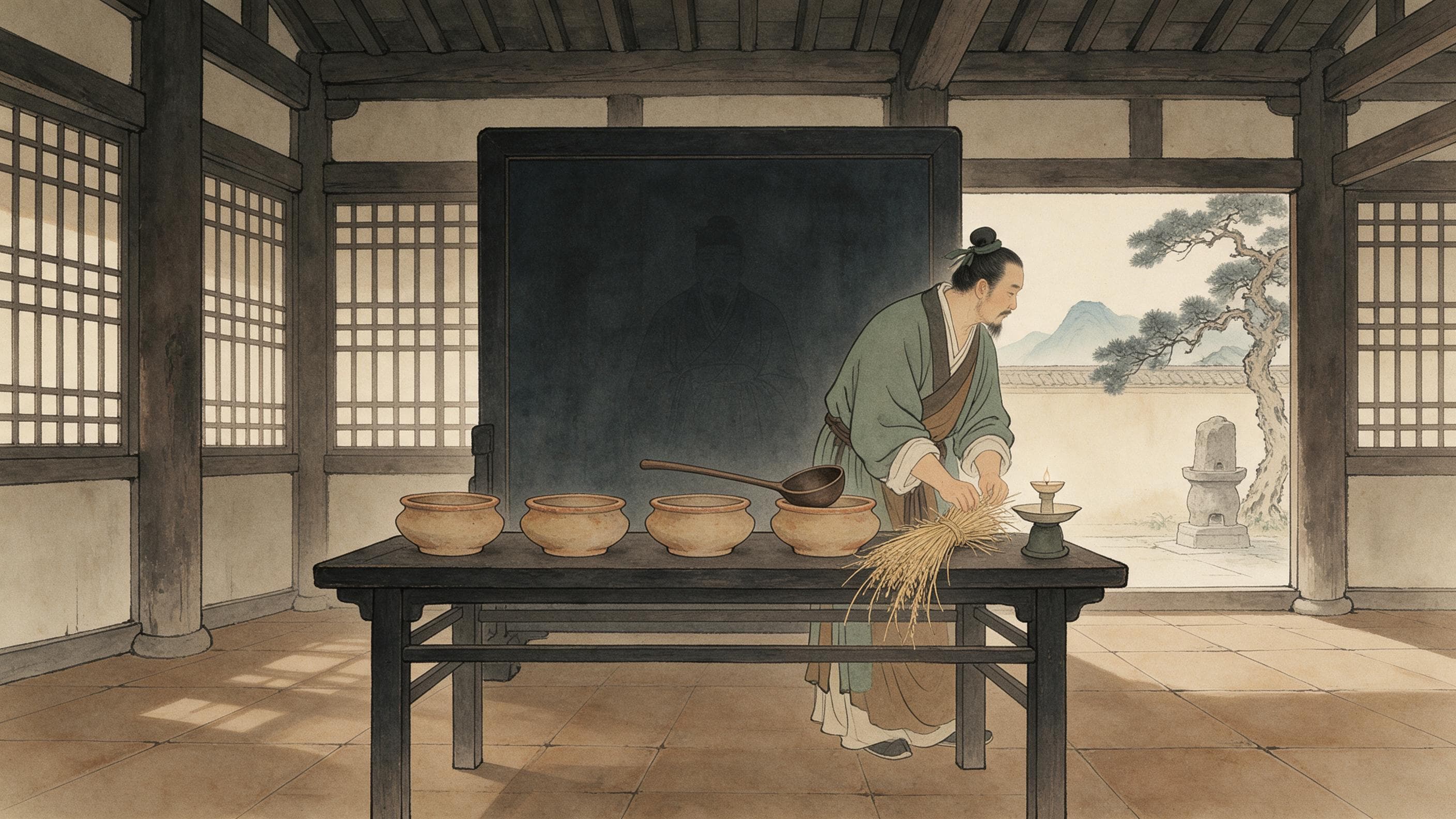
At Huo Guang's death 上及皇太后親臨光喪, the emperor and empress dowager came in person. The grant is itemised: 賜金錢、繒絮,繡被百領。衣五十篋,璧珠璣玉衣,梓宮、便房、黃膓題湊各一具,樅木外臧椁十五具。東園溫明,皆如乘輿制度 — money and silk, a hundred embroidered quilts, fifty cases of clothes, jade burial armour of discs and pearls, one each of the zi coffin, the side chamber and the huangchang ticou, fifteen outer coffins of cong wood, the Dongyuan warming mirror, 皆如乘輿制度, all by imperial precedent.
That last clause matters. Huo Guang was a subject, and what he received was the imperial standard — not something he took, but something 賜, granted. Nothing in the list says the burial was reserved to the Son of Heaven; the word 'granted' turns the question of who could use it into the question of who was granted it. No table of ranks is supplied here, because these pages have none of their own.
Four Characters, Four Commentators
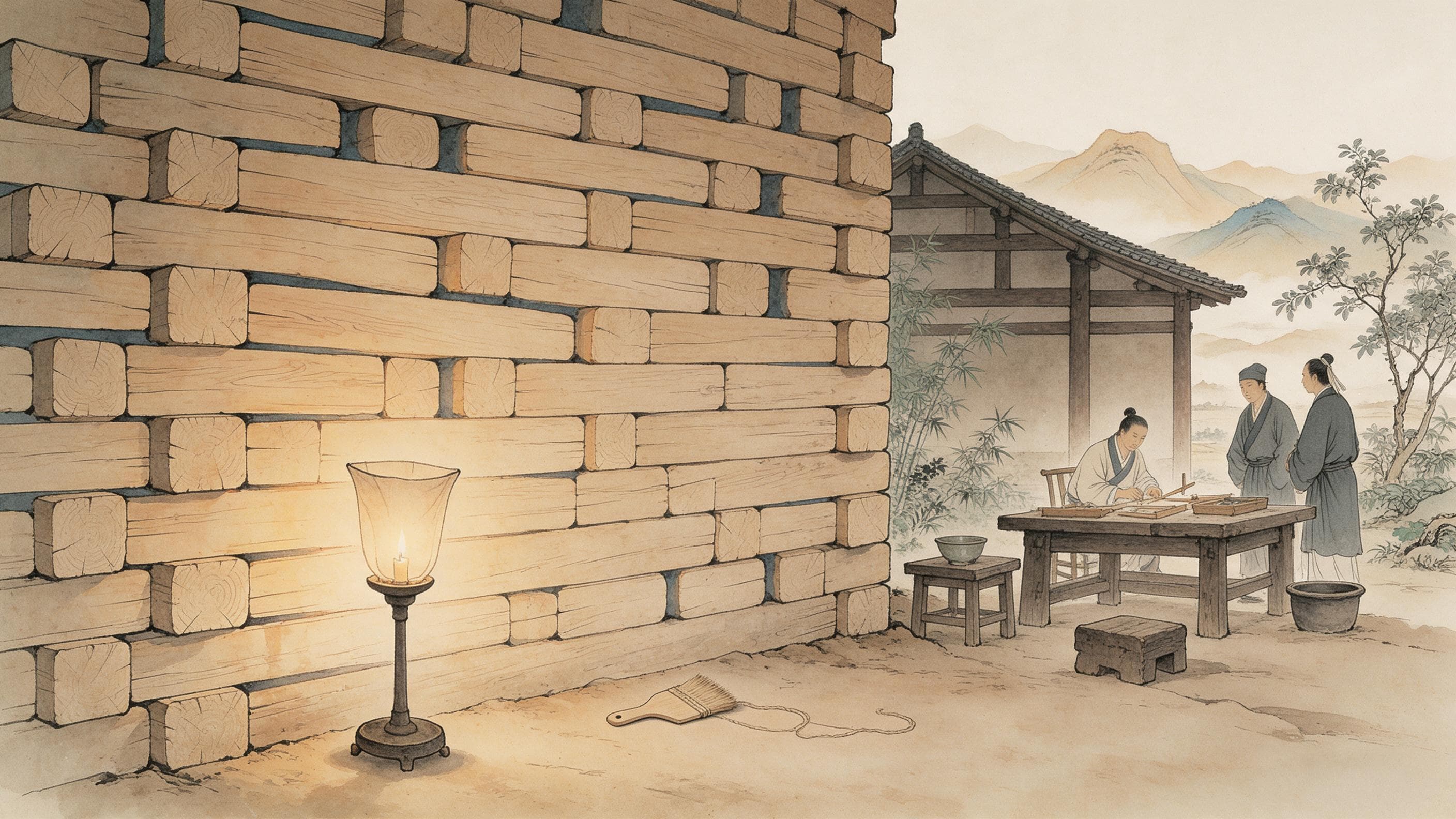
The four characters are glossed on the page. Su Lin: 以柏木黃心致累棺外,故曰黃腸。木頭皆內向,故曰題湊 — cypress with a yellow heart, piled layer on layer outside the coffin, hence 黃腸, yellow heart; the ends of the logs all turned inward, hence 題湊, the ends gathered. Yellow-hearted cypress and inward-facing ends are the frame of the phrase. This is a commentator's explanation, not the text; it is quoted as Su Lin's note.
Ru Chun quotes the Han ritual code for the measurements and the layers: 天子陵中明中高丈二尺四寸,周二丈,內梓宮,次楩槨,柏黃腸題湊 — in the imperial tomb the mingzhong chamber is one zhang two chi four cun high and two zhang around, with the zi coffin inside, then a pi coffin, then the cypress huangchang ticou. That is a code quoted by a commentator, not the text of the Book of Han; the measurements are printed as given, not converted.
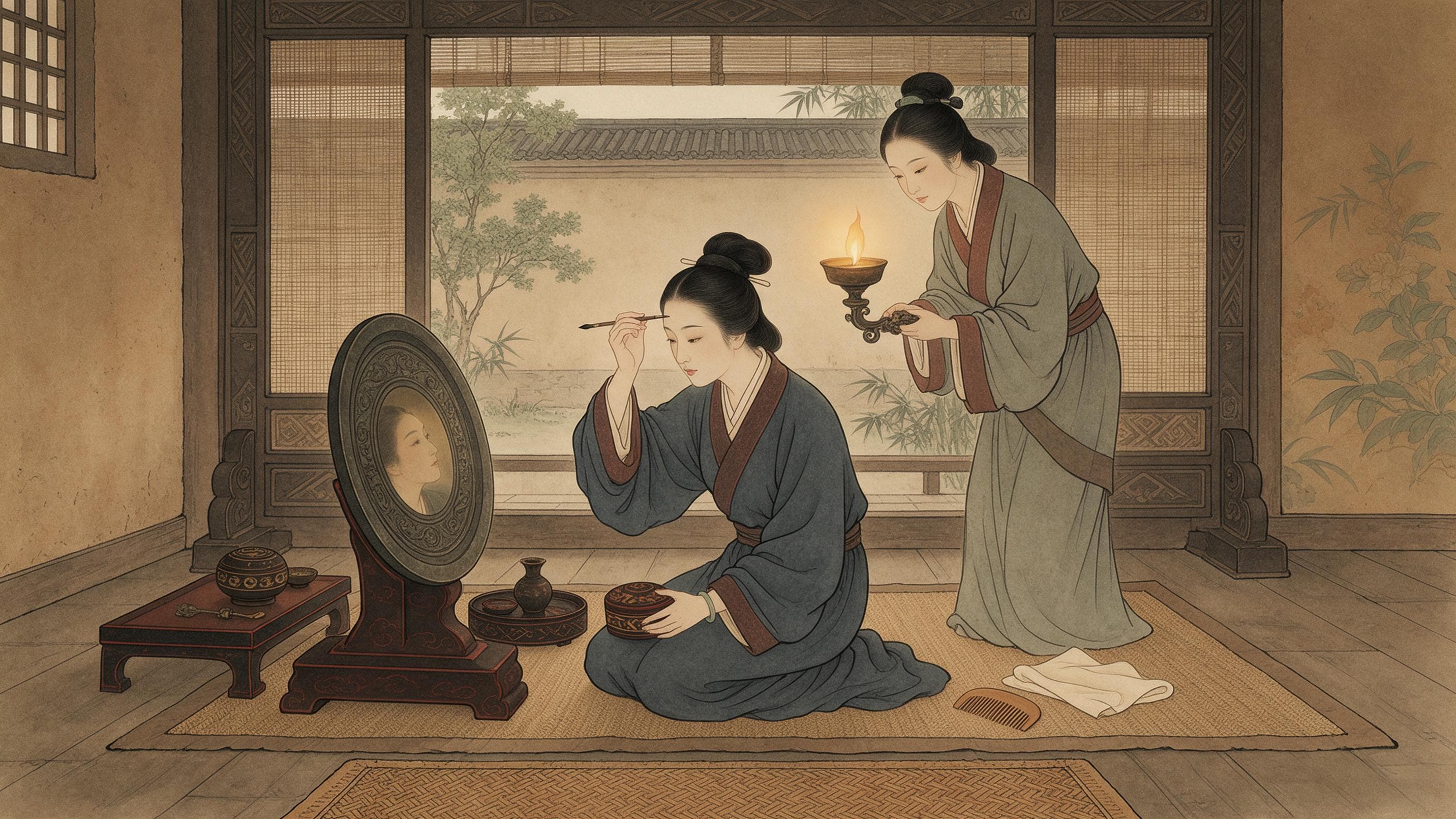
The other names are disputed, and the page records the disputes. 便房: Fu Qian calls it a seat within the deposit; Yan Shigu calls it a small inner room, and rejects Ru Chun's reading of 楩 as the name of a wood. 梓宮: Fu Qian says only 'coffin'; Yan Shigu adds that it is made of zi wood, the coffin next to the body, and is called a palace because it is the imperial standard. 樅木外臧椁: Fu Qian places it outside the main deposit, for concubines or kitchens and stables; Su Lin says cong is a tree with cypress leaves and pine trunk; Yan Shigu cites the Erya and the Mao Songs to correct him — cong has pine leaves and cypress trunk, and it is the gui that has cypress leaves. 東園溫明: Fu Qian describes it as a square lacquered bucket, open on one side, painted, with a mirror inside, hung over the corpse; Yan Shigu explains Dongyuan as the office under the privy treasury that made it. Four commentators, not one note, and they correct each other.
Who Could Use It: Two Lines
The Book of Han's line is the grant. Huo Guang, a subject, received the imperial standard; the funeral was managed by officials of the full two-thousand-shi grade (中二千石), the escort was formed of material officers, light chariots and the five corps of the northern army, drawn up in ranks to Maoling; a tomb shrine was raised and three hundred households set to guard it. The life then follows the family: after Huo Yu inherited, Huo Xian 改光時所自造塋制而侈大之, altered and enlarged the tomb works Huo Guang had built for himself, raised three mountain gates, laid a spirit road, adorned the shrine, and ran covered galleries to a long lane — the same family tomb, first granted above its station and then enlarged by the family itself. The life records it without a verdict.
The Discourses' line is wealth. 古者,瓦棺容屍,木板堲周,足以收形骸,藏發齒而已。及其後,桐棺不衣,采槨不斲。今富者繡墻題湊。中者梓棺楩槨,貧者畫荒衣袍,繒囊緹橐 — in antiquity a tile coffin held the body and a plank frame was enough; later a plain paulownia coffin and an unplaned outer coffin; now the rich use embroidered walls and ticou, the middling a zi coffin and a pi outer coffin, the poor painted shrouds and plain robes. Here ticou is the display of the rich, not an imperial institution.
The Gap Between the Pages
Put together, the two pages still do not yield 'only the Son of Heaven could use huangchang ticou'. One says a subject was granted the imperial standard; the other says the rich used embroidered walls and ticou. The first is a grant, the second an usurpation, and neither page contains a prohibition or a list of ranks. This article keeps to that: who could use it has no answer in these pages, only the word 'granted' and the words 'the rich'.
It also matters whose sentence is whose: the notes of Su Lin, Fu Qian, Ru Chun and Yan Shigu are commentators' words; the Han ritual code is a code they quote; the line about the rich is an argument. Neither page has an object in front of it, and none gives the number of logs, their measurements, the number of layers or the volume of the chamber. The excavated examples are not on these pages, and are not used here.
What the Pages Do Not Give
Neither page gives how many logs the ticou used, how long or thick each was, how they were arranged, how many layers there were, or how large the chamber was; neither gives the names of the buried or the text of any prohibition. The page's 膓 is printed as it stands, not normalised to 腸, and the commentators' measurements — one zhang two chi four cun, two zhang around, jade plates a chi long and two and a half cun wide — are printed as given, not converted.
Other subjects are kept out: the Shang tomb inventories, Cao Pi's argument for thin burial, the scale of the Qin mausoleum and the ritual books' burial rites each belong to other articles. This one is the names, the notes and the one line about the rich. No general theory of lavish Han burial is offered — the pages give a grant, four characters with four commentators, and one line of complaint from a writer who disliked the display.
Related reading:The Great Exorcism: Driving Pestilence Out of the Palace on the Year's Last Night · The Fifth-Day Bath: One Day in a Han Official's Life · Guo Pu's Divinations: A Horse, Beans, and a Donkey-Rat
Sources & further reading
- 《汉书》卷六十八·霍光传(东汉班固撰,附服虔、苏林、如淳、颜师古等注;维基文库本,页面正文与注混排,未与中华书局点校本复核) — The grant at Huo Guang's death: 赐金钱、缯絮,绣被百领。衣五十箧,璧珠玑玉衣,梓宫、便房、黄膓题凑各一具,枞木外臧椁十五具。东园温明,皆如乘舆制度. The page carries the commentaries separately: Fu Qian on 便房 as a seat within the deposit; Su Lin on 黄肠 (cypress with yellow heart, piled outside the coffin) and 题凑 (the log ends turned inward); Ru Chun quoting the Han仪注 on the imperial chamber, 'a height of one zhang two chi four cun and a circumference of two zhang', with the zi coffin inside, then a pi coffin, then the cypress huangchang ticou; Yan Shigu correcting 便房 as a small inner room and rejecting Ru's reading of 楩 as a wood name, and elsewhere correcting Su Lin's description of the cong tree. The life also says the family later enlarged the tomb works Huo Guang had built for himself.
- 《盐铁论》卷六·散不足第二十九(西汉桓宽撰;维基文库本,页面白文无注,未与中华书局点校本复核) — The passage on burials: in antiquity a tile coffin held the body and a plank frame was enough to gather the bones; later a plain paulownia coffin and an unplaned outer coffin; 今富者繡墻題湊。中者梓棺楩槨,貧者畫荒衣袍,繒囊緹橐 — today the rich use embroidered walls and 题凑, the middling a zi coffin and a pi outer coffin, the poor painted shrouds and plain robes. The chapter's argument is that the living are loved less and the dead honoured more expensively, and that lavish burial is praised as filial.