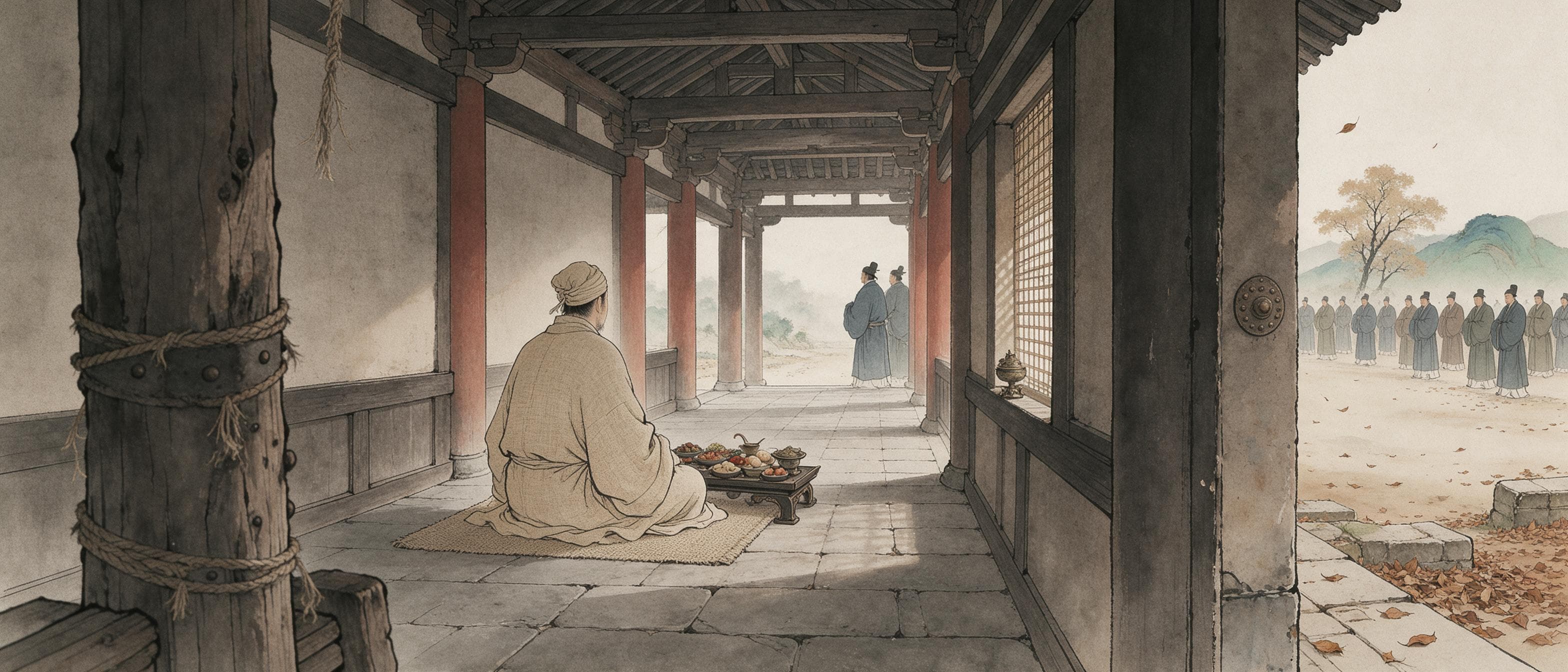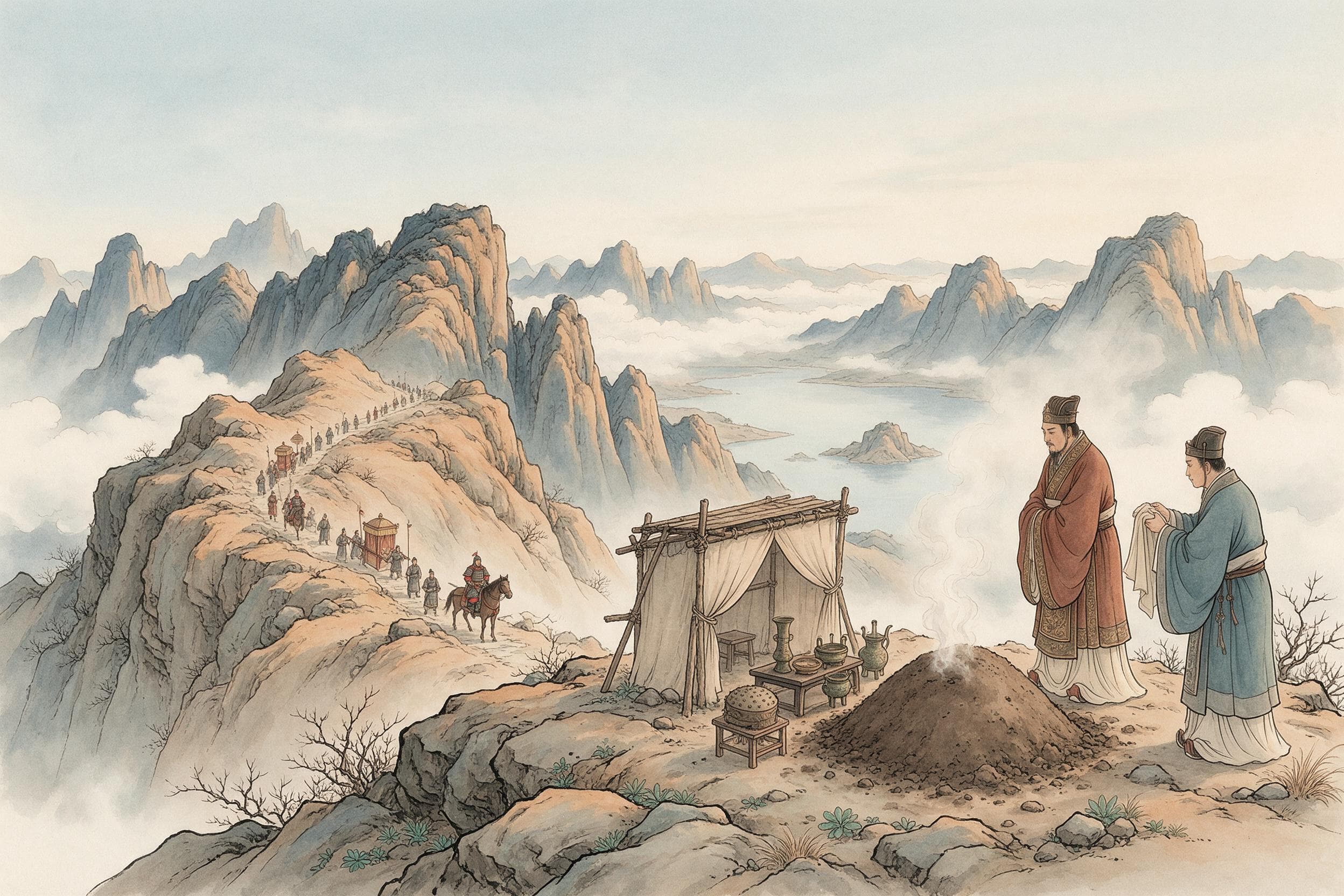
On the day ji-si in the fourth month, at Chengpu. With the lords of Song and the generals of Qi and Qin, the Chu army camped with its back to the heights of Xi. Before the fighting the Jin lord climbed the ruins of Youshen, looked at his troops and said: 'young and old keep their order; they can be used' (少长有礼,其可用也). The Zuo Zhuan has already given the figure: seven hundred chariots of Jin, with their straps and harness (晋车七百乘,韅、靷、鞅、靽). A few days earlier this army had fallen back ninety li.
Three She of Retreat
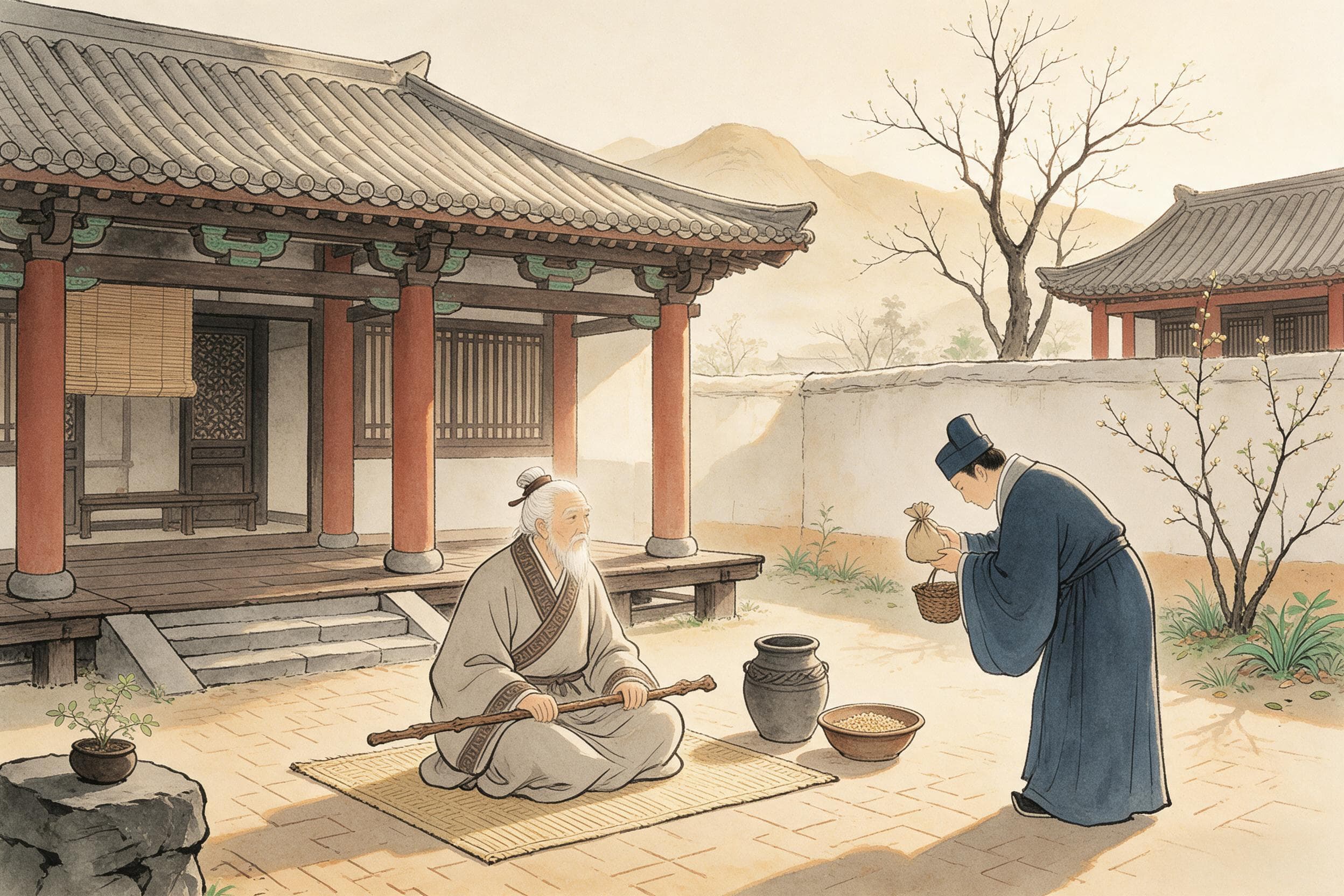
The promise of three she was made years before, in Chu. Asked how he would repay the lord of Chu, the exiled Chong Er listed what Chu already had, then said: 'if by your spirit I return to Jin, and Jin and Chu marshal their armies and meet on the central plain, I will retire three she before you' (其辟君三舍); and if that still did not satisfy him, with whip and bow in his left hand and quiver at his right he would 'have a turn' with him. Zi Yu wanted him killed; the lord of Chu refused.
In the twenty-eighth year the words came due. The king of Chu did not want the battle: he ordered Zi Yu away from Song and 'not to follow the Jin army', quoting the Military Records three times — turn back when fitting, withdraw when it is hard, the virtuous cannot be opposed — and said all three described Jin. Zi Yu asked for battle; the angry king 'gave him few troops: only the Western Broad, the Eastern Palace and the six companies of Ruo Ao' (唯西广、东宫与若敖之六卒). Zi Yu sent Wan Chun to demand Wei's restoration and Cao's enfeoffment for lifting the siege of Song. Xian Zhen proposed the counter: promise Cao and Wei secretly to split them, arrest Wan Chun to anger Chu, 'and settle it after the battle'. Cao and Wei broke with Chu; Zi Yu followed the Jin army; the Jin army withdrew. The officers objected that retreating before a subject was a disgrace; Zi Fan answered that 'an army is strong when it is straight and old when it is crooked', that the retreat repaid Chu's kindness, and that 'if they press on, then a lord has retired and a subject has pressed, and the crookedness is theirs' (君退臣犯,曲在彼矣). They retired three she; the Chu ranks wanted to stop; Zi Yu would not. Thirty li make one she, so ninety li in all — the usual gloss, and neither page notes it.
The Lines at Chengpu
At Chengpu the Jin lord was troubled by the Chu camp at Xi; his men sang 'the fields are thick with grass; let go the old and plan the new'. Zi Fan said 'fight'; Luan Zhenzi said that Chu had destroyed the Ji clans north of the Han, and that a small kindness was not worth a great shame. The Jin lord dreamed he wrestled with the lord of Chu, who lay on him and gnawed his brains; Zi Fan read the dream as auspicious. Then the speeches: Zi Yu's envoy asked to 'sport with your lord's soldiers' while the two lords watched (请与君之士戏); Luan Zhi answered that Jin had retired for Chu's sake, and closed 'prepare your chariots, respect your lord's business; we shall meet in the morning' (诘朝将见).
The lines were clear. Jin's centre under Xian Zhen with Xi Zhen, upper army under Hu Mao and Hu Yan, lower under Luan Zhi and Xu Chen; Chu's centre under Zi Yu with the six companies of Ruo Ao, saying 'today there will be no Jin', Zi Xi on the left, Zi Shang on the right. Seven hundred Jin chariots; for Chu the Zuo Zhuan gives only the troops the king had grudgingly supplied, and no total.
The Day Itself
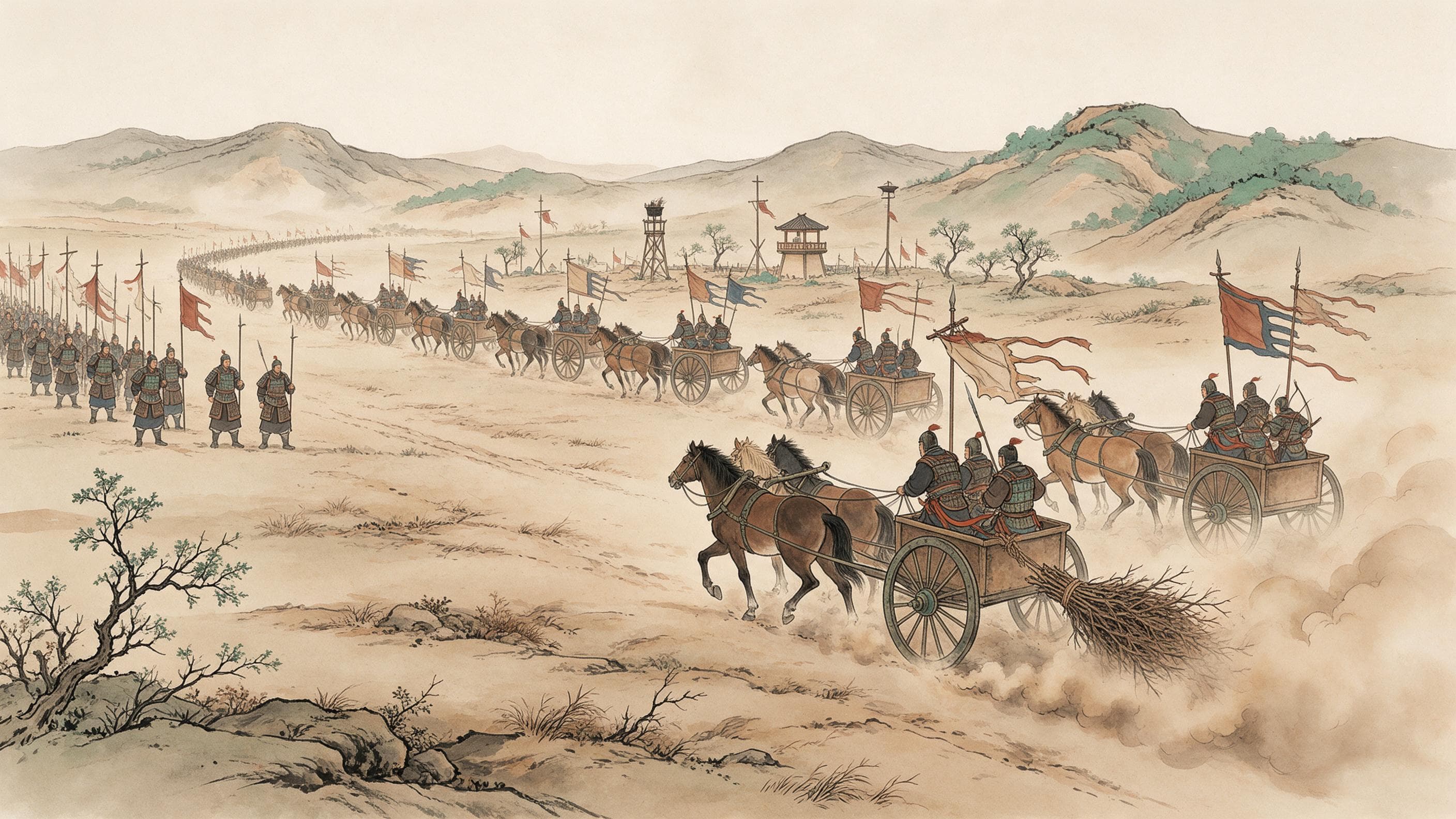
The fighting took four moves. Xu Chen, second of the lower army, faced Chen and Cai, covered his horses with tiger skins and struck; they fled and the Chu right broke. Hu Mao set up two pennants and retired; Luan Zhi made his chariots drag brushwood so that the dust looked like flight; the Chu army galloped after them. Then Yuan Zhen and Xi Zhen with the ducal clan of the central army struck across, and Hu Mao and Hu Yan took Zi Xi from both sides; the Chu left broke. The Chu army was defeated; only Zi Yu gathered his men and halted, and so was not broken.
Afterwards the Jin army ate from Chu's fields three days before withdrawing; at Hengyong it built the royal palace at Jiantu; in the fifth month it presented a hundred four-horse chariots and a thousand foot soldiers; the king made the Jin lord leader of the lords and gave him the great and war carriages with their robes, one red bow and a hundred red arrows, a thousand black bows and arrows, a jar of black-millet wine, three hundred tiger guards, with the charge to 'revere the king's command and bring peace to the four quarters' (敬服王命,以绥四国). Zi Yu's end has two versions: the Chun Qiu text says only 'Chu killed its grand officer Dechen'; the Shiji says the king reproached him and 'Zi Yu killed himself' (子玉自杀).
Between the Two Pages
Figures and accounts stay apart. The Zuo Zhuan gives Jin seven hundred chariots and Chu only the Western Broad, the Eastern Palace and the six companies; the Shiji's Jin house gives no chariot count and says only that 'on ji-si he joined battle with the Chu army, and the Chu army was defeated' (己巳,与楚兵合战,楚兵败). The pages do not agree, and no verdict is given here — nor is any chariot count turned into men. Other variants run the same way: the Zuo Zhuan has the lord of Cao 'not employing Xi Fu Ji while three hundred men rode in carriages'; the Shiji has 'three hundred beauties riding in carriages' (用美女乘轩者三百人也). The Shiji alone adds 'Jin burned the Chu army, and the fire did not go out for several days', and a scene after the battle where the Jin lord ranks Hu Yan's 'he told me not to break faith' above Xian Zhen's 'in war victory is the rule'.
The retreat can be read on two levels. In the Zuo Zhuan it is first Zi Fan's calculation of straightness and crookedness; in the Shiji it becomes the Jin lord's own words — 'in Chu I promised to retire three she; can I double it?' (昔在楚,约退三舍,可倍乎) — and then a reason in the rewards. The pages give a layer each; this article sets them side by side without deciding the motive, and without a lesson on good faith. Thirty li to the she, ninety li, is quoted from the usual gloss.
One Day of Fighting
This article covers one day: Chengpu, the day ji-si in the fourth month, seven hundred Jin chariots, the Chu centre, left and right, the reasons for the three-she retreat, the four moves of the fighting and the result. Neither page gives a map, battlefield area or total strengths; none is supplied, and no archaeology is added. The Zuo Zhuan itself has a verdict at the end of the previous year — 'one battle and he became leader of the lords; this was the teaching of Wen' (一战而霸,文之教也) — quoted as its own line, not developed into a thesis about a turning point in Jin-Chu rivalry.
Related reading:Jade, Silk and Horses: What an Envoy Carried · Lowering the Coffin: The Day of the Burial · The Dark Bird and the Birth of Shang: Two Lines of Verse and a Story
Sources & further reading
- 《春秋左氏传》僖公(维基文库本,未与点校本复核) — The full account. The promise in the twenty-third year: 'if by your spirit I return to Jin, and Jin and Chu marshal their armies and meet on the central plain, I will retire three she before you; if I still do not receive your command, then with whip and bow in my left hand and quiver at my right I will have a turn with you' (其辟君三舍……以与君周旋). In the twenty-eighth year: the king of Chu orders Zi Yu not to follow the Jin army and quotes the Military Records; 'he gave him few troops: only the Western Broad, the Eastern Palace and the six companies of Ruo Ao went with him' (唯西广、东宫与若敖之六卒实从之); Wan Chun's proposal and Xian Zhen's counter; the retreat, the officers' objection, and Zi Fan's 'an army is strong when it is straight and old when it is crooked … a lord has retired and a subject has pressed on him, and the crookedness is theirs' (师直为壮,曲为老……君退臣犯,曲在彼矣). At Chengpu: the divination songs, the dream, the two speeches (请与君之士戏……诘朝将见), 'seven hundred chariots of Jin' (晋车七百乘), the lines under Xian Zhen, Hu Mao and Hu Yan, Luan Zhi and Xu Chen, and Zi Yu's centre with Zi Xi left and Zi Shang right; the fighting — tiger skins, two pennants, brushwood dust, 'Yuan Zhen and Xi Zhen with the ducal clan struck across' (原轸、郤溱以中军公族横击之), both Chu wings broken, Zi Yu gathering his men; then three days of Chu's grain, the presentation of prisoners, and the king's charge and gifts. The Chun Qiu text in the same page has 'Chu killed its grand officer Dechen'.
- 《史记》卷三十九·晋世家(西汉司马迁;维基文库本,未与点校本复核) — The parallel account with the differences that matter. The same campaign, with 'three hundred beauties riding in carriages' (用美女乘轩者三百人也) where the Zuo Zhuan has only the three hundred riders; the king of Chu's refusal to fight and his 'few troops'; Wan Chun's mission and Xian Zhen's counter; the retreat justified in the lord of Jin's own words, 'in Chu I promised to retire three she; can I double it?' (昔在楚,约退三舍,可倍乎). The battle is given in one line, with no chariot count: 'on ji-si he joined battle with the Chu army, and the Chu army was defeated' (己巳,与楚兵合战,楚兵败). Then the presentation of prisoners, the king's appointment of the lord of Jin as leader of the lords with the gifts, and the line 'Jin burned the Chu army, and the fire did not go out for several days' (晋焚楚军,火数日不息). Zi Yu's end: the king 'reproached Zi Yu, and Zi Yu killed himself' (让责子玉,子玉自杀). After the battle the lord of Jin ranks the rewards, putting Hu Yan first because 'he told me not to break faith', over Xian Zhen's 'in war victory is the rule' — a judgement the Zuo Zhuan passage does not contain.