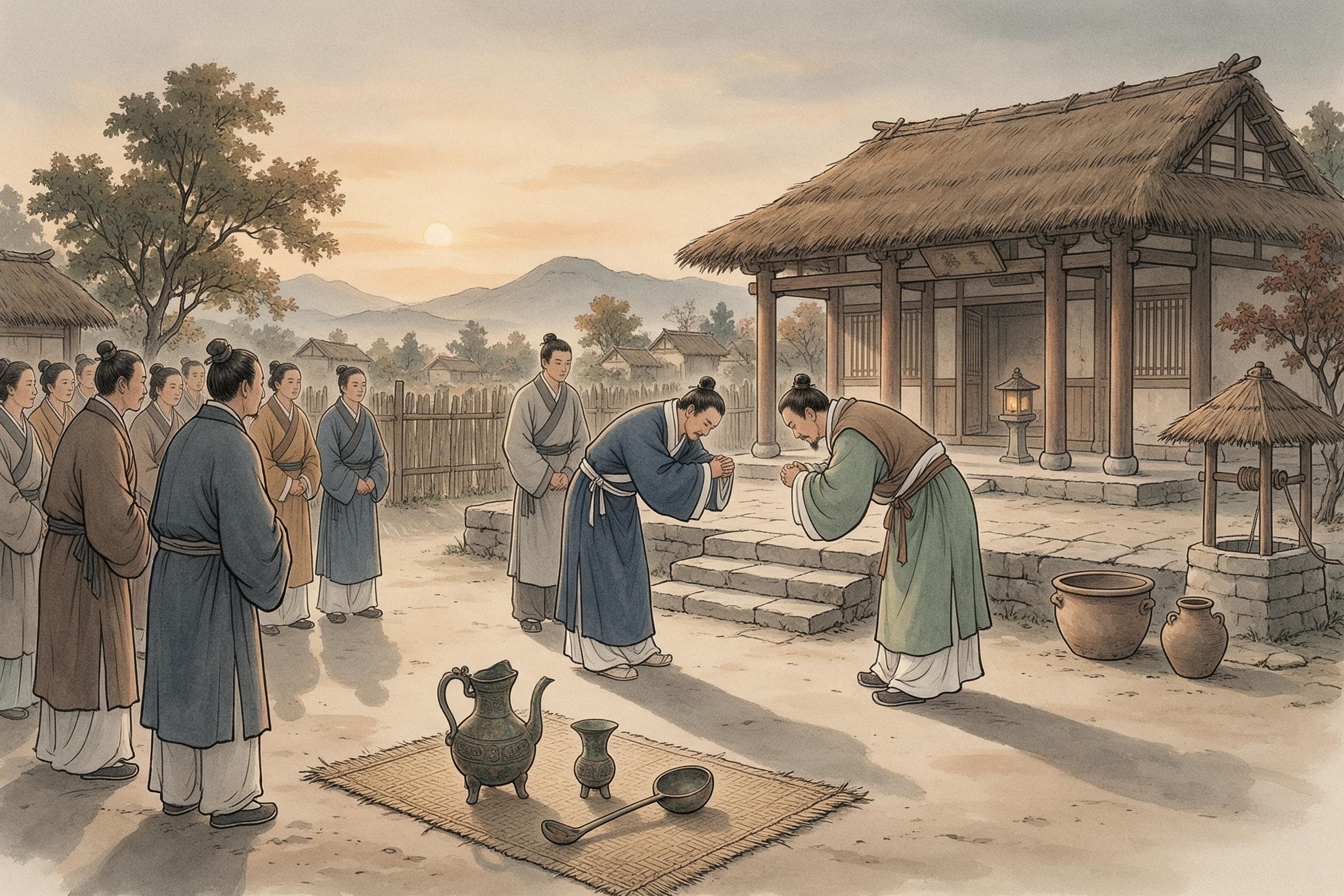
There is a scene in the ritual manual that still makes a modern reader stop. The capping is over; the young man takes up the dried meat, comes down from the western steps, crosses to the eastern wall and faces north to see his mother — and 'the mother bows and receives it, the son bows and sends it off, and the mother bows again' (母拜受,子拜送,母又拜). Before that day the gesture does not happen. After it, it is ordinary.
First the Day, Then the Guest
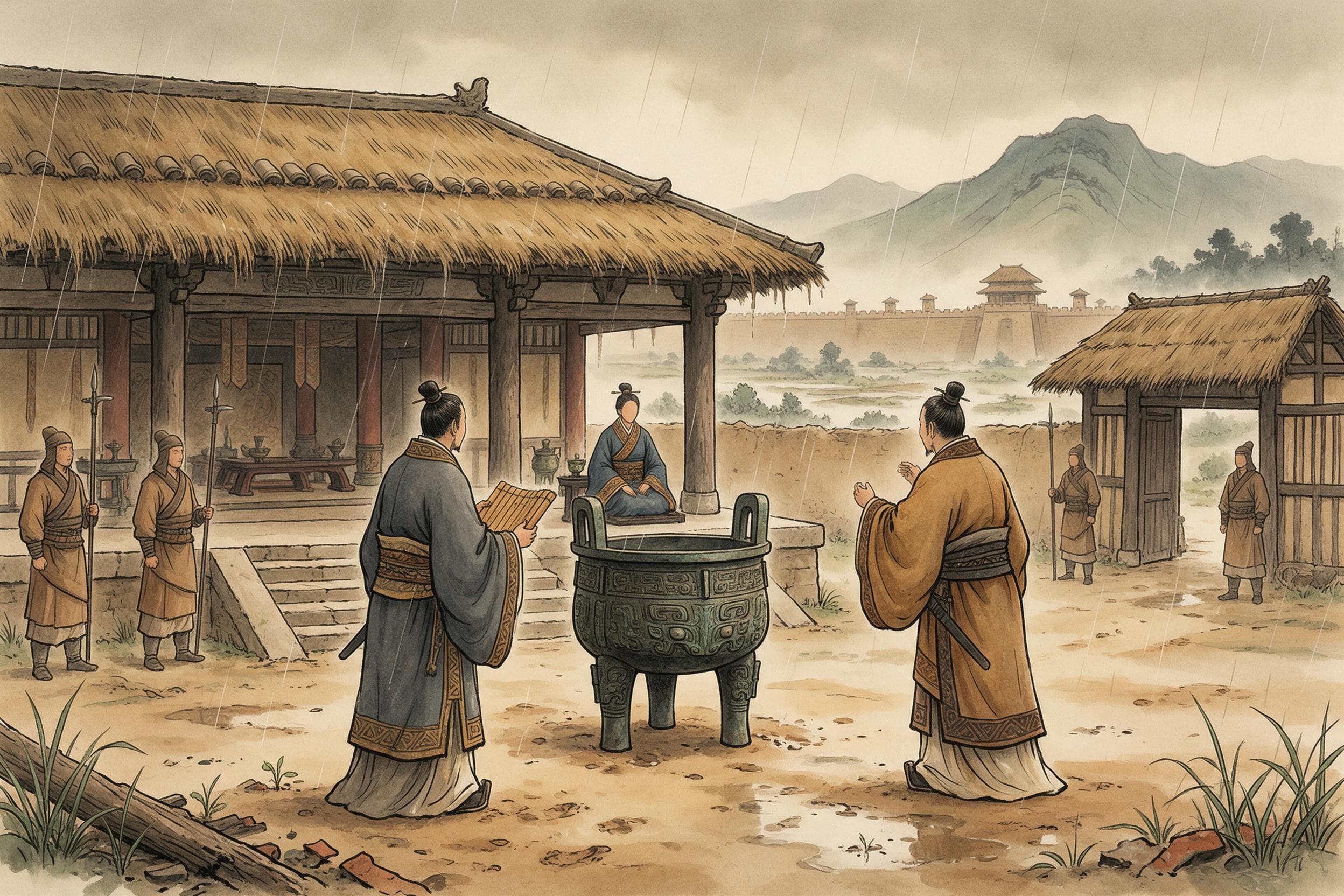
The preparation is longer than the ceremony. First the day is chosen by divination (筮日). Three days before, the guest who will perform the capping is chosen the same way (筮賓,如求日之儀). The guest is then formally invited and lodged, and on the evening before, outside the temple gate, the hour is set: the steward announces 'act at full daylight' (質明行事). The invitation is plain: 'I have a son, so-and-so; I am about to add cloth to his head; I wish you, sir, to instruct him' (某有子某,將加布於其首,願吾子之教之也). The manual names the great occasion by its simplest physical act: adding cloth to a head.
The essay on the rite explains why so much care goes into the choosing: 'the ancients divined the day and divined the guest, and by this respected the capping; respecting the capping, they honoured ritual; honouring ritual, they made it the root of the state' (筮日、筮賓,所以敬冠事。敬冠事所以重禮,重禮所以爲國本也). And why it happens in the ancestral temple: 'because they honoured the capping they performed it in the temple; performing it there was to humble oneself and honour the ancestors' (所以自卑而尊先祖也). A family matter is put inside the ancestral hall to say that it is not the family's own affair.
Three Caps
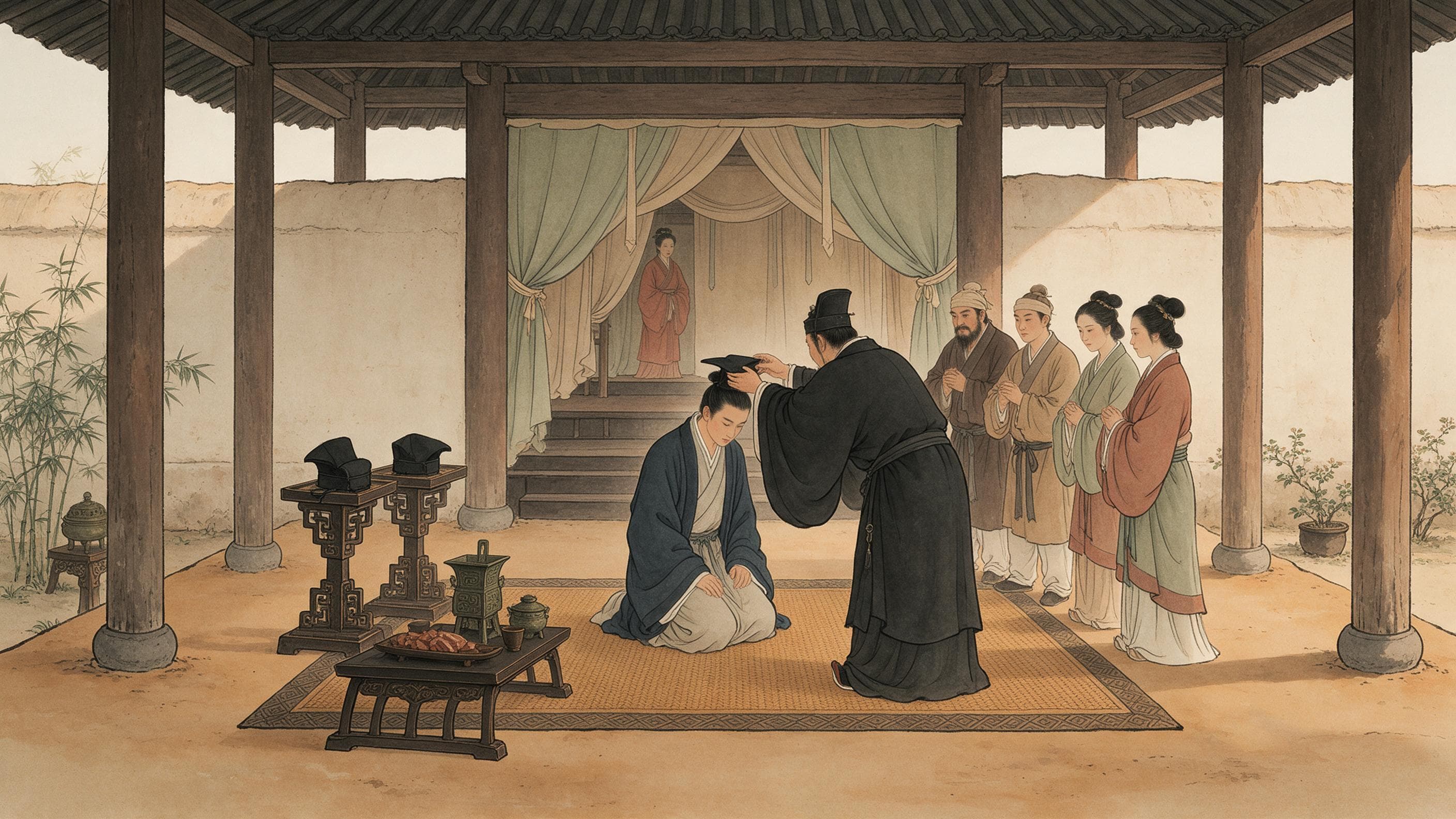
On the day the clothes are laid out first, along the western wall of the room: the jue-cap robes (a crimson lower garment, plain upper robe, black sash, red knee-covers), the leather-cap robes (white pleated skirt, black sash, white knee-covers), the dark xuan-duan (black, yellow or mixed lower garment, all permitted), the black cloth cap with its blue silk band; then the black silk head-cloth, the hairpins for the leather and jue caps, a comb, two rush mats, a jar of sweet wine, ladle, cup, horn spoon, and strips of dried meat. The three caps each sit in a bamboo box, held ready at the foot of the steps.
The capping happens three times, each with a cap, a set of clothes and a blessing. The first, with the black cloth cap: 'A lucky month and a lucky day: first we add the primary garment. Cast off your childish will, follow your accomplished virtue. Long life and good fortune; great blessing be added to you' (令月吉日,始加元服。棄爾幼志,順爾成德). The second, with the leather cap: 'A lucky month and hour: again we renew your dress. Respect your bearing, carefully guard your virtue; ten thousand years of long life, forever receiving great blessing.' The third, with the jue cap: 'By the correctness of the year, by the goodness of the month, all your garments are added. Your brothers are all here, to complete your virtue; grey-haired longevity without bound, receiving heaven's blessing.' Each cap is more honoured than the last — the manual's closing notes call it 'the three caps growing more honoured' (三加彌尊).
Then a cup of sweet wine, with its own words: 'Sweet wine, how thick; the fine offerings, how fragrant. Bow, receive, sacrifice — so fix your blessing; receive heaven's favour, and long life unforgotten.' If the family does not use the sweet wine, the rite is done with liquor instead (醮), with a different set of blessings — two procedures stand side by side in the same manual. Then the guest gives the young man his courtesy name (字): 'The rites are complete; on a lucky month and lucky day I declare your name. A name greatly good, fit for a fine man… you shall be called Bo-such-and-such (伯某甫)', with Zhong, Shu or Ji according to his birth order. Then the round of visits: mother, brothers, the assistants, aunts and elder sisters; a change into dark cap and dark robe; and presentation with gifts to his lord, then to the great officers of the district and the village elders.
The Way of the Adult
The essay compresses the whole sequence into one phrase: 'to be capped and then given a courtesy name is the way of the adult' (已冠而字之,成人之道也). Why does the mother bow? 'Because he is an adult and is treated with ritual' (成人而與爲禮也). From that day the relation between mother and son is conducted by adult ceremony. Then the essay takes the step that matters most: 'to make him an adult is to hold him to adult ritual; to hold him to adult ritual is to hold him to the ritual conduct of a son, a younger brother, a subject and a junior' (成人之者,將責成人禮焉也…). And the conclusion: 'only when the conduct of filial piety, fraternal duty, loyalty and compliance is established can a man be a man' (孝弟忠順之行立,而後可以爲人).
So the rite is not a celebration of growing up; it is a way of laying obligations on a person, and the caps are only the signs. The difference between the two books makes this clearest. The same phrase, 'the three caps grow more honoured', is explained twice: the manual's closing notes say it is 'to discuss his intentions' (論其志也), while the essay says it is 'to add to what he has accomplished' (加有成也). One sentence of procedure, two explanations — the manual and the essay cannot be read as one text.
For Whom the Rite Was Written
The manual is a shi's rite. Its closing notes are explicit: 'there is no capping rite for great officers; they have their wedding rite. In antiquity rank came only after fifty — what capping rite would a great officer have?' (無大夫冠禮…古者五十而後爵). Lords and marquises acquired a capping rite only late, in the last age of the Xia. And: 'the eldest son of the Son of Heaven is still a shi; under heaven no one is noble at birth' (天子之元子,猶士也,天下無生而貴者也). That is the book's standpoint in a sentence: a ritual text for the shi order, not a description of everyone's custom.
Age is worth a word: neither page states a year. 'Capped at twenty' is a rule from other chapters of the ritual books, not from the two pages used here, and this article does not supply it; the age at which capping was actually done was not uniform across periods, and these pages do not fix it. These pages call capping 'the beginning of ritual' and what follows it 'the way of the adult'; what concerns them is not the number of years but the position the rite occupies in a life.
What Is Not Here
No record of any actual performance; no year, place or name; no indication of how many families did it. The cap names and robes also disagree within the manual itself: the notes give 'weimao, the way of Zhou; zhangfu, the way of Yin; wuzhui, the way of the Xia', then 'Zhou's bian, Yin's xu, Xia's shou', and 'the three kings shared the leather cap and white skirt'; and the sweet wine and the liquor are two procedures. These variants are recorded here side by side, not merged. What this article describes, then, is the capping rite as the ritual books set it out — a ceremony written down step by step, not proof that everyone in Zhou China came of age this way.
Related reading:Fifty Disciples: The Han Academy That Was an Appointment Pipeline · One Crossbow, Fifty Paces of Wall: The Working Life of a Warring States Siege · Mallows, Beans and a Lamb: What People Ate in the Spring and Autumn
Sources & further reading
- 《仪礼·士冠礼》(战国至汉初成书;维基文库本,未与点校本复核) — The ritual manual itself, step by step. The day and the guest are chosen by divination (筮日;前期三日,筮賓,如求日之儀), the guest is invited and lodged, and the hour is set by the steward: 'act at full daylight' (質明行事). The invitation says 'I have a son, so-and-so; I am about to add cloth to his head; I wish you, sir, to instruct him' (某有子某,將加布於其首,願吾子之教之也). The clothes to be worn are laid out in the room: the jue-bian robes, the pi-bian robes, the dark xuan-duan, and the black cloth cap with its black silk band. The candidate is capped three times — black cloth cap, then leather cap (皮弁), then the jue cap (爵弁) — each with a blessing, of which the first begins 'A lucky month and a lucky day: first we add the primary garment; cast off your childish will, follow your accomplished virtue.' A cup of sweet wine (or, if not wine, the jiao variant) follows, then the guest gives him his courtesy name (字), then he is presented to his mother, brothers, the assistants, his aunts and elder sisters, changes into dark cap and dark robe, and is presented to his lord, the great officers of the district and the village elders. The closing 'notes' (記) add: 'the three caps grow more honoured each time — this is to discuss his intentions'; 'there is no capping rite for great officers'; 'the eldest son of the Son of Heaven is still a shi — under heaven no one is noble at birth'.
- 《礼记·冠义》(战国至汉初成书;维基文库本,未与点校本复核) — A short essay on the meaning of the rite, with no procedure of its own. It argues that 'the capping is the beginning of ritual' (冠者,禮之始也) because only after capping is dress complete, and only then are bearing, expression and speech correct; that the ancients divined the day and the guest 'to respect the capping, and respecting it to honour ritual, and honouring ritual as the root of the state'; that capping on the eastern steps marks succession, the cup at the guest's place and the three caps mark accomplishment, and the giving of the courtesy name is 'the way of the adult'; that when he is presented to his mother she bows to him, 'for he is an adult and is treated with ritual'. Then the essay's key move: 'to make him an adult is to hold him to adult ritual' — the duties of son, younger brother, subject and junior — and 'only when the conduct of filial piety, fraternal duty, loyalty and compliance is established can a man be a man'.