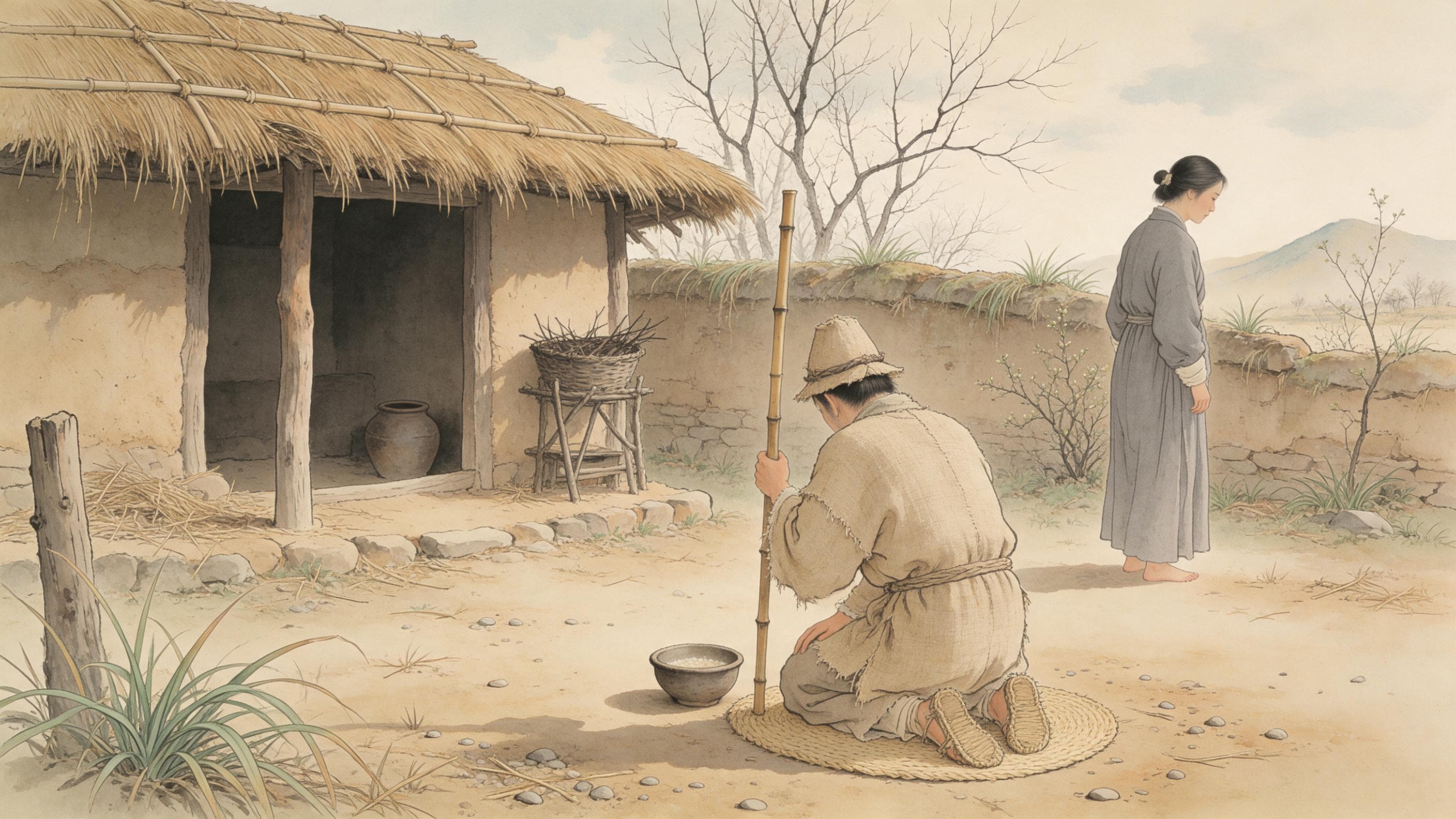
The heaviest mourning dress is described in detail: 'sackcloth upper and lower garments with unhemmed edges, a coarse hemp belt and staff, a twisted band, a cap with rope strings, straw sandals' (喪服,斬衰裳,苴絰杖,絞帶,冠繩纓,菅屨者). Then comes the list of who wears it: the feudal lords for the Son of Heaven, a subject for his lord, a father for his eldest son, one who has become another's heir; a wife for her husband, a concubine for her lord, an unmarried daughter for her father. For three years.
Five Names, More Than Five Grades
The 'five grades' are five names: zhan-cui, qi-cui, da-gong, xiao-gong, si-ma. The Yili's mourning chapter works down in exactly that order — the untrimmed grade, the trimmed grade, the nine-month grade, an extra grade of fine hemp, the five-month and the three-month. Five names, but more than five steps: the trimmed grade alone runs to three years, one year, one year without a staff, and three months, and the nine-month grade splits into mourning for the young who died and for adults. There is even a sixth name, xui-cui, worn by a feudal lord's minister for the Son of Heaven and 'removed after the burial'.
Take only the trimmed grade: for three years, 'when the father has died, for the mother; a stepmother as a mother; a foster mother as a mother; a mother for her eldest son'. For one year: 'for the mother while the father lives; for a wife; a divorced wife's son for his mother.' For one year without a staff: 'grandparents, uncles and aunts, elder and younger brothers, brothers' sons'. For three months: 'an exiled lord for the house that shelters him', 'a commoner for his ruler', 'great-grandparents'. The same trimmed grade, laid on different relations, lasts different lengths.
How the Table Is Built
Each grade has a string of persons hung beneath it. The order is not by feeling but by kinship and status: father, mother, husband, lord, eldest son, grandparents, uncles and aunts, sisters, cousins. The same grade contains both 'for a father' and 'for a lord'. Why? The Liji's chapter on the four principles of mourning says the heavy cloth is worn for a father 'by grace' and for a lord 'by right' (以恩制者也…以義制者也) — two lines, one of affection and one of duty, running together.
The coordinates of the table are distance of kin. The Liji's 'small record of mourning' gives the frame: 'kin by three, extending to five, extending to nine; cut above, cut below, cut to the side, and kinship is exhausted' (親親以三爲五,以五爲九,上殺、下殺、旁殺,而親畢矣). Count up, count down, count sideways from oneself, and the mourning decreases until there is none. The five grades are not five ranks of status but concentric circles drawn out from one person.
Cloth, Wailing, Fasting, Dwelling
The Liji's 'intervening traditions' turns the grades into things one can touch. First cloth, reckoned in sheng: 'three for the untrimmed grade; four, five or six for the trimmed; seven, eight or nine for the nine-month; ten, eleven or twelve for the five-month; fifteen, halved, for the three-month' — the lower the number, the coarser the cloth, and the heaviest mourning is the coarsest. The Yili's own closing notes give a slightly different set for the same grades — three or three and a half for the untrimmed grade, four for the trimmed with a six-sheng cap, four and a half for the fine hemp, eight or nine for the nine-month, ten or eleven for the five-month. Both sets are recorded here, not reconciled. Then the wailing: the heaviest 'goes out and does not return'; the trimmed 'goes out and returns'; the nine-month wails 'in three turns and fades'; for the lightest, a grieving face is enough. Then the fasts: three days without food for the heaviest, two for the next, three skipped meals for the nine-month, two for the lightest. Then the dwelling: for parents, a thatched hut with a straw mat and a clod for a pillow; a mud-plastered room for the trimmed grade; a mat for the nine-month; a bed is permitted for the lightest.
Why three years? The 'three years' chapter answers: 'the three years' mourning — what is it for? It is to match feeling with form… the three years match feeling with form, and are the utmost expression of grief' (稱情而立文…所以爲至痛極也). It also says the three years are 'finished in twenty-five months' (二十五月而畢), and that the term is doubled because the mourning is made heavier; it closes with Confucius: 'a child is carried three years before it leaves its parents' arms; the three years' mourning is the mourning shared by all under heaven' (天下之達喪也). The chapter on questions of dress gives the summary: 'crimes are many but punishments five; mourning is many but its grades five' (罪多而刑五,喪多而服五).
A Prescription, Not a Record
This has to be said plainly: the Yili is a ritual book, and its mourning chapter is a schedule. It lays down what sort of person wears what for whom and for how long; it does not record who actually wore it or for how long. How far it was followed, how it varied by region or period, these two pages do not say. So one cannot write that 'the people of Zhou mourned three years'; only that the ritual books prescribe it.
Nor does the schedule cover everyone. It is built mainly out of the kin relations of nobles and officers of the shi rank. Commoners appear only in isolated clauses — 'a commoner for his ruler' is one, 'the retainers of a noble or officer for their lord' is another — and beyond those, the ritual books have almost no material on how ordinary people mourned. The people a ritual book prescribes for are not the whole population of the time.
What Is Not Here
No record of an actual mourning; no evidence that the twenty-five months were ever counted out in practice; no complete table for commoners or the enslaved; no regional variation. The page that carries the Yili's chapter has the schedule and the closing notes but not the tradition (傳) that explains individual clauses, so this article uses only the schedule and the notes. That chapter is itself hard to read in places, with variants: mourning for the young who died is divided into three ages with different terms (within the nine-month grade, 'the eldest and middle young die at nine months with cap strings; the middle at seven months without'), and the fine-hemp grade hangs on a single clause about a lord's minister and the Son of Heaven.
The five grades, then, are a table with kinship on one axis and status on the other. Their force came later — law and custom both used them to fix who was close and who was not — but the table itself is ritual prescription. What is worth remembering is not five feelings but five kinds of cloth, five kinds of staff, five dwellings and five numbers of days without food: ritual took grief and broke it into actions that could be regulated.
Related reading:Nine Generations of Disorder: Succession as the Shiji Tells It · Fifty Disciples: The Han Academy That Was an Appointment Pipeline · The Day Was Divined, the Night Was Not: Two Ways of Asking in Spring and Autumn China
Sources & further reading
- 《仪礼·丧服》(战国至汉初成书;维基文库本,未与点校本复核) — The table itself. It opens with the heaviest grade: 'Mourning dress: sackcloth upper and lower garments with unhemmed edges, a coarse hemp belt and staff, a twisted band, a cap with rope strings, straw sandals' (喪服,斬衰裳,苴絰杖,絞帶,冠繩纓,菅屨者) — and under it a list of persons: the feudal lords for the Son of Heaven, a subject for his lord, a father for his eldest son, one who has become another's heir; a wife for her husband, a concubine for her lord, an unmarried daughter for her father: for three years. The chapter then works down by grade: a trimmed-hemp version for three years (father deceased, then for mother; stepmother and foster mother as mother; mother for eldest son), a one-year version (father alive, for mother; for wife; a divorced wife's son for his mother), an unstaffed one-year version (grandparents, uncles and aunts, elder and younger brothers, brothers' sons…), three months (the exiled lord for his host, a commoner for his ruler, great-grandparents…), then the nine-month, five-month and three-month grades, and an extra grade of fine hemp, worn by a feudal lord's minister for the Son of Heaven 'and removed after the burial'. It is a schedule of who wears what for whom: it gives no record of anyone actually wearing it. The page used here carries the chapter's schedule and its closing notes (記) with cloth measurements, but not the tradition (傳) that explains individual clauses in question-and-answer form; this article cites only the schedule and the notes.
- 《礼记》间传、三年问、服问、丧服小记、丧服四制(战国至汉初成书;维基文库本,未与点校本复核) — The commentary and rationale, in several chapters. 間傳 turns the five grades into cloth and behaviour: the cloth is reckoned in sheng — three for the heaviest, four to six for the trimmed grade, seven to nine for the nine-month, ten to twelve for the five-month, fifteen halved for the three-month; the wailing differs by grade (the heaviest 'goes and does not return'); the fasts differ (three days without food for the heaviest, two for the next, three skipped meals for the nine-month, two for the lightest); and the dwelling differs (a thatched hut with a straw mat and a clod for a pillow for parents, a mud-plastered room for the trimmed grade, a mat for the nine-month, a bed for the lightest). 三年問 explains the three years: 'the three years' mourning is finished in twenty-five months' (三年之喪,二十五月而畢), 'it is doubled because it is made heavier' (加隆焉爾也,焉使倍之,故再期也), and quotes Confucius on the three years a child is carried. 服問 gives the summary sentence: 'crimes are many but punishments five; mourning is many but its grades five' (罪多而刑五,喪多而服五). 喪服小記 gives the kinship frame: 'kin by three, extending to five, extending to nine; cut above, cut below, cut to the side, and kinship is exhausted' (親親以三爲五,以五爲九,上殺、下殺、旁殺,而親畢矣). 喪服四制 explains that the heaviest grade is worn for a father 'by grace' and for a lord 'by right' (以恩制者也…以義制者也), and that a father alive means a one-year grade for the mother, 'for there are not two honoured ones' (見無二尊也). The other chapter pages are https://zh.wikisource.org/wiki/禮記/三年問, /禮記/服問, /禮記/喪服小記 and /禮記/喪服四制. All are prescriptions; none records an actual funeral. Note that the Yili's closing notes and the Liji's 間傳 give slightly different sheng counts for the same grades; this article records both rather than merging them.