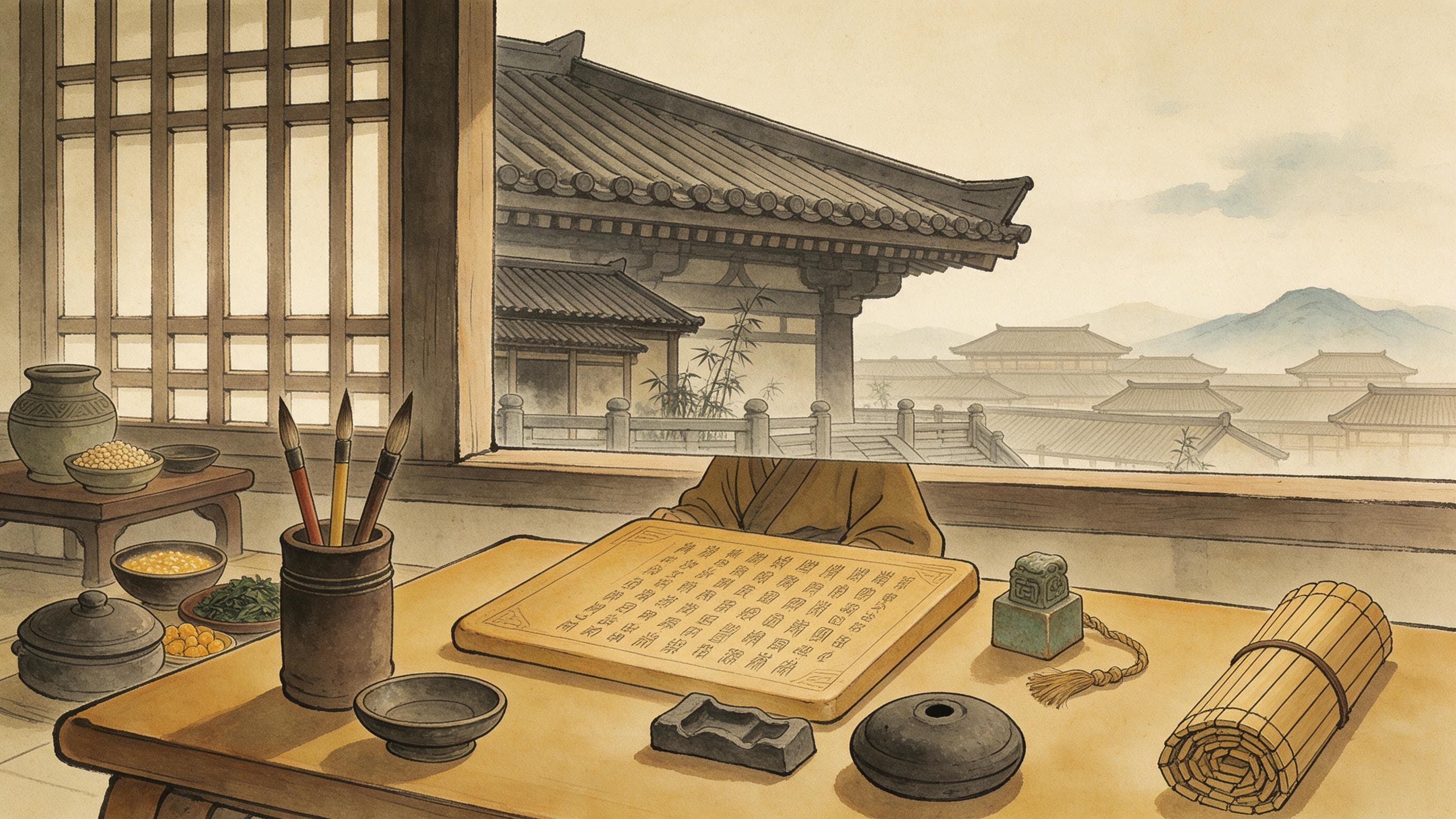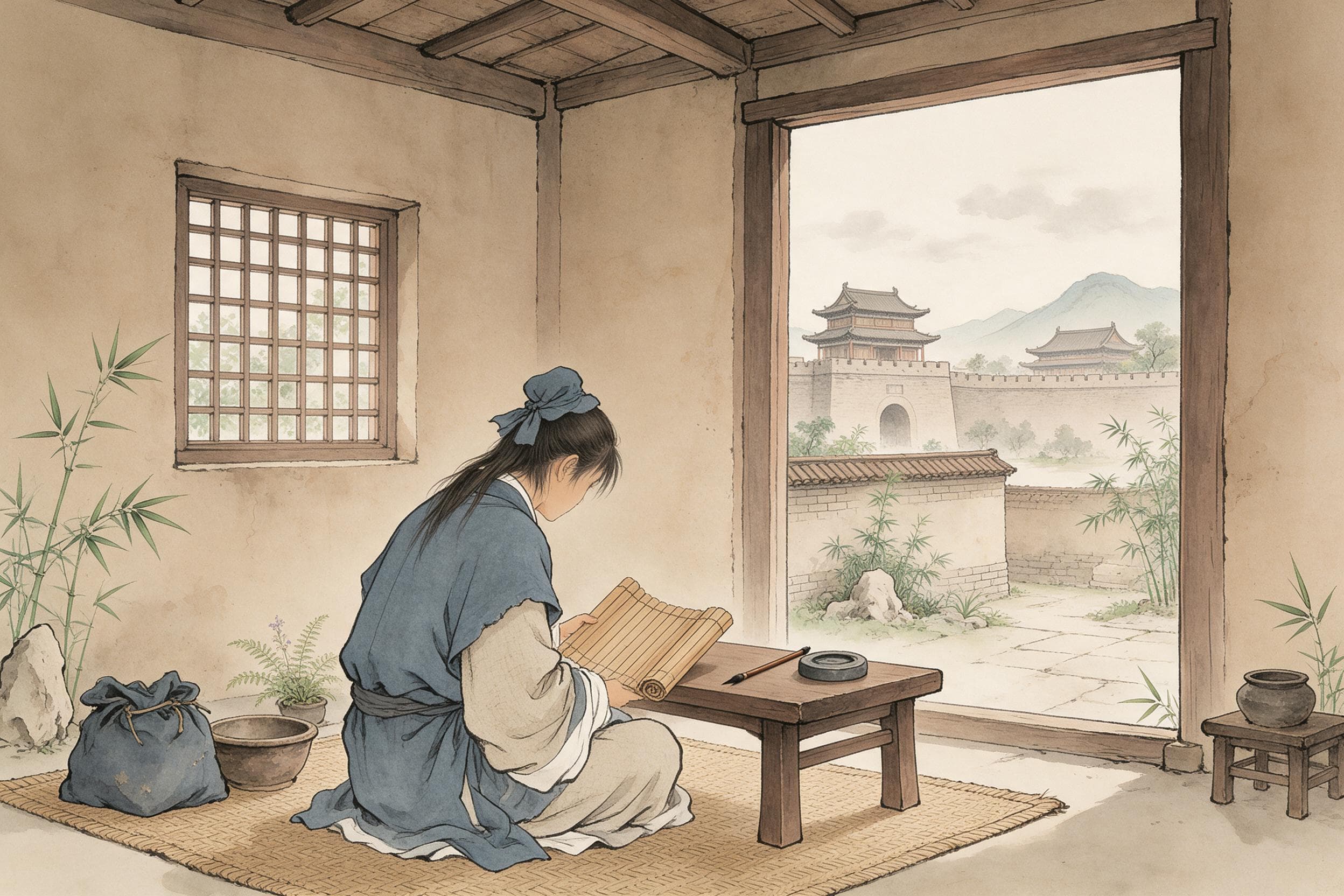
In the Shiji's chapter on the scholars there is a poor student named Ni Kuan. Recommended by his commandery for his letters, he went to study under the Erudite Kong Anguo. He was 'so poor he had nothing to use, and often cooked for his fellow disciples, and from time to time hired himself out for wages to pay for food and clothes'; he 'always carried the classic with him, and when he stopped to rest he recited it'. In the end he 'passed the examination in the ranking and was appointed to the post of tribunal scribe'. That account is more concrete than any definition of the Grand Academy: a student's day was a book, a meal and an examination.
Fifty
The Han shu's annals of Emperor Wu fix the dates. In the spring of the fifth year of Jianyuan (136 BCE) 'the Erudites of the Five Classics were established' — the chairs came first. In the sixth month of the fifth year of Yuanshuo (124 BCE) an edict lamented that 'the rites are ruined and music is broken', ordered the officers of rites to encourage learning and the Grand Master of Ceremonies to confer on disciples for the Erudites; then, in six words, 'the chancellor Hong asked to establish a fixed number of disciples for the Erudites, and learners grew more numerous.' Chairs first, students more than a decade later.
The number and the terms come from the memorial of Gongsun Hong, copied into the Shiji: 'Attach fifty disciples to the offices of the Erudites, and exempt them from labour service.' Fifty is the figure of the first establishment in 124 BCE, not a standing total; neither book gives later enrolments. There were two ways in. The Grand Master of Ceremonies chose men 'of eighteen and over, of upright appearance' in the capital; or a commandery, county or district recommended 'those who love letters, respect elders, honour the teaching, are obedient in their neighbourhood and whose conduct does not contradict what they have heard', sending them up through the two-thousand-bushel officials and on to the capital with the annual accounts, 'to receive teaching as disciples'.
One year, one examination
Then came a term and a test: 'After one year they are all examined; those who can master one classic or more fill gaps among the literary clerks; those of the highest rank who can be palace gentlemen are listed by the Grand Master of Ceremonies and reported; those of outstanding talent are named separately. Those who do not study, or are of poor ability, or cannot master a single classic, are dismissed, and those who recommended them are punished.' A year, one classic, one examination; the exit is an office or a dismissal, not a degree. There are no year groups.
The memorial even lists the posts: those of rank comparable to two hundred bushels and above, and clerks of a hundred bushels who master one classic, to be assistants to the inner secretaries and the grand herald; those below a hundred bushels, to be assistants to commandery governors, two each, one in frontier commanderies, 'taking first those who can recite the most'. The last request is that this be entered in the statute of merit (功令) — the same statute the Grand Historian says he was reading when he sighed over 'the widening of the path to the offices of learning'.
Where it was
Neither book describes a Grand Academy compound: no school buildings, no lecture hall, no dormitory. The disciples hang from the Erudite offices — 'attach disciples to the offices of the Erudites' — and teaching happens where the Erudite is. Ni Kuan 'went to the Erudite to receive teaching, studying under Kong Anguo'; Shen Gong, in old age, 'retired to teach at home, and disciples came from far away, more than a hundred of them'. Where the teacher was, there the school was. The word 太學 appears only in the Han shu's appraisal of Emperor Wu — 'he raised the Grand Academy' — a retrospective summary written in the Eastern Han, not the language of the edict of 124 BCE.
Nor was there a faculty of departments. The Shiji lists the lines of transmission: for the Odes, Shen Pei Gong in Lu, Yuan Gu in Qi, Master Han in Yan; for the Documents, Fu Sheng in Jinan; for the Rites, Gao Tang Sheng in Lu; for the Changes, Tian He in Zichuan; for the Spring and Autumn, Huwu Sheng in Qi and Lu and Dong Zhongshu in Zhao. The five chairs were those five lines. A disciple who could 'master one classic' passed; there were no year groups and no timetable in the modern sense.
What it produced
The Shiji states the result plainly: 'From this time on, among the ministers, grandees, officers and clerks there were many men of letters.' Shen Gong's disciples included more than ten who became Erudites, and officials up to governors and commandery officers; 'of the disciples of the offices of learning, down to grandees, palace gentlemen and literary clerks, there were a hundred and more'. Ni Kuan rose from poor disciple to imperial censor. The school's output was office, and its function was to supply the bureaucracy.
The figures need care. Fifty is the initial establishment; neither book gives later totals. 'Three thousand students' is an Eastern Han figure and is not in these two sources, so it is not imported here. Nor is there tuition, an entrance examination in the modern sense (selection was by the Grand Master of Ceremonies and by commandery recommendation), a campus, or classes. To call this a Han 'university' is to erase exactly those differences.
What the sources cannot show
Much is out of sight: where the students lived, who paid, how many came after the first fifty, how teaching was conducted day to day, what the examination actually asked beyond 'one classic'. The Han shu's phrase 'raised the Grand Academy' is a summary written in the Eastern Han, more than two centuries after 124 BCE; the Shiji copies an approved memorial, which sets out a design, not its working. The design can be described; the working cannot be invented.
So what was established in 124 BCE, as far as these two books show, was not a campus but a small attachment: fifty men hung on the existing chairs of the Erudites, exempted from labour service, examined after a year, and sorted either into clerkships across the offices or out of the door, with their sponsors answering for them. The name 'Grand Academy' comes later. What these pages describe is an appointment pipeline — and its most concrete scene is still Ni Kuan, carrying his classic to a day of hired work: a book, a meal, and an examination.
Sources & further reading
- 司马迁《史记》卷一百二十一·儒林列传(西汉;维基文库本,未与中华书局点校本复核) — Western Han history. Its opening says the Grand Historian read the 'statute of merit' (功令) and sighed over 'the widening of the path to the offices of learning'. The chapter records the full memorial of Gongsun Hong as officer of learning: attach fifty disciples to the offices of the Erudites (为博士官置弟子五十人), exempt them from labour service, have the Grand Master of Ceremonies choose men of eighteen and over of upright appearance, let commanderies recommend promising students who come to the capital with the annual accounts, test them all after one year, appoint those who master one classic to fill gaps among the literary clerks, report the best for the post of palace gentleman, dismiss the rest and punish those who recommended them; it also lists the posts to be filled and asks that the rule be entered in the statute of merit; the answer is 'approved'. The same chapter tells of the poor disciple Ni Kuan, who hired himself out for food while carrying his classic, and of Shen Gong's hundred-odd students and the officials they became. It records an approved proposal and its stated aims, not a day-to-day account.
- 班固《汉书》卷六·武帝纪(东汉;维基文库本,未与点校本复核) — Eastern Han history. Under the fifth year of Jianyuan (136 BCE) it notes 'the Five Classics Erudites were established' (置五经博士). Under the sixth month of the fifth year of Yuanshuo (124 BCE) it gives the edict on ritual and music decay and orders the Grand Master of Ceremonies to confer on disciples for the Erudites, followed by 'the chancellor Hong asked to establish a fixed number of disciples for the Erudites, and learners grew more numerous'. The chapter's appraisal (贊) says of Emperor Wu that he 'raised the Grand Academy' (兴太学) among his works. The appraisal is a retrospective summary written in the Eastern Han; the chapter gives no buildings, no campus, no later totals.