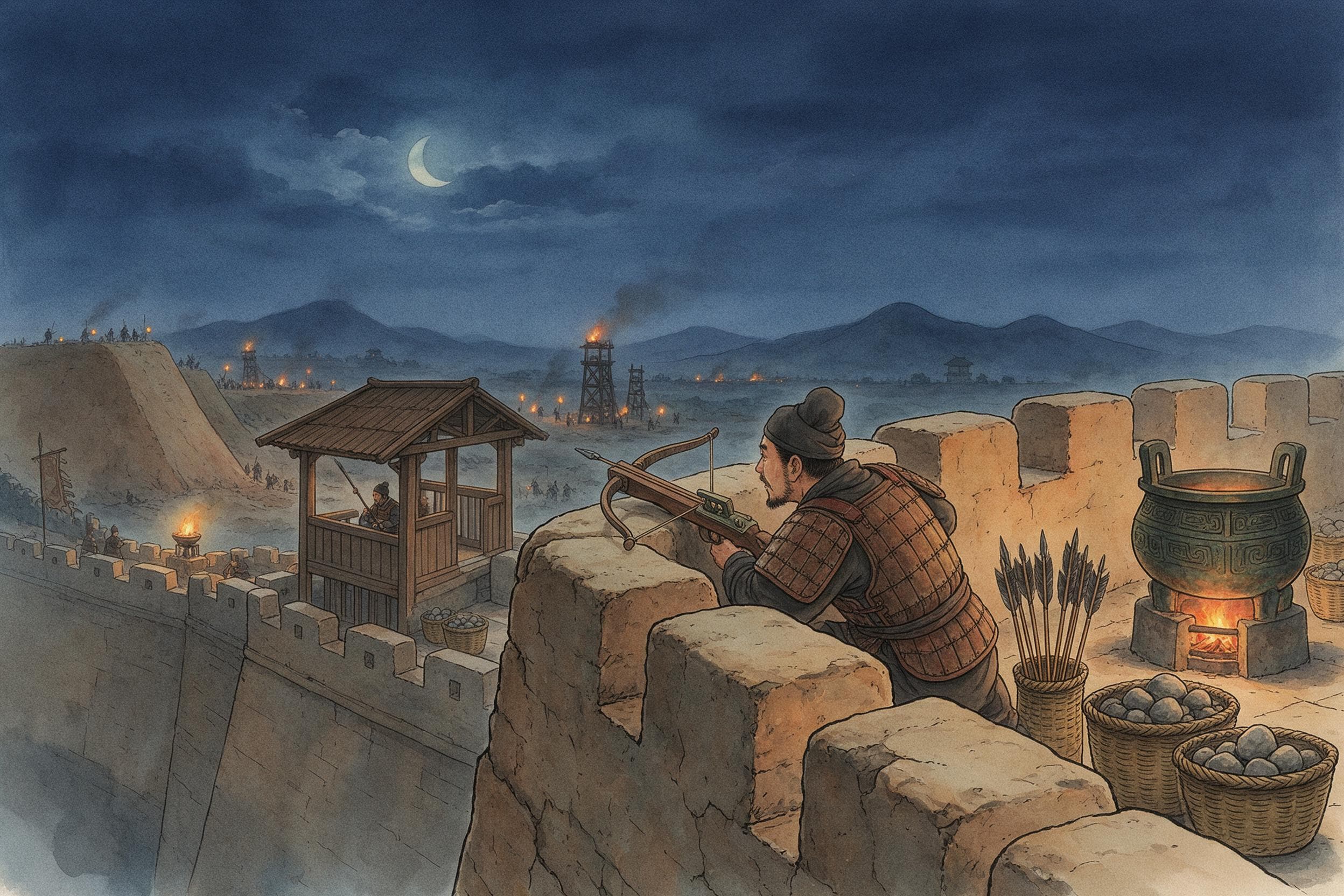
Take fifty paces of city wall and read what the manual says must be stacked on it. Every two paces, one wooden crossbow, and it must shoot at least fifty paces. Every two paces, also, five hundred stones, each at least half a jun in weight. Every five paces, a water jar. Every twenty-five paces, a stove with an iron cauldron holding at least one shi, kept for boiling water — and sand, never less than a thousand shi. Every thirty paces, a covered lookout standing four chi above the battlements. Every hundred paces, a tower inside a walled compound fourteen chi high, with a gate that can be shut and one officer in charge. That list is from the Mozi, in the chapter on preparing the city gates (備城門), and it is not the description of a battle. It is a requisition list written by someone who expects to be attacked.
The twelve ways to take a wall
The chapter opens with a question. Qin Guli asks Mozi how a small state is to hold out when the world's armour is rising and the strong press the weak; Mozi asks in return what methods of attack he means, and the answer is a list of twelve: earth ramps, hooks, battering rams, scaling ladders, filling the moat, water, tunnels, sallies through holes, hollowing, swarm assault, covered wagons, and siege towers on wheels (臨、鉤、衝、梯、堙、水、穴、突、空洞、蟻傅、轒轀、軒車). Mozi's first answer is not a weapon but a condition: walls and moats in repair, defences serviced, grain sufficient, officers and men on good terms, and help from neighbouring states. The rest of the chapter is the working out of that answer, item by item, in paces and weights.
What is actually inside a crossbow
The National Museum of China holds a Warring States bronze trigger of exactly the kind the wall lists would have used, and its catalogue entry is blunt about the mechanism: the piece is made of three parts — the 牙 (the catch that holds the string), the 钩 (the hook), and the 悬刀 (the trigger lever) — with no 郭, no metal housing, the whole assembly mounted by a bronze pivot in a slot cut into the wooden stock. That is a 臂張弩, a hand-spanned crossbow. The same entry notes that the earliest crossbows appeared in the early Warring States and were spanned by arm strength, with an effective range of only about eighty metres; later came the 蹶張弩, spanned by the foot, and the 腰引弩, drawn with the waist.
The second museum piece shows what the mechanism became. By the Han, the trigger had a bronze housing and a rear sight: the entry lists a 望山 (sight), a 悬刀 (trigger), a 钩心 or 牛 (sear) and two axles through the whole assembly. And on the metal there is an inscription, 「□工何造」 — a workshop office, and the name of the man who made it. A weapon stamped with the office and the artisan is a weapon somebody could be blamed for: the same state that counted coins into sealed baskets also put a name on its crossbow parts.
The Mozi also describes a much larger machine, in the chapter on meeting an enemy who builds an earth ramp higher than the wall (備高臨). It is a crossbow cart: a bronze mechanism housing weighing one shi and thirty jin, three wheels on two axles, a frame eight chi high, arms whose stated dimensions run to the inch, arrows ten chi long, and ten men assigned to work it. It should be said plainly that no excavated object matches this description, and the text is instructions rather than a purchase order; the cart belongs to the same category as the rest of the manual, a design on paper for a war of engineers.
Fifty paces, ten men, one warden
The numbers that make the manual worth reading are the ones about people. The garrison rule gives the allotment for fifty paces of wall: ten able-bodied men, twenty adult women, ten old people and children — forty in all (五十步丈夫十人,丁女二十人,老小十人,計之五十步四十人). The wall itself is held at roughly one person per pace. Ten men form a squad under a 什長, attached to one officer and one 亭尉; every hundred paces there is a 亭, a walled post with a gate, and one officer for it, and the text says the man chosen for that post must be 「有重厚忠信可任事者」 — solid, honest, fit to be trusted with work. Those who are neither old nor fit for service are still put on the wall, in the sections not facing the attack.
Then come the small routines that turn a wall into a night watch. If the enemy is below the wall, the drum sounds, the torch bundles (苣) are lit, the drum sounds again, and the torches go into the 爵穴 — the small openings below the battlements — to light the ground outside. Water carriers signal with a flag: every fifty paces there is a pole a zhang tall, and whoever goes for water waves it (棄水者操表搖之). Every fifty paces there is a latrine, sharing its pit with the one below (與下同圂). And the material is everywhere: stones piled by the pace, cauldrons of hot water on stoves, sand by the thousand shi, arrows whose shafts the text insists must not be bamboo but 楛, 趙, 𢱋 or 榆 wood.
Where the men and the timber came from
A city under siege eats its own houses. The manual orders that timber, tiles and stone from private houses, wherever they can add to the city's defences, be brought up — 「盡上之。不從令者,斬」, all of it up, and whoever disobeys is beheaded. That single line says more about how a Warring States army was raised for defence than any speech about patriotism: the materials of ordinary homes became military stores by command, on pain of death, and the people who owned them went onto the wall as labour.
The chapter also gives the fourteen conditions under which a besieged city can be held at all — walls thick and high, moat deep and wide, towers repaired, defences sharp, fuel and food enough for three months or more, people numerous and selected, officers and civilians in accord, ministers with merit, a lord trusted, and so on to the last pair: rewards clear enough to be believed, punishments severe enough to be feared (賞明可信而罰嚴足畏). Fourteen conditions, and the text says that if not one of them holds, even a good defender cannot hold the city. It is a checklist written by someone who had watched cities fall.
What this material is, and what it is not
The Mozi's city-defence chapters are generally dated to the late Warring States and attributed to later followers of the school; the process by which they were compiled is disputed, so they should be read as a body of professional doctrine rather than as a report from one siege. The museum entries give the crossbows a firm anchor on the other side: triggers of this pattern are early Warring States in date, and the type found with the terracotta army belongs to the army that ended the period. Between a manual and an object, the picture holds: a war fought with massed crossbows, walls, and requisitioned timber.
What the material will not give is the thing modern readers ask for first: how many men fought. The sources carry numbers, but they are either the manual's own allocations or the claims of persuaders, and this article uses neither for the size of an army. Nor does it give the cost of a campaign or the daily ration of a soldier. What it gives instead is a man on a wall at night, a torch going into a hole below the battlements, a stone pile counted by the pace, and a name stamped inside a bronze trigger — the ordinary texture of a war that was, for most of the people in it, a job of standing watch and carrying water.
Sources & further reading
- 《墨子·备城门》(Mozi, "Preparing the City Gates") — Siege techniques, the twelve ways of attack, the garrison ratio per fifty paces, watchtowers, water jars, stones, night signals, latrines, and the requisition of private timber; a defensive manual, not a battle report.
- 《墨子·备高临》(Mozi, "Preparing Against the High Approach") — The repeating crossbow cart: bronze mechanism housing of one shi thirty jin, ten-chi arrows, three wheels, ten men to work it; a text design with no excavated counterpart in our sources.
- 中国国家博物馆藏「铜弩机」(Bronze crossbow trigger, National Museum of China) — Warring States trigger of 牙, 钩 and 悬刀 with no housing, mounted by a bronze pivot; hand-spanned type with an effective range of about 80 m; the same kind as weapons from the terracotta army pits.
- 中国国家博物馆藏「鎏金铜弩机」(Gilt-bronze crossbow trigger, National Museum of China) — The developed form: bronze housing, rear sight (望山), trigger (悬刀), sear (钩心); an inscription naming the workshop office and the artisan.