At the battle of An in 589 BCE, the duke of Qi gave an order that has survived better than most royal commands: 余姑翦滅此而朝食 — "I will wipe these people out first, and then eat my morning meal." He then charged without waiting to armour his horses, and lost. The line is famous because of the defeat, but read it another way and it is a small piece of evidence about daily life: there was a defined first meal of the day, it had a name (朝食), and a commander could decide to have it after the killing rather than before. What was in it, the Zuo Zhuan does not say. For that we have to go to a poem.
A food list arranged by month
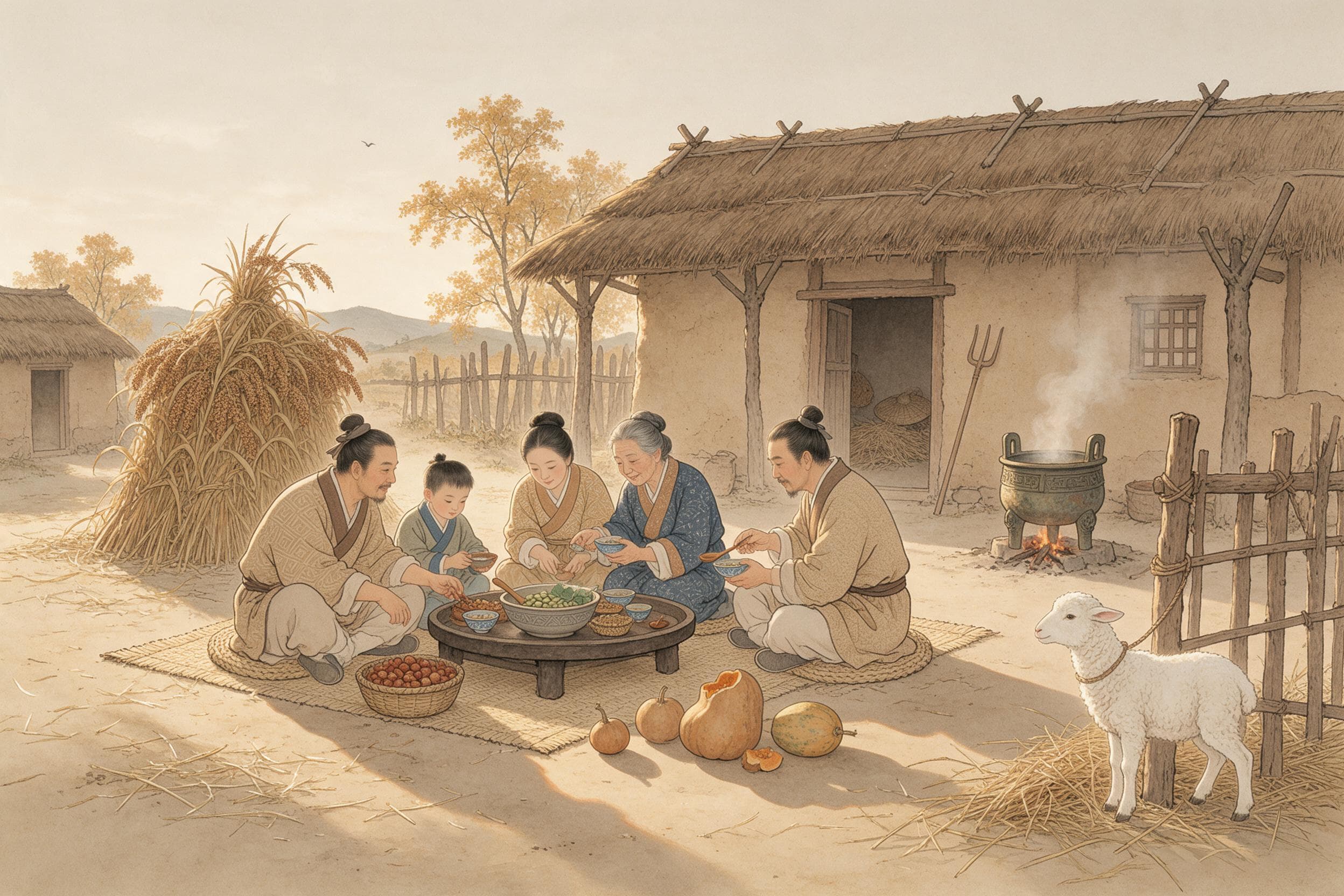
The seventh-month ode in the Book of Songs, 七月, is the closest thing the period leaves to a food calendar, and it reads like one: 六月食鬱及薁,七月亨葵及菽,八月剝棗,十月穫稻。為此春酒,以介眉壽 — in the sixth month they eat wild plums and vines, in the seventh they cook mallows and beans, in the eighth they strip the dates, in the tenth they harvest rice, and turn it into spring wine to wish long life. Then: 七月食瓜,八月斷壺,九月叔苴,采荼薪樗,食我農夫 — gourds in the seventh month, gourds cut from the vine in the eighth, hemp seed and bitter herbs gathered in the ninth, and all of it, the poem says, to feed the farmers. Note where the rice goes: into wine and a blessing, not into the everyday bowl. The staple is not rice.
The staples are named a few lines down: 黍稷重穋,禾麻菽麥 — the two kinds of millet, panicled and late-ripening, then 禾 (another millet), 麻 (hemp, grown for its edible seed), 菽 (beans) and 麥 (wheat). Six crops, from which the later formula of the "five grains" grows. This is a northern, dry-field list: millets at the centre, beans and hemp alongside, wheat present, rice an item of the wetter margins. And it is a list with nothing added: no peaches, no melons of the later Chinese kitchen, nothing from the New World — no chilli, no maize, no tomato, none of which existed in China then.
Two meals, and one eaten early
The 朝食 of the duke of Qi is the ordinary morning meal; the Zuo Zhuan also gives the army's version of it. Before the battle of Yanling in 575 BCE, the Jin commanders' orders are summarised in four characters: 蓐食申禱 — eat on the bedding, repeat the prayers. The commentaries explain 蓐食 as eating before getting up, or simply eating early, then forming ranks before dawn. Either way, the picture is of an army whose day was built around one meal taken before light, because the fighting would not wait. A second meal came at the end of it.
That two-meal pattern is usually called 饔飧 — breakfast and evening meal — and the phrase comes from a passage in the Mencius, where a follower of the agriculturalist Xu Xing argues that a worthy ruler should plough alongside his people and "cook morning and evening meals and govern" (饔飧而治). The dating matters: the Mencius is a Warring States text looking back, so 饔飧 describes what a fourth-century BCE writer took to be normal, and the Zuo Zhuan's 朝食 show the word in use in the Spring and Autumn. That is enough for "two meals was the ordinary arrangement"; it is not enough for "everyone in the Spring and Autumn ate twice a day and never more".
Meat belongs to the feast
Meat appears in the poem at one moment, and it is the end of the year: 九月肅霜,十月滌場。朋酒斯饗,曰殺羔羊。躋彼公堂,稱彼兕觥。萬壽無疆 — frost in the ninth month, the threshing floor swept in the tenth, then friends and wine, a lamb killed, up to the hall, the rhinoceros-horn cup raised, the wish for endless years. Lamb, wine and a shared cup: a feast, a sacrifice and a drinking party at once. The same poem has a second lamb earlier, in the sacrifice at the start of spring, 獻羔祭韭 — offer a lamb and leeks — and a detail that is easy to miss between the two: 二之日鑿冰沖沖,三之日納于凌陰 — in the second month they cut ice, in the third they store it in the ice house. A northern community that cut and kept winter ice for the rites was also a community whose food year had a very hard season in it.
Who grows it, and who eats it
The poem does not pretend the year is comfortable. The same stanza that lists the harvest continues: 嗟我農夫,我稼既同,上入執宮功。晝爾于茅,宵爾索綯。亟其乘屋,其始播百穀 — the crops are in, so up to the lord's house for the palace work; by day cut thatch, by night twist rope, hurry and get on the roof, and then the sowing of the hundred grains begins again. Food and labour are two names for the same year. The phrase that ends the food list — 食我農夫, "to feed our farmers" — is the point of the list: this is what the harvest is for, and it is not much.
The other text usually quoted here is the Mencius, and it has to be handled as what it is. Mencius describes a well-field: 方里而井;井九百畝,其中為公田。八家皆私百畝,同養公田。公事畢,然後敢治私事 — a square li divided into nine hundred mu, eight households with a hundred each and a public field farmed in common, private work only after the public work is done. This is a programme for how a state ought to be organised, argued in the fourth century BCE; whether any Spring and Autumn village ever looked like it is not something the sources show. What it does show is the assumption behind all of it: eight households, one field, and the first claim on their labour going elsewhere.
Three kinds of text, and no menu
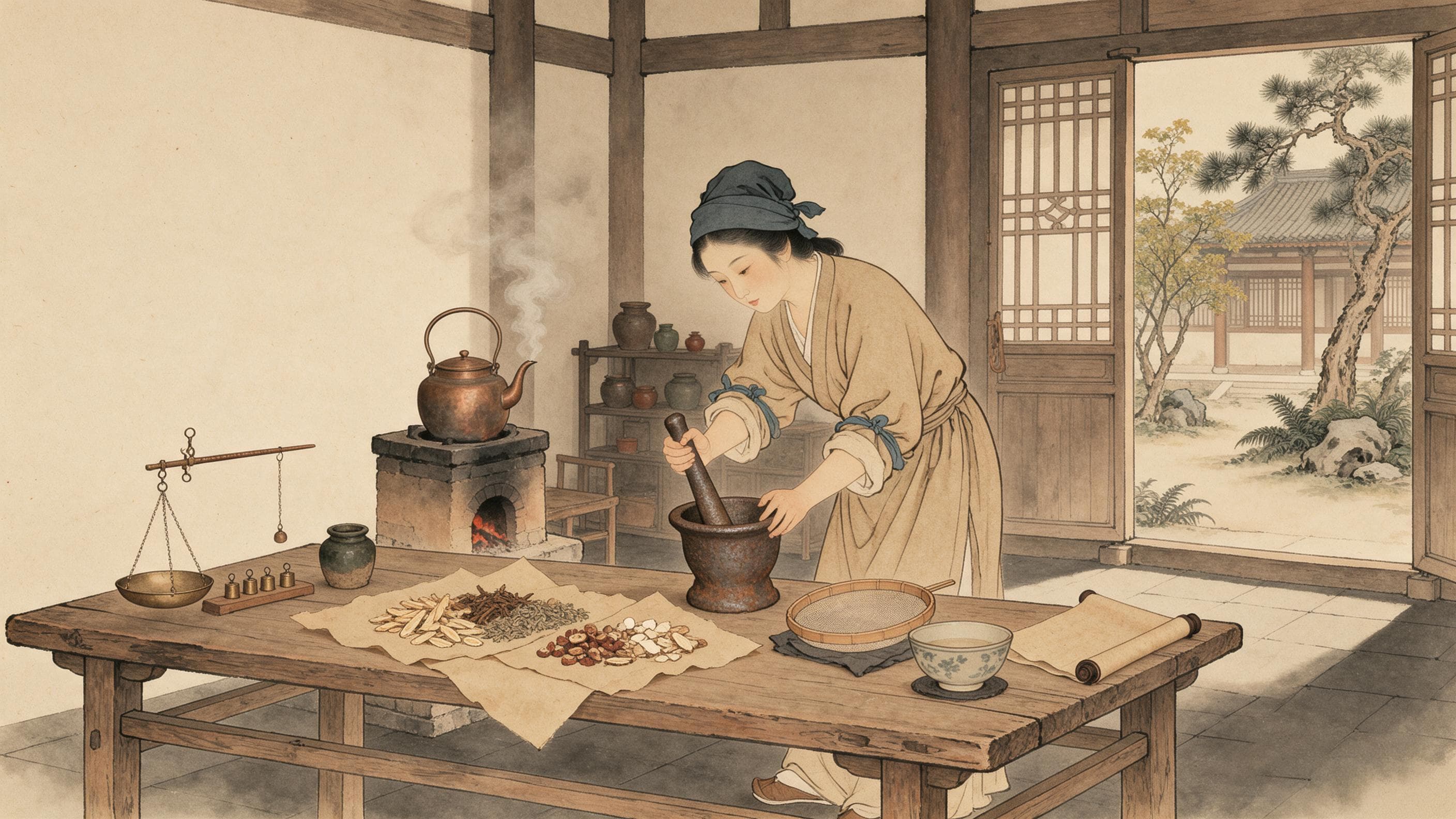
The material for this subject falls into three kinds, and each has to be labelled. The Book of Songs gives a literary list — a poem using the farming year to make a point about the state, not a farmer's diary. The Zuo Zhuan gives narrative — a meal mentioned because a battle turned on it. The Mencius gives argument, written centuries later, about how things should be. None of them is a food record, and no Spring and Autumn kitchen has been excavated to supply one: the archaeological material for this period's cooking is thin, unlike the richer evidence from Shang and Han sites. So the article can say boiled and steamed food, because the tripods, cauldrons and steamers survive in numbers and the poem itself uses 亨, to cook; it can say roasting was probably done, marked as inference; it can say salt and sour plums were probably used, marked the same way. It cannot say 炒, stir-frying, which needs a pan and a fuel economy the period did not have.
Put it back together and the answer to "what did they eat" is a year, not a dish. Mallows and beans in summer, dates in autumn, rice turned into wine for a blessing, gourds eaten and gourds dried, hemp seed and bitter greens gathered when nothing else was left, millet in the bowl every day, and a lamb once a year, at the feast, with the cup going round. A duke could postpone his morning meal until after a battle. A farmer's morning meal was whatever the last harvest had left. The sources give us the calendar and the labour; the taste of it is gone.
Sources & further reading
- 《诗经·国风·豳风·七月》(Shijing, "Seventh Month", Bin section) — The farmer's year in food: mallows and beans in the seventh month, dates, rice for spring wine, gourds, bitter herbs; the six grains; lamb and wine at the year-end feast. A poem, not a menu.
- 《左传·成公》(Zuo Zhuan, Duke Cheng) — "Morning meal" (朝食) at the battle of An in 589 BCE, and "eating on the bedding" (蓐食) before the battle of Yanling — the eating rhythm of an army.
- 《孟子·滕文公上》(Mencius, Teng Wen Gong I) — "Morning and evening meals" (饔飧) in Xu Xing's programme; the well-field blueprint with public work before private. A Warring States argument, not a Spring and Autumn record.