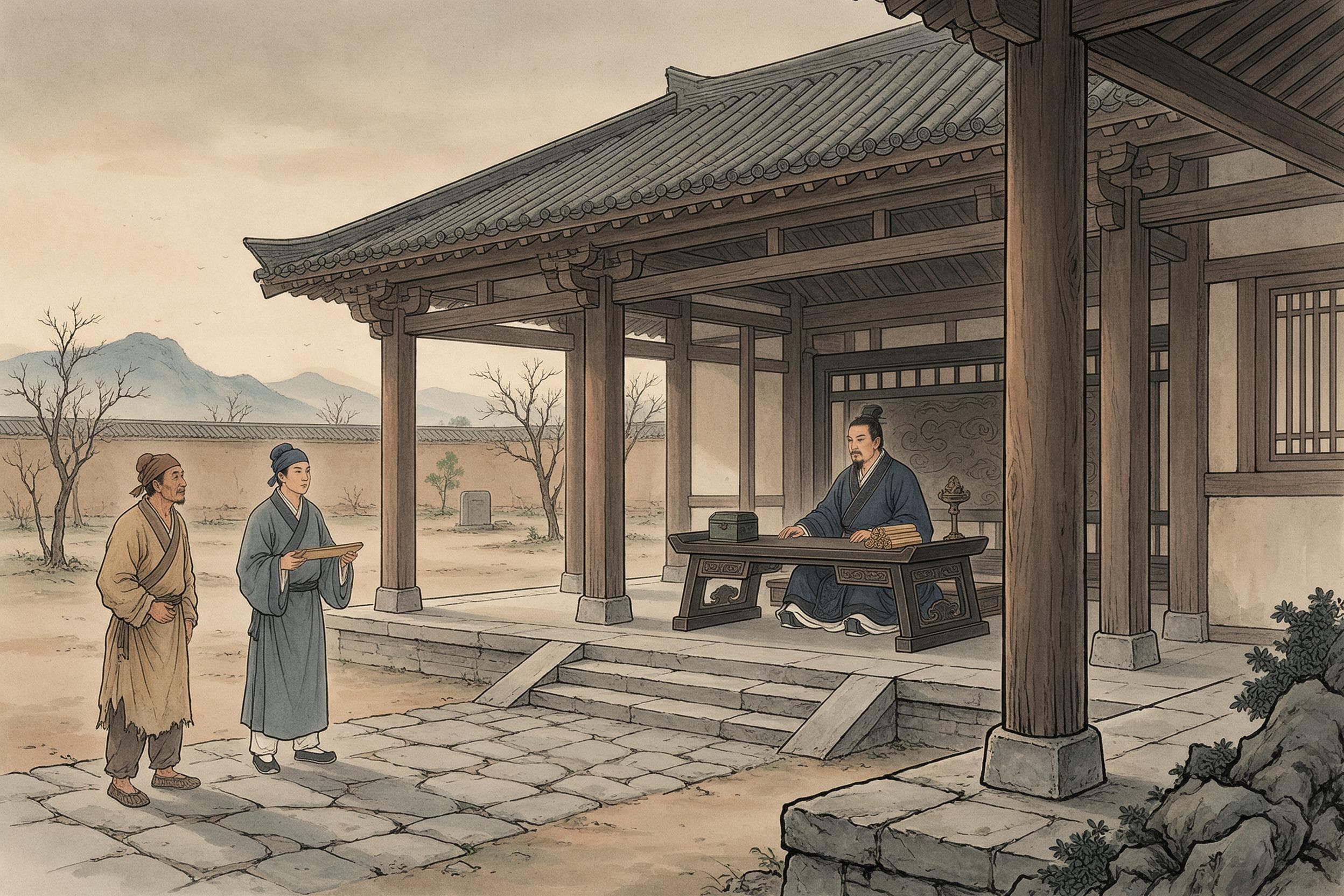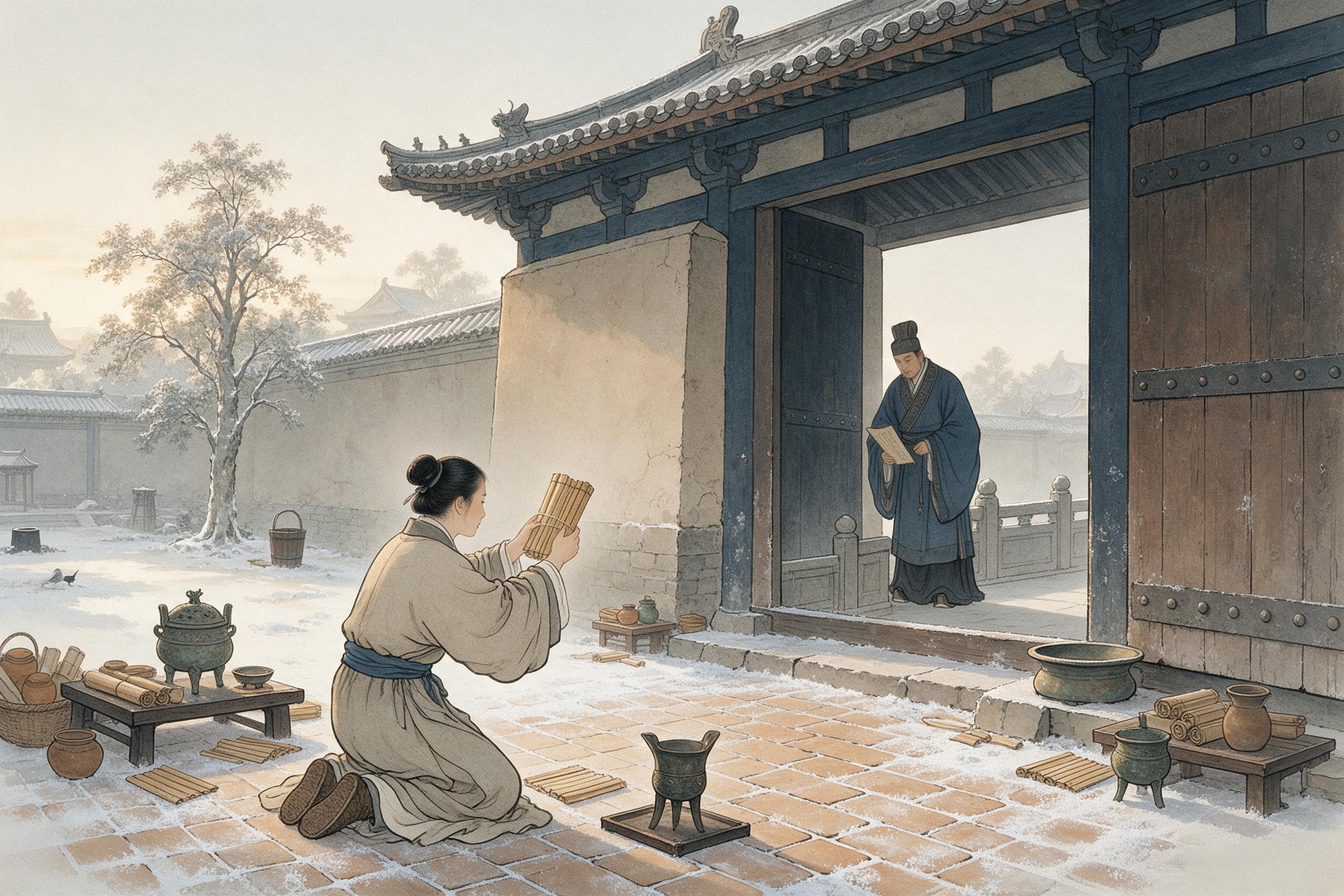
In the fifth month of the thirteenth year of Emperor Wen, the grand granary keeper of Qi, a man named Chunyu, was sentenced to a punishment and taken under guard to Chang'an. He had five daughters and no son. As he was led away he cursed them: 'Begetting children and not begetting a son — when trouble comes there is no use in you' (生子不生男,有緩急非有益也). The youngest, Tiying, wept at the shame of it and followed him to the capital.
Her petition survives in both histories with small differences of wording. 'My father was an official, and in Qi all called him honest and fair; now he has run foul of the law and is to be punished. I grieve that the dead cannot come back to life and that a body once cut cannot be joined again (死者不可復生,刑者不可復屬), so that even one who wishes to reform has no road to do it. I beg to be entered as a government slave, to redeem my father's punishment, so that he may reform' (妾願沒入為官婢,贖父刑罪,使得自新). What follows is one sentence: the petition was presented, and 'the emperor pitied the intent of it' (天子憐悲其意).
That is all. Neither book says what became of her father — whether the punishment was carried out, commuted or dropped. The Tiying episode is a story about a daughter, not a record of how a law was made; the two histories tell it to set up the edict that follows. The edict is the institutional text, and both books carry it. From there the two pages part: the Shiji has the edict and nothing else; the Hanshu adds the ministers' drafting of the replacement penalties.
The Edict
The edict opens with a picture of high antiquity: in the days of the Youyu clan (有虞氏), 'robes and caps were painted and the badges of rank made different, and the people did not offend' (畫衣冠異章服以為僇,而民不犯). That is the edict's own imagining of a golden age, not a report. It then turns: 'Now the law has three mutilating punishments, and wickedness does not stop. Where is the fault? Is it not that my virtue is thin and my teaching unclear?' And the sentence the whole reform hangs on: 'When punishment reaches the point of cutting the limbs and carving the skin, so that the injury never heals for life — how bitter and painful and unkind it is! How can this be called the meaning of being father and mother to the people?' (夫刑至斷支體,刻肌膚,終身不息,何其楚痛而不德也,豈稱為民父母之意哉). It ends in four words: 'Abolish the mutilating punishments' (其除肉刑).
The edict says 'three mutilating punishments' and never names them; the clauses that follow treat them as brand, nose, and the two feet. Nor does it say what should replace them. The Shiji's version stops at the four characters. The Hanshu's version is a decree addressed to the imperial secretary (制詔御史), and it carries an extra authorisation: 'abolish the mutilating punishments and have something to replace them; and let offenders, according to the lightness or weight of their offence, if they do not flee, be released after a number of years. Let this be made into ordinance' (其除肉刑,有以易之…具為令). The substitution is left to the ministers.
What Replaced What
The chancellor Zhang Cang and the imperial secretary Feng Jing answered with a table, which only the Hanshu preserves. Among its substitutions: 'Those who should be branded are to be shaved, collared and sent to hard labour' (當黥者,髡鉗為城旦舂); 'those who should have the nose cut are to receive three hundred strokes' (當劓者,笞三百); 'those who should have the left foot cut are to receive five hundred strokes' (當斬左止者,笞五百); and 'those who should have the right foot cut… are all to be executed in the market' (當斬右止…皆棄市). The emperor's reply was one word: 'Approved' (制曰:可).
Read down that table and the direction is not uniform. Brand, nose and left foot move from mutilation to shaving, strokes, strokes — lighter, at least on paper. The right foot moves the other way: from a mutilation to death. A man sentenced to lose his right foot under the old law had been maimed and lived; under the new one he was killed. This is the table's quiet reversal, and the point at which the reform's name and its effect come apart.
A Name Lighter Than the Punishment
The Hanshu draws the conclusion in its own voice: 'After this, outwardly there was the name of lighter punishment; inwardly it was killing people. Those who should have the right foot cut were also condemned to death; those who should have the left foot cut received five hundred strokes, and those who should have the nose cut three hundred, and most of them died' (是後,外有輕刑之名,內實殺人…率多死). That is Ban Gu's judgement, and the clauses after it are his reasons. Later in the same treatise he puts the point again: the abolition 'was meant to preserve people whole, but now a man who steps down from shaving and the collar falls into execution; to rule the people by death is to lose the original kindness' (本欲以全民也…失本惠矣).
The Rod
The next reign kept adjusting the machine. In the first year of Emperor Jing an edict says that 'adding strokes is no different from a heavy punishment: if a man is lucky enough not to die, he can never be a whole man again', and orders five hundred strokes reduced to three hundred and three hundred to two hundred (笞五百曰三百,笞三百曰二百). The treatise adds, drily: 'still they were not whole' (猶尚不全).
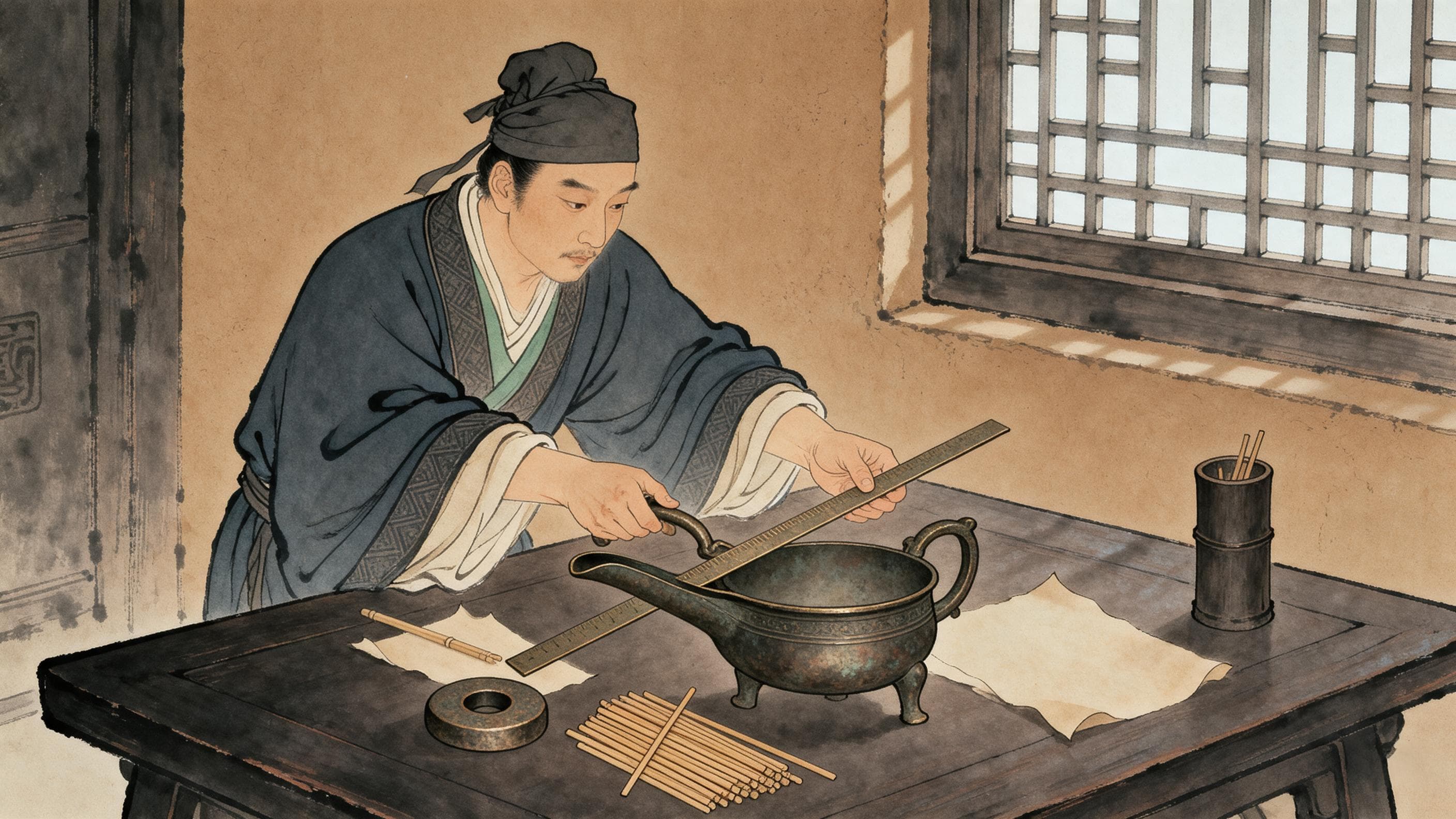
In the sixth year of Jing's middle period another edict: 'Some who are sentenced to strokes die before the strokes are finished; I pity them greatly' (加笞者,或至死而笞未畢,朕甚憐之) — three hundred to two hundred, two hundred to one hundred. Then a regulation on the rod itself, drafted by the chancellor Liu She and the imperial secretary Wei Wan: 'The rod is five chi long, its base one cun thick; if bamboo, the tip half a cun thin, and the joints smoothed flat. The strokes are to fall on the buttocks. The man wielding it is not to be changed; one offender's punishment is to be finished by one man' (箠長五尺…當笞者笞臀。毋得更人). After that, the treatise says, 'those sentenced to strokes came through whole — though cruel officials still used it to overawe' (自是笞者得全,然酷吏猶以為威). It closes the account with a judgement of its own: 'the death penalty was heavy and the living penalty light, and the people easily offended' (死刑既重,而生刑又輕,民易犯之).
What the Two Pages Do Not Give
Neither page gives the number of people punished, the share of mutilations among all sentences, the interval between the edict and the ministers' table, how far the reform was carried out, or the fate of the man whose case began it. The edict's painted robes in high antiquity belong to the edict, not to a record. What the two pages do give is a chain with a direction: a petition, an edict in four words, a table of substitutions, a killing in place of a maiming, two reductions in the strokes, and a rule about the length and thickness of a rod. Whether the reform was better or worse is not a question the pages answer. They record what the sentences became.
Related reading:A Thousand Yi of Gold: How the Histories Counted It · The Garrison Farm: Zhao Chongguo's Account at Huangzhong · What a King Gave: Two Lists of Reward
Sources & further reading
- 《史记》卷十·孝文本纪(西汉;维基文库本,未与点校本复核) — In the fifth month of the thirteenth year the grand granary keeper of Qi, Chunyu, was sentenced; his five daughters were scolded for not being sons, and the youngest, Tiying, followed him to Chang'an and petitioned to be made a government slave in exchange for his punishment. The emperor, moved, issued the edict: mutilation cuts the body and carves the skin so that the injury never heals, and 'how can this be called being father and mother to the people? Abolish the mutilating punishments.' The Shiji gives the edict only — no replacement penalties, and no word of the father's fate.
- 《汉书》卷二十三·刑法志(东汉;维基文库本,未与点校本复核) — Ban Gu tells the same story and supplies what the Shiji omits: the edict ordered the mutilations 'replaced by something', and the chancellor Zhang Cang and the imperial secretary Feng Jing drafted the substitutions — branding to shaving with iron collar and hard labour, nose-cutting to three hundred strokes, the left foot to five hundred strokes, the right foot to execution. Ban Gu's verdict follows: 'outwardly there was the name of lighter punishment, inwardly it was killing people', since the strokes were often fatal. Under Emperor Jing the stroke counts were twice reduced and a regulation fixed the size of the rod.