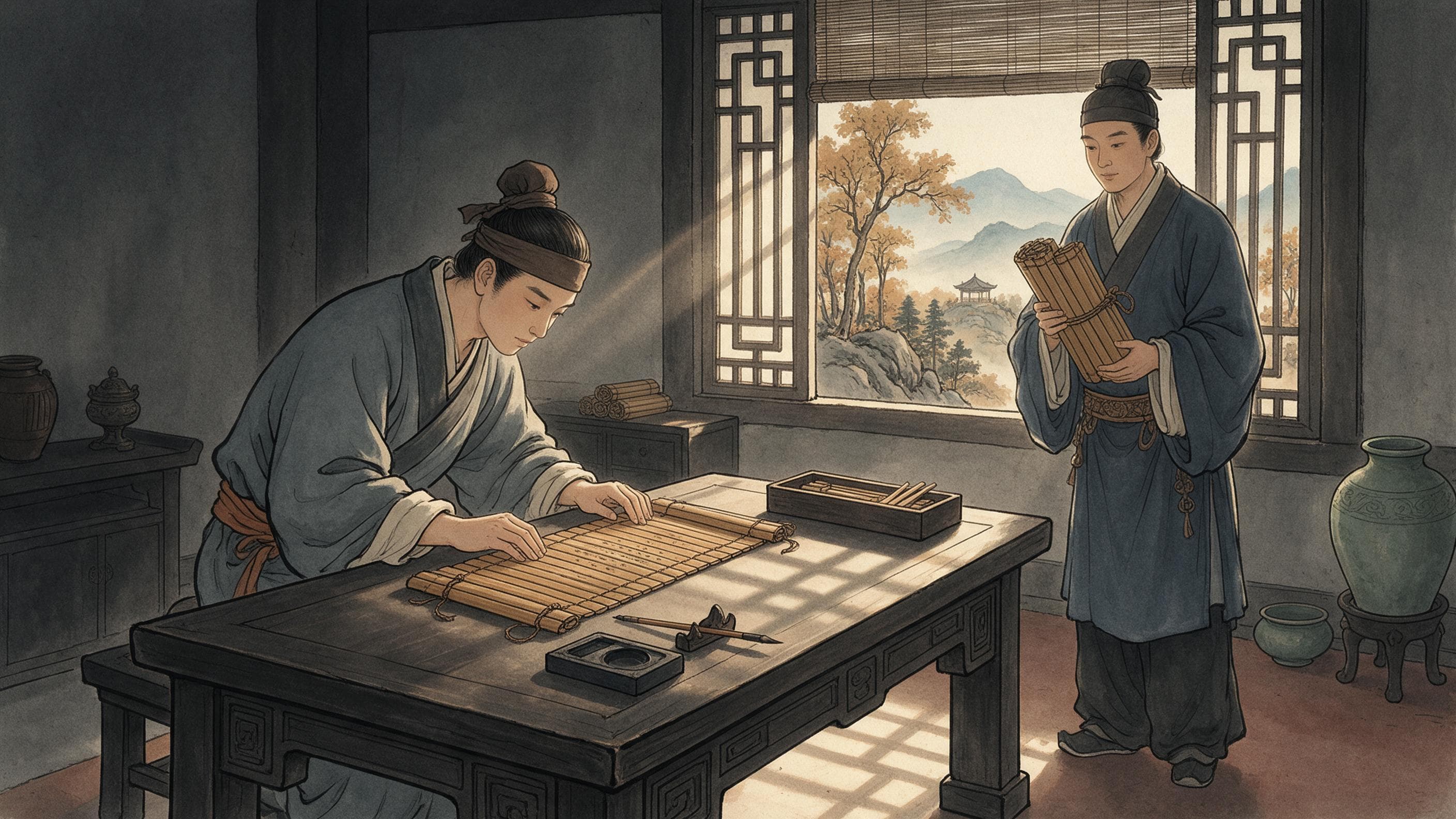
The biography of Chen Qun (陳羣) in the Records of the Three Kingdoms is a long run of offices and promotions. In the middle of it, between a marquisate and the next move up, stands one clause: 'When he took the king's seat, he enfeoffed Qun as marquis of Changwu ting and moved him to be director of the secretariat. The law of nine grades for appointing men was made — Qun established it' (及即王位,封羣昌武亭侯,徙爲尚書。制九品官人之法,羣所建也). The biography does not say how many grades there were, who assigned them, or how a man entered one. It never uses the word 中正, 'rectifier', once.
One Line in a Career
Read in sequence, the clause is a line of career record: after Cao Pi becomes king of Wei, makes Chen Qun a marquis and a director, and before the same Cao Pi, now emperor, raises him again. The date is not there. The Tang compendium Tongdian (通典) supplies one, with a motive: 'In the first year of Yankang, Chen Qun, minister of personnel, because the court's selection did not exhaust talent, then established the law of nine grades' (延康元年,吏部尚書陳群以天朝選用不盡人才,乃立「九品官人之法」). The same passage first sets a scene: 'when Emperor Wen of Wei was king of Wei, the three sides stood against one another, the gentry had scattered, the four kinds of people were mixed, and there was no way to check' (三方鼎立,士流播遷,四人錯雜,詳覈無所). Yankang 1 is, by the standard reckoning, 220 CE.
That is the whole of the Wei record, and the Tang compiler says as much. His note ends: 'tracing it to the root, Chen Shou's Wei zhi speaks of it too briefly, and so I have argued it out in detail' (討其根本,陳壽魏志言之太略,故詳辯之也). What the Tongdian then supplies is therefore not a recovered statute. It is a reconstruction made centuries later from unnamed materials, and should be quoted with that label attached. The nine grades are not named on any of the three pages; the Tang note says only that men were 'fixed at nine grades' (定為九等).
The Four Sentences of a Procedure
The Tongdian's account of the method is almost absurdly compact. 'Every province and commandery set up a rectifier, to settle its selection; they chose men of the province or commandery who were worthy and had discernment to serve; they distinguished men and ranked them high or low' (州郡皆置中正,以定其選,擇州郡之賢有識鑒者為之,區別人物,第其高下). A further rule follows at once: 'a commandery of a hundred thousand mouths or more examined and recommended one man a year; where there was outstanding talent, population was not to be a limit' (郡口十萬以上,歲察一人,其有秀異,不拘戶口). Four clauses; population and men are the only numbers.
The compiler's own note adds what a statute ought to have: rectifiers at three levels, a rank 'fixed at nine grades' (定為九等), and a scale that moved both ways: 'sometimes raised from the fifth to the fourth, from the sixth to the fifth; sometimes lowered from the fifth back to the sixth, from the sixth back to the seventh' (或以五升四,以六升五……或自五退六,自六退七). It also judges them: 'could know a family's standing, and no longer judged whether a man was worthy or foolish' (唯能知其閥閱,非復辨其賢愚) — the compiler's verdict, not a Wei document's. Of the Jin it adds that when the ministry of personnel appointed a man it 'must send down to the rectifier, asking the man's residence and his father's and grandfather's offices' (必下中正,徵其人居及父祖官名).
Three Difficulties and Eight Harms
The man who attacked it was not a casualty of it. Liu Yi (劉毅), a native of Ye in Donglai, made a career of weighing people: as a commandery officer he 'sifted out more than a hundred clerks', and when his superior blocked an impeachment he threw down his tally and walked out. Under Emperor Wu of Jin he reached left assistant director of the secretariat. The Book of Jin introduces the memorial in a sentence of its own: 'Yi held that the nine grades, as Wei had established them, were a provisional measure of the time, which had not been seen to get the right men, and had eight harms; he then submitted a memorial' (毅以魏立九品,權時之制,未見得人,而有八損,乃上疏曰). That is the historian's summary, not a sentence of the memorial.
He starts from the difficulty of knowing, not from bribery: 'official talent has three difficulties, from which rise and fall both come: men are hard to know, one; likes and dislikes are hard to guard against, two; true and false are hard to distinguish, three' (人物難知,一也;愛憎難防,二也;情偽難明,三也). Only then does he turn to the office: 'now rectifiers are set up and the nine grades fixed; high and low lie with their will, honour and disgrace in their hands; they wield the ruler's awe and favour and take away the court's power' (今立中正,定九品,高下任意,榮辱在手。操人主之威福,奪天朝之權勢).
The body of the memorial is a numbered bill, 'harm to government, the first' through 'the eighth'. The first is faction: the rectifier 'does not refine on real talent but leans on party profit', so that 'high and low follow strength, right and wrong follow love and hate' (高下逐強弱,是非由愛憎) — and from that comes the sentence that outlived him: 'thus the upper grades contain no poor households, the lower grades no powerful clans' (是以上品無寒門,下品無勢族). The Tongdian, quoting him centuries later, has different words in the other order: 'the lower grades contain no high gates, the upper grades no poor scholars' (下品無高門,上品無寒士). Both are printed here; they are not reconciled. The rest are procedural — no penalty for a wrong judgment, no village elder to record conduct, the grade and the appraisal 'hampering each other' (品狀相妨) — and he sums it up in a couplet: 'the office is named rectifier, and is in fact a house of villains; the scheme is named nine grades, and has eight harms' (雖職名中正,實為奸府;事名九品,而有八損), asking that both be abolished: 'dismiss the rectifiers, do away with the nine grades, discard the flawed law of Wei and establish a fine system' (宜罷中正,除九品,棄魏氏之弊法,立一代之美制).
A Good Edict, No Change
The answer is recorded in four characters and a sequel: 'the memorial was submitted; a fine edict answered it' (疏奏,優詔答之). Others agreed: 'afterwards the minister of works Wei Guan and others also jointly memorialised that the nine grades should be reduced and the old village discussion and local recommendation restored' (後司空衛瓘等亦共表宜省九品,復古鄉議里選). The outcome is one line: 'the emperor in the end did not put it into practice' (帝竟不施行). Neither page names a grade, an office or a rule the memorial changed; neither dates it.
The Critic in the Chair
What the pages do record is what became of the critic. The Book of Jin has him retire at seventy with the title of grand master of light; then the minister of works nominated Liu Yi as grand rectifier of Qingzhou, the secretariat objected that a man who had handed in his carriage should not be troubled with detail, and the chancellor of Chenliu, Sun Yin, argued that he should not be spared. The upshot: 'from the second grade upward, Qingzhou took its standard from Yi' (於是青州自二品已上憑毅取正). And then: 'thus Yi in the end became the provincial arbiter; he weighed and set in order the stream of men, distinguished clear from muddy, and his impeachments and demotions began with the relatives of the great and the noble' (由是毅遂為州都,銓正人流,清濁區別,其所彈貶,自親貴者始).
Three texts, then. A biography that gives the institution a founder and one clause. A Tang handbook that gives it a procedure and a verdict. A memorial that gives it an indictment, with the accused named. Eleven characters founded it; eight items attacked it; the answer was a good edict. What the grades were called, who appointed a rectifier, how a grade attached to an office — none of that is in the pages, and they do not even agree on how the famous sentence runs. What they do record is a man who called the office a house of villains and later sat in it.
Related reading:One Man Each: How the Han Ordered Its Commanderies to Recommend · The Pool at Hedong: Northern Wei Salt and Its Officers · The Price of Doubt: Five Punishments in the 'Lü Xing'
Sources & further reading
- 《三国志》卷二十二·魏书·陈群传(晋陈寿撰;维基文库本,未与中华书局点校本复核) — The only notice of the institution in the Wei record: after Cao Pi took the king's seat, enfeoffed Chen Qun as marquis of Changwu ting and moved him to director of the secretariat, 'the law of nine grades for appointing men was made — Qun established it'. The page gives no grades, no procedure, and never uses the word zhongzheng (rectifier).
- 《通典》卷十四·选举二·历代制中(唐杜佑撰;维基文库录文,页面自标 textquality 25%,未与点校本复核) — A Tang compendium's account: in the first year of Yankang Chen Qun, minister of personnel, finding the court's selection did not exhaust talent, established the nine-grade method; every province and commandery set up a rectifier, chosen from the worthy and discerning, to distinguish men and rank them high or low; a commandery of 100,000 mouths recommended one man a year, outstanding talent not limited by population. The compiler's own note adds rectifiers at three levels, a rank fixed at nine grades, promotions and demotions between grades, the verdict that they knew only family standing, and the Jin rule that the ministry of personnel must ask the rectifier for a man's residence and his father's and grandfather's offices; it also says Chen Shou's Wei zhi was 'too brief', which is why he argues the matter in detail.
- 《晋书》卷四十五·刘毅传(唐房玄龄等撰;维基文库本,未与中华书局点校本复核) — Liu Yi's memorial against the nine grades: official talent has three difficulties — men hard to know, likes and dislikes hard to guard against, true and false hard to distinguish; eight numbered harms, among them 'the upper grades contain no poor households, the lower grades no powerful clans', 'the office is named rectifier but is in fact a house of villains'; he asks that both be abolished. 'The memorial was submitted; a fine edict answered it… the emperor in the end did not put it into practice.' Later the minister of works nominates Liu Yi as grand rectifier of Qingzhou, and he becomes the provincial arbiter, his impeachments beginning with the relatives of the great.