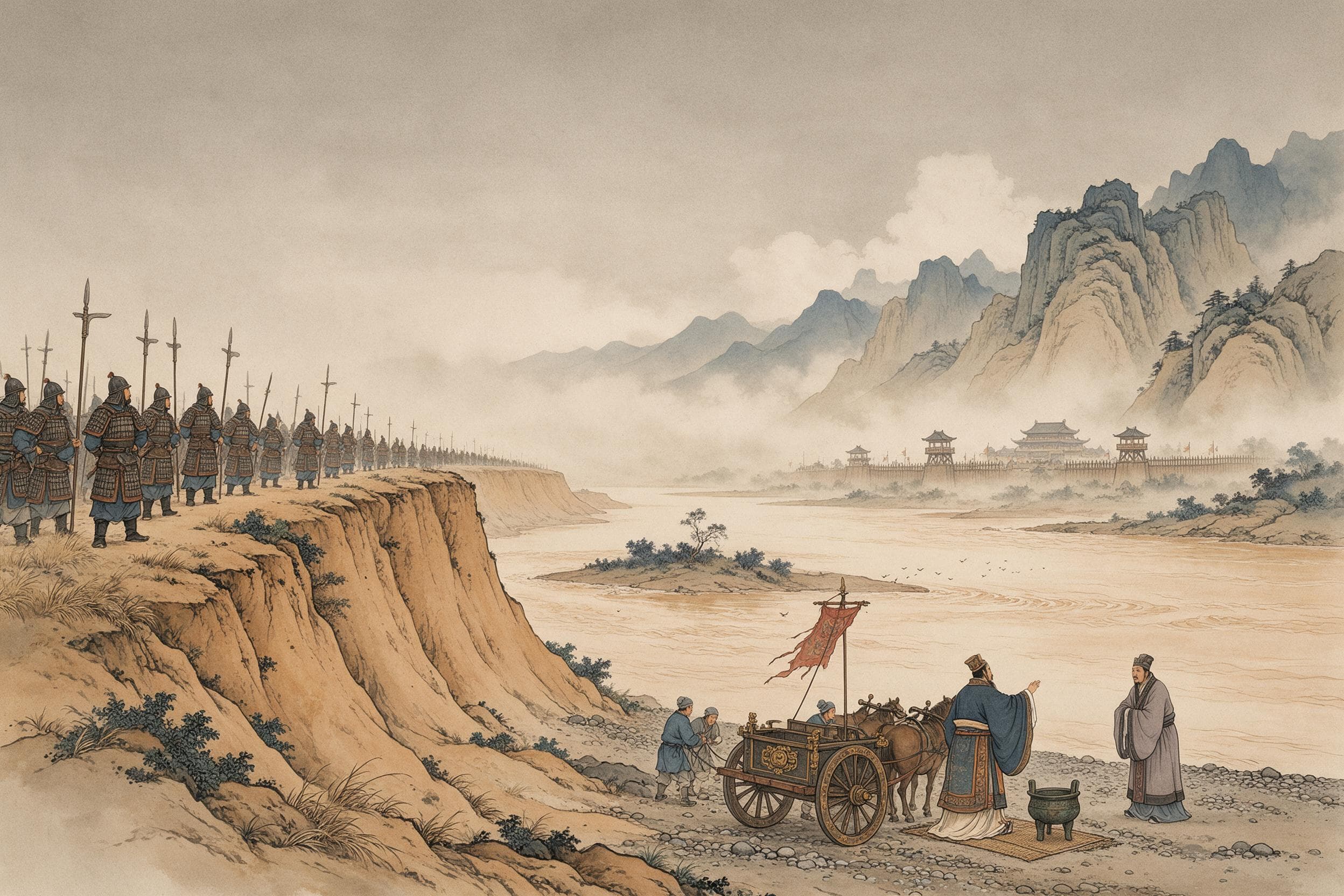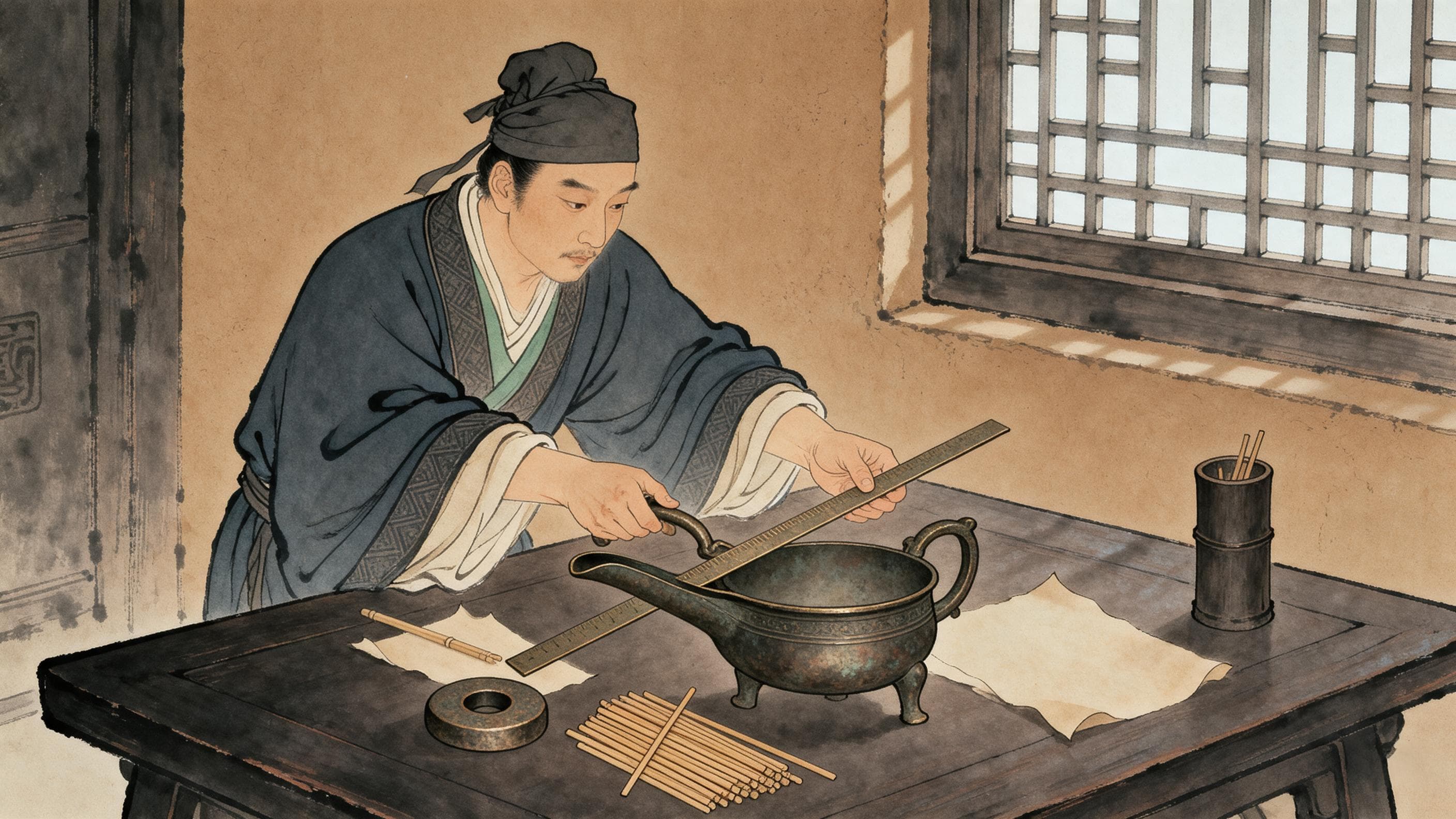
In the twenty-sixth year, the last kingdom gone, the annals set out what the empire did, one clause at a time: thirty-six commanderies; the people renamed; a great feast; the weapons gathered and melted; and then 'the law and measure of weight, stone, zhang and chi were made uniform; the axles of carriages were made the same; writing was made the same' (一法度衡石丈尺。車同軌。書同文字). The whole policy on weights and measures is those six characters. Not one unit, not one step between units, not one object.
Six characters
The six characters sit in a list, and the list's manner is itself evidence: commanderies and their officers; the people renamed 'black-haired'; a great feast; the weapons melted into bells and twelve bronze men; then the six characters; then axles; then writing; then the four borders. Each item is one clause, and none is a procedure. The one other sentence about length in that year is not in this clause at all: it is inside the explanation of the Water virtue — 'six chi make a pace' (六尺為步), one of the sixes by which Qin ordered its numbers. Two statements about length in one year, and neither says how long a chi was.
The six characters name two families only: 衡石, weight and its stone, and 丈尺, the zhang and the chi. Capacity — the dou, the hu — is not in the sentence. The Hanshu treatise, by contrast, gives three complete sets, and capacity is one of them. That is a difference in coverage between the two pages, and it is left as a difference: the annals do not say capacity was unified, so this article does not say it was, or that it was not.
Length: fen, cun, chi, zhang, yin
Length gets five units and a single chain of tens: 'the measure of length is fen, cun, chi, zhang, yin… one makes a fen; ten fen make a cun; ten cun make a chi; ten chi make a zhang; ten zhang make a yin, and the five measures are complete' (一為一分,十分為寸,十寸為尺,十尺為丈,十丈為引,而五度審矣). Its origin is not a metal bar but a note: 'it takes its rise from the length of the yellow bell' (本起黃鐘之長), and the note is fixed by grain — 'taking middle-sized grains of black millet, the breadth of one grain, ninety of them make the length of the yellow bell' (以子穀秬黍中者,一黍之廣,度之九十分,黃鐘之長). The chain is decimal; the starting point is acoustics and a crop.
Then the object. 'Its method uses bronze: one cun high, two cun broad, one zhang long, and the fen, cun, chi and zhang are present in it' (其法用銅,高一寸,廣二寸,長一丈,而分寸尺丈存焉). The yin is wood or bamboo instead: 'a bamboo yin, one fen high, six fen broad, ten zhang long' (用竹為引,高一分,廣六分,長十丈). And the office is named: 'the duty lies with the inner officials; the commandant of justice controls it' (職在內官,廷尉掌之). These are Han instruments and a Han office — not Qin's.
Volume: yue, ge, sheng, dou, hu
Volume follows the same pattern, but its starting point is a vessel: 'the measure of volume is yue, ge, sheng, dou, hu… it takes its rise from the yue of the yellow bell; its capacity is examined by the measures of length; a thousand two hundred grains of black millet fill the yue, and well water strikes the level' (本起於黃鐘之龠……以井水準其概). The chain: 'two yue make a ge; ten ge make a sheng; ten sheng make a dou; ten dou make a hu, and the five measures are complete' (合龠為合,十合為升,十升為斗,十斗為斛,而五量嘉矣). One bronze vessel carries all five: 'above it is the hu, below it the dou, the left ear the sheng, the right ear the ge and the yue; its shape is like a drinking cup… it weighs two jun' (其上為斛,其下為斗。左耳為升,右耳為合龠……其重二鈞).
Weight: zhu, liang, jin, jun, shi
Weight is where the decimal chain stops. 'The weights are zhu, liang, jin, jun, shi… it takes its rise from the weight of the yellow bell. One yue holds a thousand two hundred grains and weighs twelve zhu; double that and you have a liang. Twenty-four zhu make a liang. Sixteen liang make a jin. Thirty jin make a jun. Four jun make a shi' (一龠容千二百黍,重十二銖,兩之為兩。二十四銖為兩。十六兩為斤。三十斤為鈞。四鈞為石). Twelve zhu is half a liang, twenty-four is a liang; then sixteen, thirty, four. The instrument is a ring: 'round and ringed, its flesh twice its hole, turning without end, ending and beginning again' (圜而環之,令之肉倍好者,周旋無端,終而復始). And the treatise ties the numbers to the calendar: twenty-four zhu for the twenty-four breaths, thirty jin for a month, four jun for the four seasons, a hundred and twenty jin for the twelve months. That is a Han reading of the numbers, not a Qin enactment.
Who made the tables, and what is missing
The treatise is candid about its own making. It opens with the Book of Yu — 'thereupon the pitch pipes and the measures of length, volume and weight were made uniform' (乃同律度量衡) — and then, after a short history, says: 'in the Yuanshi period Wang Mang held power, and wishing to shine with reputation he summoned more than a hundred men who understood the bells and pitch pipes, and had Xihe Liu Xin and the rest take charge and report item by item, which was the most detailed account of it. So the false phrases were cut away, the correct sense taken, and it was set out in this chapter' (至元始中王莽秉政……使羲和劉歆等典領條奏,言之最詳。故刪其偽辭,取正義,著于篇). The five lengths, five volumes and five weights are therefore a Han organisation of the subject, put together at the end of the Western Han. Qin contributes the six characters.
Two more things belong to that Han layer. Why bronze at all? 'All pitch pipes and measures of length, volume and weight use bronze… bronze is the most refined of materials: it does not change its regulation with damp or dry, cold or heat, nor alter its form in wind and rain, but stands constant, like the conduct of a gentleman' (不為燥溼寒暑變其節). And who keeps them: length under the commandant of justice, volume under the grand minister of agriculture, weight under the grand herald (廷尉掌之/大司農掌之/鴻臚掌之). Three sets of tables, three offices, one theory of metal — all Han.
What neither page gives is the Qin instrument. No length for a Qin chi, no capacity for a Qin sheng, no weight for a Qin shi; no text of a Qin edict on the subject; no record of how the order was carried out or for how long. So this article stops at the chains and their starting points: no centimetres, no grams, no capacity worked out for any object. Six characters set a policy; a book written three centuries later supplies the tables, and fits them out with bells, millet, four seasons and twelve months. None of that is in the six characters.
Related reading:One Man Each: How the Han Ordered Its Commanderies to Recommend · The Pool at Hedong: Northern Wei Salt and Its Officers · The Price of Doubt: Five Punishments in the 'Lü Xing'
Sources & further reading
- 司马迁《史记》卷六〈秦始皇本纪〉(维基文库本,未与点校本复核) — The twenty-sixth year gives the whole policy in one clause inside a list: after the division into thirty-six commanderies, the renaming of the people, the great feast and the melting down of weapons, 'the law and measure of weight, stone, zhang and chi were made uniform; the axles of carriages were made the same; writing was made the same' (一法度衡石丈尺。車同軌。書同文字). No unit, no step between units, no object. The same year, in the explanation of the Water virtue, has one other length: 'six chi make a pace' (六尺為步), among the sixes by which Qin ordered its numbers.
- 班固《汉书》卷二十一〈律历志上〉(维基文库本,未与点校本复核) — The three sets in full. Length: fen, cun, chi, zhang, yin, 'one makes a fen; ten fen a cun; ten cun a chi; ten chi a zhang; ten zhang a yin' (一為一分,十分為寸,十寸為尺,十尺為丈,十丈為引), rising from the length of the yellow bell fixed by ninety grains of black millet; the bronze rule 'one cun high, two cun broad, one zhang long'. Volume: yue, ge, sheng, dou, hu, 'two yue make a ge; ten ge a sheng; ten sheng a dou; ten dou a hu' (合龠為合……十斗為斛), with one bronze vessel carrying all five and weighing two jun. Weight: zhu, liang, jin, jun, shi, 'twenty-four zhu make a liang; sixteen liang a jin; thirty jin a jun; four jun a shi' (二十四銖為兩。十六兩為斤。三十斤為鈞。四鈞為石), the ring weight 'round and ringed, its flesh twice its hole'. The chapter states its own provenance: 'in the Yuanshi period Wang Mang held power… he had Xihe Liu Xin and others take charge and report item by item, the most detailed account; so the false phrases were cut away and the correct sense set out in this chapter' (至元始中王莽秉政……使羲和劉歆等典領條奏,言之最詳。故刪其偽辭,取正義,著于篇).