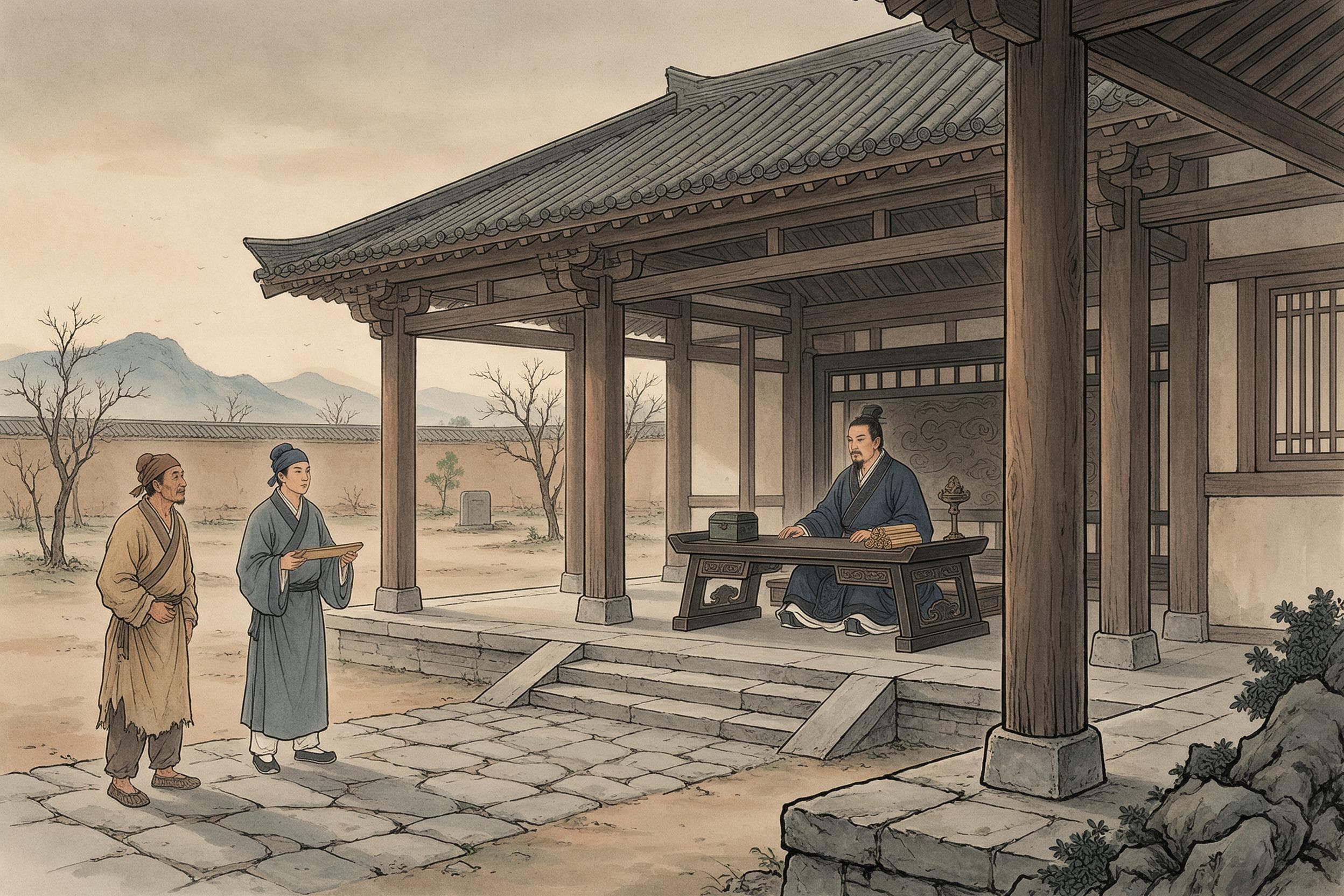
In the eleventh month of winter, the first year of Yuanguang, the annals of Emperor Wu give one line: 'for the first time he ordered the commanderies and kingdoms to recommend one filial and incorrupt man each' (初令郡國舉孝廉各一人). Ten characters, and a national scheme of recruitment. What follows is not a description of how it ran but a chain of edicts and deliberations: who was to recommend, how many, what to do with a commandery that sent nobody, and what the recommended man was for. Not one name of a recommended man appears in the chapter.
Two doors: by edict, and by standing order
Two doors into office stand on the same page, and they do not look alike. One is opened by edict. In the tenth month of Jianyuan 1 the court ordered the chancellor, the censors, the marquises, the two-thousand-bushel officials and the chancellors of the kingdoms to recommend 'men of square character, upright speech and blunt remonstrance' (賢良方正直言極諫之士); the chancellor then screened the list, striking off those who studied Shen Buhai, Shang Yang, Han Fei, Su Qin or Zhang Yi, with the emperor's approval. In the fifth month of Yuanguang 1 another such edict went out, and 'Dong Zhongshu, Gongsun Hong and others came forward from it.' His biography adds that from the start of the reign 'men of worth and letters were recommended, a hundred or more over the years' (舉賢良文學之士前後百數).
The other door is the line of the eleventh month: a standing order, issued by commandery and kingdom, one man each. The pages make the difference plain. The worthies had to answer questions: the Yuanguang edict says they were 'versed in the substance of past and present government, and when examined on policy replied in writing' (受策察問,咸以書對). For the filial and incorrupt there is no examination, no written reply, no test of any kind recorded. The recommenders differ too: the worthies edict names the chancellor, censors, marquises, two-thousand-bushel officials and kingdom chancellors; the filial and incorrupt, in the later memorial, is 'ordered to the two-thousand-bushel officials to recommend' (令二千石舉孝廉). Whether a filial and incorrupt candidate was examined at all, the two pages do not say, and this article does not supply it.
Who recommends, and how many
Dong Zhongshu begins by attacking the existing routes: 'senior officials mostly come from the Household Gentlemen, or from the sons of two-thousand-bushel officials chosen as Gentlemen, or else by wealth — they are not necessarily worthy' (夫長吏多出於郎中、中郎,吏二千石子弟選郎吏,又以富訾,未必賢也). Three ways in, none of them a guarantee. His replacement: 'let the marquises, commandery governors and two-thousand-bushel officials each choose the worthy among their clerks and commoners, and send up two men a year to serve as palace guards, and thereby observe the ability of the great ministers; those who send up worthy men are rewarded, those who send up unworthy men are punished' (各擇其吏民之賢者,歲貢各二人以給宿衞). The pool is specified as clerks and commoners; the destination as palace guard duty; and the last clause puts the recommender himself under inspection.
These numbers cannot be set against the edict's. Dong counts by office — each marquis, governor and two-thousand-bushel official, two men; the edict counts by administrative unit — each commandery and kingdom, one man. Two different units. Two details must be kept: the word 'yearly' (歲) occurs only in Dong's proposal, not in the Yuanguang edict; and the 'each' of 'one man each' can be read either as one man per commandery or as one filial and one incorrupt man, and the pages carry no gloss. Both readings stand here, unresolved. Nor do the pages give the number of commanderies, so no annual total can be multiplied out.
What happens if nobody is recommended
In the eleventh month of Yuanshuo 1 the emperor turned to enforcement. The edict begins with a proverb — 'in a hamlet of ten households there must be loyalty and good faith; among three men walking there must be one who can teach me' (夫十室之邑,必有忠信;三人並行,厥有我師) — and then states the problem: 'now some whole commanderies recommend not one man' (今或至闔郡而不薦一人). A commandery that produces nobody means, he says, that instruction has not reached down and that worthy men are blocked from above. The principle follows: 'advancing the worthy earns the highest reward, hiding the worthy earns open execution — this was the way of old' (進賢受上賞,蔽賢蒙顯戮). Then the procedure: 'discuss with the two-thousand-bushel officials, the ritual officials and the erudites the penalty for those who do not recommend' (其與中二千石、禮官、博士議不舉者罪).
The officials' reply starts from antiquity: when the lords presented scholars, one fit man was called love of virtue, two a love of worthies, three merit, and brought the nine bestowals; for not presenting any, one failure cut the rank, two cut the land, three cut both away. Then it comes to the present: 'the edict now continues the former emperors' thread, ordering the two-thousand-bushel officials to recommend filial and incorrupt men, to transform the people and change custom. Not recommending a filial man, not obeying the edict, should be judged as disrespect; not examining for incorruptibility is incompetence, and should be dismissal' (不舉孝,不奉詔,當以不敬論。不察廉,不勝任也,當免). Approved. The two penalties are not the same weight, and the text separates the two acts: recommending a filial man and examining for incorruptibility are written as two duties with two consequences. On this page 'filial and incorrupt' is not one thing.
Where the recommended man goes
The edict only says recommend; it does not say what for. The destination is in Dong's proposal: 'to serve as palace guards' — that is, into the Household Gentlemen, the very door he had just criticized. He was not changing the terminus but who entered it. And 'to observe the ability of the great ministers', with reward and punishment for what they send, makes recommendation itself a form of performance review: the recommender is being graded. All of this belongs to a proposal, not to an edict; neither page records what office a recommended man received, or when.
One later sentence needs a shelf of its own. At the end of the biography Ban Gu writes: 'when Dong Zhongshu answered the questions, he set out Confucius and dismissed the hundred schools; the establishment of schools and officials, and the recommendation of abundant talent and filial and incorrupt men by the provinces and commanderies, all issued from Dong Zhongshu' (州郡舉茂材孝廉,皆自仲舒發之). That is a second-century historian's attribution, not an edict. Three kinds of material must be kept apart: the proposal, the edicts and memorials, and the later account. Note also that Ban Gu pairs 'abundant talent' with 'filial and incorrupt'; these two pages have the edict for the latter only, and no date for the separate creation of the former. The gap is left open.
What the pages do not give
The missing pieces can be listed: how many men were actually recommended each year, their names and homes, who recommended them, whether anyone was ever punished as disrespect for failing to recommend, and what became of those who were sent up. None of it is in the two pages. What is certain is the rule: 'one man each' is a quota, not a count; 'some whole commanderies recommend not one man' is an accusation in an edict, not a statistic. So this article performs no arithmetic. A ten-character entry, followed by two penalties and a deliberation — that is the whole of what 'one man from each commandery' looks like on these pages.
Related reading:The Pool at Hedong: Northern Wei Salt and Its Officers · The Price of Doubt: Five Punishments in the 'Lü Xing' · Half a Liang: The Weight Written on a Coin
Sources & further reading
- 班固《汉书》卷六〈武帝纪〉(维基文库本,未与点校本复核) — The edicts in order: Jianyuan 1, tenth month, the chancellor, censors, marquises, two-thousand-bushel officials and kingdom chancellors are told to recommend 'men of square character and blunt remonstrance' (賢良方正直言極諫之士), and the chancellor strikes from the list those who study Shen Buhai, Shang Yang, Han Fei, Su Qin or Zhang Yi. Yuanguang 1, eleventh month: 'for the first time he ordered the commanderies and kingdoms to recommend one filial and incorrupt man each' (初令郡國舉孝廉各一人). Yuanguang 1, fifth month: another worthies edict, from which 'Dong Zhongshu, Gongsun Hong and others came forward' (於是董仲舒、公孫弘等出焉). Yuanshuo 1, eleventh month: the emperor complains that 'some whole commanderies recommend not one man' (今或至闔郡而不薦一人) and orders a discussion of penalties; the officials reply that 'not recommending a filial man, not obeying the edict, should be judged as disrespect; not examining for incorruptibility is incompetence, and should be dismissal' (不舉孝,不奉詔,當以不敬論。不察廉,不勝任也,當免), which is approved.
- 班固《汉书》卷五十六〈董仲舒传〉(维基文库本,未与点校本复核) — Dong Zhongshu's critique of the existing routes into office: 'senior officials mostly come from the Household Gentlemen, or from the sons of two-thousand-bushel officials chosen as Gentlemen, or else by wealth — they are not necessarily worthy' (夫長吏多出於郎中、中郎,吏二千石子弟選郎吏,又以富訾,未必賢也). His proposal: 'let the marquises, commandery governors and two-thousand-bushel officials each choose the worthy among their clerks and commoners, and send up two men a year to serve as palace guards, and thereby observe the ability of the great ministers; those who send up worthy men are rewarded, those who send up unworthy men are punished' (使諸列侯、郡守、二千石各擇其吏民之賢者,歲貢各二人以給宿衞……所貢賢者有賞,所貢不肖者有罰). The biography also states that 'the recommendation of abundant talent and filial and incorrupt men by the provinces and commanderies all issued from Dong Zhongshu' (州郡舉茂材孝廉,皆自仲舒發之) — Ban Gu's later attribution, not an edict.