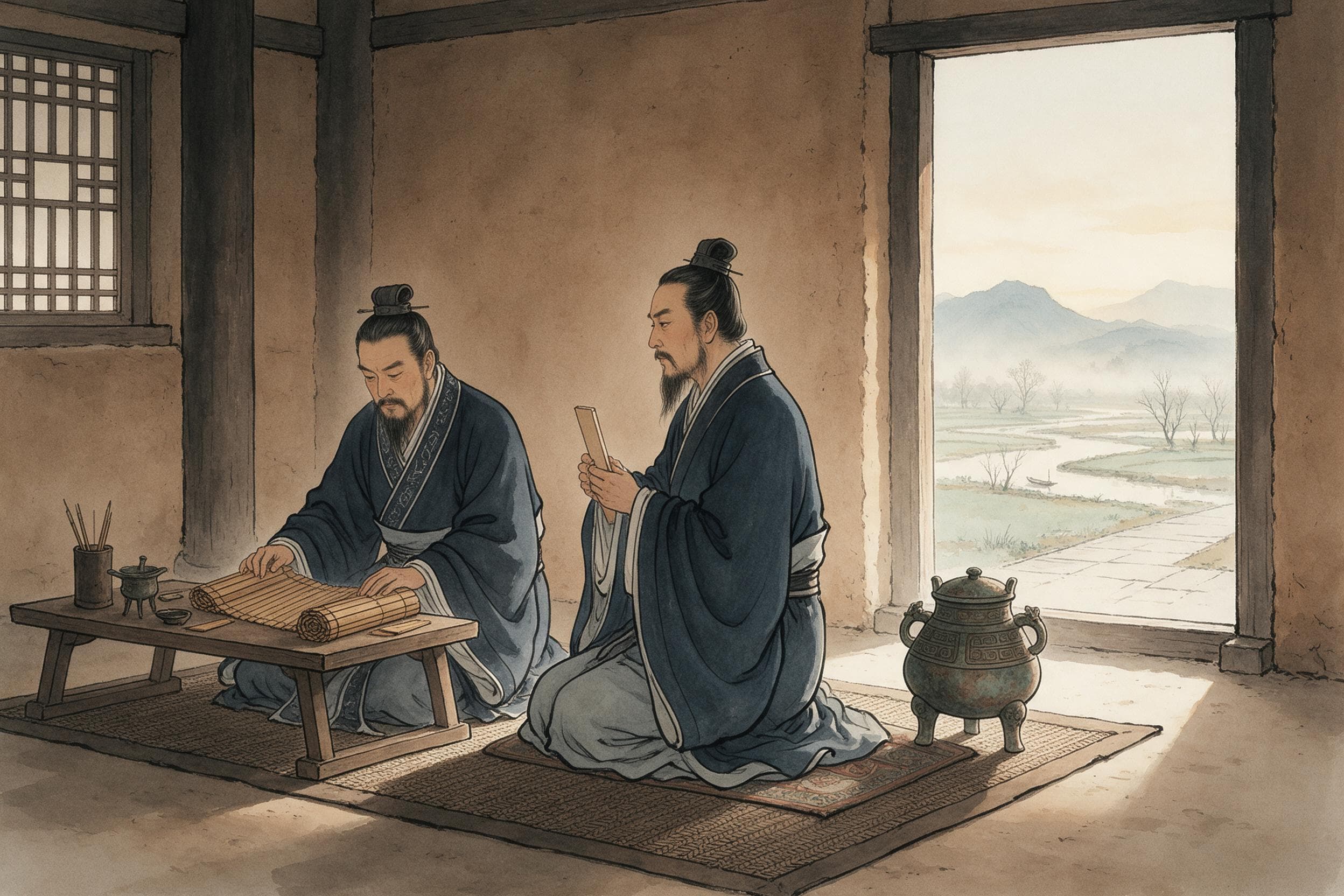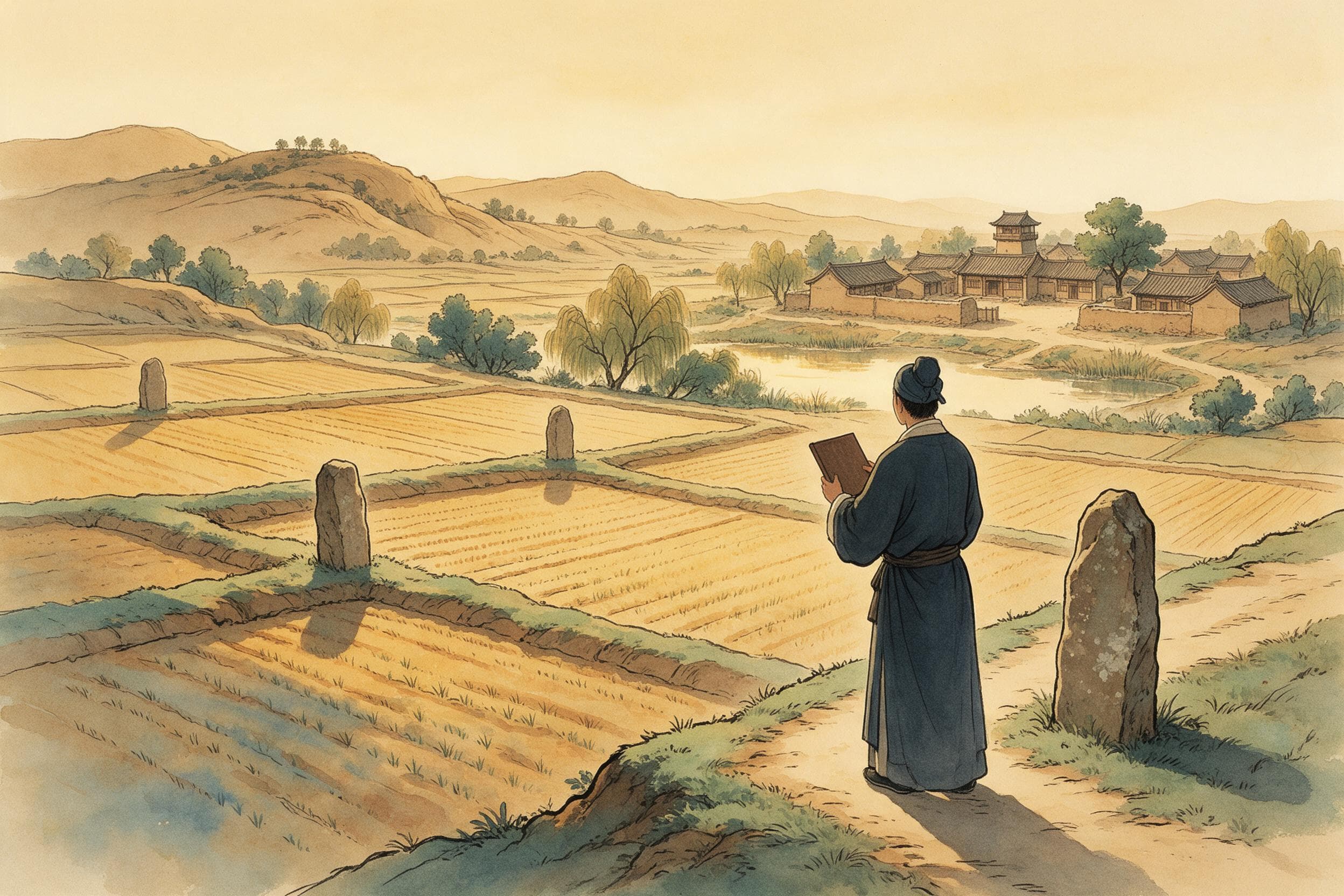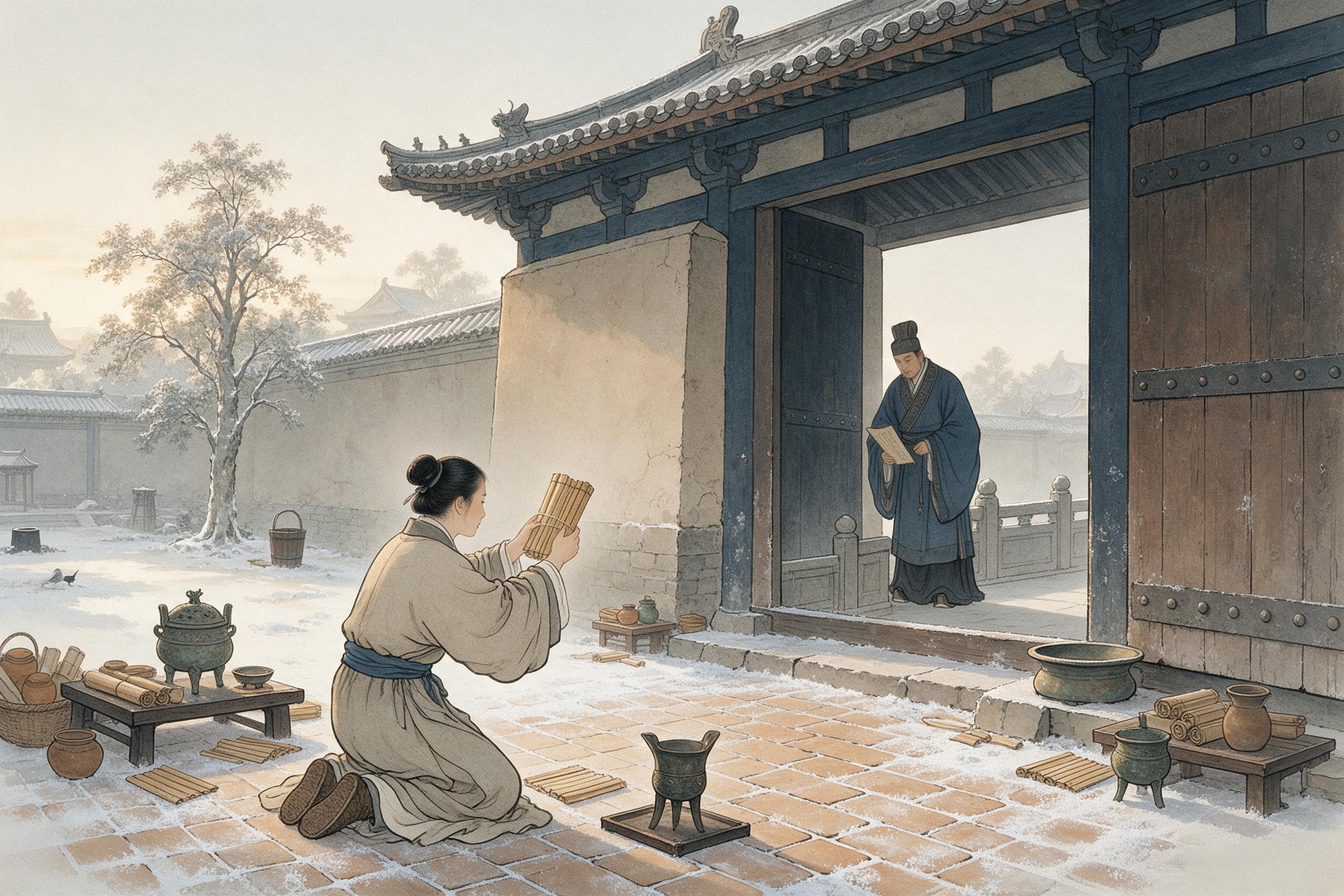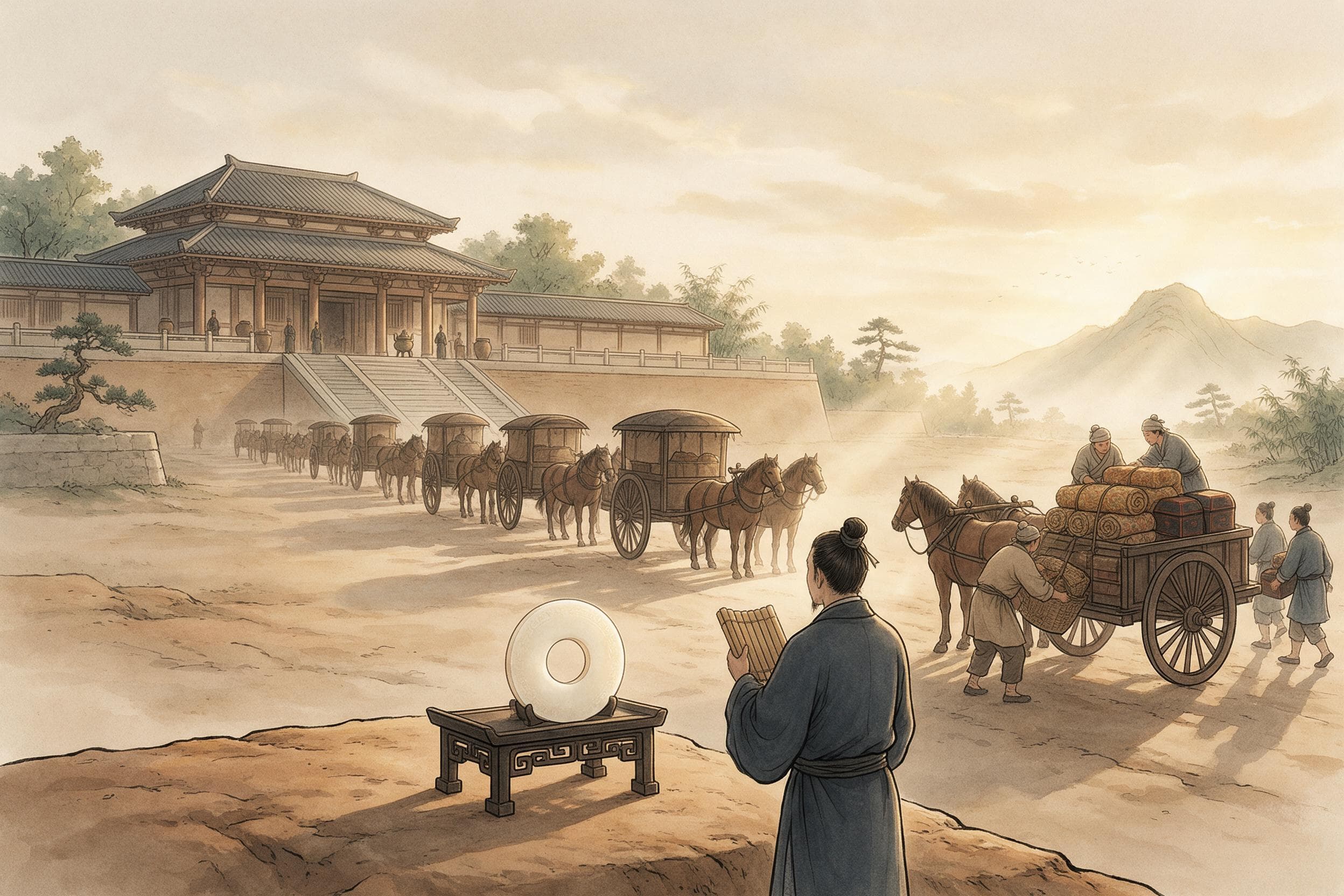
Before Su Qin leaves for the other courts, the king of Zhao equips him. The list says precisely what a persuader needs: a hundred carriages with their fittings, a thousand yi (溢) of gold, a hundred pairs of white jade, a thousand chun (純) of brocade and embroidery — all of it 'to conclude the alliances' (以約諸侯). The Shiji puts the gold between the carriages and the jade, one item in a line of four. It does not say whether the gold was weighed, stamped, coined or wrapped. It is a number in a list, and the list is the scene.
The passage stands in the Shiji (史記), in the chapter on Su Qin (卷六十九·蘇秦列傳), written by Sima Qian in the Western Han. Su Qin is a Warring States persuader moving between the courts of Yan, Zhao and Qin; the text about him is Han, and its long speeches are period rhetoric set down by a later historian. It is read here as a text, not as a transcript. What the chapter supplies is a set of gold amounts and the situations that produce them: a ruler's gift, a traveller's fund, a family quarrel.
A Thousand Yi on a List
In this chapter gold is counted by the yi. At Zhao the number is a thousand, and the gold is not the first gift: at Yan the king had already supplied 'carriages, horses, gold and silk' (資蘇秦車馬金帛) to send the persuader to Zhao at all. Later, once the alliance is sworn and Su Qin comes home in state, he 'scattered a thousand jin of gold among his clan and friends' (散千金以賜宗族朋友). He also settled an old debt: he had borrowed 'a hundred cash' to finance the first journey, and 'repaid it with a hundred jin of gold' (以百金償之). His sister-in-law, one of the relatives who had laughed at his failure, explains her new deference — 'because I see the youngest is high in rank and has much gold' (見季子位高金多也).
Gold in a Bag, Gold in a Story
These are amounts inside a story, and the story never converts them. The hundred cash and the hundred jin stand in one sentence, and the text claims no rate between them; it says only that the repayment was generous. Nor is there a gold coin anywhere in the chapter. Gold is counted, carried, given and displayed — the substance of a gift and, to the relatives who had laughed at him, a sign of standing. The persuasion itself is argued in chariots, soldiers, grain and terrain, never in gold.
Two Classes of Money
The sentence that puts gold into a system is in the Han shu (漢書). In the Treatise on Food and Money (食貨志), Ban Gu writes of the Qin settlement: 'Qin united the world, and money was made in two classes: gold, named by the yi, was upper money; the bronze coin, of the same substance as the Zhou coin, read 半兩 on its face and weighed according to its legend' (秦兼天下,幣為二等:黃金以溢為名,上幣;銅錢質如周錢,文曰「半兩」,重如其文). The Shiji's Treatise on the Balanced Standard has the same rule in slightly different words: gold, 'named by the yi, was the upper coin' (黃金以溢名,為上幣).
Two things follow from that sentence; one does not. What follows: gold is classified as money, and as the higher of two classes — shang bi (上幣), upper money, against xia bi (下幣) below. What does not follow is any account of what makes it upper. No weight, no fineness, no rate against the coin, no list of what it buys. The same passage closes the category as tightly as it opens it: 'pearl, jade, turtle shell, cowrie, silver and tin were made into ornaments and treasures and were not money' (而珠玉龜貝銀錫之屬為器飾寶臧,不為幣). In this account money is two things only.
At the treatise's opening Ban Gu defines the word itself: 'goods (貨) means cloth and silk that can be worn, and gold, knives, turtle shell and cowries, by which wealth is divided, profit distributed and surplus and want connected' (貨謂布帛可衣,及金刀龜貝,所以分財布利通有無者也). Gold is inside the definition, named first in the list, and the sentence is Ban Gu's own framing, set down some three centuries after the Qin it describes.
A Square Inch, One Jin
One passage does give gold a measurement. The Han shu credits Tai Gong (太公) with a coinage law for Zhou: 'gold a square cun in size weighed one jin; the coin was round and enclosed a square, its light and heavy reckoned in zhu; cloth was two chi two cun wide and four zhang to the bolt. Thus among goods gold was the treasure' (太公為周立九府圜法:黃金方寸,而重一斤;錢圜函方,輕重以銖;布帛廣二尺二寸為幅,長四丈為匹。故貨寶於金). A size and a weight in one clause — as close as these pages come to a specification. The attribution to Tai Gong is the treatise's own retrospective, and no part of the clause is a measurement of surviving metal.
Two gold units then stand side by side, unbridged. Gold is 'named by the yi' in the Qin rule, and weighed by the jin in the Zhou law and in a bare clause about the Han founding — 'when Han arose… gold one jin' (漢興…黃金一斤), which the Shiji's parallel gives as 'one gold, one jin' (一黃金一斤). Neither history says how many jin make a yi, or whether the yi was a weight at all. The text does not supply the bridge, and this article will not build one.
The treatise also asks why gold is valued, and answers with the ruler. Quoting a memorial by Chao Cuo (晁錯): 'pearl, jade, gold and silver cannot be eaten when hungry nor worn when cold, yet the multitude values them because the ruler uses them. As objects they are light and easy to store, they fit in the hand, and they can travel the whole world' (夫珠玉金銀,飢不可食,寒不可衣,然而眾貴之者,以上用之故也…可以周海內). The same memorial urges a wise ruler to value grain and despise gold and jade: the explanation of gold's worth is delivered as an argument against prizing it.
Nor are the treatise's metals all gold. An official proposal under Emperor Wu ranks them: 'gold has three grades: yellow gold is the highest, white gold the middle, red gold the lowest' (金有三等,黃金為上,白金為中,赤金為下). The same proposal then has white metal cast from silver and tin (銀錫白金). So jin (金) in these pages can name metal in general; huang jin (黃金) is the yellow one, and it is graded, not weighed.
What the Pages Do Not Supply
Neither history gives a fineness, a circulating quantity or an exchange rate for the Warring States; neither reports gold being weighed at a market, and neither describes a gold coin. What they give is a run of occasions: a king's gift, a traveller's fund, a repayment, a distribution among relatives, a class in a two-part system, a grade in a three-part list, a square cun of metal called a jin. Even the unit is a word without a size. A reader who wants to know what a yi of gold could buy is asking these pages for something they do not contain.
Put the two habits of speech together and the picture is narrow, but it is consistent. In the narrative, gold is an amount that moves between people, always part of a larger gift; in the treatise, it is a category the state assigns — upper or lower, yellow or white or red. Between the amount and the category sits the yi, named and undefined. That gap is not a hole in the evidence to be filled from elsewhere. It is what the evidence is.
Related reading:The Garrison Farm: Zhao Chongguo's Account at Huangzhong · What a King Gave: Two Lists of Reward · The Cash Box: How a Warring States Market Ran
Sources & further reading
- 司马迁《史记》卷六十九·苏秦列传(西汉;维基文库本,未与点校本复核) — The Zhao king equips Su Qin with a hundred carriages, a thousand yi of gold, a hundred pairs of white jade and a thousand chun of brocade 'to conclude the alliances'; the same chapter has Su Qin scattering a thousand jin of gold, repaying a hundred cash with a hundred jin, and his sister-in-law's 'high in rank and much gold'. The unit and the story are given; no weight, coin or rate is.
- 班固《汉书》卷二十四·食货志(东汉;维基文库本,未与点校本复核) — The Qin rule that money was made in two classes, with gold 'named by the yi' as upper money and the banliang coin as lower; the exclusion of pearl, jade, shell, silver and tin from money; Tai Gong's law with 'gold a square inch weighed one jin'; the bare 'gold one jin'; Chao Cuo's memorial on why gold is valued; and the three grades of metal.
- 司马迁《史记》卷三十·平准书(西汉;维基文库本,未与点校本复核) — The parallel account of the Qin two-class rule in slightly different wording ('gold, named by the yi, was the upper coin'), the same bare 'one gold, one jin', and the three grades of metal with yellow gold highest.