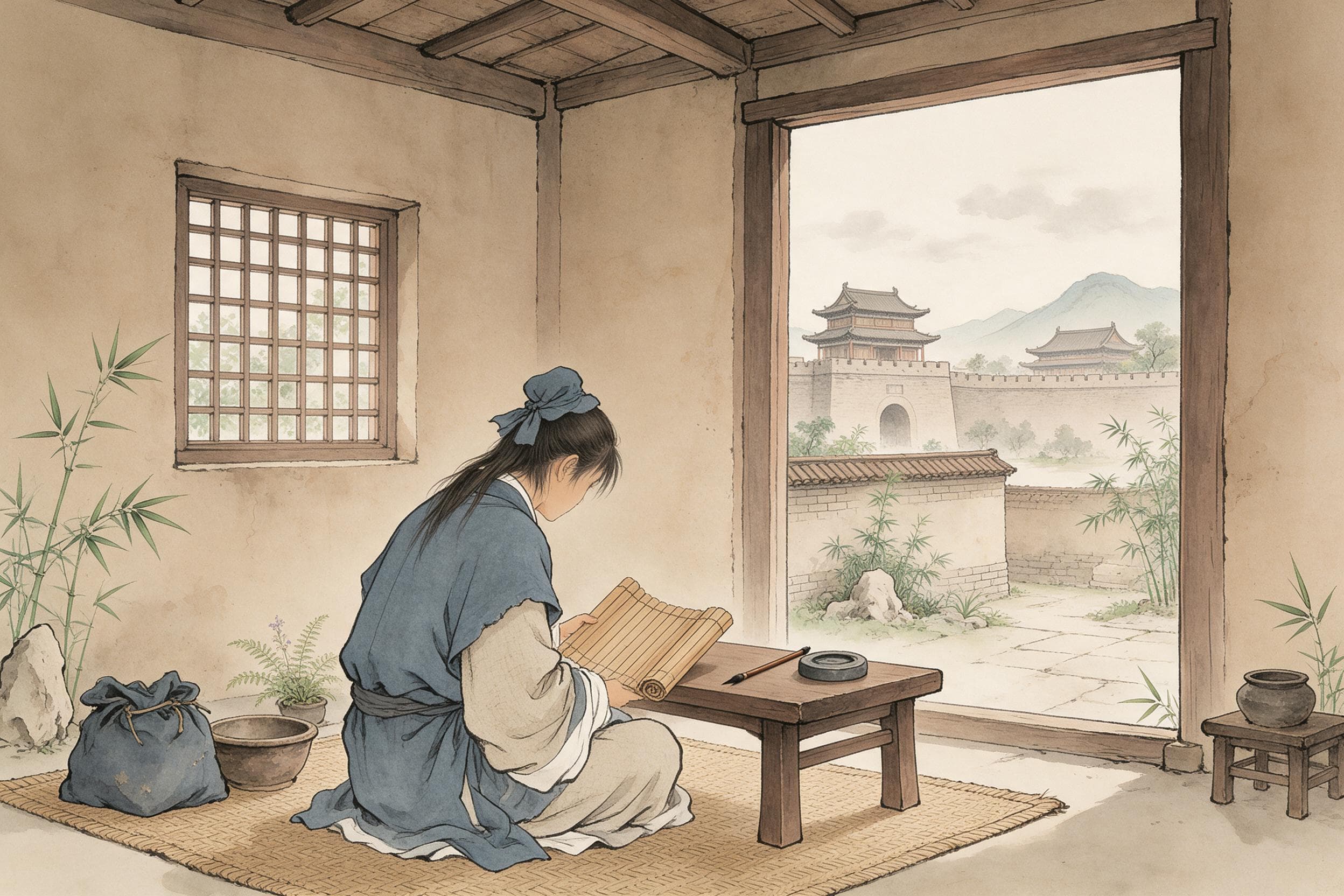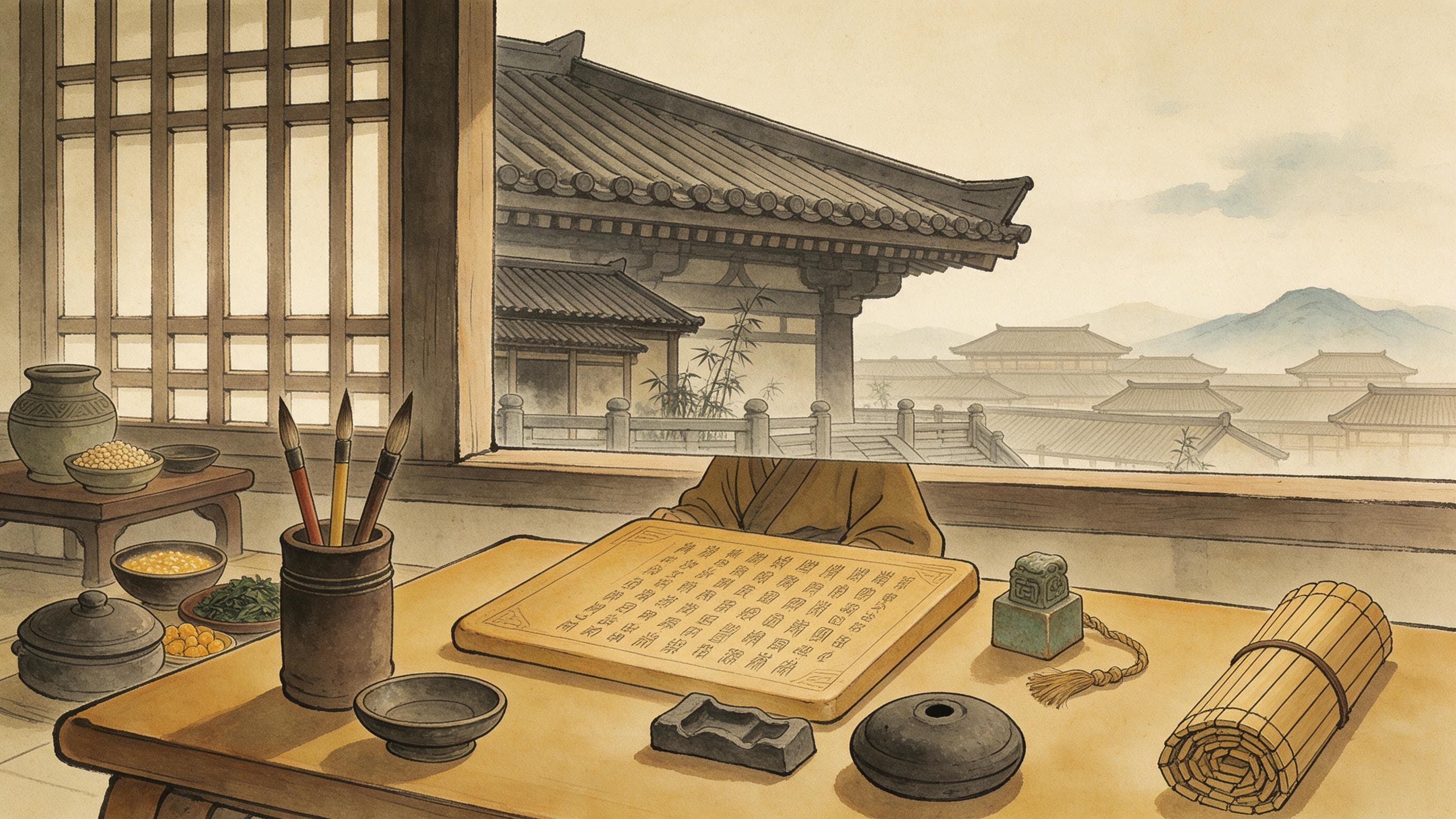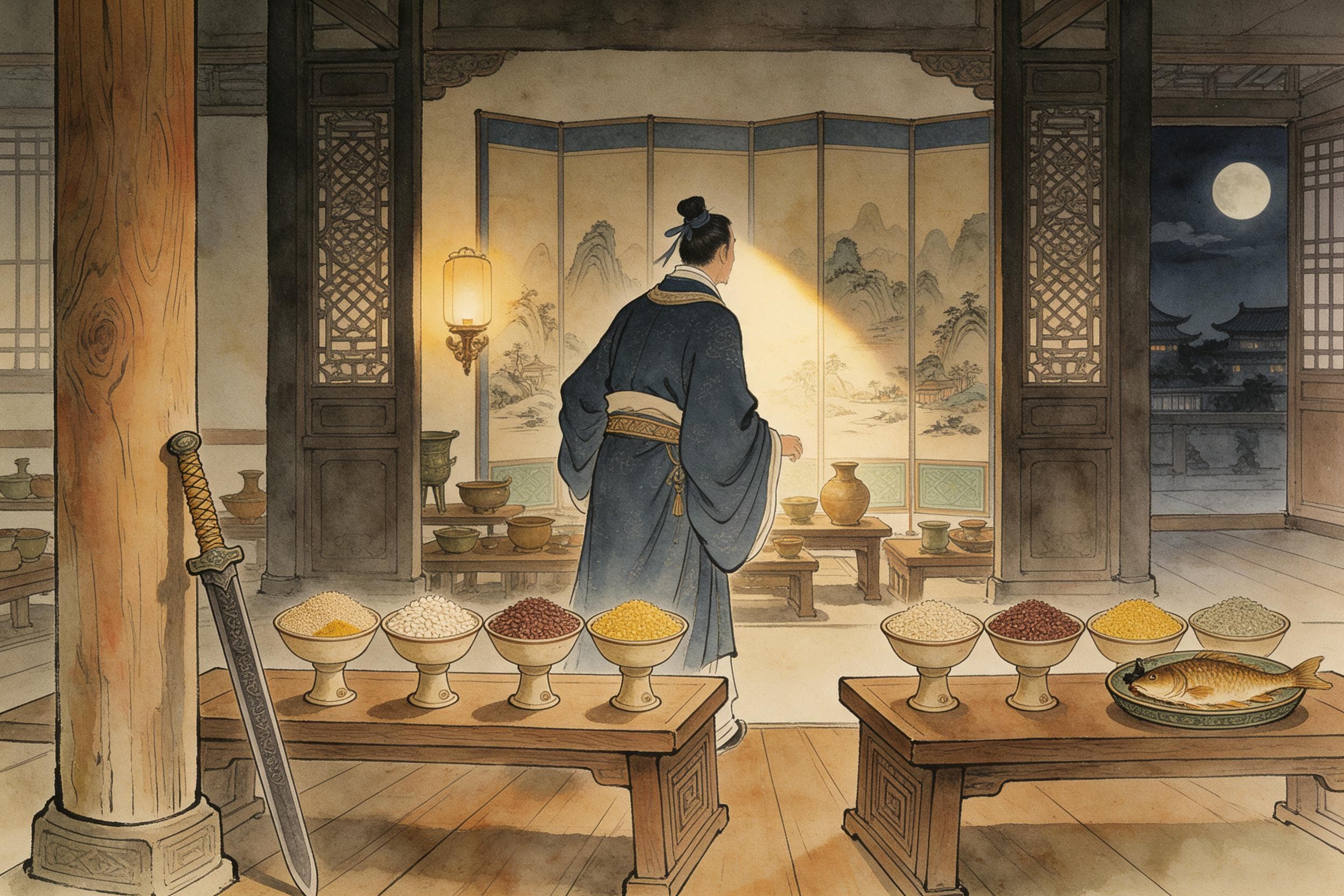
One night Mengchangjun, lord of Xue, was eating with a guest. Someone stood between the guest and the lamp, so that the guest could not see what his host's bowl held. Certain that the food was not the same, he put down his bowl and rose to leave. Mengchangjun got up, took his own bowl and held it beside the guest's to compare. The guest was ashamed and cut his own throat. The Shiji tells this as proof of how generously Mengchangjun treated men: the point of a meal was that everyone could see it was equal. Yet the same biography, with a second book, describes a table that was not equal at all.
Three thousand guests and a bill
The Shiji says Mengchangjun, born Tian Wen, gathered at Xue 'lords' guests and men who had committed crimes', lodged them and treated them well; 'the retainers who ate numbered several thousand, and high and low alike he treated as he treated himself, Wen.' The machinery of that equality is described: while he sat talking with a guest, a clerk behind a screen wrote down what was said and where the guest's relatives lived; when the guest left, greetings and gifts had already gone to his family. As a young man he reproached his father in the same terms: 'your rear chambers tread on figured silk while your scholars do not get a short jacket; your servants and concubines have grain and meat to spare while your scholars are not filled with husks and chaff.'
Feeding several thousand people had a price. Mengchangjun was chancellor of Qi and held ten thousand households in Xue, and still, the Shiji says, 'the income of the fief was not enough to support the guests, so he had money lent out in Xue'. A year passed and little came in: 'many of those who had borrowed could not pay the interest, and the guests' provisions were about to fail.' He sent Feng Huan (冯驩; the Zhanguo ce writes the name 冯谖) to collect. Feng took the interest — 'a hundred thousand cash', the text says — brewed wine, bought cattle, called in the debtors and burned the tallies of those who could not pay, explaining that the loans were made 'because the people had nothing to start their work with, and the interest was asked because there was no other way to support the guests.'
The ladder in the Shiji: three hostels
When Feng Huan first arrived he was poor, with one sword and a worn cord on its hilt. Mengchangjun 'lodged him in the relay hostel for ten days', under a hostel officer. Feng leaned on a post, plucked the sword and sang: 'Long sword, let us go home — there is no fish to eat.' He was moved to the favoured hostel, 'and there was fish.' Five days later the song changed: 'Long sword, let us go home — there is no carriage to go out in.' He was moved to the third hostel, 'and went in and out in a carriage.' Then came the third song: 'Long sword, let us go home — there is nothing to support a family.' This time 'Mengchangjun was not pleased.'
The Zhanguo ce tells it differently, and the differences matter. It has no named hostels at all. Feng Xuan is first fed 'coarse fare' (草具) because the attendants saw that their lord thought little of him. The first song brings the order to 'feed him as one of the guests of the house'; the second, 'make a carriage for him as one of the carriage guests'; the third — 'nothing to support a family' — brings not displeasure but a question: 'Has Master Feng relatives?' 'He has an old mother.' 'Mengchangjun sent them food and use so that they lacked nothing. After that Feng Xuan sang no more.'
What the ranks were called
The ladder changes shape between the books. The Shiji has three named hostels and an officer, the 'hostel chief', who tells Mengchangjun what a guest is doing. The Zhanguo ce has no hostel names: only 'the guests of the house' and 'the carriage guests', comparisons to existing grades, plus the initial 'coarse fare'. The grades become a menu only in commentary: the twelfth-century scholar Bao Biao (鲍彪) quotes a lost Biographies of Retainers (《列士传》): 'Mengchangjun's kitchen had three rows: the upper guests ate meat, the middle guests ate fish, the lower guests ate vegetables.' That sentence is in neither base text; it is a note quoting a book that no longer exists.
With that note, 草具 becomes legible: vegetables, no meat. But the base texts say only 'coarse fare' and 'there was fish'. No quantity, no grain measure, no cloth, no money appears anywhere on the ladder. What a guest received was lodging, a place at table, and the visible sign that went with it. The fish in this story is not a foodstuff; it is a rank made edible.
Fish, a carriage, a mother
Each rung was something other people could see: fish in the bowl, a carriage at the gate, an old mother sent food and use. Household and town could read from those signs where a man stood. The Shiji makes the same point from the bottom, with the men it calls the dog thief and the cock crower: when Mengchangjun was held in Qin, it was a man in 'the lowest seat' who stole the white fox fur, and another of 'the lower seats' who crowed like a cock and got the pass opened at dawn. 'The guests had all been ashamed of them; after that, they were convinced.' Seating did not measure ability; it measured position, and the story knows the difference.
Nor was the ladder a career. The third request is the episode the two books handle most differently: the Shiji records displeasure, the Zhanguo ce records an old mother fed. Later, when the household needs someone to collect the debts in Xue, the hostel chief reports that the guest in the third hostel 'has a good appearance and a ready tongue, is an elder, and has no other skill; he could be sent to collect the debt' — the same man who had sung for fish. The story's interest is not promotion. It is that once the signs were handed out, everyone took them as due.
What the story is not
Neither book is a household account. The Shiji was written by Sima Qian in the Western Han, more than two centuries after these events; the Zhanguo ce was edited by Liu Xiang in the Western Han from earlier materials, most of them speeches and anecdotes. Both are Han books about Warring States people. Their numbers — 'several thousand', 'three thousand' — are round; the same chapter uses both. There is no roster, no ration, no wage and no price. What the two versions agree on is small: a house with graded lodgings, food that marked the grade, and a client who kept asking until the signs were raised. They disagree on the names of the grades, on the wording of the songs, and on what the third request brought. This piece keeps the two tellings side by side, unsewn.
Which brings the story back to the night meal. The guest killed himself not because the food was bad but because he could not see whether it was the same; only when the host held his own bowl beside it did the difference, or its absence, become visible. What the sources record is not a wage scale but the visibility of rank at a shared table. Three thousand remains a number in a story. The thing these pages actually measure is a position — and in one version, the position was worth a fish.
Sources & further reading
- 司马迁《史记》卷七十五·孟尝君列传(西汉;维基文库本,未与中华书局点校本复核) — Western Han history by Sima Qian, written more than two centuries after the events. The chapter claims that Mengchangjun kept 'several thousand' guests and treated high and low alike as himself, tells the night meal at which a guest, unable to see his host's bowl, took offence and killed himself, describes the clerk behind the screen who recorded conversations and the gifts sent to guests' families, and states that the fief's income could not support the guests so that money was lent out in Xue. It gives the three hostels (chuanshe, xingshe, daishe) with an officer over them, Feng Huan's songs for fish, a carriage and a family, the debt collection in Xue and the burning of tallies, and the cock-crow and dog-thief episode. It is a story, not a household account: no roster, no rations, no wages.
- 《战国策》卷十一·齐四·齐人有冯谖者(西汉刘向编定;士礼居丛书本,维基文库录文) — Western Han edition by Liu Xiang of earlier Warring States materials. The chapter tells the same episode differently: Feng Xuan is first fed 'coarse fare' (cao ju); the first song brings the order to feed him 'as a guest of the house', the second a carriage 'as a carriage guest', and the third an inquiry after his old mother, who is given food and use. It has no hostel names, and it gives the debt collection and burning of tallies. Bao Biao's twelfth-century commentary, quoted here only as commentary, cites a lost Lishi zhuan for 'three rows' in the kitchen (upper guests meat, middle guests fish, lower guests vegetables); that sentence is not in either base text.