A square li of land cut into nine plots: eight around the edge, one to each household, a hundred mu apiece; the middle one the public field, worked by all eight together. Only when the public work is finished may a man attend to his own. That is the well-field Mencius described to the state of Teng — described in a conversation, not measured off a field.
Benevolent Government Begins with the Boundaries
Duke Wen of Teng sent Bi Zhan to ask about well-fields, and Mencius began not with distribution but with boundaries: 'benevolent government must begin with the field boundaries. If the boundaries are not correct, the well-fields are uneven and the grain stipends unequal. That is why tyrants and corrupt officers always neglect the boundaries. Once the boundaries are correct, dividing fields and fixing stipends can be settled sitting down' (夫仁政必自經界始). The order of operations is the first thing he says: survey and mark the lines, then talk about who gets what.
Then the three dynasties' taxes: 'under the Xia each household had fifty mu and paid the gong; under the Yin seventy mu and the zhu; under the Zhou a hundred mu and the che. All were in fact a tenth' (夏后氏五十而貢,殷人七十而助,周人百畝而徹). Che is 'taking through', zhu is 'borrowing' — borrowing the people's labour for the public field. He quotes Longzi: no way of managing land is better than zhu, none worse than gong, because gong averages several years and fixes that as the constant; in a good year, when grain lies about in heaps, it takes less, and in a bad year, when manuring the field is not enough, it takes the full amount. Then the poem: 'Rain on our public field, and then on our private' (雨我公田,遂及我私) — only under zhu is there a public field, so 'even the Zhou used zhu'.
A Square Li Is One Well
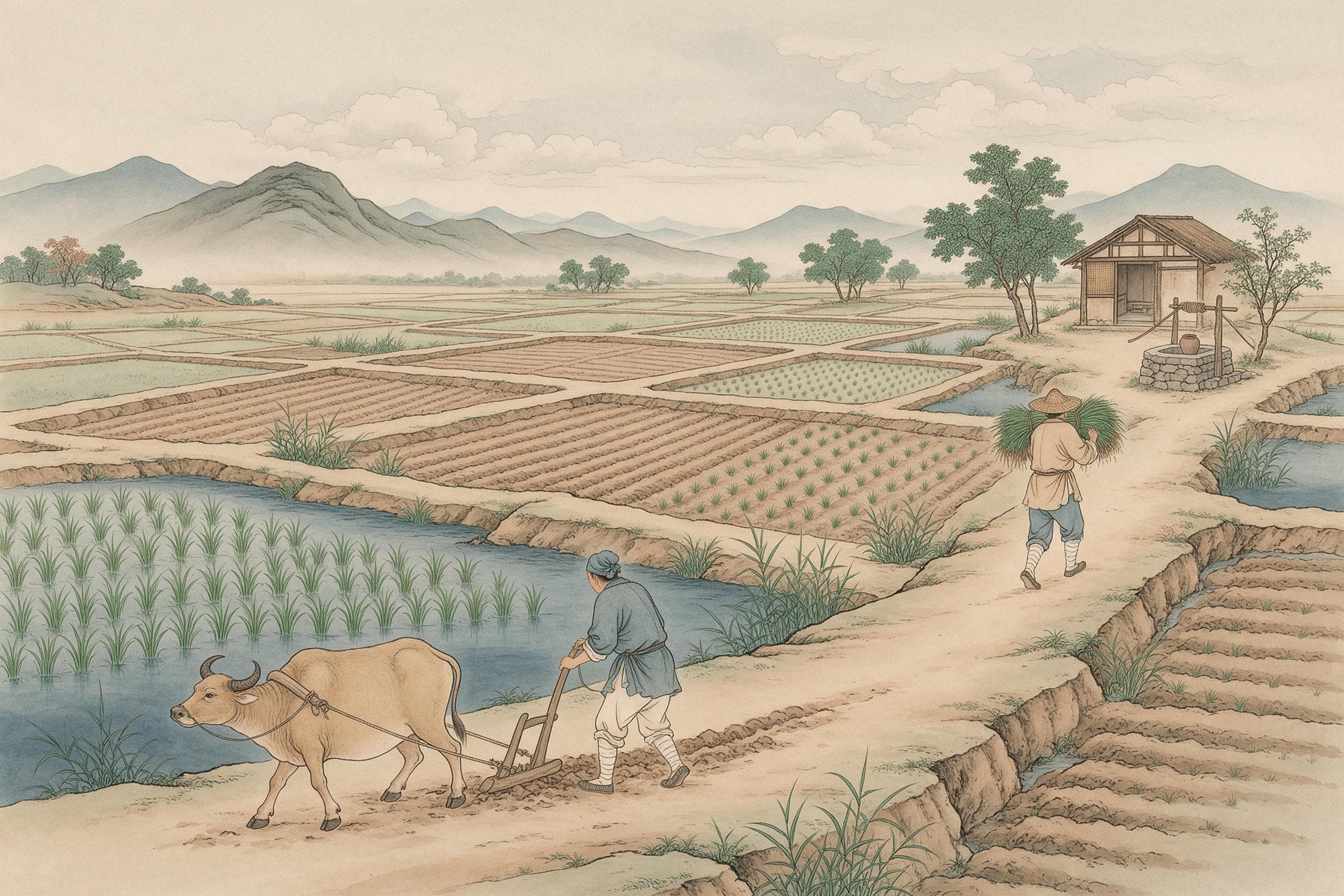
The scheme itself is brief: in the countryside one in nine, by zhu; in the capital region one in ten, self-assessed; from the ministers down a gui field of fifty mu, and twenty-five mu for a surplus son; in death and removal no one leaves the district, and those who farm one well share a village, companions going out and coming in, helping one another on watch and in illness. 'A square li is one well: a well is nine hundred mu, the middle is the public field, eight households each hold a hundred mu privately and together till the public field. Only when the public work is done dare they attend to private work — this is how the countryman is distinguished' (方里而井,井九百畝,其中為公田。八家皆私百畝,同養公田。公事畢,然後敢治私事,所以別野人也).
And the most important sentence comes at the end: 'this is the rough outline; the polishing of it is up to the ruler and to you' (此其大略也。若夫潤澤之,則在君與子矣). The speaker is Mencius himself, the audience a minister of Teng, the content a scheme open to revision. So it is a well-field on paper, and whether Teng ever laid one out, the passage does not say and nothing else in these pages does either.
The Other Design in the Zhou Li
The Zhou li's earth offices set out fields on quite another arithmetic. The junior minister's duties read: 'he lays out the land and assigns the fields by well and pasture: nine households to a well, four wells to a settlement, four settlements to a mound, four mounds to a hunt-land, four to a district, four to a capital district, to assign the land's work and order the tribute and taxes' (九夫為井,四井為邑,四邑為丘,四丘為甸). Nine households, not eight; and above the well the ladder runs by fours. There is no public field here and no shared tillage: the well is simply the first link in a chain used to allot work and levy tribute.
The passage on the field officers is more concrete. Land is graded first, middle and third: 'first-grade land: one house plot, a hundred mu of field, fifty mu of fallow; a surplus son the same. Middle grade: a hundred mu of field, a hundred of fallow. Third grade: a hundred of field, two hundred of fallow' (上地,夫一廛,田百畝,萊五十畝). Then the drainage: 'a ditch between households with a footpath on it; for ten households a channel with a raised path; for a hundred a waterway with a road; for a thousand a larger channel with a highway; for ten thousand a river with a road, reaching the royal domain' (夫間有遂…十夫有溝…萬夫有川). And the settlements run in fives: five households to a neighbourhood, five neighbourhoods to a ward, four wards to a group, five groups to a district and so on.
The two sets of figures do not mesh. Mencius has eight households round one well and a hundred mu of public field in the middle; the Zhou li has nine households to a well and a ladder of fours above it. Mencius says nothing about ditches; the Zhou li's ditches are counted in tens, hundreds, thousands and ten thousands, which will not fit a nine-household square. Nobody has miscopied anybody: these are two different kinds of document — one a programme addressed to a ruler, the other the duty list of an office. Try to draw them as one map and the first line will not go down.
Was It Ever Done
Neither page offers evidence of execution. Mencius never says Teng carried it out, and he ends by calling the scheme an outline; the Zhou li is a design whose author and date are disputed, not a survey of any district. Whether the well-field was ever practised, and how far, is a strongly contested question, and this article does not settle it. Two things can be said: Mencius proposed such a scheme, and the Zhou li designed such a system. Where the ridges actually ran, neither page says.
Nor may it be written up as ancient equal shares of land. In Mencius's scheme the noble and the countryman are carefully separated — the closing clause is precisely 'this is how the countryman is distinguished' — ministers and below hold gui fields, a surplus son gets twenty-five mu, and the eight households of a well are not the only ranks involved. Land is allotted by status and household, not equally. That is the part most easily lost when the scheme is retold: 'eight households a hundred mu each' sounds like equality, but the scheme itself is written to mark a difference.
What Is Not Here
No conversion of mu — and none into square metres; no figures for yields, rations or tax rates; no map of boundaries that fits both books; not one record of enforcement. Nor do the pages make clear whether the 'well' is a physical feature — a water well, a nine-square pattern of ridges — or a unit of account. Mencius only says 'a square li is one well'. On the question of the well-field on paper, what these two pages give is exactly paper: one programme, one set of offices, and no ridges.
Related reading:Smiting the Martial Yin: A Campaign in a Sacrifice Ode · A Thousand Jin at Tenfold: Wartime Lending and Wang Mang's Credit Order · The Guild Elder and the Matchmaker: How Song Cities Hired People
Sources & further reading
- 《孟子·滕文公上》(战国;维基文库本,未与点校本复核) — The only passage where the 'well-field' is described. Duke Wen of Teng sends Bi Zhan to ask about well-fields, and Mencius answers: benevolent government must begin with the field boundaries (夫仁政必自經界始), because if the boundaries are wrong the fields are uneven and the grain stipends unequal. He then states the scheme: in the countryside one in nine, by zhu (assisting with labour on the public field); in the capital region one in ten, self-assessed; gui fields of fifty mu for the ministers and below; twenty-five mu for a surplus son. 'A square li is one well: a well is nine hundred mu, the middle is the public field, eight households each hold a hundred mu privately and together till the public field; only when the public work is finished dare they attend to private work — this is how the countryman is distinguished' (方里而井,井九百畝,其中為公田。八家皆私百畝,同養公田). He closes: 'this is the rough outline; the polishing of it is up to the ruler and to you' (此其大略也). The page gives no place, no date, no survey and no evidence that Teng adopted it.
- 《周礼·地官司徒》(作者与成书年代有争议;维基文库本,未与点校本复核) — A design for offices, not a record. The junior minister (小司徒) 'lays out the land and assigns the fields by well and pasture: nine households to a well, four wells to a settlement (邑), four settlements to a mound (丘), four to a hunt-land (甸), four to a district (縣), four to a capital district (都)' (九夫為井) — a four-based ladder that starts from nine, with no public field mentioned. The 遂人 divides land into first, middle and third grade, each household getting a house plot, a hundred mu of field and fifty, a hundred or two hundred mu of fallow (萊); and sets the drainage: a ditch between households, channels for ten, watercourses for a hundred, larger channels for a thousand and a river for ten thousand, each with a path or road on its bank (夫間有遂…十夫有溝…萬夫有川). The rural chain of settlements is five-based (五家為鄰…五縣為遂). The page is a manual of offices and contains no executed survey, no date and no locality.