The poem opens like a dispatch: 'He smote that martial Yin; it fiercely attacked Jing and Chu.' It went deep into their strongholds and gathered the hosts of Jing. Then the last stanza leaves the campaign altogether and climbs a hill to cut pines and cypresses, square the rafters, raise rows of pillars — 'the chamber finished and deeply at peace' (寢成孔安). A war at the start, a temple at the end; the ending is what tells you what kind of sentence the opening is.
Whose Sacrifice It Is
'Yin Wu' is the last ode in the Shang hymn group of the Book of Songs, and the Mao preface disposes of its purpose in one line: 'The Yin Wu is a sacrifice to the Exalted Ancestor' (毛詩序:《殷武》,祀高宗也). Who was the Exalted Ancestor? The Shiji's account of Wu Ding says that after his death Zu Ji, admiring how the king had made a portent into a matter of virtue, 'established his temple and named him Exalted Ancestor' (立其廟為高宗). The two pages meet here: a hymn for Wu Ding's sacrifice, placed last among the Shang odes.
When the Shang odes were made is disputed. An older view takes them as Shang work; another takes the group as ancestral songs of the state of Song — descendants of the Shang, sacrificing to Shang kings — composed perhaps as late as the Spring and Autumn period. This article records both views and settles neither. What matters either way is that it is a song sung in an ancestral hall, not a report sent to a scribe. A text meant for a choir in a hall has other duties than a record: it must fit the order of a rite, name the ancestor's deeds, and come to rest where the rite comes to rest.
The Campaign in the Poem
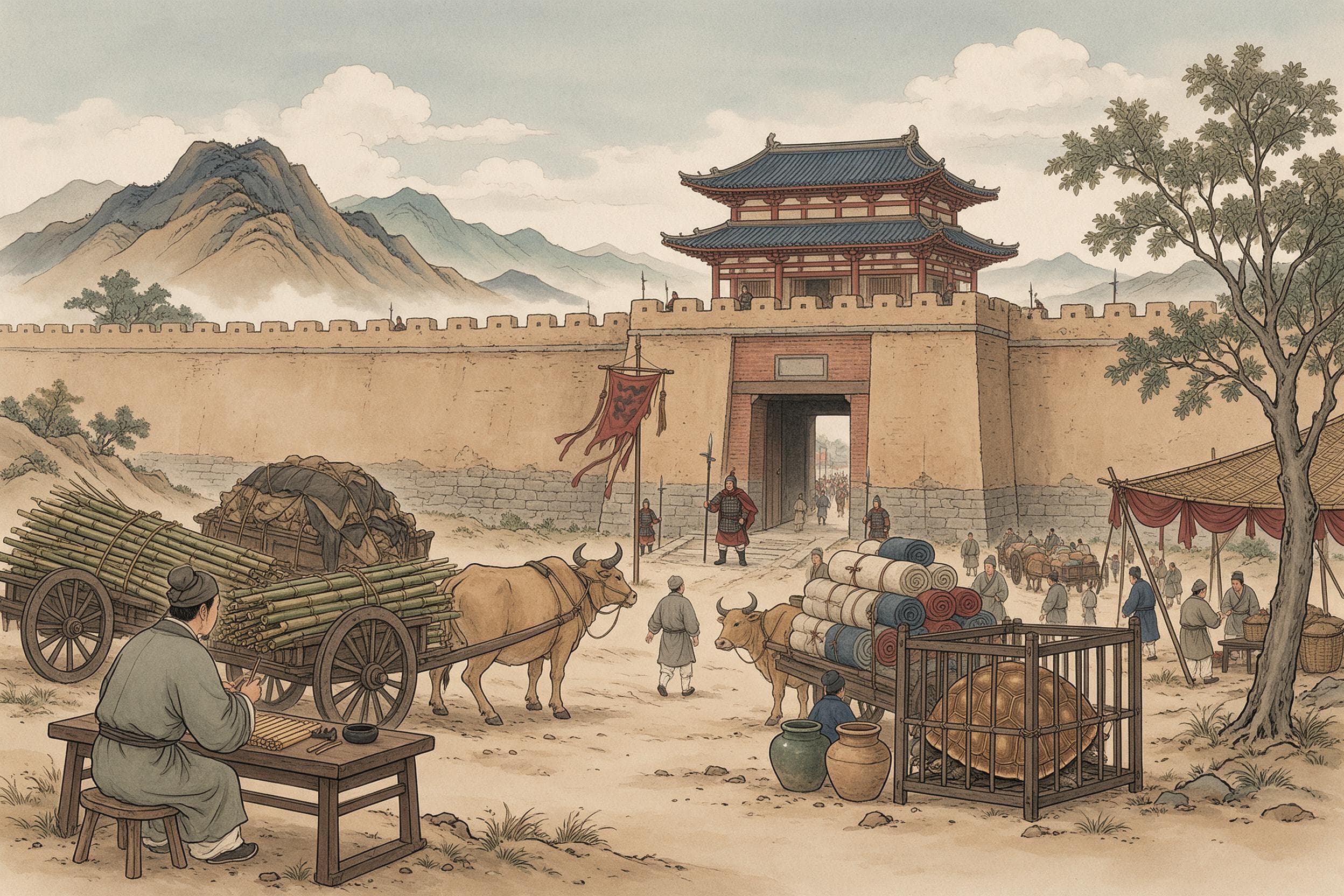
The first two stanzas move fast: 'He smote that martial Yin; it fiercely attacked Jing and Chu. It penetrated deep into their strongholds and gathered the hosts of Jing. Their ground was cut out and ordered — the work of Tang's descendant' (撻彼殷武,奮伐荊楚。罙入其阻,裒荊之旅。有截其所,湯孫之緒). Then the poem gives only a direction: 'You, Jing and Chu, dwell in the southern quarter of the realm.' Where that was, how far, which road the army took — the ode does not say.
From the south the poem then reaches much further out: 'Of old there was Cheng Tang; even from the Di and Qiang none dared fail to come with offerings, none dared fail to come to court. This was the constant rule of Shang' (昔有成湯,自彼氐羌,莫敢不來享,莫敢不來王。曰商是常). And then: 'The Shang capital, majestic and ordered, is the pole of the four quarters.' By this point the campaign has been fitted into a frame of distant peoples coming to court; Jing and Chu are not the object of a campaign but a name that ought to have come and did not.
What the History Records
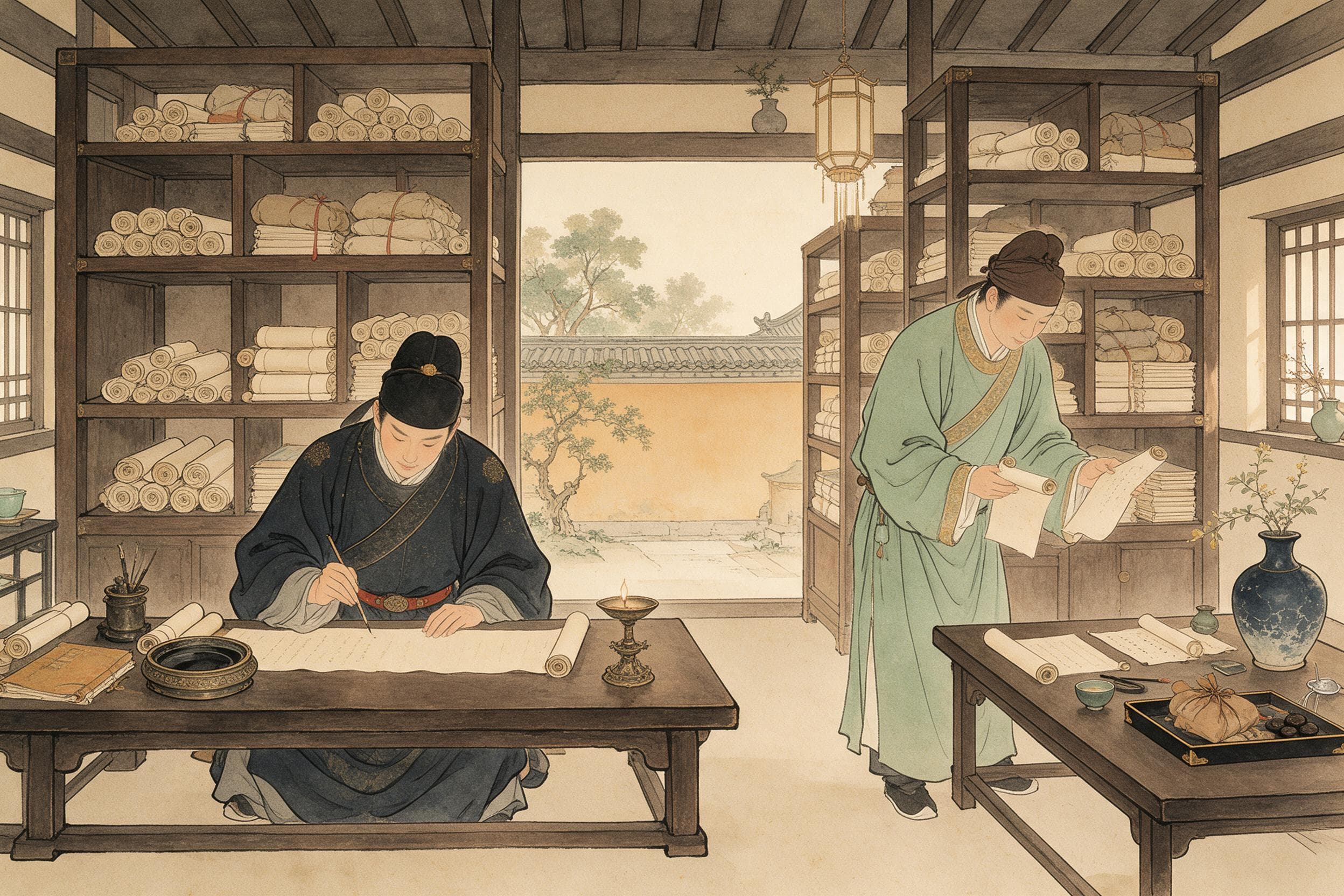
On the same reign the Shiji gives something else entirely. Wu Ding takes the throne thinking to revive Yin but without a helper; for three years he does not speak, and affairs are decided by the chief minister while he watches the customs of the state. He dreams of a sage named Yue, sends men to find him, and finds Fu Yue labouring on a wall at Fu Yan; made minister, 'the state of Yin was greatly governed'. Later, sacrificing to Cheng Tang, he sees a pheasant fly up and crow on the ear of a cauldron and is afraid; Zu Ji tells him not to worry but to put the government in order first, and admonishes him on heaven's mandate and the people's lot. The account closes: 'Wu Ding cultivated government and practised virtue; all under heaven rejoiced, and the way of Yin revived' (武丁修政行德,天下咸驩,殷道復興).
In that passage there is no Jing and Chu, no southern campaign, no battle of any kind. It is a story about finding the right man, hearing admonition, and mending the government, plus one omen read as a lesson. The ode speaks of power, the history of virtue: the hymn praises an ancestor's war in a temple, the chronicle records a dynasty's rise at a desk. They need not contradict each other; they are not answering the same question, and they cannot be stitched into a war report.
Why the Last Stanza Cuts Trees
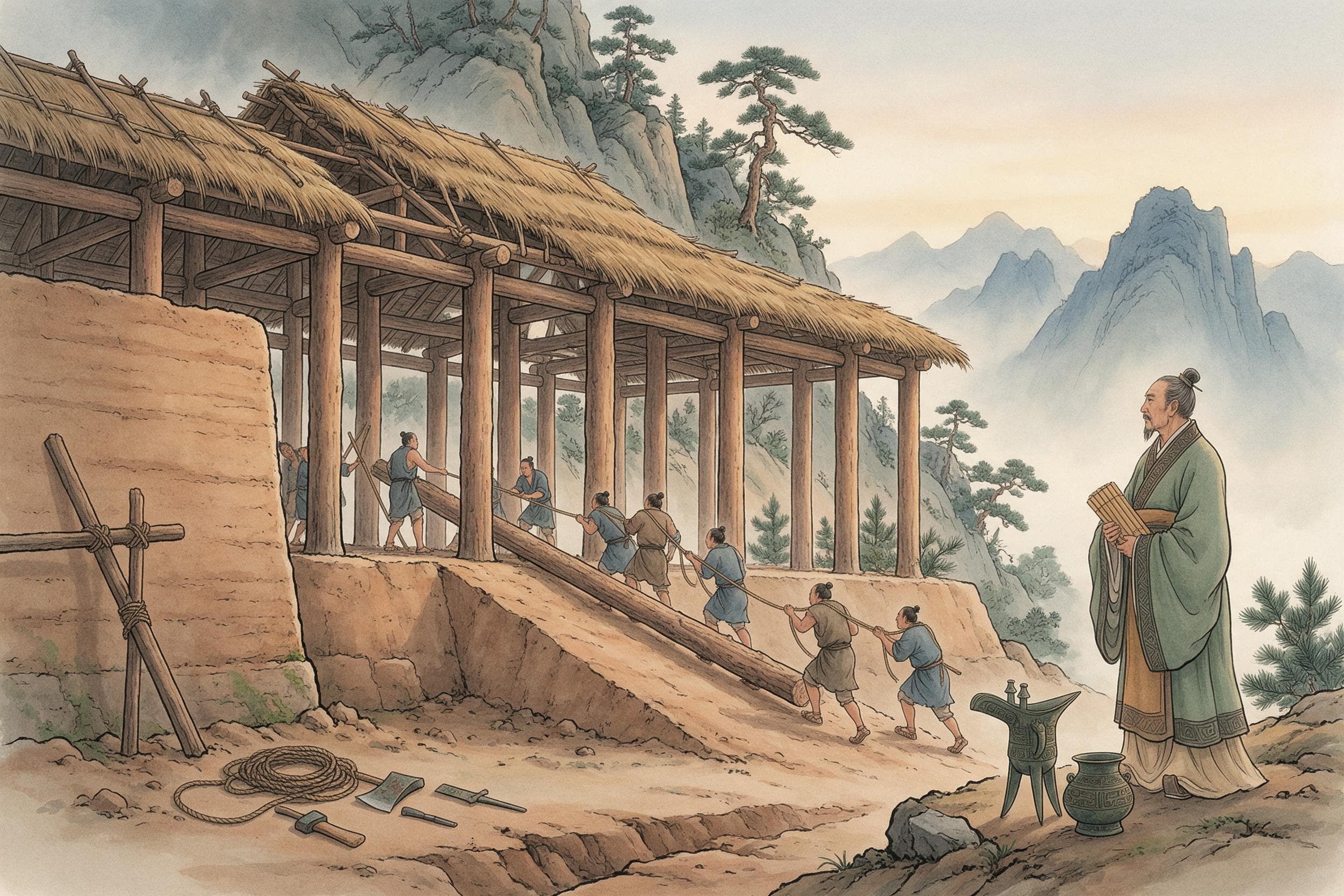
The final stanza walks away from the battlefield: 'They climbed Jingshan, where the pines and cypresses stand round and straight; cut and hauled, squared and shaped with care. Pine rafters long, rows of pillars firm — the chamber is finished and deeply at peace' (陟彼景山,松柏丸丸。是斷是遷,方斵是虔。松桷有梴,旅楹有閑,寢成孔安).
That is temple-building, not a record of merit, and it explains the poem's use. First the ancestor's war and the mandate he held, then the hall built for him. The Mao preface says the piece is a sacrifice to the Exalted Ancestor; the last stanza says the chamber is finished; the two agree. The six stanzas have a shape — campaign, submission, mandate, capital, then the temple — and it is a temple hymn that comes to rest on the completion of a building. The 'fierce attack on Jing and Chu' is therefore a line sung in a hall, not a bulletin from the front.
What Is Not Here
There is no year, no strength, no route, and no clear statement whether Jing and Chu were a state, a people or a region — the ode offers only the 'southern quarter'. No commander is named either; 'Tang's descendant' is as close as the poem comes to a person. There is no detail of victory, only that 'their ground was cut out and ordered'. The Shiji does not fill these gaps: its account of the reign does not contain the war at all. Whether oracle-bone inscriptions record such a campaign is not in either page used here, and this article does not reach for them to make up the difference.
So the question 'how far did Shang armies go' gets only half an answer from these pages. A hymn says they smote Jing and Chu and went deep into their defiles; a dynastic history says Wu Ding restored the way of Yin. Each sentence stands; together they do not make a route. What is solid is the gap itself: the same war is an ancestor's merit when sung in a temple and simply absent when the scribes list reigns. Ask how far Shang arms reached, and the first thing to ask is which kind of text you are holding.
Related reading:A Thousand Jin at Tenfold: Wartime Lending and Wang Mang's Credit Order · The Guild Elder and the Matchmaker: How Song Cities Hired People · Four Hundred Jin a Permit: The Price of Salt in Yuan China
Sources & further reading
- 《诗经·商颂·殷武》(维基文库本,含毛诗序;未与点校本复核) — One ode of the Shang hymn group, printed with the Mao preface: 'The Yin Wu is a sacrifice to the Exalted Ancestor' (毛詩序:《殷武》,祀高宗也). The poem opens with a campaign — 'he smote that martial Yin: it fiercely attacked Jing and Chu; it penetrated deep into their strongholds and gathered the hosts of Jing; their ground was cut out and ordered, the work of Tang's descendant' — places Jing and Chu 'in the southern quarter of the realm', reaches back to Cheng Tang and the Di and Qiang who 'dared not fail to come with offerings, dared not fail to come to court', calls the capital 'the pole of the four quarters', and ends not with a victory but with the building of a temple: pines and cypresses cut on Jingshan, rafters and pillars raised, 'the chamber finished and deeply at peace' (寢成孔安). The page gives the text and the preface only: no date, no campaign narrative, no names of commanders, no numbers.
- 司马迁《史记》卷三·殷本纪(西汉;维基文库本,未与点校本复核) — A Western Han dynastic narrative. Its account of Wu Ding (武丁) has him think of reviving Yin without finding a helper, keep silent for three years while the chief minister decided affairs, dream of a sage named Yue, find Fu Yue at Fu Yan and make him minister, receive the omen of a pheasant on the cauldron's ear, be admonished by Zu Ji, and then 'cultivate government and practise virtue, so that all under heaven rejoiced and the way of Yin revived' (武丁修政行德,天下咸驩,殷道復興). After his death Zu Ji, admiring how he made the portent a matter of virtue, 'established his temple and named him Exalted Ancestor' (立其廟為高宗). The chapter contains no campaign against Jing or Chu, no southern war at all for this reign, and gives no dates or numbers for any of it.