Yongzhou's tribute is three words: 'its tribute is qiu and lin jade and langgan' (厥貢惟球、琳,琅玕). Yangzhou's is longer: 'its tribute is gold of three grades, fine jade, bamboo great and small, ivory, hides, feathers and hair, and timber' (厥貢惟金三品,瑶、琨、篠簜,齿、革、羽、毛惟木). Every item is named; not one has a quantity. That is how the Yugong works: it turns the produce of the world into a list that can be read aloud.
First a Boundary for Each Province
The chapter opens: 'Yu spread the soil, followed the mountains and cut the trees, and fixed the high mountains and great rivers' (禹敷土,隨山刊木,奠高山大川). Then province by province, and each begins with a boundary: 'the Ji and the Yellow River make Yanzhou'; 'the sea and Mount Tai make Qingzhou'; 'the sea, Mount Tai and the Huai make Xuzhou'; 'the Huai and the sea make Yangzhou'; 'the Jing and the south of Mount Heng make Jingzhou'; 'the Jing and the Yellow River make Yuzhou'; 'the south of Mount Hua and the Black Water make Liangzhou'; 'the Black Water and the Western River make Yongzhou'. The lines are drawn with rivers and mountains — between two rivers, between sea and mountain. The number nine comes out of those sentences.
After the boundary come four things: soil, field, tax, tribute. Soil is colour and texture (Jizhou's 'white clay', Yanzhou's 'black rich earth'). Field and tax are each graded on a nine-step scale from highest to lowest, with 'mixed' (錯) where a province does not sit neatly in one grade. Jizhou is 'field middle-middle, tax highest-highest mixed' — its land only middling, its tax at the top; Yongzhou the reverse, 'field highest-highest, tax middle-low'. This is the most revealing layer: across one world, the grade of the land and the grade of the levy do not agree, and the ordering itself is a judgment.
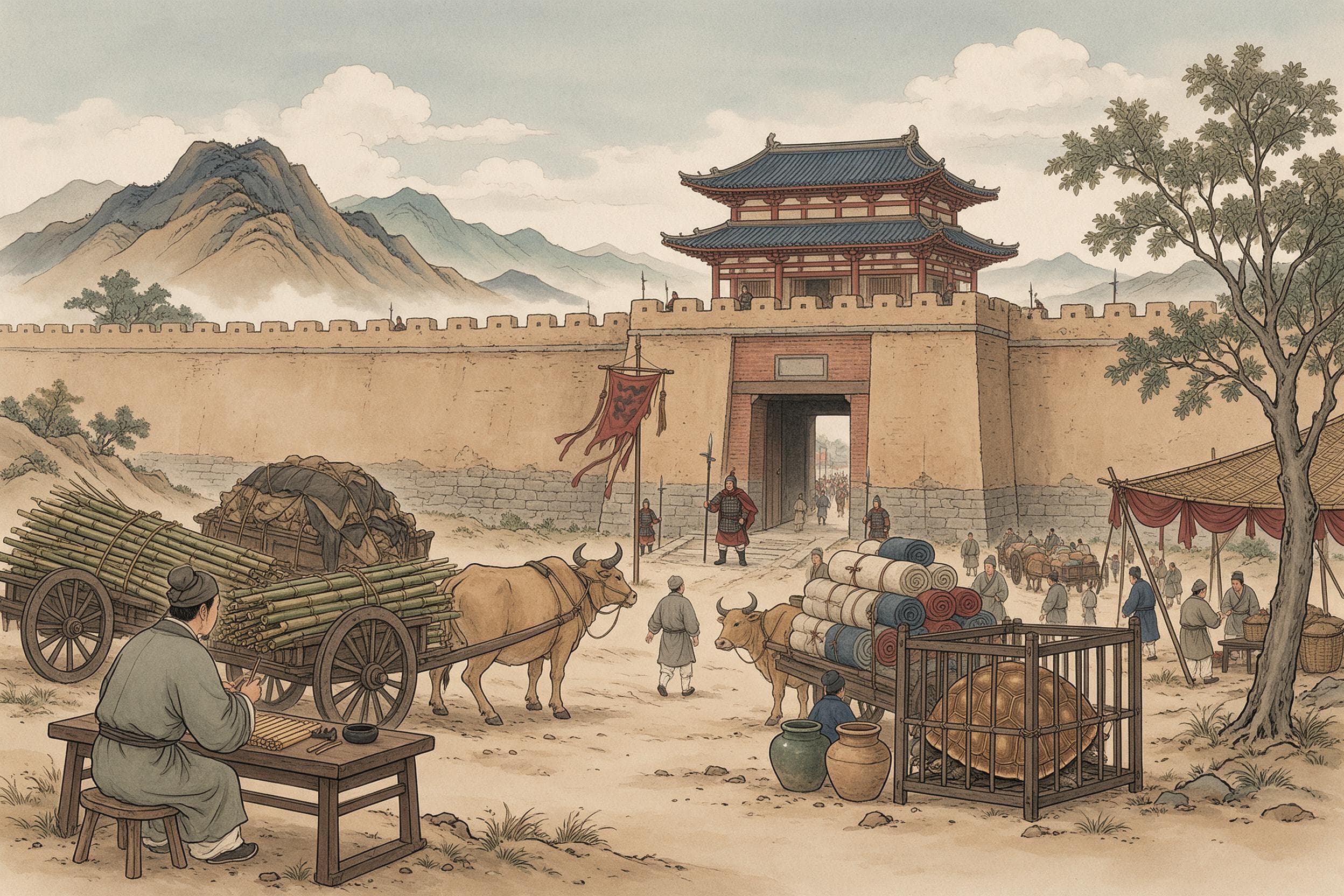
The goods are listed province by province, under 'tribute' (貢) and 'basket' (篚): Yanzhou 'lacquer and silk, and in the basket patterned cloth'; Qingzhou 'salt and fine hemp cloth, sea products of every kind, silk, hemp, lead, pine and strange stones from the Tai valley'; Xuzhou 'the five-coloured earth, pheasant feathers from the Yu valley, the solitary catalpa of Mount Yi, the floating chime-stones of the Si'; Jingzhou 'wrapped bundles of the fragrant mao grass' and 'the great tortoises presented from the Nine Rivers'. Each province ends with a water route — 'float on the Ji and the Ta, reach the River', 'float on the Wen, reach the Ji' — so the goods and the way they travel to the capital are written in the same breath.
One exception is worth noticing: Jizhou has no tribute list at all. It is the royal domain, and its entry gives only the tax and the skins of the island barbarians. The list is not spread evenly over nine provinces: the province that contains the capital pays a levy, not local produce.
The Other Book's Nine Provinces
The map officer (職方氏) in the Zhou li's summer offices 'holds the maps of the world and thereby the lands of the world', distinguishing the feudal states, the royal domains and the surrounding peoples 'with the numbers of their resources, nine grains and six animals'. He then 'distinguishes the lands of the nine provinces so that they share the same benefits' (乃辨九州之國,使同貫利) — and names them by direction: southeast Yangzhou, due south Jingzhou, south of the River Yuzhou, due east Qingzhou, east of the River Yanzhou, due west Yongzhou, northeast Youzhou, within the river bend Jizhou, due north Bingzhou (正北曰并州).
Each province is recorded in a different set of terms: mountain, marsh, river, tributary, profit, people, animals, grain. Yangzhou is 'Mount Kuaiji for its mountain, Juqu for its marsh, the three rivers for its waters, the five lakes for its tributaries; its profit is metal, tin, bamboo and arrows; its people are two men to five women; its animals are birds and beasts; its grain is rice'. Bingzhou is Mount Heng, the Zhaoyu marsh, the Hu and Yi rivers, the Lai and Yi tributaries, profit in cloth and silk, two men to three women. No tribute list, no field or tax grades; what is added instead is the sex ratio and what will grow.
The Two Inventories Do Not Meet
Set them together and the province names collide first: the Yugong has Xuzhou and Liangzhou and the Zhou li has neither; the Zhou li has Youzhou and Bingzhou and the Yugong has neither. Then the method of division: the Yugong draws lines with rivers and mountains ('the Ji and the River make Yanzhou'), the Zhou li names directions ('due east is Qingzhou'). Then the items: the Yugong gives soil, field grades, tax grades, goods and routes; the Zhou li gives mountain, marsh, river, tributary, profit, people, animals and grain.
So the two cannot be fitted into one map, nor merged into one tribute list. The same Yangzhou is 'gold of three grades, fine jade, bamboo, ivory, hides, feathers, hair and timber' in one book and 'profit in metal, tin, bamboo and arrows', 'two men to five women' and 'grain is rice' in the other. Nobody miscopied: these are two kinds of document — one a register of tribute and levy, 'setting the tribute by the soil', the other an officer's geography of the world's maps.
When Was It Made
The Yugong is attributed to Yu the Great and opens with him spreading the soil and fixing the mountains and rivers; when it was actually compiled is disputed — Warring States and Han dates both have supporters — and this article does not settle it. The map officer belongs to the Zhou li, whose author and date are equally disputed. Neither page can be read as the state of any one country in any one year.
And one step further: nine grades of field, a few goods per province, one water route per province — the neatness is itself a claim. It arranges the world into an order that can be surveyed at a glance, rather than adding up local ledgers. That is why it reads like an institution and not like a statistic: no quantities, but grades and ranks everywhere.
What Is Not Here
No quantities, no years, not one record of goods actually received; no surveyed provincial borders; and neither page says whether the nine provinces were administrative units or geographical regions. None of it converts into modern areas, and this article makes no claim about it being the earliest economic geography. What can be written is three things: a tribute list of names, a nine-grade scale of field and tax, and an officer's map-list by direction — and the places where the two lists refuse to agree.
Related reading:A Square Li Divided Nine Ways: Mencius's Well-Field on Paper · Smiting the Martial Yin: A Campaign in a Sacrifice Ode · A Thousand Jin at Tenfold: Wartime Lending and Wang Mang's Credit Order
Sources & further reading
- 《尚书·禹贡》(托名大禹,成书年代有争议,战国至汉说并有;维基文库本,未与点校本复核) — A survey of the world under Yu, opening 'Yu spread the soil, followed the mountains and cut the trees, and fixed the high mountains and great rivers' (禹敷土,隨山刊木,奠高山大川). It divides the land into nine provinces, each opened by a boundary line drawn from rivers and mountains — 'Ji and the Yellow River make Yanzhou', 'the sea and Mount Tai make Qingzhou', 'the Huai and the sea make Yangzhou', 'the Black Water and the Western River make Yongzhou'. Each province then gives its soil, its grade of field and of tax in a nine-step scale (冀州: 田中中,賦上上錯; 雍州: 田上上,賦中下), its tribute goods by name — lacquer and silk, salt and fine cloth, gold of three grades, jade, bamboo, ivory, hides, feathers, the great tortoise of the Nine Rivers, the well-reeds of Jing — sometimes what goes in the round basket (篚) or the wrapped bundle (包), and finally the water route by which the goods reach the capital: 'float on the Ji and the Ta, reach the River' (浮于濟、漯,達于河). No quantities are given anywhere. The province containing the capital, Jizhou, has no tribute list at all, only tax and the skins of the island barbarians.
- 《周礼·夏官司马》职方氏(作者与成书年代有争议;维基文库本,未与点校本复核) — The map officer 'holds the maps of the world and thereby the lands of the world', distinguishing the peoples of the feudal states, the royal domains and the surrounding nations 'with the numbers of their resources, nine grains and six domestic animals'. He then 'distinguishes the lands of the nine provinces so that they share the same benefits' (乃辨九州之國,使同貫利), naming them by direction: southeast Yangzhou, due south Jingzhou, south of the River Yuzhou, due east Qingzhou, east of the River Yanzhou, due west Yongzhou, northeast Youzhou, within the River bend Jizhou, due north Bingzhou (正北曰并州). For each he records the mountain sacrifice, marsh, river, tributary, the profit of the land, the male-to-female ratio of the people, which animals suit it and which grains suit it — e.g. Yangzhou: Mount Kuaiji, the Juqu marsh, the three rivers, the five lakes, profit in metal, tin, bamboo and arrows, 'two men to five women', birds and beasts, rice. It also says the king 'fixes their tribute according to what each has' (制其貢,各以其所有), and appends a nine-fold scheme of outer domains. It contains no tribute list by province and no field or tax grades.