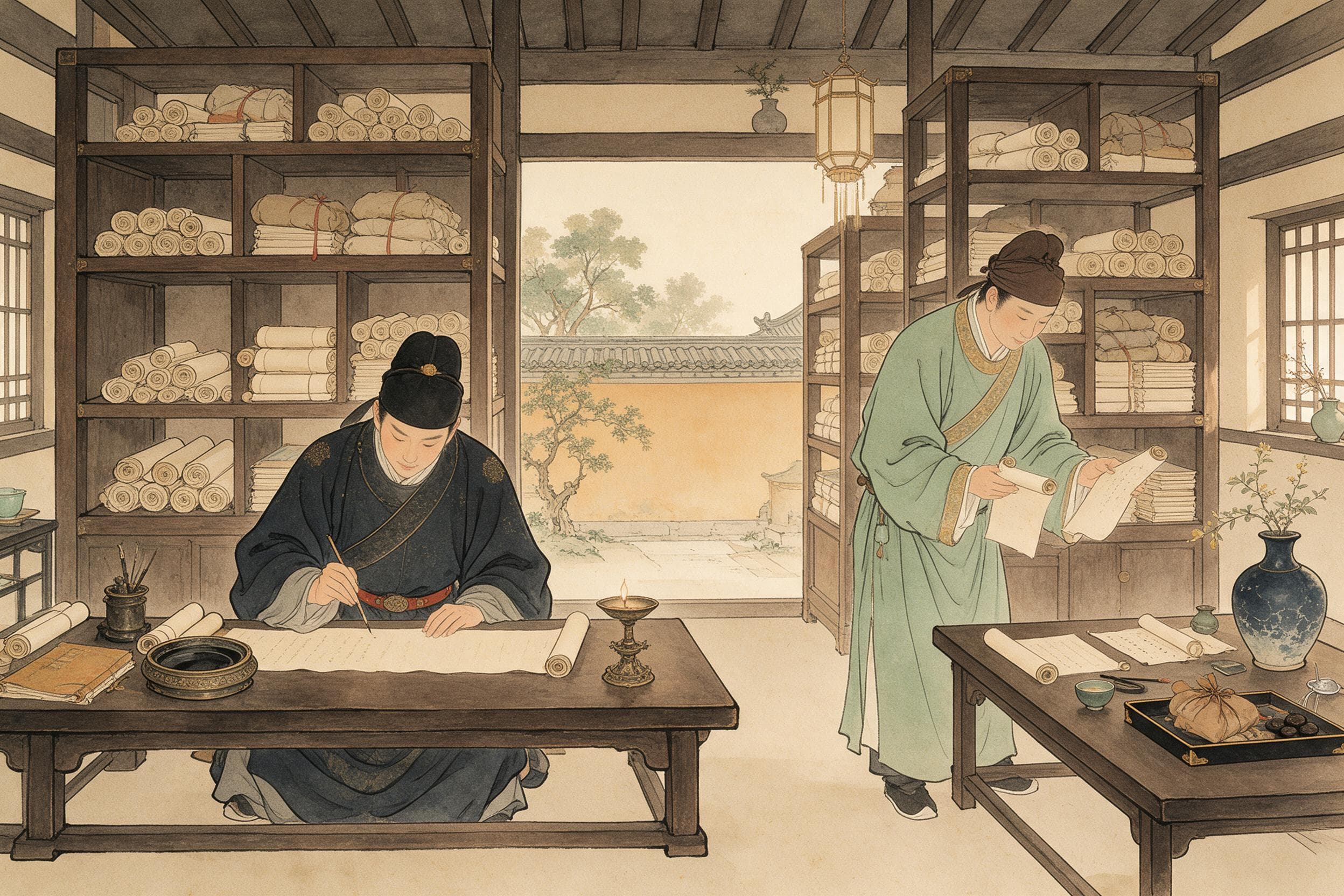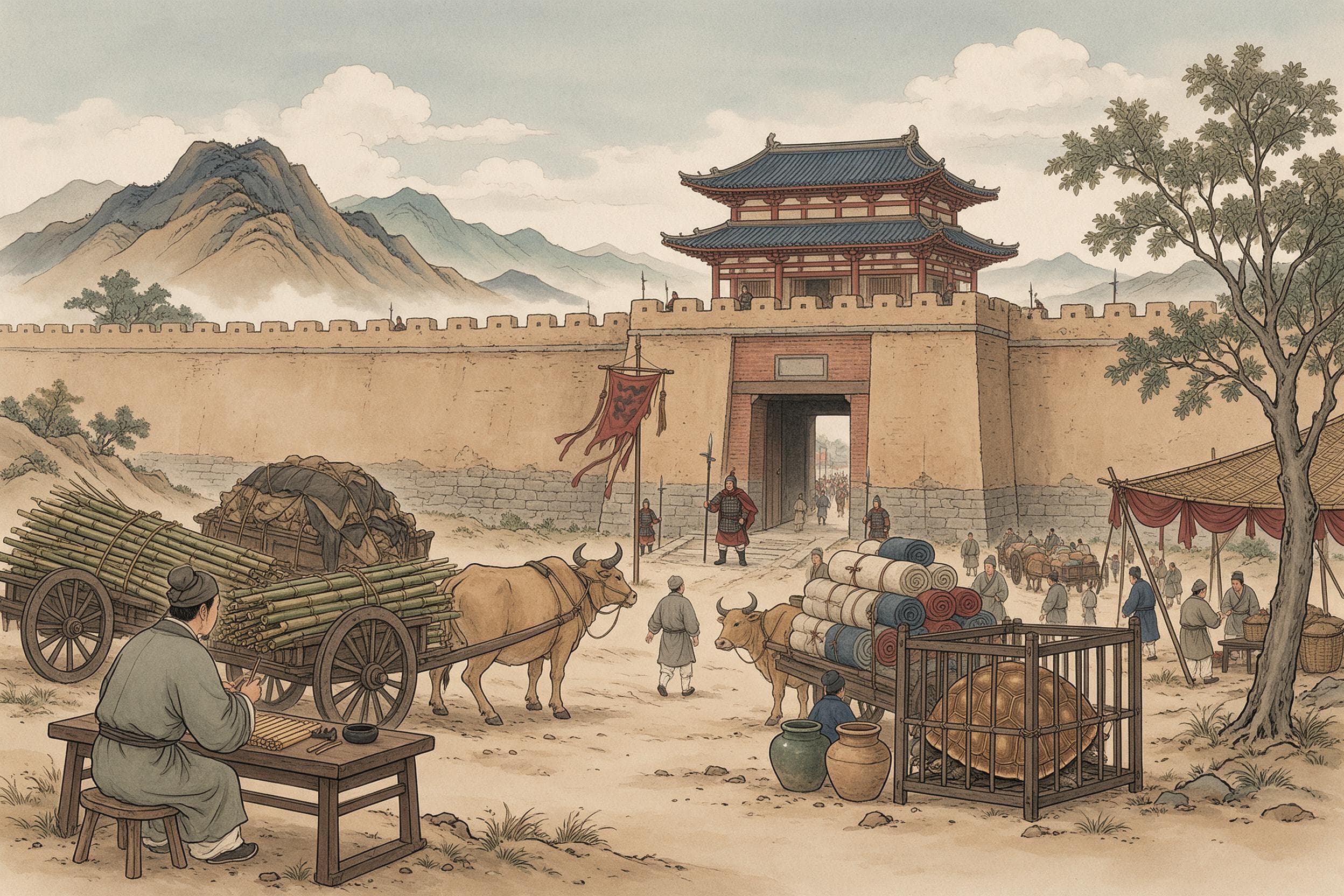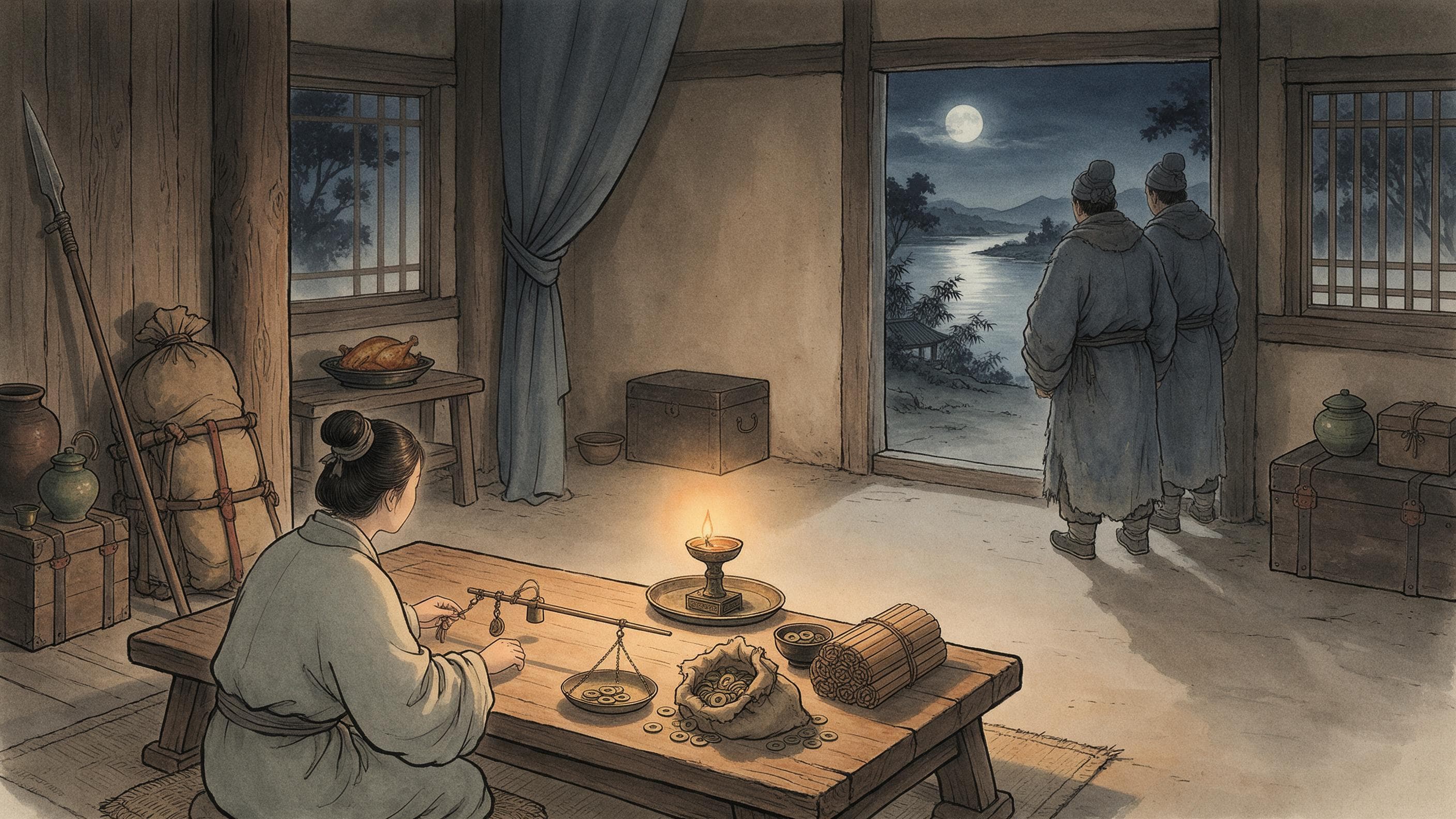
In Chang'an the errand was urgent. The marquises and enfeoffed lords had to march with the army, which meant horses, gear and equipment bought before they left, so they went to borrow. The money-lenders would not lend. Not for lack of funds: the war had no visible outcome. Their fiefs lay east of the pass, the rebellion of Wu and Chu might win or lose, and a loan made now might not come back at all.
When Nobody Would Lend
The Shiji's chapter on wealth and trade disposes of the whole matter in two sentences: 'When the seven states of Wu and Chu rose, the marquises and lords in Chang'an, going out with the army, borrowed money at interest; the money-lenders reasoned that their fiefs lay east of the pass and the outcome there was undecided, and none would lend' (子钱家以为侯邑国在关东,关东成败未决,莫肯与). The lenders even have a name, zi qian jia — 'the interest-money families'. They priced the risk and declined the trade. The chapter gives no firm, no contract and no rate they would have charged; what it records is a refusal, and the refusal is itself information: lending in Chang'an was a business that weighed a war before it weighed a man's security.
'Only the Wuyan family put out a thousand jin to lend, and its interest was tenfold' (唯无盐氏出捐千金贷,其息什之). Three months later Wu and Chu were pacified; 'within one year the Wuyan interest was tenfold, and by this they grew as rich as the houses of Guanzhong.' It was a bet that came off: the others feared the outcome, this one bought into it.
One Case, Not a Rate Table
The passage needs its context. The chapter is about wealth, and it lists rich men of every region; the Wuyan family is one illustration among many. Sima Qian ranks fortunes in the chapter himself — 'wealth from the root is best, from the branch next, from crookedness lowest' (本富为上,末富次之,奸富最下) — and lending falls on the branch. He also says of the men he lists that they grew rich 'without fiefs or stipends, without twisting the law or committing crimes' (皆非有爵邑奉祿弄法犯姦而富), by reading the times. So this is an example inside an argument, not a credit statistic; it is reported as the chapter reports it, with the author's judgment around it.
The chapter mentions one more thing: in its list of businesses that make a man comparable to 'the house of a thousand chariots', beside brewing, grain-dealing and butchery, stands 'money lent at interest, a thousand strings' (子贷金钱千贯). Lending is a trade with a capital threshold. But there is no rate table: the whole chapter contains one interest figure, and the text gives it twice in slightly different words — 'its interest was tenfold' (其息什之) and later 'the interest was tenfold' (息什倍) — without saying whether that is interest on top of the principal or the whole return, and without a term, a pledge or a contract.
Wang Mang's Credit Order
In the other book, lending becomes an office. The Han shu's treatise on food and money reports Wang Mang's Xin-dynasty measures, and he begins by citing antiquity: 'the Rites of Zhou has credit, the Yueyu has the five equalizations' (夫周礼有赊贷,乐语有五均). Offices are set up in Chang'an and at Luoyang, Handan, Linzi, Wan and Chengdu, each with five trade officers and one money-office officer, and one of the six state monopolies is 'the five equalizations and credit' (五均赊贷).
The terms are detailed. 'When people wished to perform sacrifices or funerals and had nothing, the money office let them take goods on credit from the tribute of artisans and merchants; for sacrifices no more than ten days, for funerals no more than three months.' And: 'when people were destitute and wished to borrow in order to work at a trade, it lent to them all, and after deducting their expenses charged interest on what they gained, no more than a tenth of the year' (毋过岁什一).
The two words are kept apart: 赊 is goods had now and paid for by a deadline; 贷 is money borrowed and interest charged, with a ceiling. And the scheme belongs to the Xin, not to the Western Han — the wartime loan was made in Emperor Jing's reign, the credit order came after the Western Han had fallen, more than a century later.
Two Different Kinds of Money
Set side by side, they show two ways of lending. One is private, wartime and one-off: the terms are agreed between the parties, the risk sits with the lender, and so the interest-money families looked at the odds and refused while the Wuyan family looked at the odds and took them, at tenfold. The other is official and standing: its uses are sorted into sacrifices and funerals on one side and productive loans on the other, its terms are written into an order, and its interest is capped at a tenth of the year. One is a wager; the other is an institution.
The Han shu also records how the institution went, and the record is bad. The supervisors sent to oversee the monopolies, several to a commandery, were 'all rich merchants' (皆用富贾) — men from Luoyang, Linzi and elsewhere who 'rode the post roads after profit, criss-crossing the realm', until they 'colluded with the commandery and county offices, kept many empty ledgers, so the treasuries were not accurate, and the people suffered the more'. The treatise reports the appointment of rich merchants as part of the failure, not as an accident. The tenth-of-the-year in the decree and the empty ledgers in the counting house are two different things.
What Is Not Here
No rate table, no contract, no total of loans and no rule for default. For the Wuyan loan, the chapter does not say how the money was repaid, who stood surety or whether anyone brokered it. For Wang Mang's tenth, the treatise does not say whether it was a ceiling or what was actually collected, nor how much the offices lent in a year. And nothing about the price of credit in ordinary years: one page speaks of an emergency, the other of a decree. These pages give a story and a set of rules, not an account book.
Nor can any of it be converted into modern interest. What Han money bought, what grain cost, how long a term ran — none of that is settled here, and turning 'tenfold' into an annual percentage would look precise while measuring Han cloth with a modern rule. 'Usury' is a later word, and neither page uses it. What can be written is this: one loan that everyone avoided before a war and one man took; and one order, carefully drafted, whose officers kept false books. A story on one side, institutional history on the other.
Related reading:The Guild Elder and the Matchmaker: How Song Cities Hired People · Four Hundred Jin a Permit: The Price of Salt in Yuan China · Inspect, Do Not Levy: The Pass and the Market in Warring States Thought
Sources & further reading
- 司马迁《史记》卷一百二十九·货殖列传(西汉;维基文库本,未与点校本复核) — A chapter on how fortunes were made, written with the author's own judgments — it ranks 'wealth from the root first, from the branch next, from crookedness lowest' (本富为上,末富次之,奸富最下) and says of the men it lists that they were rich without fiefs, salaries or crime. Its only money-lending case is one sentence long: when the seven states of Wu and Chu rose, the marquises and enfeoffed lords in Chang'an borrowed to equip themselves for the campaign, and the money-lenders (子錢家) refused because their fiefs lay east of the pass and the outcome was undecided; 'only the Wuyan family put out a thousand jin to lend, at tenfold interest' (唯无盐氏出捐千金贷,其息什之); three months later Wu and Chu were pacified, and within a year the interest was tenfold, making them as rich as the houses of Guanzhong. The chapter also lists 'money lent at interest, a thousand strings' among businesses of the great cities, and says such a man is comparable to the house of a thousand chariots. It gives no rate, no term, no contract and no other loan.
- 班固《汉书》卷二十四·食货志下(东汉;维基文库本,未与点校本复核) — An Eastern Han treatise on the Xin dynasty's economy. Wang Mang, justifying himself from the Rites of Zhou, opens credit and the five equalizations: offices are set up in Chang'an and five other cities, each with five trade officers and one money-office officer; the six state monopolies include 'the five equalizations and credit' (五均賒貸). The credit rules: those who wish to sacrifice or bury and have nothing may take goods on credit from the money office, with ten days for sacrifices and no more than three months for funerals; those who are destitute and wish to borrow to work at a trade are lent to after their expenses are deducted, interest on the profit being no more than a tenth of the year (毋過歲什一). The treatise also records how it went: the supervisors appointed were rich merchants who 'rode the post roads after profit', colluded with the commandery offices, 'kept many empty ledgers, so the treasuries were not accurate, and the people suffered the more'.