A code has been lost, and a list survives. 'It further set out ten gravest crimes: first rebellion, second great逆, third treason, fourth surrender, fifth cruelty to kin, sixth inhumanity, seventh irreverence, eighth unfilial conduct, ninth injustice, tenth incest. Those who commit these ten are not within the limit of the eight deliberations and redemption' (又列重罪十條…其犯此十者,不在八議論贖之限). The list is not in a Bei Qi statute book. It is in the Sui History, compiled under the Tang.
The Code Is Somewhere Else
The Sui History's chapter on punishment records how the Bei Qi made its law: 'In the third year of Heqing, the prince of Zhao Commandery and others presented the Qi code in twelve chapters: first general principles, second guards, third marriage and households, fourth unauthorised levies, fifth breach of regulations, sixth fraud, seventh assault and litigation, eighth theft, ninth arrest and judgment, tenth damage, eleventh stables and pastures, twelfth miscellany. Its convictions numbered nine hundred and forty-nine articles.' A new set of ordinances followed in forty chapters, and the punishments were five: death (by carriage-tearing, exposure, decapitation, strangling), exile, penal servitude in five terms, whipping in five grades, caning in three; redemption, once paid in gold, was now paid in silk, and the chapter gives the prices — a hundred bolts of silk for a capital crime, ninety-two for exile.
Every one of those details — chapters, articles, punishments, prices — is read here from a Tang history. The Bei Qi code itself does not survive. So this article can describe 'the Bei Qi code as the Sui History reports it', not 'the Bei Qi code as it stood'. That is the first rule for reading the passage.
The nature of the ten also needs care: they create no new punishment. The point is the last clause — 'not within the limit of the eight deliberations and redemption' (不在八議論贖之限). The eight deliberations were a procedure for persons of a certain standing; redemption was payment in silk. Listing ten crimes removed them from both doors. What the eight deliberations actually were, neither page lists, and this article does not fill it in.
From Ten Crimes to Ten Abominations
The same chapter records the Sui's Kaihuang code: 'it further established the ten abominations, mostly adopting the later Qi system, with some additions and losses. First plotted rebellion, second plotted great逆, third plotted treason, fourth cruelty to kin, fifth inhumanity, sixth great irreverence, seventh unfilial conduct, eighth disharmony among kin, ninth injustice, tenth incest' (多採後齊之制,而頗有損益). It adds that those convicted of the ten abominations or of deliberate killing were struck from the rolls even when an amnesty came.
Set the two lists side by side and the differences matter. The Bei Qi 'rebellion', 'great逆' and 'treason' become, under the Sui, 'plotted rebellion', 'plotted great逆' and 'plotted treason'; the Bei Qi 'surrender' has no place among the Sui ten; the Sui adds 'disharmony among kin'; the Bei Qi 'irreverence' becomes 'great irreverence'. So the ten abominations are not the ten crimes renamed. The Sui History's own phrase is 'mostly adopting the later Qi system, with some additions and losses' — adopted and altered: a lineage, not an identity.
The chapter also records that the Northern Zhou 'did not establish the ten abominations' but singled out six of them — cruelty to kin, inhumanity, great irreverence, unfilial conduct, injustice, incest — for heavier treatment. Three governments, three different selections: these lists were technical arrangements, open to addition and subtraction.
The Northern Wei Side
The other book is the Wei History's chapter on punishment, and it is about the Northern Wei. In the Shenjia years Emperor Shizu 'ordered the minister Cui Hao to fix the statutes': the five- and four-year servitudes were abolished and a one-year term added; capital punishment was divided into two grades, death and beheading, with strangling added; great逆 and inhumanity were punished by waist-cutting, the household slain, boys under fourteen castrated and women taken by the state; one who harmed his own kin was torn apart by chariots; poisoners were beheaded and their houses burned; sorcerers were drowned with a black ram and a dog. Interrogation was limited to forty-nine blows; every death sentence had to be memorialised, and provincial capital cases reported before execution; a drum for grievances hung at the palace gate.
Those are Northern Wei provisions and procedures, not Bei Qi ones. The Wei History was written by Wei Shou, a Bei Qi subject, but it records the Northern Wei; the Sui History was compiled under the Tang and reports the Bei Qi and the Sui. The Bei Qi did draw on Wei and Jin precedent, so there is a line of descent — but reading the Wei History's clauses as Bei Qi law mixes two dynasties. That must be stated plainly.
How to Read These Pages
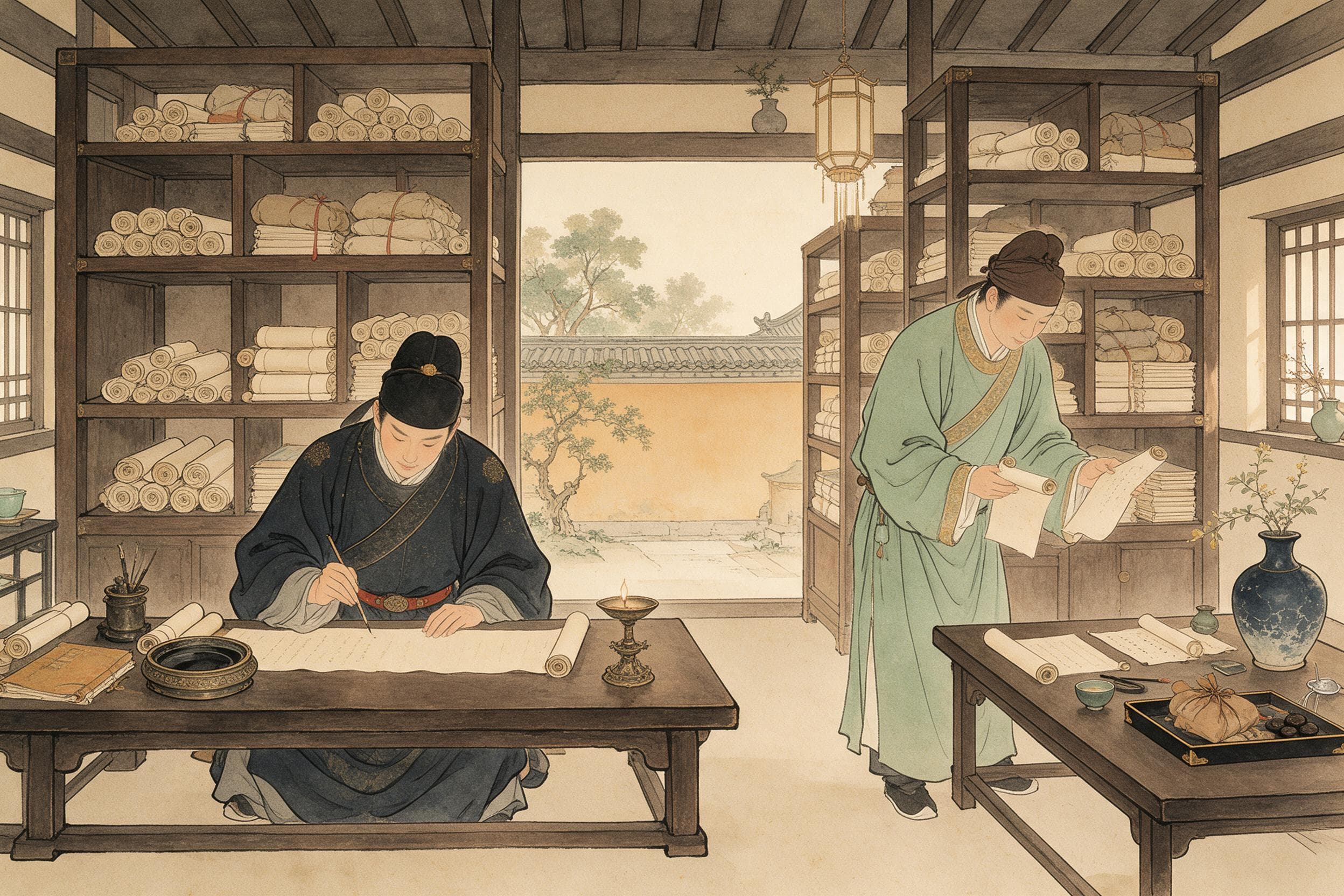
What the two pages leave are two kinds of trace: the Bei Qi code reported by Tang historians, its articles surviving as names while the text does not; and Northern Wei provisions recorded in their own dynasty's history. What a reader actually sees is how historians wrote about law, not the law itself. And after setting down the ten, the same Sui chapter adds its verdict: 'from this time the statutes were clear and careful, the articles brief' (法令明審,科條簡要), and 'the men of Qi mostly understood the law, and this was the reason'. The same Tang historian who copied the ten crimes also praised the code's clarity.
So 'savage' is not the word for these pages. The ten are a technical exception list — removing certain crimes from the doors of deliberation and redemption; the Northern Wei passage is about grades of capital punishment, reporting procedures and limits on interrogation. These are questions of institutional design, not a measure of cruelty.
What Is Not Here
The gaps are plain: the Bei Qi code itself, the punishment attached to each of the ten, the trial procedure, any case; the names of the eight deliberations; and on the Wei side, only grades and individual cases, not a complete table of capital offences. Nor can the two books' figures (949 articles, two grades of death) be compared directly, since they are built on different plans.
One list, then, travelled from Bei Qi into Sui and Tang: names changed, contents gained and lost, and the label changed — 'ten gravest crimes' in Bei Qi, 'ten abominations' under the Sui. What can be traced is the list inside the report, not a whole Bei Qi code. The Northern Wei pages leave another dynasty's procedures; read together, the two books show how law was remembered, not how it was enforced.
Related reading:Ending the Wine Monopoly: Four Coins a Sheng and a Thousand Batches · Nine Provinces, Two Inventories: The Tribute List of the Yugong · A Square Li Divided Nine Ways: Mencius's Well-Field on Paper
Sources & further reading
- 《隋书》卷二十五·刑法志(唐魏征等撰;维基文库本,未与点校本复核) — A Tang compilation that describes the Northern Qi code the code itself no longer allows us to read. Under the third year of Heqing (河清三年) it reports that the prince of Zhao Commandery and others presented the Qi code in twelve chapters with 949 articles, five names of punishment (death by carriage-tearing, exposure, decapitation, strangling; exile; penal servitude; whipping; caning) and a redemption scale paid in silk. Then: 'it further set out ten gravest crimes: first rebellion, second great逆, third treason, fourth surrender, fifth cruelty to kin, sixth inhumanity, seventh irreverence, eighth unfilial conduct, ninth injustice, tenth incest' (又列重罪十條…其犯此十者,不在八議論贖之限) — those who commit them are excluded from the eight deliberations and from redemption. The same chapter records the Sui's Kaihuang code: 'it further established the ten abominations, mostly adopting the Northern Qi system, with additions and losses' (多採後齊之制,而頗有損益), lists the ten, and notes that the Northern Zhou 'did not establish the ten abominations' but singled out six of them. It also calls the Qi code 'clear and careful in its statutes, brief in its articles', which is why 'the men of Qi mostly understood the law'.
- 《魏书》卷一百一十一·刑罚志(北齐魏收撰;维基文库本,未与点校本复核) — A history of the Northern Wei, a different dynasty from the Northern Qi. It records that in the Shenjia years Emperor Shizu had the minister Cui Hao fix the statutes: the five- and four-year servitudes were abolished and a one-year term added; capital punishment was divided into two grades, death and beheading, with strangling added; great逆 and inhumanity were punished by waist-cutting with the household slain, boys under fourteen castrated and women taken by the state; those who harmed their own kin were torn apart by chariots; poisoners were beheaded and their houses burned; sorcerers were drowned with a black ram and a dog; interrogation was limited to forty-nine blows; every death sentence had to be memorialised, and provincial capital cases reported before execution. It also mentions that the nine-rank officials could use rank to commute punishment, that pregnant women were executed a hundred days after childbirth, and that the sounding drum for grievances hung at the palace gate. These are Northern Wei provisions, not the Bei Qi code.