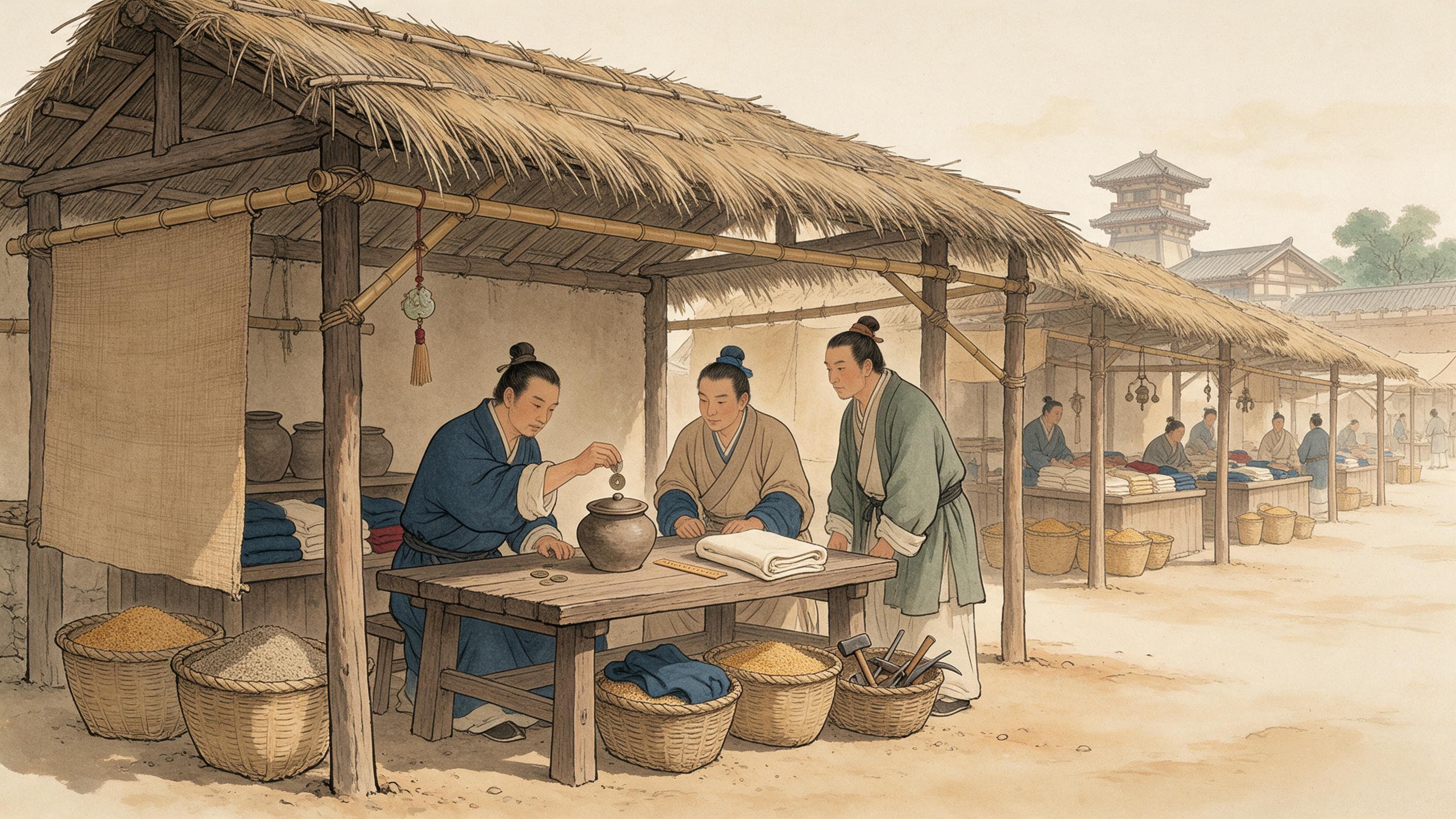
In a market of the state of Qin at the end of the Warring States period, there was a rule about taking money. When government workshops or government shops sold something, the cash received had to go straight into the qianxiang (钱缿), the receptacle for takings, and it had to be done in front of the payer — 令市者见其入 — or the official was fined a suit of armour. That is the most concrete moment in the entire record of the Warring States market: not a speech about commerce, but a man holding coins over a box while a stallholder watches them fall. What survives of that market is mostly this: small hard actions, and several layers of text that refuse to fit into a single picture.
A day divided into three markets
The fullest description of a market comes from the Rites of Zhou (周礼), which is a blueprint, not a report. In its design the day held three sessions: 大市日昃而市,百族为主 — the great market in the afternoon, for the townspeople; 朝市朝时而市,商贾为主 — the morning market, for the merchants; 夕市夕时而市,贩夫贩妇为主 — the evening market, for the pedlars, men and women. One market changing its customers three times a day: wholesale in the morning, retail in the afternoon, small trade at dusk. It should be said plainly that this is what the text prescribes; no town plan or account shows the three sessions actually running that way.
Opening was a small ceremony. The 胥 stood at the gate with whip and rule (执鞭度守门); the officers levelled the rows, examined the goods and settled prices (平肆、展成奠贾); then a banner went up at the 思次, the market office, and only then was the market open (上旌于思次以令市). Prices were fixed before selling began. The 贾师 balanced goods by quality, announced the price, and in a bad year was to forbid profiteering (禁贵儥者) and hold to what the text calls the constant price.
A place for every stall
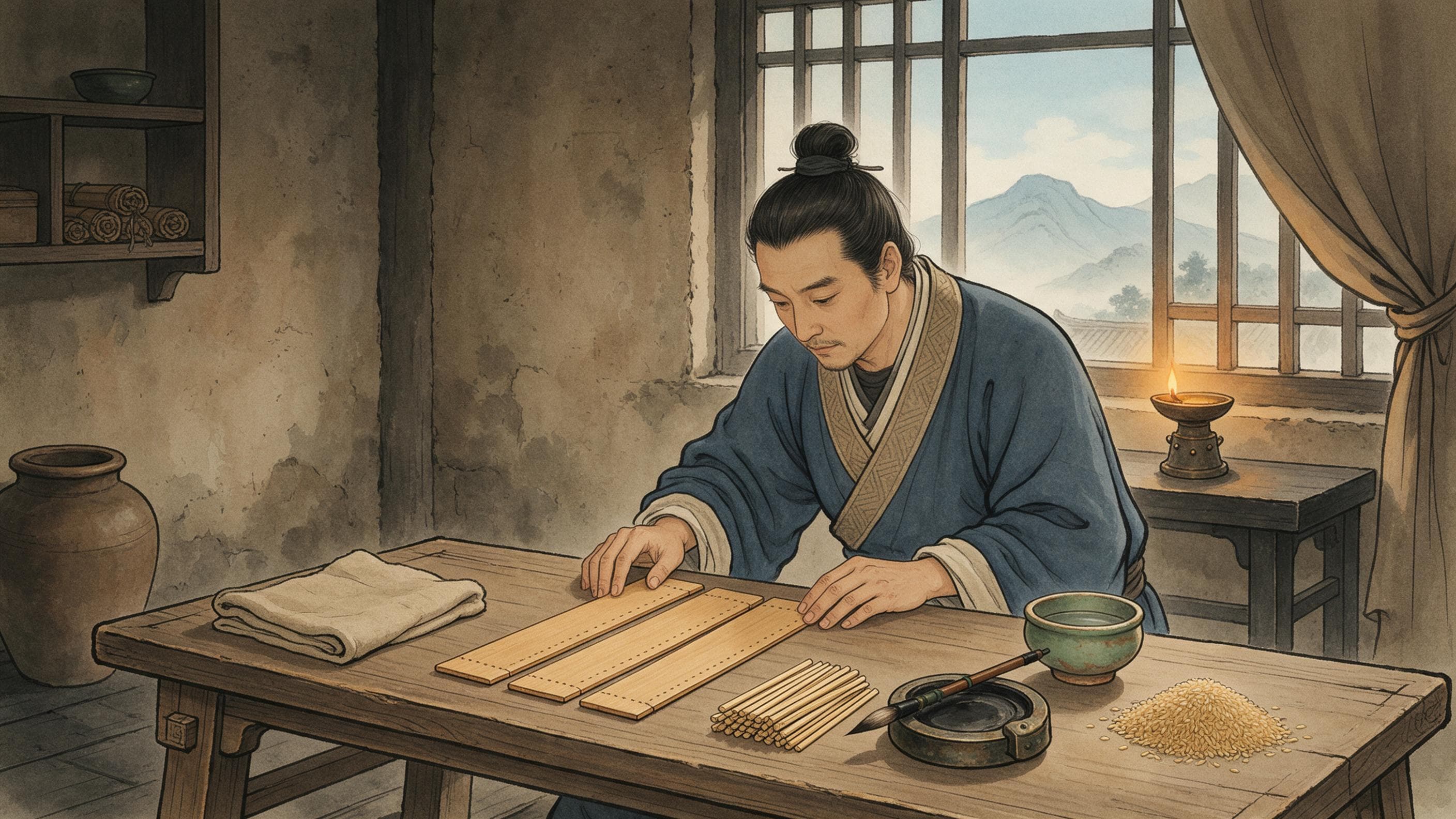
Inside, space was organised twice: by 次, zones, and by 肆, rows where goods of one kind stood together (以次叙分地而经市,以陈肆辨物而平市). The 肆长 in each row arranged the display on a rule that sounds like modern merchandising — similar names kept apart, similar goods kept together (名相近者相远也,实相近者相尔也). Supervision was dense and graded: one 胥 per two rows, one 司稽 per five, one 司虣 per ten, and one 胥师 and one 贾师 per twenty, each with two scribes. The 司市 at the top held nine instruments of control: zones, rows, a ban on luxury goods, the movement of merchants, weights and measures, contracts, informers against fakes, punishments, and the state treasury. Selling bad goods dressed up as good was a named offence (饰行儥慝). Large deals were written as 质, small ones as 剂, by the 质人, who also unified weights and measures (同其度量).
Five levies and a treasury
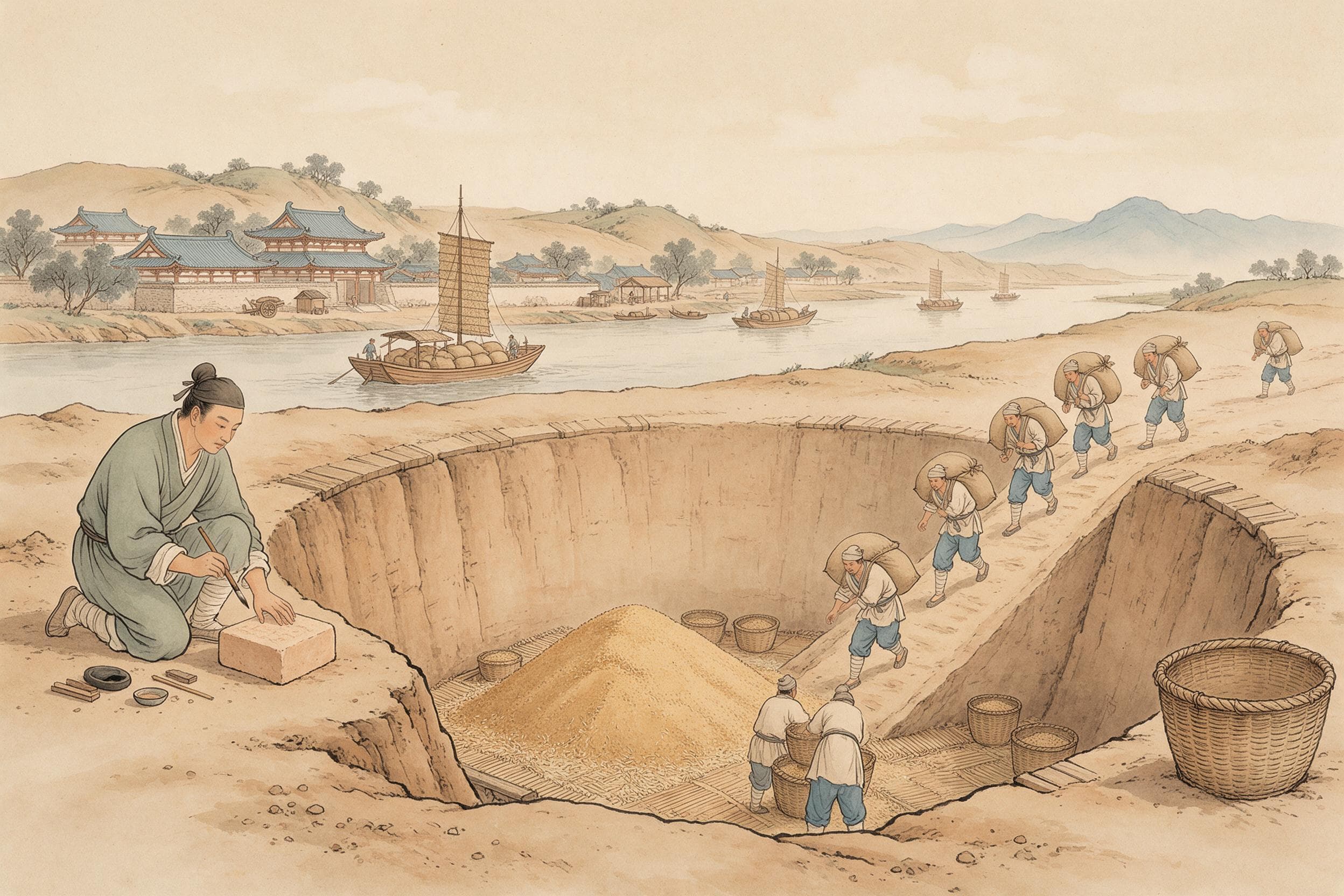
The 廛人 collected five levies, all paid into the 泉府: 絘布, 总布, 质布, 罚布, 廛布. What each covered has been argued over for two thousand years; the text gives names, not rates. In a year of famine, epidemic or mourning the market was not taxed at all (市无征). The 泉府 then used the money as capital: it bought up goods that would not sell and were piling up unused, at the market price, and lent or sold on credit — ten days for sacrifices, three months for funerals — with interest taken in labour service (以国服为之息). Even the ruler was kept at a distance: when the lord crossed the market, punishments were remitted; his wife paid a fine of one curtain, his heir one canopy, and nobles a fine in coverings — ritual signs that the market was a space set apart.
The cash box
The Qin material is the opposite of a blueprint. A statute in the Shuihudi corpus, in the section on passes and markets, applies to government workshops and government selling: cash received must go into the money receptacle at once, in the sight of the payer, on pain of a fine of one suit of armour. What it establishes is modest and useful: the state was a seller in the market; cash was the medium; the receipt was to be visible; the fine was paid in armour, that is, in kind. What it does not establish is what the receptacle was made of — the text says only qianxiang — so the pottery savings jar of later centuries should not be imagined here. Nor does it prove that everyone paid in coin: knife money (刀), spade money (布) and ring coins circulated, but barter had not disappeared. And the dating matters: this is the law of Qin at the end of the Warring States, not a rule for all the contending states.
The boast about Linzi
The most famous number in Warring States commerce is salesmanship. Su Qin, trying to move the king of Qi, told him that Linzi held 70,000 households; at three men a household, he reckoned, that came to 210,000 men. The streets, he said, were so crowded that cart axles knocked together and shoulders rubbed, that garments joined into curtains and sleeves into canopies, and that the crowd's sweat fell like rain. It is an advocate's speech, arguing for a figure he has not counted, and it can be used for what Linzi felt like, not for what Linzi held. The counter-argument to the whole picture is Mencius, who urged that a market should provide ground and take no tax (市,廛而不征): a policy proposal that only makes sense because taxation was the practice.
Set the layers side by side and they will not make one picture. The Rites of Zhou describes an administration that may never have existed in that form; the Qin statute is one state's practice at one date; Su Qin's crowd is rhetoric; Mencius's market is a wish. What all of them assume is the same machine: a market that opened on a signal, priced goods before selling them, sorted sellers into rows, wrote contracts, weighed and measured, collected several kinds of fee, and kept a box for the money. Whether a given town ran three sessions a day, paid five levies or one, no source can say. What can be said is that somewhere, in some market, one man was required to drop the coins where the payer could see.
Sources & further reading
- 《周礼·地官司徒》(司市、质人、廛人、胥师、贾师、司虣、司稽、肆长、泉府各条) — 制度蓝图,非实录:三场市、举旗开市、次叙与肆、五布、泉府敛赊;成书年代有争议,正文一律写「《周礼》规定/设想」
- 《孟子·公孙丑上》 — 「市,廛而不征」的轻税主张,反证当时市场征税是常态
- 《史记》卷六十九·苏秦列传 — 临淄「七万户」「车毂击,人肩摩」;纵横家说辞,有夸张,不作人口统计
- 睡虎地秦简《秦律十八种·关市》(战国末秦制) — 「受钱必辄入其钱缿中,令市者见其入,不从令者赀一甲」;只代表秦制,不代表列国通例