The History of the Song begins with a hedge: 'The methods of huizi and jiaozi were perhaps taken from the flying money of the Tang' (會子、交子之法,蓋有取於唐之飛錢). 蓋 is a word of conjecture, and the conjecture is the historian's, not a settled finding. What follows is specific: under Emperor Zhenzong, Zhang Yong was stationed in Shu and, 'troubled that Sichuan's iron cash was heavy and inconvenient for trade, set up a system of contracts: one note to one string, exchanged every three years' (患蜀人鐵錢重……一交一緡,以三年為一界而換之). This article keeps to the two Song pages, jiaozi in the north and huizi in the south; the Jin and Yuan notes are not here, and the three are not run into one history.
Sichuan: Sixteen Households
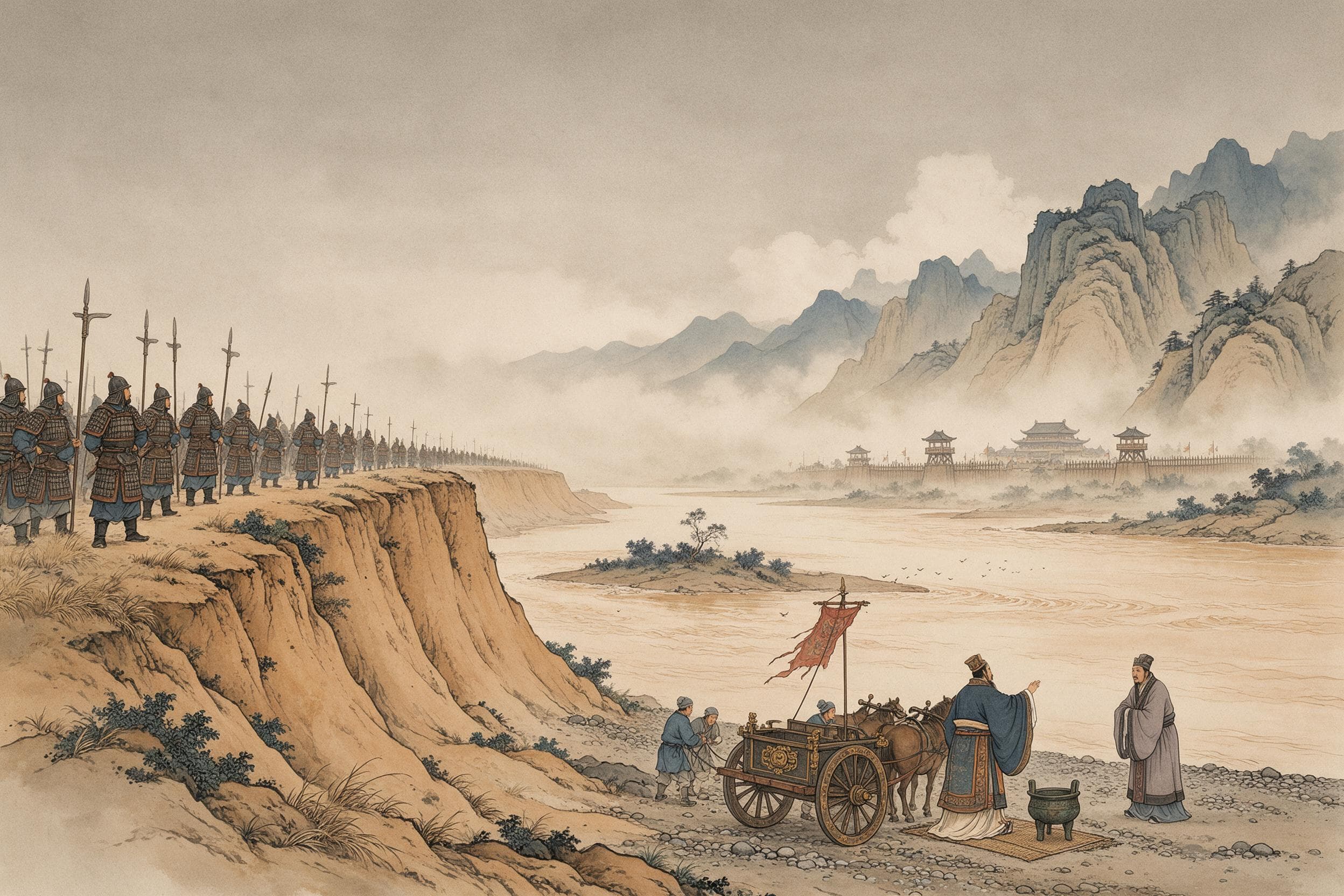
The first managers were private. 'In sixty-five years there were twenty-two issues, and it was called jiaozi; sixteen rich households managed it' (六十五年為二十二界,謂之交子,富民十六戶主之). One note to a string, a new issue every three years, the old redeemed: a certificate system run by sixteen households. How the sixteen were chosen, how the notes were printed, what security they lodged — the page does not say. What it says is how the arrangement ended: 'afterwards the wealth of the rich households declined, they could not redeem what they owed, and litigation went on without end' (後富民資稍衰,不能償所負,爭訟不息).
Then the state. The transport commissioners Xue Tian and Zhang Ruogu 'asked to establish the Yizhou jiaozi office, to monopolise its issue and forbid private manufacture; Renzong followed their proposal' (請置益州交子務……私造者禁之。仁宗從其議). The issue was fixed: 'the ceiling of an issue was 1,256,340 strings' (界以百二十五萬六千三百四十緡為額) — a figure to the ten. From the fifth year of Xining two issues ran at once: 'the jiaozi had two issues from this' (交子有兩界自此始). Forgery drew penalties first 'as for forging official seals and documents', and in the third year of Chongning 'those who privately made jiaozi paper were punished with penal servitude' (私造交子紙者,罪以徒配). Printing increased after the Shaosheng era, 'the smaller by several hundred thousand strings, the larger by several million' (少者數十萬緡,多者或至數百萬緡) — the page's round figures, not a total. In the first year of Daguan the Sichuan office became an office for money-notes, and at the change 'one new jiaozi was set against four of the old' (新交子一當舊者四).
Huizi: A Million Strings an Issue
The southern note began badly. In the first year of Shaoxing the government made guanzi (關子) for Wuzhou — drafts on the monopoly, another kind of paper altogether. In the sixth year it ordered an office for huizi at the temporary capital, and a memorial stopped it in eight characters: 'the government has no capital of its own; how are the people to trust it?' (官無本錢,民何以信?) The office was abolished.
The system was settled in the fourth year of Qiandao: 'three years were fixed as one issue, an issue capped at ten million strings, new notes made and old exchanged with each issue' (三年立為一界,界以一千萬貫為額,隨界造新換舊); 'on each note a service charge of twenty cash was collected, half of that on notes of a hundred and less' (每道收靡費錢二十足,零百半之). A worn note whose characters and seal could still be checked was exchanged. In the fifth year the capital offices were allowed to accept the first issue in payment for tea, salt, incense and alum certificates, and every issue after it on the same terms; of the transport cash sent up from the prefectures, 'seven parts were to be taken in cash and three in huizi' (以七分收錢,三分收會).
Three figures from the third year of Chunxi give the proportions: 'the ministry of revenue's annual income was twelve million, half of it in huizi; the southern treasury bought in four million with gold and silver; what circulated outside was only two million' (戶部歲入一千二百萬,其半為會子……四百萬……才二百萬耳). The page gives the three numbers and no more: an issue ceiling is not a stock in circulation, and this article does not add the figures up into one.
Then the issues were stretched. In the third year of Chunxi the third and fourth issues were each extended three years. In the first year of Shaoxi the seventh and eighth were extended, and a memorial said what that meant: 'an issue of huizi is limited to three years; now it has been extended twice, which makes nine — how is confidence to be shown?' (今展至再,則為九年,何以示信?) In the first year of Qingyuan the ceiling itself was raised: 'the huizi issue was capped at thirty million' (會子界以三千萬為額). By the beginning of Jiading a string 'was worth only four hundred iron cash or less' (每緡止直鐵錢四百以下). One page carries both ends: ten million, thirty million, four hundred cash.
Hangzhou: The Short String
The Mengliang lu, a late-Southern-Song notebook on the capital and not an administrative record, gives the street in a few lines. The short string: 'formerly the city's string was seventy-seven; recently the people have cut it to fifty and use that in the market' (元都市錢陌用七十七陌,近來民間減作五十陌行市通使) — the 元 here is generally read as 'formerly', not as the Yuan dynasty. The notes in use: 'the government also printed huizi, and issues fifteen to eighteen are current' (自十五界至十八界行使). Then a different paper: 'in the Xianchun period, when Jia Qiuhuo was chancellor, he changed the law and made gold-and-silver guanzi, at three strings of the eighteenth issue to one guanzi, current throughout the realm' (以十八界三貫準一貫關子). And the consequence in the author's words: 'after this was promulgated, in every trade and market goods rose in price and the money string melted away' (諸行百市,物貨涌貴,錢陌消折矣). The page also notes that the government, its coin law failing, 'cast lead tally-placards in Hangzhou for convenience in use' (杭城增造镴牌).
Two Kinds of Page
The two pages cannot be spliced. The History of the Song counts in state-capped issues — 1,256,340 strings for the Sichuan jiaozi, ten million and then thirty million for the huizi — and gives fees, extensions and the exchange of old for new. The Mengliang lu counts what a Hangzhou resident saw: issues fifteen to eighteen in use, a string cut from seventy-seven to fifty, three strings of the eighteenth issue to one guanzi. The notebook's issues belong to the last decades of the Song; this article does not convert them into the history's numbering, nor treat the notebook as a government ledger. One page is an institution, the other a street, and the bridge between them is on neither.
What Neither Page Gives
Neither page gives paper, pulp or printing: no material, no process, no cost of a single note. The nearest thing to a cost is the service charge quoted above — 'twenty cash on each note' — and the page does not say what it paid for; the usual understanding is that it was charged when old notes were exchanged for new, and it is marked here as the usual understanding, not the text's words. Nor is there a total in circulation: an issue ceiling is a ceiling. Anti-forgery is present only as penalties, with no plate and no technique. Nothing is converted into modern money, no purchasing power is computed, and neither page calls this the first paper money in the world.
Two notes, two governments, two pages. The jiaozi began as a private certificate in an iron-cash province, passed to an office when the sixteen households could not redeem it, was capped and then over-printed, and changed at one new note to four old. The huizi began from a question about capital, was fixed at ten million strings an issue, and ended at a ceiling of thirty million with a string worth four hundred cash or less. The notebook adds the short string and the price of goods, and stops at 'goods rose in price and the money string melted away'. Neither page explains the other, and neither says so; they are printed side by side here, and not joined.
Related reading:Forty Li of Purple Silk, Fifty of Brocade: Shi Chong and Wang Kai · Mud, Silk and Gold: The Qixi Dolls of Song China · From Buried Coins to Burned Paper: The Making of Money for the Dead
Sources & further reading
- 《宋史》卷一百八十一·食货志下三(元脱脱等撰;维基文库本,页面白文无注,未与中华书局点校本复核) — The Song record of the two notes. Jiaozi: the historian's hedged remark that the method was 'perhaps taken from the flying money of the Tang'; Zhang Yong in Sichuan, troubled by heavy iron cash, setting up a contract system of one note to one string, exchanged every three years; sixty-five years and twenty-two issues managed by sixteen rich households; their decline and the litigation; the transport commissioners' request for the Yizhou office, granted by Renzong, with the issue capped at 1,256,340 strings; two issues running at once from the Xining period; penalties for forgery and for privately making note paper; the increases after Shaosheng; the change to money-notes and the new note set at a quarter of the old. Huizi: guanzi in Shaoxing, the argument that the government had no capital of its own, the Qiandao settlement of a three-year issue capped at ten million strings with a service charge of twenty cash a note, the three-quarters cash rule, the Chunxi figures, the extensions of issues, the Qingyuan ceiling of thirty million, and the Jiading value of a string at four hundred iron cash or less.
- 《梦粱录》卷十三·都市钱会(南宋吴自牧撰;维基文库本,未与点校本复核) — A late-Southern-Song notebook on the capital, not an administrative record: the city's short string formerly at seventy-seven, cut by the people to fifty; huizi of issues fifteen to eighteen in use; in the Xianchun period the chancellor Jia Sidao creating gold-and-silver guanzi at three strings of the eighteenth issue to one guanzi; the author's report that after this goods rose in price and the short string collapsed; and the casting of lead tally-placards in Hangzhou when the coin law failed.