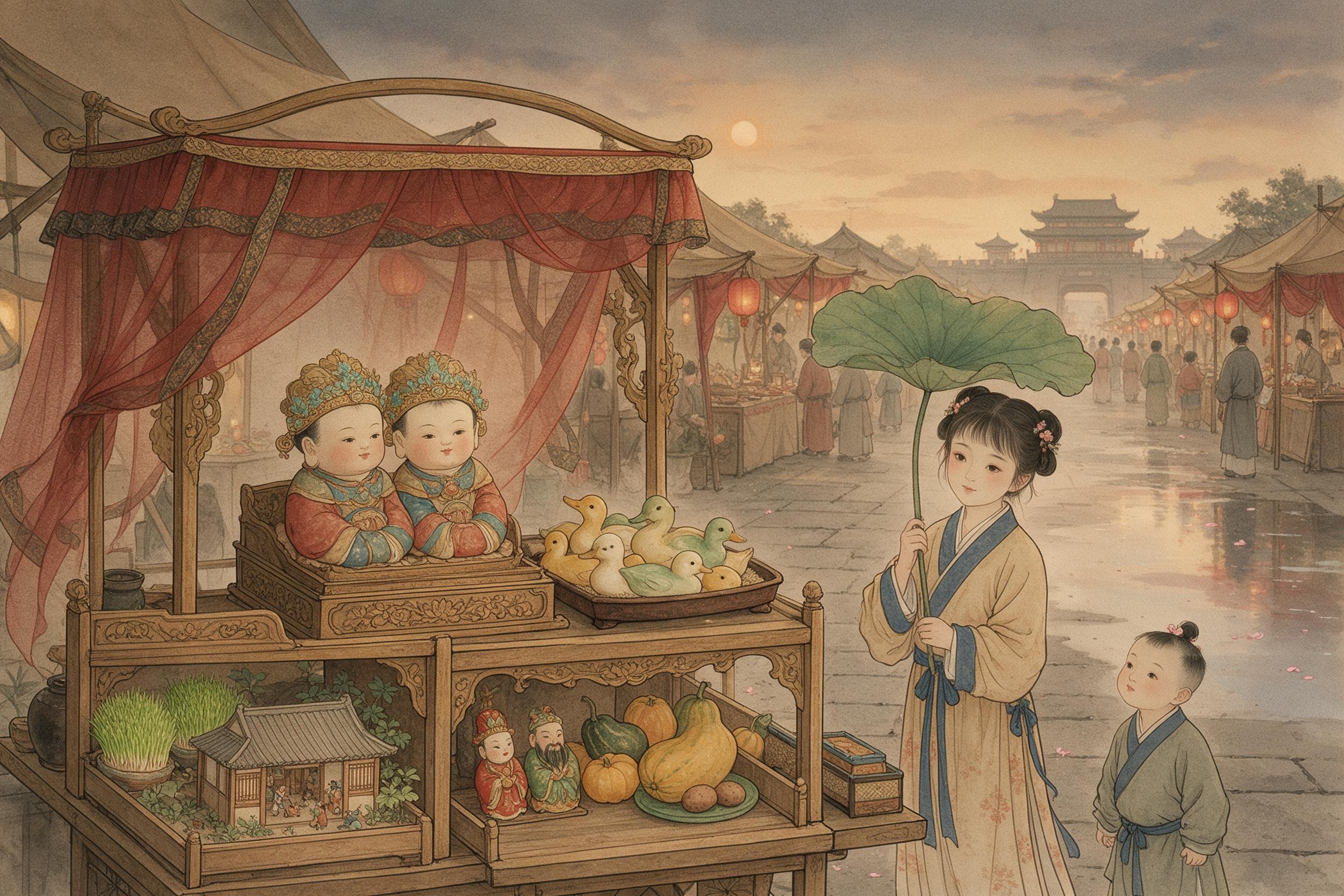
Before Qixi, the Double Seventh, a stall in Kaifeng displayed a pair of clay dolls less than a foot tall: a carved and painted wooden stand, a cage of red gauze and green silk, gold and pearls and kingfisher feathers hung on the figures. The price is in the Dongjing Meng Hua Lu: a pair could cost several thousand cash. The same passage says the palace, the great houses and ordinary townspeople were all buying them, "keeping up with the season" — chasing a festival, and paying for a lump of clay. The same object was split in two: a child's festival plaything and a luxury for the cabinet.
Not one stall but five districts
Meng Yuanlao lists the places at once: the entertainment quarter outside the Song Gate east of Panlou Street, the quarter outside Liang Gate to the west, the north gate, the street outside the south Zhuque Gate, and inside Maxing Street. This was not a temple monopoly or a single licensed market but several shopping streets selling the same seasonal line. In the days before, carriages and horses filled the markets and silk filled the streets; people snapped unopened lotus buds and made one bloom into a double-headed lotus to carry home; on the sixth and seventh nights, wealthy households built coloured towers in their courtyards and set out the dolls with carved melons, wine and roast meat, brushes and inkstones, and needle and thread — a "tower for begging skill" (乞巧樓), where they burned incense and bowed. Even lanes and brothels "set displays at their doors, competing in extravagance".
So the doll was never a lone toy; it was also one of the few festival goods given a price at all. The same stalls sold "water floaters", ducks, geese, turtles and fish cast in yellow wax and painted with gold; "grain boards", a tray of soil with millet sprouting, a tiny thatched hut, trees and farm figures; "flower melons", melons carved into patterns; "fruit-food figures", dough and honey twisted into smiling faces, with pairs in armour called "fruit-food generals"; and "sprouted grain", beans and wheat grown a few inches in water and tied with red and blue thread. A whole miniature world, and the doll was its most expensive piece: everything else on the stall was wax, dough, sprouts and carved rind. The food of the season included a madder-dyed chicken (茜雞) and endless fruit-figures.
A child and a lotus leaf
Children were buyers too. "Small children must buy a fresh lotus leaf to carry, imitating the mohele," Meng writes; they dressed up for the occasion and competed over who looked brighter. A century and more later in Lin'an the custom was the same: children wore short lotus-leaf jackets and held lotus leaves, "several times imitating the mohele". The doll was something to imitate, not only to own: the game copied it.
The other half of Qixi was qiqiao (乞巧), "begging for skill". Women threaded needles by moonlight; a spider was shut in a box and the web examined next day — round and even meant the skill had been granted. Buying a doll and practising a craft happened on the same night, and the sources put them in one entry: the people who wrote them did not see these as two separate things.
From stall to tribute
After the court moved south, the same doll changed rank; in Lin'an it stands on the standard Qixi list beside fruit-figures and madder chicken. The Wulin Jiu Shi calls it 摩歊羅 — the Kaifeng mohele under another transcription — and says the finest, ornamented with gold and pearls, had a price "beyond reckoning". The palace accounts are harder still. The Palace Maintenance Office regularly submitted "ten tables of mohele, thirty pieces to a table": three hundred at a time, and the word 例 marks it as routine, a yearly submission rather than a special commission. The largest stood three feet tall, carved from ivory or made from ambergris and bergamot incense, covered in gold filigree and pearls; clothes, coins, hairpins, bracelets, pendants, pearls and the little props in their hands were all made of the seven treasures, and each figure came in its own case of five-coloured gold-worked gauze.
Higher still, military commissioners, great officials and the capital prefecture "even had them cast in gold as tribute". Below, rich girls and market girls wore "Qixi trinkets" as hair ornaments and collar decorations. A seasonal clay doll runs from a street price of several thousand to a price beyond reckoning and a gold tribute — both ends of the market sit in these two passages. The middle is missing: what an ordinary pair cost, neither book says.
The name and the object are both difficult
The name is disputed first. Mohele and mohoula are usually connected with a Buddhist transcription, sometimes with the story of the Deer Mother; the derivation is still argued, so it can be given as "generally thought" but not as settled fact. The objects are harder. Few Song clay figures survive, and most museum labels reading "Song mohele" cannot be matched to the documents. Nor does any Song source describe how the dolls were moulded, fired or painted.
What survives instead is a price list and a procedure: five market districts, carved stands, red gauze, gold and kingfisher feathers, several thousand for a pair; ten tables, three hundred pieces, three feet tall, ivory and incense wood, seven-treasure props, gauze cases. The dolls are gone; the rules for making them are not, and neither is the night on which they were bought.
Sources & further reading
- 孟元老《东京梦华录》卷八·七夕 (Meng Yuanlao, Dongjing Meng Hua Lu, juan 8, "Qixi") — Where mohele was sold in Kaifeng, the carved stands, red gauze cages and gold ornaments, the price of a pair running to thousands, and the other miniature festival goods; the children's lotus leaves and the qiqiao rites.
- 周密《武林旧事》卷三·乞巧 (Zhou Mi, Wulin Jiu Shi, juan 3, "Qiqiao") — The Southern Song version: clay dolls called 摩歊羅, pearls and gold, 'price beyond reckoning', the Palace Maintenance Office's ten tables of thirty, the three-foot figures, ivory and incense-wood, and the seven-treasure accessories.