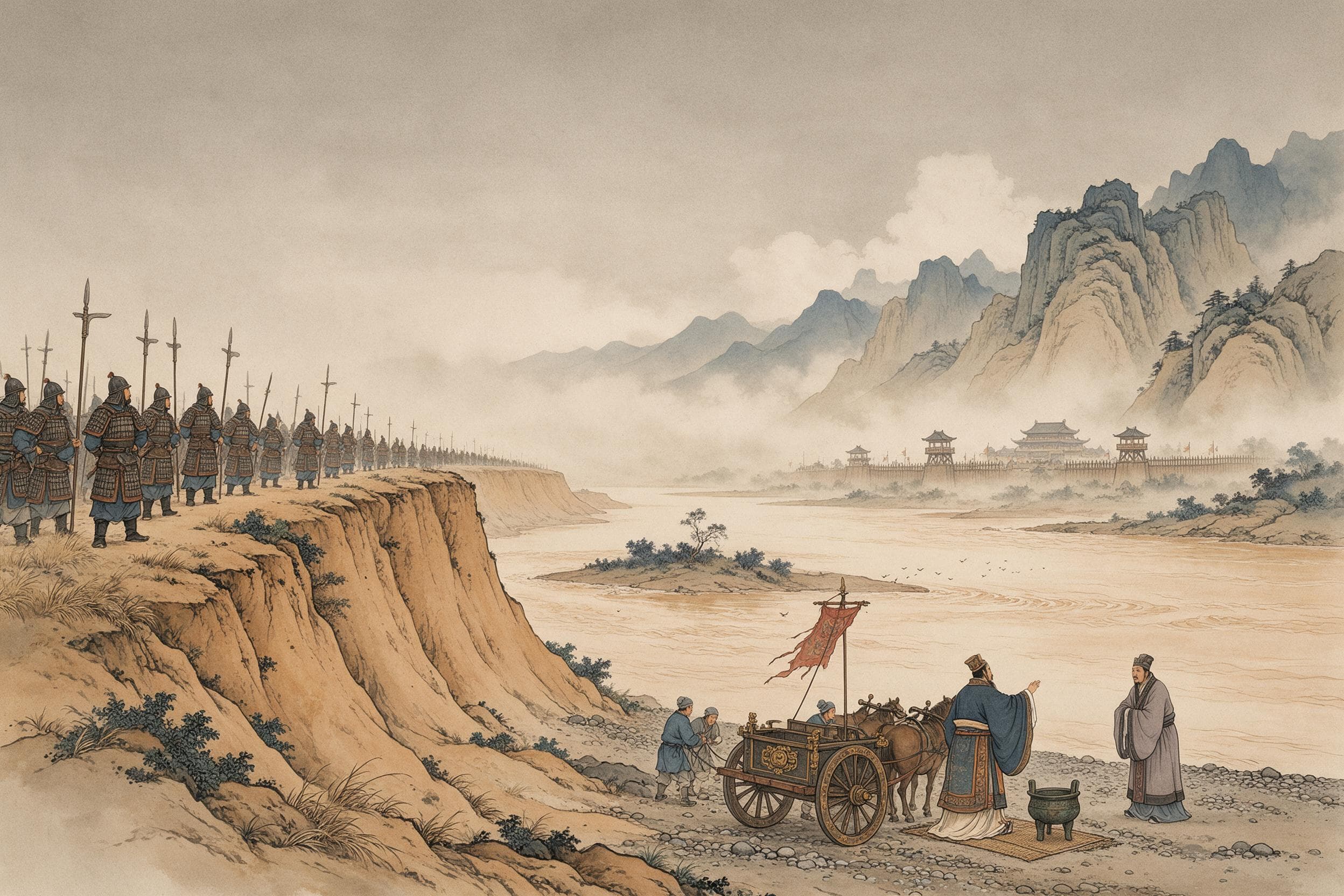
Two pages describe the same cauldron. The Shishuo xinyu, in the chapter called 'Extravagance' (汰侈): 'Wang Junfu washed his cauldron with glutinous rice; Shi Jilun cooked with candles' (王君夫以𥹋糒澳釜,石季倫用蠟燭作炊). The Book of Jin, in Shi Chong's biography: 'Kai washed his cauldron with 𥹋; Chong used wax in place of firewood' (愷以𥹋澳釜,崇以蠟代薪). One contest, two sentences: the cauldron is washed in both, the rice is named in one and the candles in the other, and the wax is fuel in one and a substitute for firewood in the other. This article sets the two versions side by side and does not blend them.
Two Pages, Two Kinds of Book
The two witnesses are different machines. The Shishuo xinyu is a collection of anecdotes by Liu Yiqing, arranged by category; this chapter's category is 'extravagance', each item a few lines, with no narrative join and no dates. The main text is very short; an old commentary in angle brackets quotes Wang Yin's History of the Jin, the Jin gongzan and other works. The Book of Jin is a history compiled under the Tang: juan 33 is the biography of Shi Bao with his son Shi Chong appended, a continuous Life of parentage, offices, ruin and the killing of the household. The same events appear in two genres, and a fact in the main text of one may sit in a note in the other.
Take the money first, since neither page gives a figure. The Shishuo main text never says where Shi Chong's wealth came from. Its commentary does: quoting Wang Yin's history, 'Shi Chong, as governor of Jingzhou, robbed and killed, and so became immensely rich' (石崇為荊州刺史,劫奪殺人,以致巨富). The Book of Jin puts the same charge in its main text: 'at Jingzhou he robbed the envoys and merchants who came from afar, and grew rich beyond reckoning' (在荊州,劫遠使商客,致富不貲). Neither page gives a sum, a price or an income; 不貲 is not a number.
Kitchen, Screens, Walls
Item by item, kitchen and furnishing both match and fail to match. The screens: the Shishuo has 'Junfu made a screen of purple silk cloth wrapped in green damask, forty li of it; Shi Chong made a brocade screen of fifty li to match him' (君夫作紫絲布步障碧綾裹四十里,石崇作錦步障五十里以敵之); the Book of Jin has the same forty and fifty and leaves out 'wrapped in green damask' (碧綾裹). The walls: the Shishuo, 'Shi used pepper for plaster, Wang used red mineral clay to mud the wall' (石以椒為泥,王以赤石脂泥壁); the Book of Jin, 'Chong plastered his rooms with pepper, Kai used red clay' (崇塗屋以椒,愷用赤石脂). The figures agree — forty li, fifty li — and each book adds or drops a detail. Nothing is converted into metres, and neither page prices a screen.
What the figures do not carry matters as much. A 步障 is a screen set up to shut a procession off from view; both pages say how long the two screens were and that one was made 'to match' (敵之) the other. They do not say how much cloth went into them, how many men carried them, how long the work took, or what any of it cost. The only comparison the texts themselves make is length: forty against fifty.
The Coral Tree
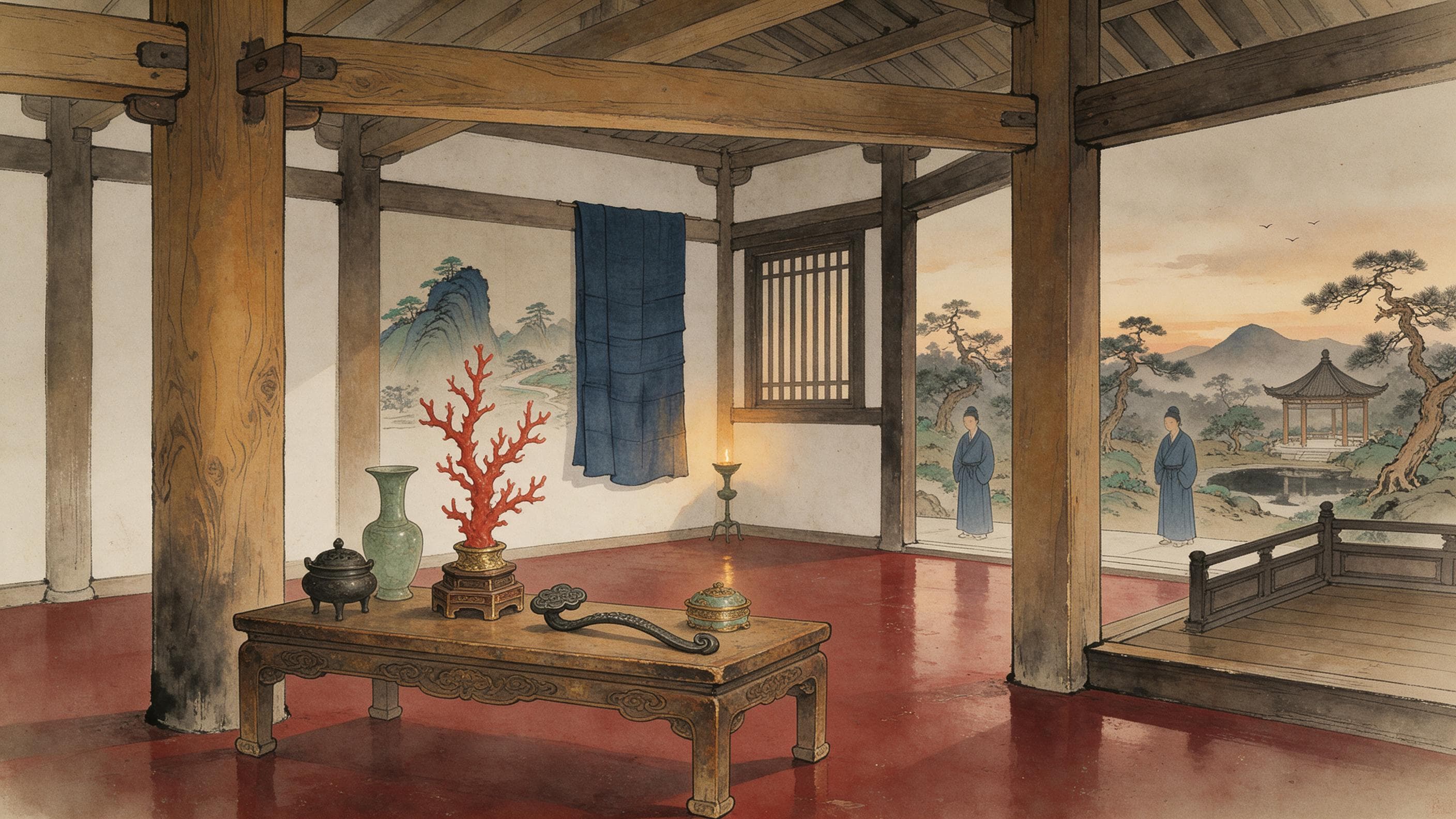
The coral is the best-known item, and the two pages frame it differently. The Shishuo: 'Emperor Wu was Kai's nephew and helped him at every turn. Once he gave Kai a coral tree about two chi high, its branches spreading, without peer in the world. Kai showed it to Chong. Chong looked, struck it with an iron sceptre and broke it at a blow… "No cause for regret; I return it to you now," he said, and ordered out all his coral: six or seven pieces three and four chi high, dazzling the eye, while those like Kai's were very many. Kai was stunned and lost' (武帝,愷之甥也……愷惘然自失). The Book of Jin drops the kinship, has 'Emperor Wu helped Kai', 'six or seven plants' (株) not pieces, and ends the same way; its page prints the last pair as 忄兄, split in transcription, where 惘 is meant.
Each page also keeps items the other does not. The Shishuo has Shi Chong's privy, with more than ten maids in attendance, aromatic powder and aloes-wood water set out, new clothes ready, the Grand General Wang stripping off his old robe without a flicker while the maids remarked, 'This guest will surely turn bandit' (此客必能作賊); Wang Wuzi serving suckling pig fed on human milk, so that Emperor Wu left before the meal was over; a banquet where a guest who did not drain his cup cost a maid her life. None of these is on the Book of Jin's page — not necessarily in the book; other juan were not checked. That page has instead the Life around the stories: the boy left out of his father's division with 'this child is small, but he will get his own' (此兒雖小,後自能得), the Jingu estate, the circle around Jia Mi, the bow at Lady Guangcheng's dust, and the ruin.
Three Tricks, and the End
The three tricks are in both pages, with one difference of detail. The Shishuo sets them up: bean gruel 'served on the instant'; a leek relish in winter; an ox that 'in form and strength was no match for Wang Kai's', yet on a late-started race to Luoyang 'after several tens of paces went swift as a bird' (數十步後,迅若飛禽). The Book of Jin has the gruel, the relish and an ox 'swift as a bird, so that Kai could never catch it' (崇牛迅若飛禽,愷絶不能及), without the head start. In both, Kai bribes Chong's household — bean powder cooked and ground beforehand, chopped leek root with wheat sprouts, a yoke let ride — and in both Chong has the informers killed.
Only the Book of Jin follows the story to the house. It gives the end: Sun Xiu demands the singer Lü Zhu, and Chong refuses; the soldiers come to the door while he is feasting on the tower; Lü Zhu throws herself down; on the way to the eastern market Chong says, 'the slaves want my property' (奴輩利吾家財), and the officer answers, 'if you knew property brought harm, why not have scattered it early?' (知財致害,何不早散之?); his mother, brother, wife and children are killed, fifteen of the household, and Chong is fifty-two. It records the inventory taken afterwards: 'water mills, 三餘區, and more than eight hundred bondservants' (水碓三餘區,蒼頭八百餘人) — the page writes 三餘, not 三十餘, and nothing is supplied here.
What Neither Page Gives
Neither page gives a price: not for the screens, the coral, the pepper plaster or the wax; no wage, no market figure, no account of spending. Neither dates the contest or the two men's births and deaths; the Book of Jin says only that Chong was fifty-two when he died, and sets no year to it. Wang Kai's age, offices and end are not here. His posthumous name, 醜, appears in a note in the Shishuo quoting the Jin gongzan, and the story of the poison bird is in that same note, while the Book of Jin puts the poison-bird story in its main text and names the officer who impeached them, Fu Zhi.
The two pages leave not one story but two ways of keeping it. In the anecdote collection the cauldron, the screens, the coral and the tricks are separate entries filed under one word, extravagance, and no entry knows the others. In the dynastic history they are folded into a single Life that ends at the eastern market. Which version came first, and which copied which, neither page says; the History of the Jin quoted in the Shishuo's notes is Wang Yin's, not this one. The iron sceptre that breaks the coral is in both pages, ; what became of it is in neither.
Related reading:Declare Your Goods: The Han Property Levy and the Rewards for Informers · Six Characters, Three Tables: Standard Measure in Qin and Han · Nine Grades: A System Created in One Sentence, Denounced in One Memorial, Left Standing
Sources & further reading
- 《世说新语·汰侈第三十》(南朝宋刘义庆撰;维基文库本,正文与〈〉内旧注同页,未与点校本复核) — The 'extravagance' chapter: Wang Junfu washing his cauldron with glutinous rice and Shi Jilun cooking with candles; the purple silk screen of forty li against the brocade screen of fifty; pepper plaster against red mineral clay; the coral tree broken with an iron sceptre; the privy with its attending maids, the suckling pig fed on human milk, the maid killed for a guest's undrained cup; the three tricks of bean gruel, winter leek relish and the fast ox. The angle-bracket commentary quotes Wang Yin's History of the Jin for the origin of Shi Chong's wealth by robbery at Jingzhou, and the Jin gongzan for Wang Kai's background and posthumous name.
- 《晋书》卷三十三·石苞传附子崇(唐房玄龄等撰;维基文库本,未与点校本复核) — The biography of Shi Chong inside his father's Life: the deathbed division of property that left him out; the charge that he robbed envoys and merchants at Jingzhou and grew rich beyond reckoning; wax in place of firewood, the forty and fifty li screens, the pepper and red clay; the coral given by Emperor Wu and smashed with an iron sceptre; the three tricks and the killing of the informers; the demand for Lü Zhu, the arrest, the remark at the eastern market, the fifteen dead of the household, Chong aged fifty-two, and the inventory taken afterwards. The juan closes with the historians' verdict and the eulogy.