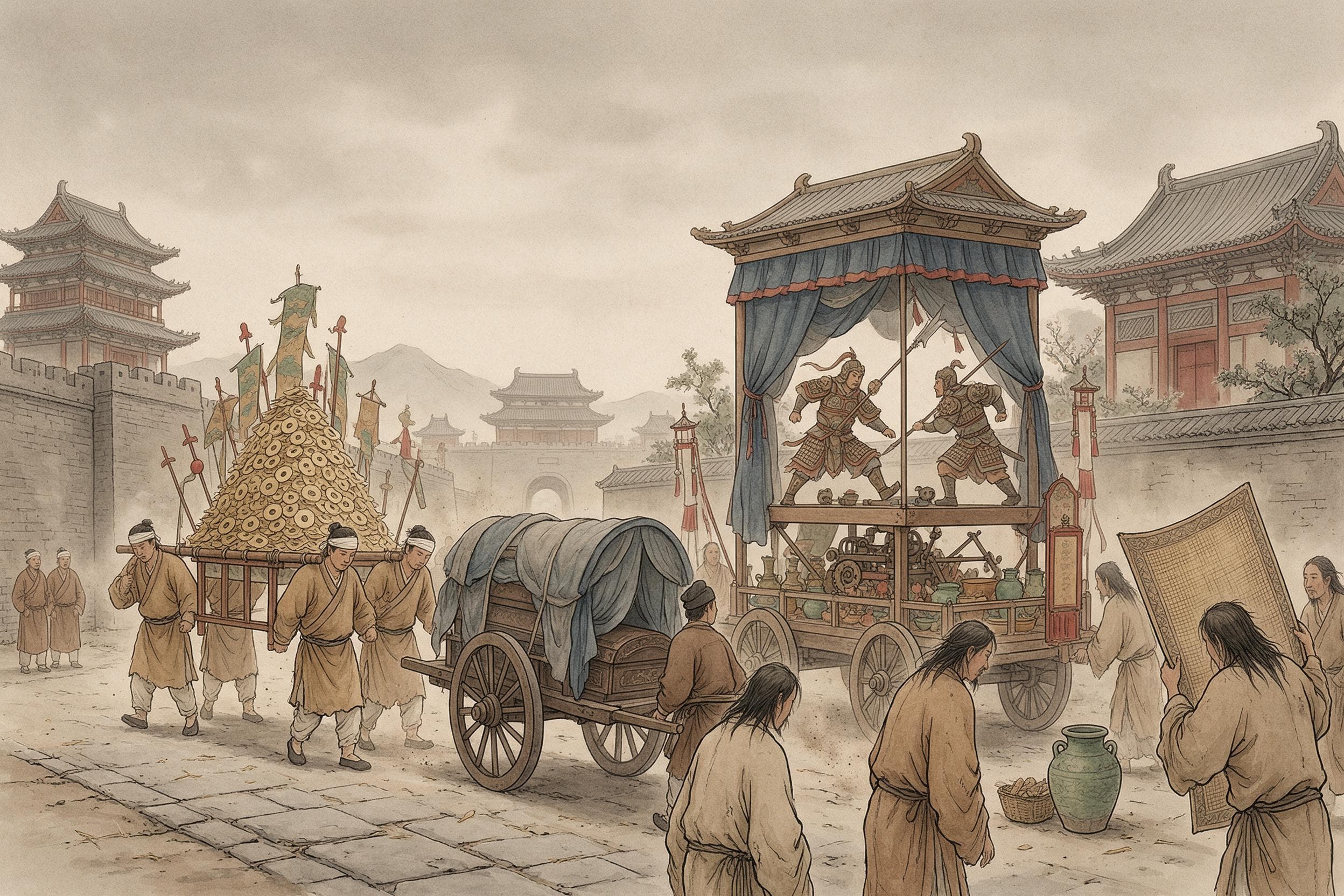
A Tang funeral procession, and the thing carried at the front is a pile of money. Not coins — pierced paper money, heaped into a mountain, richly decorated, carried ahead of the coffin. The man who wrote this down, Feng Yan, was active in the eighth century, and he used the words “in our time”, which tells us the custom was current, not ancient.
Four layers in one passage
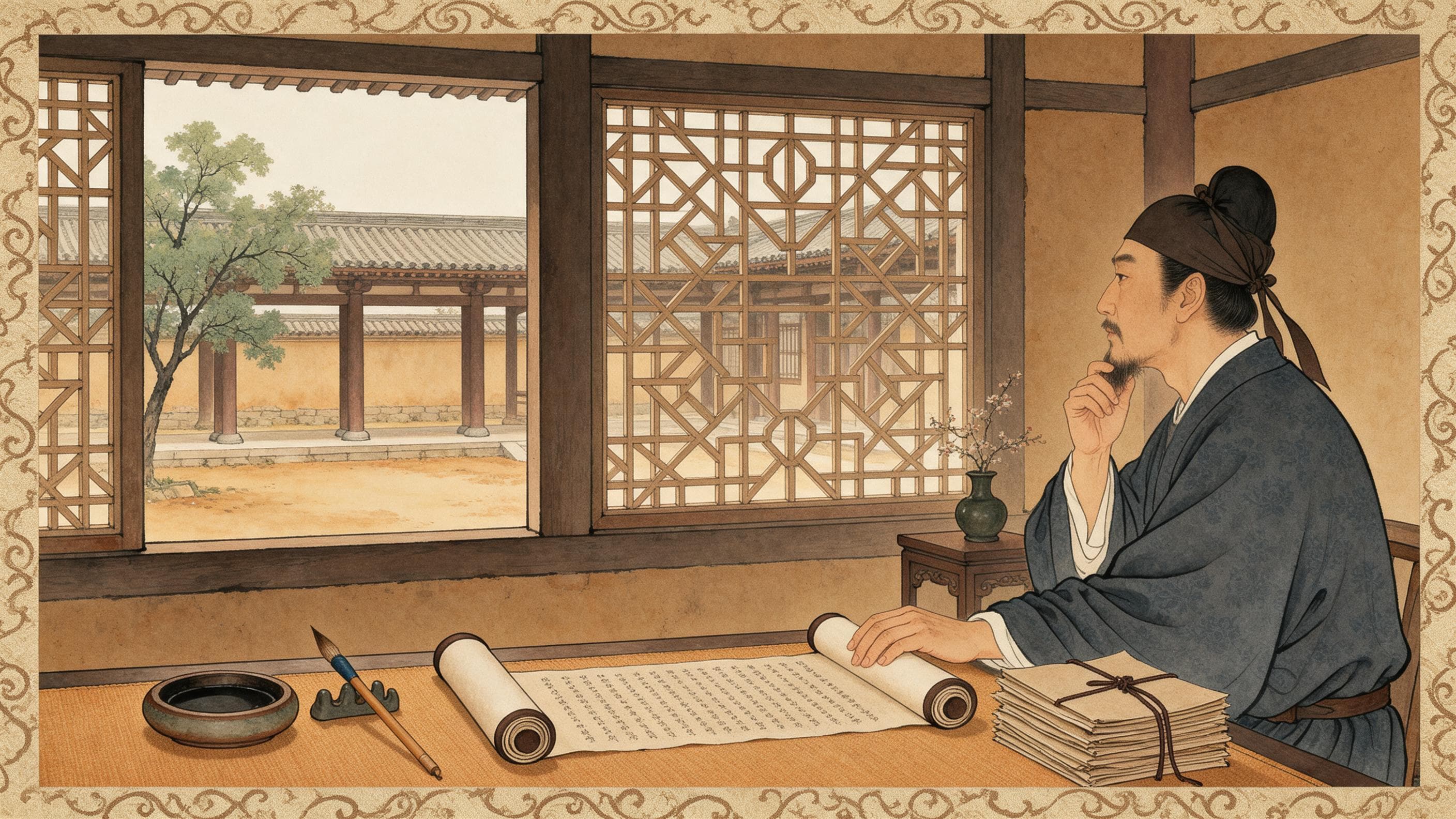
He explains the origin in a single passage with four layers: “In antiquity, offerings to ghosts and spirits consisted of jade, silk and textiles, which were buried when the rite was over. Later generations prized coin, and so sent money to the dead. The Han Shu speaks of robbers digging up the burial money at Emperor Wen's tomb. For simplicity they changed to paper money. Paper was made by Cai Lun of the Later Han; paper money as such began in the Wei and Jin. Today it is used by everyone from princes to commoners.” Jade and silk, then real coin, then paper — three stages, and by Feng's day all ranks used it.
Then the sentence that matters most: “For all things belonging to ghosts and spirits, what is used is a likeness, just as with the clay cart and the straw figures at a funeral. Anciently silk was buried; today paper money is always burned, so as to show that we do not know what the spirits do.” Spirit goods work by resemblance, like the toy cart and the straw effigies buried in place of real servants. Silk used to be buried; paper is burned, and the burning is an admission of ignorance. He does not say the dead receive the money. He says the act confesses that nobody knows. Paper money has no value; it works because it looks like money.
“Since the Wei and Jin” is a Tang retrospective
When paper money began is disputed. Feng's “since the Wei and Jin” is an eighth-century man looking backwards, not a contemporary record, and we do not know what he based it on. Claims that push paper money back to the Han, or even to before paper existed, find no support here: Feng himself says paper was made by Cai Lun of the Later Han, which puts paper money after paper. This article therefore quotes “since the Wei and Jin” as a Tang claim, not a conclusion. A firmer marker: the earliest datable use at court falls in the Xuanzong reign. That proves only that by the first half of the eighth century paper money had entered state sacrifice. It does not date the origin. The gap between the two is where the argument lives.
Wang Yu, who burned his way to chancellor
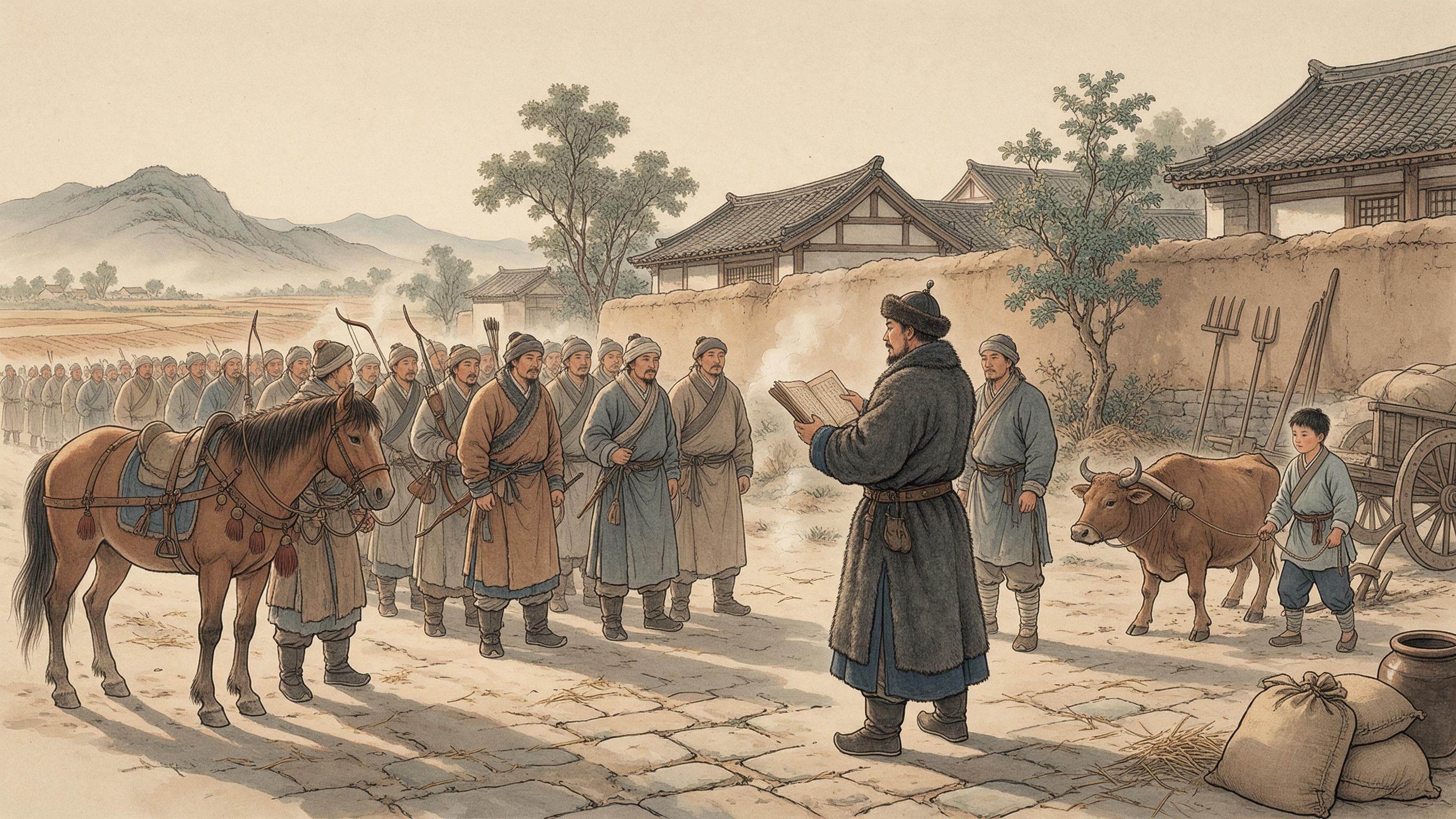
The Jiu Tang Shu, in the biography of Wang Yu: “Yu made a specialty of advancing himself through sacrificial rites; whenever he performed a sacrifice he would sometimes burn paper money, praying for blessings, close to the practice of a spirit medium, and by this he received unusual favour.” He rose from erudite of the Court of Sacrifices and investigating censor to vice director of the Secretariat and joint manager of affairs — a chancellor. The historians' verdict: “Yu reached the positions of general and minister through the monstrous and false in sacrifice.” The same entry describes him sending women shamans across the empire to sacrifice at famous mountains, “all travelling in fine dress by post-station”, taking bribes as they went; at Huangzhou the prefect Zuo Zhen broke the lock and beheaded one. Paper money enters official history for the first time tied to a scandal.
Read the two sources side by side and you hear two tones: a scholar in a notebook saying calmly that “today it is used by everyone from princes to commoners”; a dynastic history saying with contempt that it was “close to the practice of a spirit medium”. One treats it as custom, the other as a charge. Neither is complete: a custom needs someone to do it first, and official history remembers only the most conspicuous.
Funeral offerings as a competition
A second entry in the same chapter says more about how funerals spent money. In the Xuanzong reign, mourners set up offerings in the middle of thoroughfares, with curtains, artificial flowers and fruit, paste figures and wheaten food — “no more than a fathom square, no taller than a few feet” — and even that drew criticism. After the rebellion the fashion swelled: “Canopies and curtains for the offering platforms rose to eighty or ninety feet, using three or four hundred trestles. Carving, inlay and painting exhausted every skill.”
The most famous was the funeral of Xin Yunjing, military governor of Taiyuan, in the Dali reign. The platform sent by Fanyang was the tallest: “wood carved into a scene of Lord Yuchi, Duke of E, fighting a Turkic commander, with mechanisms that moved as if alive.” When the offerings were done and the hearse wanted to pass, the envoy said the “matched sets were not finished”, stopped the cart, and set up a second scene — Xiang Yu and the Han founder at Goose Gate — which took a long time. “The mourners in hemp pushed aside the cloth screens, stopped weeping and watched the play.” When it was over the chief mourner told the envoy: “The offering platform was excellent. Reward him with two horses.”
The costs come with figures. South of Fuyang, offerings were set every half li for more than twenty li down to the Zhang River: “the large ones cost over a thousand strings of coin, the small ones three or four hundred.” And the result: “the hearse passes once, and all of it is rubbish.” That is the coldest line in the passage. The reading offered here is that the money was not spent on the dead. It was spent on the people standing there watching, and when they went home it was worth nothing.
In the Song, paper money becomes a date on the calendar
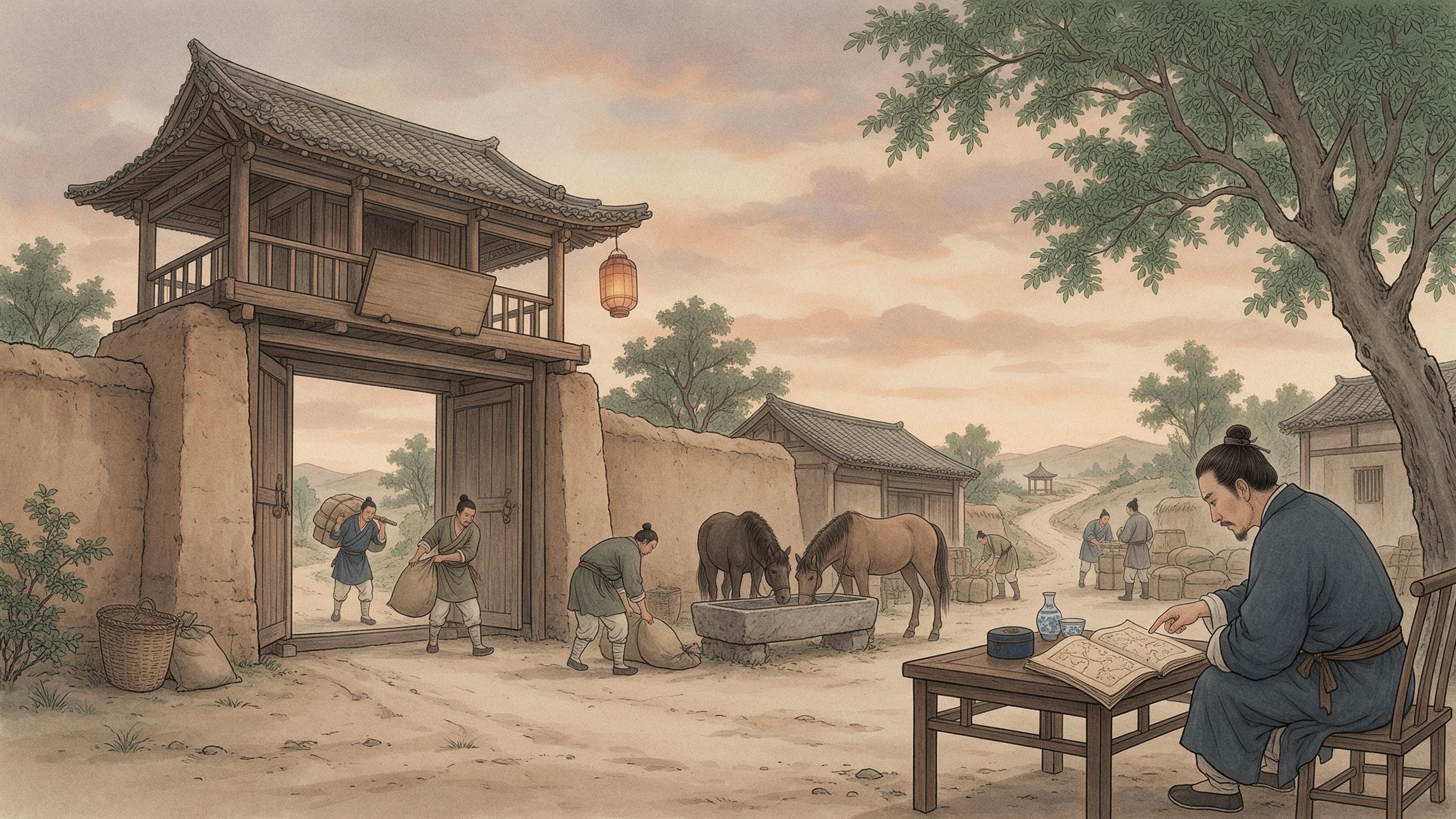
By the Northern Song, paper money needed no explanation. It was seasonal stock. Days before the Zhongyuan festival in Kaifeng, “the markets sold paper grave-goods: boots and shoes, caps and hats, imitation belts of gold and rhinoceros horn, five-coloured clothes, carried about on paper frames and offered for sale.” On the fifteenth of the seventh month, “bamboo poles were cut into three tiers, three to five feet high, woven into the shape of lamp niches and called the Yulan basin; clothes and paper money were hung on them and burned.” And the players of the entertainment quarter “from just after the seventh of the seventh month performed the zaju of Mulian Saving His Mother, until fifty days were up, and the audiences doubled.”
The market kept to the calendar. On the fifteenth, vegetarian food was offered to ancestors, and “at first light they were already selling millet rice, crying it from door to door”; families with new graves went out to sweep them; the palace sent riders to the Daoist cemetery to make offerings and “burn a mountain of money”. By late in the ninth month the streets were already selling “grave clothes, shoes, mats, hats and lengths of cloth” for the burning on the first day of the tenth month — goods arriving ten days before the date.
Three centuries, and the question had reversed. A Tang scholar had to explain why paper should be burned; a Song householder only had to know which day, what to buy and where. Feng's careful sentence — burned “so as to show that we do not know what the spirits do” — is not audible in the Song market. What is audible is a shopping list: boots, shoes, caps, hats, imitation belts, five-coloured clothes, paper money, on the shelves for the season and burned on the season's date.
Sources & further reading
- 封演《封氏闻见记》卷六「纸钱」「道祭」(Feng Yan, Fengshi Wenjian Ji, juan 6, “Paper Money” and “Offerings on the Road”) — The four-stage account of how offerings became paper money and burial became burning, plus the competition in funeral offering platforms and its costs.
- 刘昫等《旧唐书》卷一百三十《王玙传》(Liu Xu et al., Jiu Tang Shu, juan 130, “Biography of Wang Yu”) — The earliest datable burning of paper money at court, recorded as the trick of a sacrificial specialist who rose to chancellor, with the historians' verdict on him.
- 孟元老《东京梦华录》卷八「中元节」「重阳」(Meng Yuanlao, Dongjing Meng Hua Lu, juan 8, “Zhongyuan Festival”, “Double Ninth”) — Paper grave-goods sold by the market days in advance, the Yulan basin frame with clothes and paper money burned on it, the Mulian play's fifty-day run, and grave clothes sold ahead of the tenth-month burning.