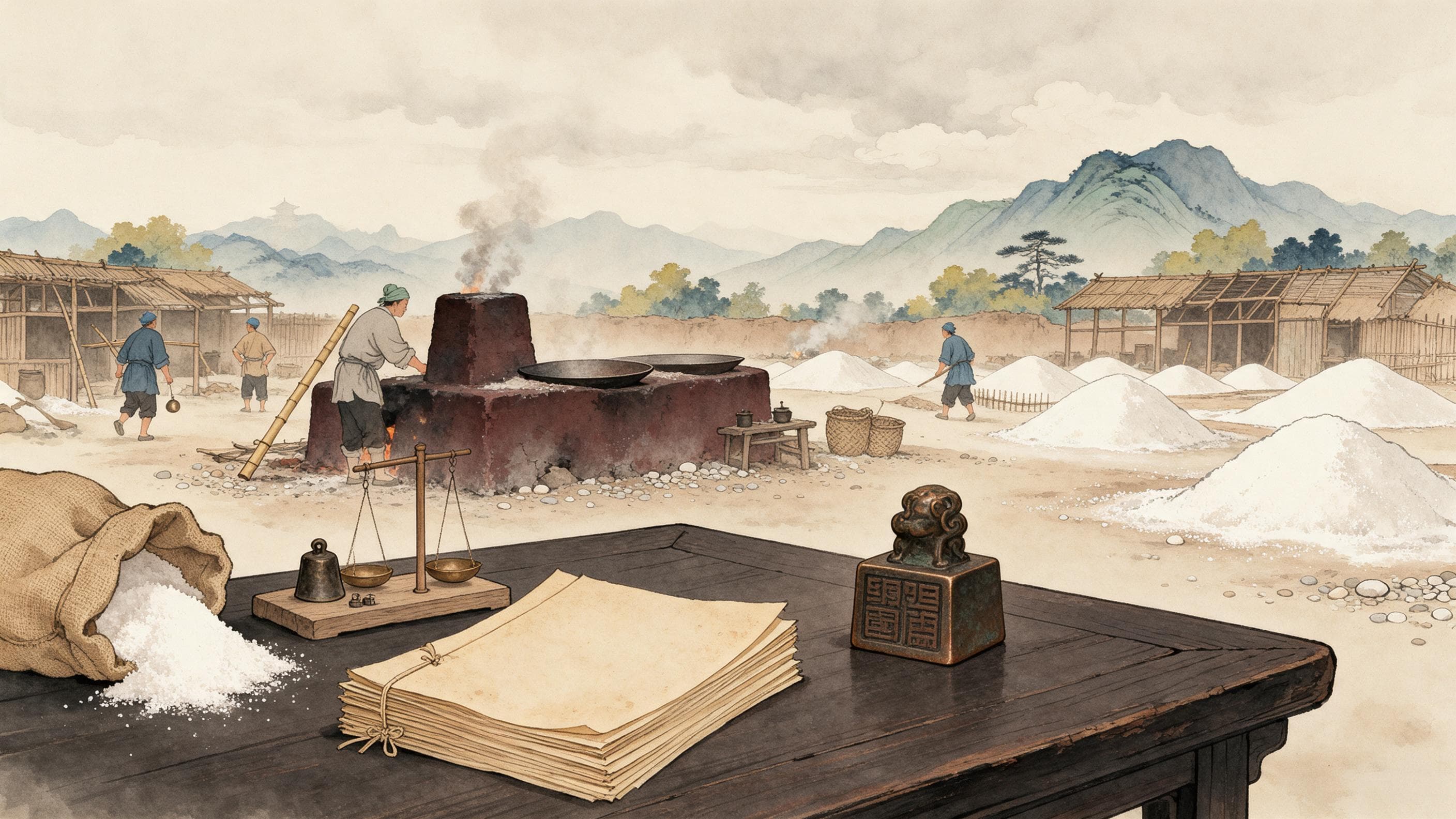
A salt permit in Yuan China was a sheet of paper and a weight at the same time. It entitled its holder to four hundred jin of salt, and the state put a price on it: ten taels of silver in 1230, one hundred and fifty guan of paper money by the early fourteenth century. The salt fields, the stove households, every province's annual quota, the executions for forgery — all of it hangs on that one unit. The chapter that records the system is a price list before it is anything else.
One permit, four hundred pounds
The Yuanshi begins with the unit, not the revenue. 'In the gengyin year of Taizong [1230], the salt law was first carried out: each salt permit weighed four hundred jin, and its price was ten taels of silver.' The weight was a standard rather than an instant fact. When the Yuan took Lianghuai in 1276, the local permit still weighed three hundred jin, and only in the next year was it made four hundred. In Shandong the same early settlement was recorded the other way round — 'for one tael of silver one got forty jin of salt', ten taels for the four hundred. A permit was not the salt itself: a merchant bought the paper and then 'went to the several fields to draw the salt and sell it'.
The price on the paper was one of two payments, and they ran in opposite directions. The other went to the households who boiled sea water or dried lake brine. In 1265, when three more fields were added at Baodi, 'the stove households' work cost was set at three taels of Zhongtong notes per permit'; in 1291 it was raised to eight taels. The chapter also says how it was paid out: 'each year officials sent from the province and the censorate distributed the stove households' work cost quarter by quarter.' What the merchant paid for the paper and what the producer was paid for the salt are two ledgers; the text never adds them together.
The same permit, a rising price
- 1230 — ten taels of silver
- 1261 — cut to seven taels
- 1276 — converted to nine guan of Zhongtong notes
- 1289 — raised to fifty guan
- 1296 — raised to sixty-five guan
- 1309–1315 — 'raised by stages to one hundred and fifty guan'
The money behind the number changes as well as the number: silver at the start, then the dynasty's own notes after the conquest of the south. The chapter lists the rises one after another and gives no reason for any of them; a reader may suspect that the note was falling and the price was chasing it, but that is a guess, not something the text says. What the same chapter does show is a gap between the official price and what salt actually sold for. A memorial of 1285 complains that the rich and powerful 'buy permits under false names and hold them back for profit' while the office sold a permit for fifteen taels, and it cites prices from 1281: at Tanzhou a permit sold for one hundred and eighty taels, in Jiangxi for one hundred and seventy, at Shangdu and Dadu for one hundred and twenty. The proposal that followed was an ever-normal salt bureau, to sell cheap when the merchants held back; Liangzhe had set one up in 1284 'to level the people's salt prices'.
Where the salt came from, and what it cost to make
Four hundred jin were not produced the same way anywhere. Hejian, Shandong, Lianghuai, Liangzhe and Fujian 'boiled the sea and then made it'. Hedong's salt crystallised by itself in Lake Xie, 'a lake one hundred and twenty li square', where in the fifth month the field officers waited for the salt to form and set men to rake up the salt flowers. Sichuan's salt came from wells, 'the deepest several hundred feet', drawn up and boiled, which the chapter calls the hardest of all. A single permit weight therefore covered very different costs, and the work cost paid per permit varies accordingly: eight taels at Dadu in 1291, but in Liangzhe by 1320 twenty taels for the regular salt of the western fields and twenty-five for the eastern, with the surplus salt higher still.
Quotas were fixed province by province, and they climbed. Liangzhe's annual quota ran from 92,148 permits in 1277 to 218,562 in 1281, 450,000 in 1286 and 500,000 by 1319; in 1294 its forty-four boiling grounds were merged into thirty-four fields. Lianghuai began at 587,623 permits in 1279, was raised to 800,000 in 1281 and cut by 150,000 in 1289. For 1329 the chapter gives Lianghuai 950,075 permits, worth 2,850,225 ding of Zhongtong notes, with twenty-nine fields under it; the national figure for that year is 2,564,000-odd permits and 7,661,000-odd ding. The chapter's word is ban 办, what was to be delivered: it is not an audited receipt, and the two should not be read as one.
Forged paper, private salt
Because the permit was the choke point, the law struck at the paper. 'Those who forge salt permits are all to be beheaded, their household property confiscated and given to the informant as reward.' Private salt was punished less severely but still heavily: 'two years of penal labour, seventy strokes, and confiscation of half the property', with half of what was seized going to whoever informed. Salt sold outside its assigned district was treated one degree below private salt, half of it confiscated and half given to the informant. The revised statutes quoted in the later history add the routine that made the paper work: 'under the salt law permits must be sold for cash; the price in notes must enter the treasury and the salt bags leave the yard before the account is closed' — and any salt carried beyond the four hundred jin of a permit was judged as private salt.
What worried the state was the paper, not the salt as such. In 1271, because 'the households of Dadu ate much private salt' and the revenue suffered, the government 'issued salt against the number of mouths' — a ration that pulled people back into the official channel. The penalties follow the same logic: the monopoly that had to be defended was the permit's, and forgery was the one offence that carried death.
What the ledger does not say
Three numbers are easy to confuse, and the sources keep them apart: the official price of a permit, the work cost paid to the stove household, and the retail price a memorial quotes. Only the first belongs to the Yuanshi's price series. The market prices come from another book, Ke Shaomin's New History of the Yuan, compiled in the 1920s; this piece uses it as a comparison only, without collating it line by line against the Yuanshi, and where the two books differ both readings are set down. What the chapter never gives is a national total of salt fields — only provincial figures and Lianghuai's twenty-nine — nor the number of salt households, nor salt's share of state revenue. No figure here is converted into modern money.
The one number that never moved was the four hundred jin. Through a century in which a permit's price went from ten taels of silver to one hundred and fifty guan of notes, the weight it entitled the holder to stayed fixed, and so did the paper's legal character: buy it for cash, carry it to a field, draw the salt, sell it inside your district. Who actually paid the difference between those two figures — the stove household, the merchant, or the eater — is not a question the chapter answers. It records what the state asked for; the other half of the ledger is missing.
Sources & further reading
- 《元史》卷九十四·食货二·盐法(明初官修;维基文库本,未与中华书局点校本复核) — Official Ming compilation of Yuan institutions. It gives the permit weight and the price series from the gengyin year of Taizong (1230): four hundred jin a permit for ten taels of silver, cut to seven taels in 1261, converted to nine guan of Zhongtong notes in 1276, raised to fifty guan in 1289, sixty-five in 1296 and one hundred and fifty by 1315. The same chapter supplies the stove households' work cost (three taels a permit in 1265, eight in 1291, quarterly distribution), regional quotas (Liangzhe 92,148 permits in 1277 rising to 500,000 under Yanyou; Lianghuai 587,623 in 1279 and 950,075 for 1329 with twenty-nine fields), the national figures for 1329 (2,564,000-odd permits and 7,661,000-odd ding), and the penalties for forged permits, private salt and salt sold outside its district. Its figures are quotas to be delivered, not audited receipts.
- 柯劭忞《新元史》卷七十一·食货四·盐课(民国重修,二手) — Ke Shaomin's New History of the Yuan is a Republican-era recompilation and a secondary source; this piece uses it as a comparison only and has not collated it line by line against the Yuanshi. It repeats the permit weight and price series, records the 1285 memorial complaining that rich households bought permits under false names and quoting 1281 selling prices (180 taels a permit at Tanzhou, 170 in Jiangxi, 120 at Shangdu and Dadu), and quotes the Zhiyuan regulations on cash-only permit sales. Where the two books differ, both readings are reported and the Yuanshi is preferred.