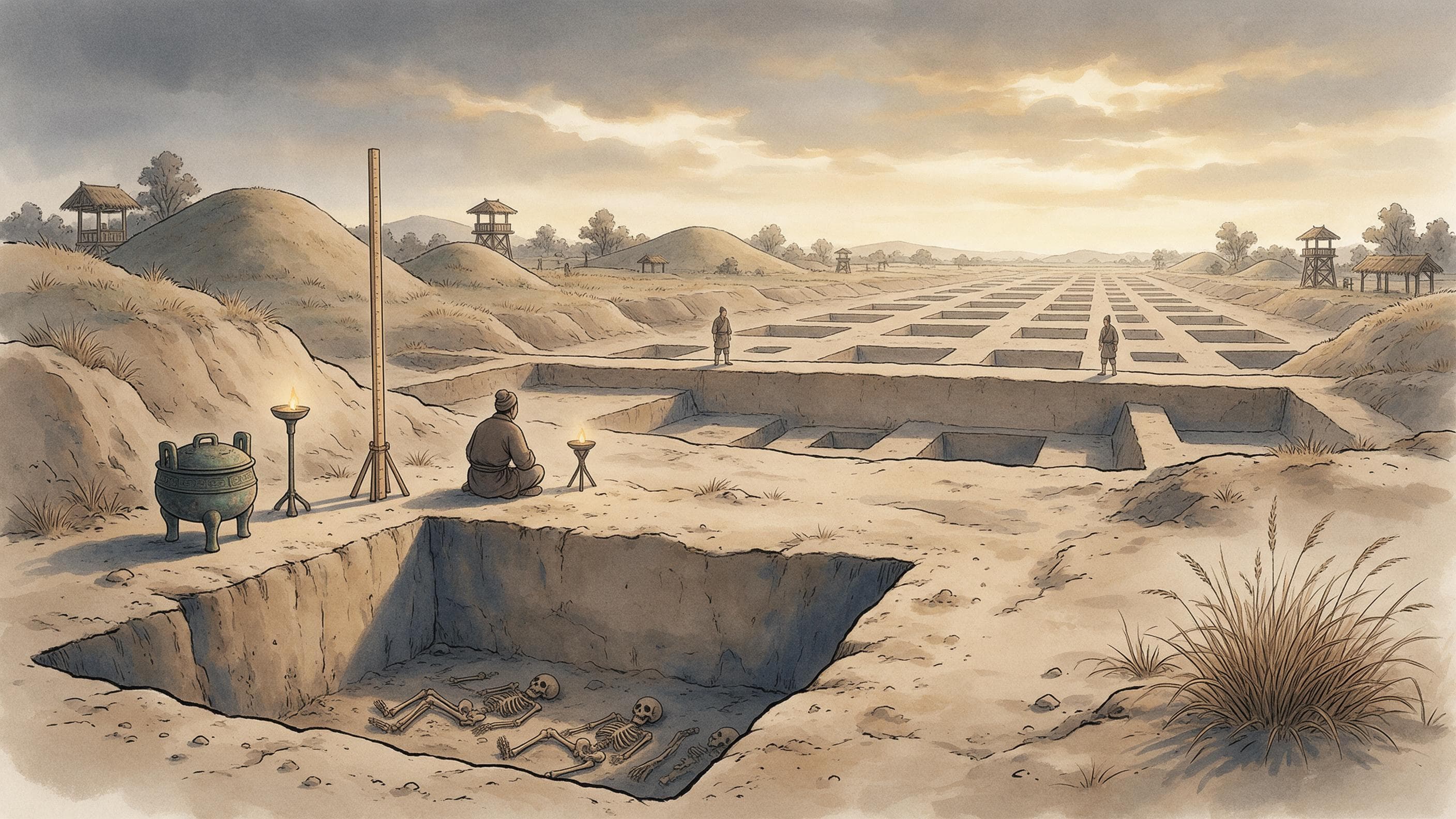
Two sets of numbers were brought together. On one side, the pits: human sacrifice pits laid out in groups, and when the bones were counted group by group, the numbers that recurred most were 10, 30, 50, 100, 300. On the other side, the oracle bones: when Shang kings sacrificed to ancestors, the texts repeatedly say 'ten Qiang', 'thirty Qiang', 'fifty Qiang', 'a hundred Qiang', 'three hundred Qiang'. The numbers matched, and a hypothesis followed: perhaps the people in the pits were Qiang.
The Research Notice
First, where the page comes from: it is a Xinhua report of July 2016 by Liu Yaming and Gui Juan, reposted under 'Archaeological News' on the website of the Institute of Archaeology, CASS. It says that at the tenth anniversary of Yinxu's World Heritage listing, Tang Jigen, then head of the institute's Anyang station, announced new findings: the people in the Xibeigang sacrifice pits were 'not slaves but Shang captives', Qiang people 'who had lived next to the Shang and were pushed by the powerful Shang into the north-west'. The report introduces the pits as a discovery 'as startling as the oracle-bone pits'. This is a research notice, not a physical-anthropology report; every conclusion on it must be attributed — 'the research argues'.
The method is stated plainly: a 2013 National Social Science Fund project, 'The human bone of the Yinxu royal-cemetery sacrifice pits and the race and culture of the Qiang', had the Anyang station working with Canadian scholars and using strontium-isotope analysis to trace where the victims came from. The team went to Gansu and Shaanxi to find bones of the Siwa and Kayue cultures, compared them with newly excavated bones from the pits, and found the isotope ratios 'very close'. Tang's explanation is quoted too: 'these Qiang were generally killed soon after being captured; had they been kept as slaves for a year or two, the strontium ratio would have changed.' The project had begun from those two sets of numbers before it went near a laboratory. The method can be written; the sample size and the actual figures are not on this page, and this article does not supply them.
The page adds two supporting points. In the passage of the great tomb associated with the Simuwu ding, 22 sacrificial skulls were well preserved, and isotope testing showed most were Qiang. And Hu Houxuan's 1974 survey of 2,000 oracle-bone inscriptions counted 8,000 Qiang among 14,000 human sacrifices at Yinxu. The second is a count from oracle-bone texts, not from bones, and must be labelled as such.
The Pits and the Scale
The report opens with scale: over 88 years of excavation at Yinxu, the Xibeigang royal-cemetery area has 'more than 2,500 sacrifice pits', mostly human sacrifices, laid out in regular rows, and over two centuries 'tens of thousands of living people' were killed as offerings to the Shang royal ancestors. These are the report's words; they are cited as such here. This article lists no pit numbers and makes no further total; the figure is a reporter's summary of the cemetery area, not a count of excavated pits.
What is worth noticing is the shape of the reasoning: grouped pits, then bone counts by group, yielding the recurring figures 10, 30, 50, 100, 300; then the oracle-bone formulas from 'ten Qiang' to 'three hundred Qiang'; then the hypothesis that these were Qiang; and only then the isotope test. Three steps — numbers, hypothesis, test — not a single leap from 'the dead at Yinxu were Qiang'.
What Mozi Says
Another book has numbers for sacrifice too, but of a different kind. The Mozi, 'Simplicity in Funerals III': 'For the Son of Heaven, those killed to follow him are at most several hundred, at least several tens; for generals and great officers, at most several tens, at least a few' (天子殺殉,衆者數百,寡者數十). This is a Warring States argument against lavish burial and long mourning. Mozi first sets out the harm: heavy coffins, deep graves, many shrouds and great mounds mean that 'the state must be poor, the people few, and punishments and government disordered'; only then does he come to the followings of the dead, inside a list of things buried with them — hangings, cauldrons and drums, tables, wine vessels, halberds and swords, feathers and banners, ivory and hides.
Mozi's own rule is the reverse: 'a coffin three cun thick is enough for the decaying body, three layers of shroud to cover the ugly; below not reaching the spring, above not letting the smell out, a mound like three furrows, and no more.' What he attacks is not killing at burials alone but the whole apparatus — coffins, shrouds, mounds, grave goods, prolonged mourning. So 'several hundred' and 'several tens' are weights in an argument, not entries in a register, and must be quoted as Warring States rhetoric, not as a count of Shang dead.
What Each Side Answers
Set side by side, the two pages answer different questions. The research answers 'who': the dead were Qiang captives, killed soon after capture — on strontium-isotope grounds, in Tang Jigen's and the project's name. Mozi answers 'how many': hundreds or tens for a Son of Heaven, tens or a few for generals — on the authority of a Warring States critique, the number serving the conclusion that lavish burial is ruinous. One is a claim about where people came from; the other a claim about what burial costs.
They cannot corroborate each other. To take Mozi's 'several hundred' as a statistic of Shang sacrifice, or to use the 2,500 pits to confirm Mozi's figures, is to sew two kinds of speech into one sentence. Nor does this article write that 'Shang human sacrifice was savage' — the two pages offer a research conclusion and an argumentative text, not a moral verdict. What they support is two sentences: the literature says lavish burial killed many; the research says the dead in the pits were Qiang captives.
What Is Not Here
The gaps: this page gives no detail of the bone analysis, no sample size, no per-pit counts, and no criteria by which 'Qiang' was identified; no age or sex composition of the dead; no pit-by-pit list. The Mozi has no Shang material at all, only Warring States argument. So this article writes how each side speaks, not who exactly was buried or how many.
On one side a research notice gives a 'where from'; on the other a Warring States argument gives a 'how many'. Between them there is no line that adds up to 'N human sacrifices in the Shang'; what does connect them is method — a hypothesis first, then evidence sought. As for who those buried people were, this page's answer is Qiang captives: a research conclusion, not a settled fact.
Related reading:Five Grades of Mourning: A Table of Kin and Cloth · Fifty Disciples: The Han Academy That Was an Appointment Pipeline · Three Thousand Guests and a Bowl of Rice: What Mengchangjun's Retainers Ate
Sources & further reading
- 刘雅鸣、桂娟《研究表明:殷墟大规模殉人的来源是俘虏而非奴隶》,新华网 2016-07-26;中国社会科学院考古研究所网站「考古动态」转载(HTML,研究介绍/报道,非人骨鉴定报告) — A research notice, not a physical-anthropology report, and it must be attributed as such. It reports that Tang Jigen, then head of the institute's Anyang station, announced at the tenth anniversary of Yinxu's World Heritage listing that the people in the Xibeigang sacrifice pits were not slaves but Shang captives — Qiang people. The project behind it, launched in 2013 under a National Social Science Fund grant ('The human bone of the Yinxu royal-cemetery sacrifice pits and the race and culture of the Qiang'), used strontium-isotope analysis with Canadian collaborators, comparing bones from the pits with bones from the Siwa and Kayue cultures in Gansu and Shaanxi; the ratios were close. The notice adds that the captives were 'generally killed soon after capture — had they been kept as slaves for a year or two, the strontium ratio would have changed', that 22 sacrificial skulls from the tomb passage of the great tomb associated with the Simuwu ding were mostly Qiang, and that Hu Houxuan's 1974 count of 2,000 oracle-bone inscriptions found 8,000 Qiang among 14,000 human sacrifices. The notice opens by describing more than 2,500 sacrifice pits at Xibeigang, laid out in rows and mostly human sacrifices, and 'tens of thousands of living people' killed over two centuries. It gives no sample size, no per-pit bone counts, no criteria for identifying 'Qiang', and no age or sex breakdown.
- 《墨子·节葬下》(战国;维基文库本,未与点校本复核) — A Warring States argument against lavish burial and prolonged mourning, not a count of Shang dead. Its sentence on sacrifice: 'If one is satisfied, then follow the dead: for the Son of Heaven, those killed to accompany him are at most several hundred, at least several tens; for generals and great officers, at most several tens, at least a few' (天子殺殉,衆者數百,寡者數十。將軍大夫殺殉,衆者數十,寡者數人). The number serves the argument, which runs: the rich bury heavy coffins, many shrouds and great mounds and put gold, jade, carriages, vessels and weapons in the grave; this 'buries wealth that should have been taxed' and 'prolongs the ban on work', so that 'the state must be poor, the people few, and punishments and government disordered' (國家必貧,人民必寡,刑政必亂). Against it Mozi sets the ancient kings' rule: 'a coffin three inches thick is enough for the decaying body, three layers of shroud to cover the ugly… below not reaching the spring, above not letting the smell out, a mound like three furrows, and no more' (棺三寸,足以朽體;衣衾三領,足以覆惡). The chapter contains no Shang evidence and no figures from excavation.