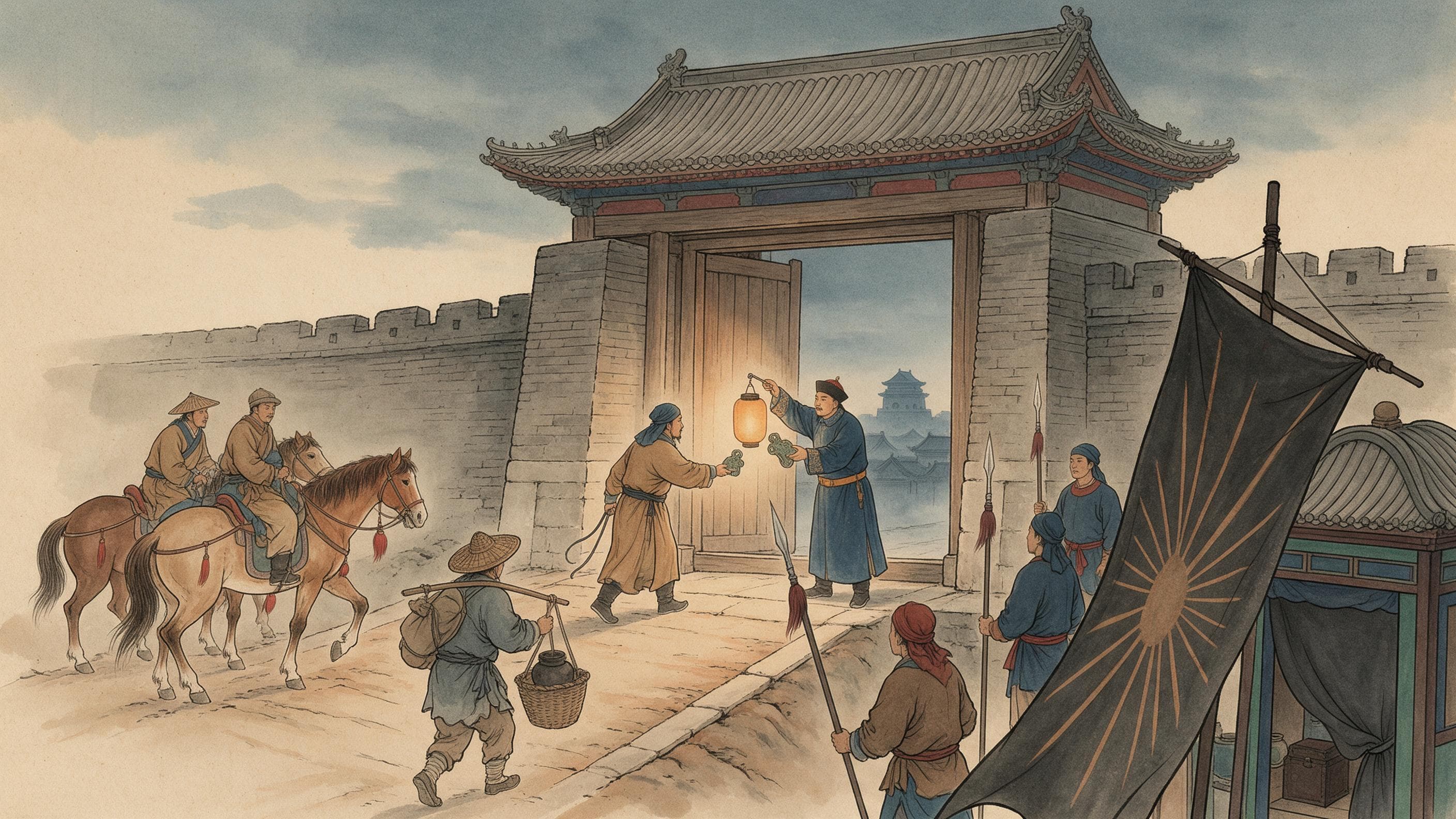
The gates of Qing Beijing did not open at a clock time. They opened according to the court's business that day. On the regular audience days of each ten-day cycle, the Ministry of Rites notified the Board of War, and 于黎明启正阳门 — the Zhengyang Gate was opened at daybreak. When the emperor heard memorials at the palace gate, officials living outside the wall who had to come in early were admitted 于晓钟后, after the morning bell. On days of sacrifice at the altars and temples, those attending from both inner and outer cities were let through 于五鼓后, after the fifth watch. Anyone else needing a gate opened early had to send a sealed document to the Board of War for clearance; 如无兵部印文,概不准启 — without the Board's document, the gate did not open. A day in the capital began with a piece of paperwork.
A gate on the calendar
The office responsible is named plainly in the Qianlong-era topography Chengyuan Shilue, juan 6: the gendarmerie command (步军统领衙门) 'commanded the guards and managed the opening and closing of the nine gates'. The three kinds of day each had their own rule, and an ordinary day required the Board of War's paperwork. One caveat belongs here: the statutes say 黎明, 晓钟 and 五鼓 — daybreak, the morning bell, the fifth watch — not clock hours. Daybreak moves with the season, so the hour of opening moved through the year. How early or late that was at midsummer or midwinter the statutes do not say, and this article does not supply it.
The two halves of the tally
At night the rules tightened. In 1726 it was ordered that the gendarmerie and the two gates of Zhengyang and Xizhi each be given a yin-text tally (阴文合符). If a night order from the throne or urgent military business required a gate to be opened at once, the palace sent out the matching yang-text tally (阳文合符). At Zhengyang and Xizhi the officer compared the halves (照验明白), opened, and reported to the commander. At other gates the commander brought his half to the gate himself and verified it. In ordinary times the usual schedule applied. By day, the rule; by night, the tally.
Time passed from post to post
The city's time was relayed, not struck for all at once. Under the statutes, the watch posts 夜则巡更击柝,每汛设立更筹,自初更起,上下汛往来传送,至黎明乃止 — at night they patrolled and beat the clapper, each post keeping a watch-token, and from the first watch the tokens were passed up and down from post to post until dawn. The Drum and Bell Towers were the origin of that network. The Drum Tower had held a bronze water clock in the Yuan: four vessels with a gong in the middle, 时至则每刻击铙者八, struck eight times a quarter as the water measured the hours. By the Qing, the Chengyuan Shilue says, the tower no longer used the bronze vessels 惟以时辰香定更次 — it fixed the watches with time-incense; the clock chamber remained, the water clock was gone. The Bell Tower was rebuilt in 1745 and a bell hung in it, 声远愈闻之, heard further the higher it hung. How many strokes marked each watch is not in the statutes examined here, and is not written.
After the first watch the city shuts
The curfew fixed in the first years of Shunzhi is blunt: 京城内起更后闭栅阑,自王以下官民人等概禁行走 — after the first watch the barricades in the capital are closed, and from princes down, officials and commoners alike are forbidden to walk. Officers of the watch were assigned streets in rotation, and the deputy commanders still patrolled. When could a barricade be opened? For two kinds of official business — orders from the throne, or dispatches from a ministry — and for six kinds of private emergency: a death, a birth, illness, summoning a doctor, sacrifice, or a marriage. The officer on duty had to 详问事故,记其旗分佐领姓名, question the case and record the man's banner and company, before opening, and then send a soldier to escort him on. For walking without due cause, the offender's name was recorded and reported the next day. An official forfeited a month's salary (罚俸一月); a commoner took fifty strokes of the whip (鞭五十). A barricade left open, or a watch not kept, cost the corporal thirty strokes, the private twenty-seven, the watch officer two months' salary and his deputy one.
The hardware of the night has real numbers. Each gate was established with forty gate soldiers (门军); the nine inner gates had twenty mounted gate guards and two gunners apiece. On the inner nine gates' walls stood 241 buildings of three rooms each — 723 rooms in all — of which 135 were watch-post rooms, with 87 soldier posts. The seven outer gates had no official buildings on the wall, only eighteen posts of three infantrymen each. The barricades were counted by jurisdiction: eighteen in the Bordered Yellow Manchu quarter of the Imperial City, ninety-odd in the wider city, and for the three outer camps 193, 145 and 102 respectively, each barricade manned by three soldiers. Yu Chenglong's Kangxi-era memorial described barricades at every lane mouth and night watchmen 鸣锣击柝,彻夜巡查, ringing gongs and beating clappers all night. The memorial argued for a baojia registry that the board rejected as burdensome to the poor, so only its description is used here, and the separate banner figures are not added into a city total.
The nights one was allowed out
The statutes left a few exits. At the Lantern Festival, from the thirteenth to the seventeenth of the first month, the six streets hung lamps, the court banqueted and set off fireworks, and the markets lit up; the finest lights were at the East Four Archway and Di'anmen, and the crowds lasted 自白昼以迄二鼓, from daylight to the second watch, when the smoke thinned and they drifted off laughing. That is one of the few nights with a recorded closing time. The other exit was summer: in 1732 an edict noted that by old custom 每值三伏,居民人等晚间听其露处乘凉 — in the dog days residents were allowed to sit out in the open in the evening — and confirmed it for the heat. Otherwise there is no statute licensing a night market: by these rules, ordinary nights had no legal street trade, and the city's night life belonged to festivals and hot weather.
The last thing to state is the limit of the material. All of the above is regulation, and regulation is not practice: no one counted how many people obeyed at night, or how many were whipped in a given year. The gaps are real — how the towers beat the watches, the seasonal table of gate hours, the late-Qing night-market texts (not opened here, not cited), the watchmen's numbers, pay and rotation, and the criminal night-curfew statute, so that only the administrative penalties of the Collected Statutes are used, and the two are not mixed. What can be established is a clear chain: gates opened by the court's calendar, and at night by matching tallies; time relayed from watch post to watch post; after the first watch the barricades closed and from princes down no one walked, with six private exceptions and fines or strokes for the rest. A city's daily rhythm was written into its statutes. One question those statutes cannot answer is the one they raise themselves: they say 黎明, daybreak, and never say what time that was.
Related reading:Seventeen Festivals, One Dish Each: A Five Dynasties Menu for the Year · How People Lived in Tang Chang'an: Wards, Rented Rooms and Inns · One Table, Two Chairs: The Banquet Set Out in a Jin Tomb
Sources & further reading
- 允禄等《钦定大清会典则例》卷一百七十九·步军统领(乾隆二十九年;四库全书本) — 门禁:常朝日黎明启正阳门、御门听政日晓钟后启、坛庙祭祀日五鼓后启、其余早开需兵部印文;雍正四年阴文/阳文合符;顺治初年夜禁与栅栏、六项例外、罚则;守卫:更筹传筹、门军四十人、守门骁骑二十名炮手二名、城上房241所723间、堆拨房135所、外七门堆拨18所;雍正十年三伏露处乘凉
- 吴长元《宸垣识略》卷六·内城(乾隆五十三年;识典古籍影印本) — 步军统领衙门「司九门启闭并缉捕之事」;鼓楼元代铜刻漏四壶(天池、平水、万分、收水)、「时至则每刻击铙者八」,清代「不用铜壶等物,惟以时辰香定更次」;钟楼乾隆十年重建悬钟
- 于成龙《抚直奏稿》卷八(康熙朝;识典古籍影印本) — 奏疏描述北京「各胡同口尽立栅栏」,栅内十家牌长「每牌多拨更夫,鸣锣击柝,彻夜巡查」;注意这是官员描述、且所议编保甲被部议否决,只能引其对既有栅栏与更夫的描述
- 富察敦崇《燕京岁时记》「灯节」(光绪三十二年) — 灯节十三至十七、十五为正灯、六街之灯以东四牌楼及地安门为最盛、「自白昼以迄二鼓」;按语记明代灯市初八至十八共十日,清则「灯归城内,市归琉璃厂」