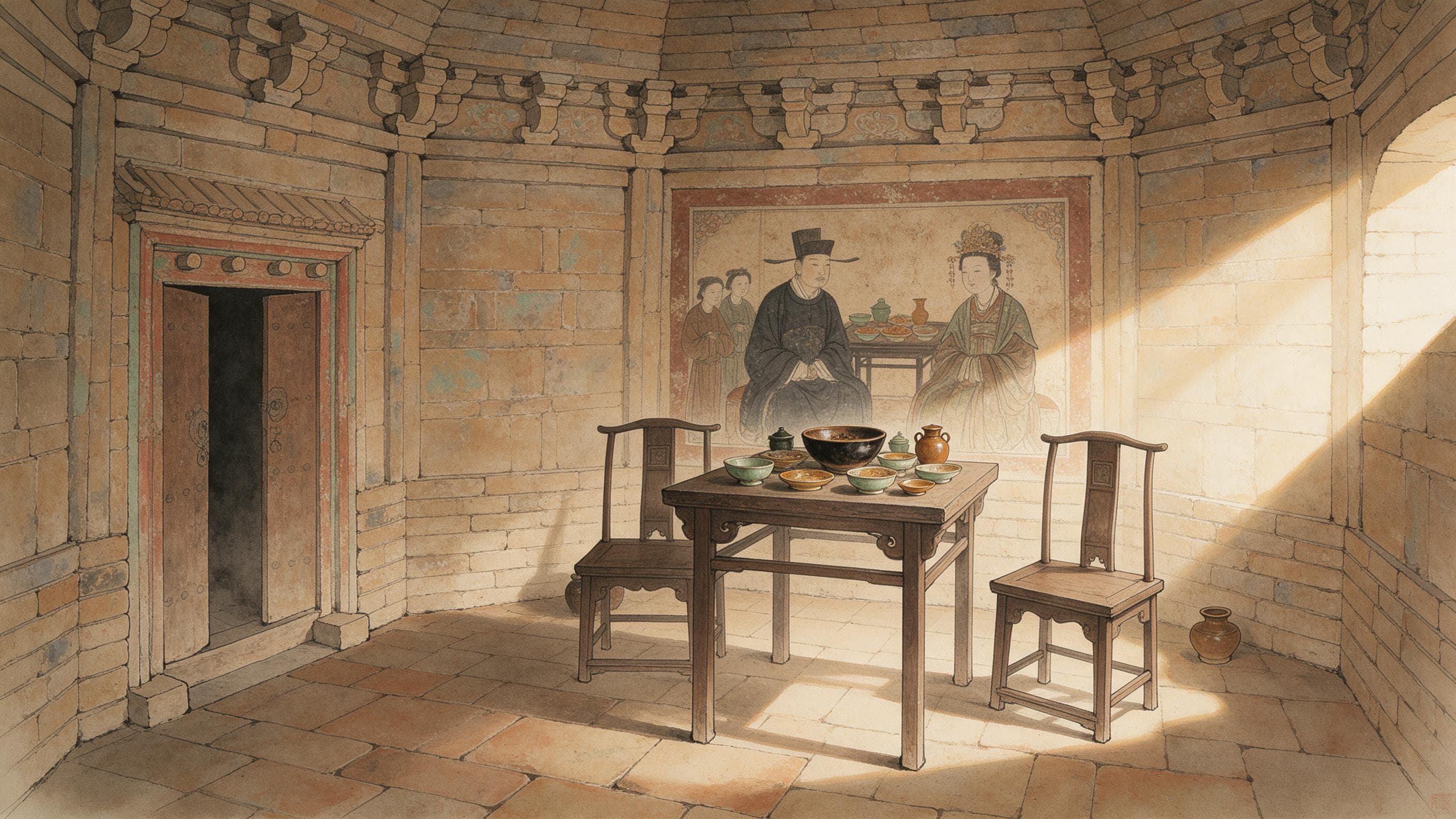
The room has eight sides. Four of its walls carry painted figures, and in front of the low coffin platform, where a table would stand in a house, a wooden table and two wooden chairs have been set out for good. On or beside them are the bowls and dishes that came out of the tomb: eight pieces of glazed ceramic, one pot of unglazed clay, and the three pieces of furniture. Nobody is sitting down. This is the tomb found in May 2020 in a building plot on the slope south of Huwo Road, Xiyang county, Shanxi, and published by the Shanxi Provincial Institute of Archaeology in August 2025.
It is a brick chamber with an octagonal dome, its woodwork imitated in carved and painted brick: a sloping passage, a gate, a corridor, the main room, a side chamber. The roof was partly broken; the rest was intact. No coffin survived. The bones lay scattered on the coffin platform and in the side room. Around the top of the dome, badly preserved, were the Four Deities and the twenty-eight lunar mansions — a ceiling of stars above a dinner party.
Two banquets, on two walls
The northwest and northeast walls carry almost the same picture: a husband and wife seated facing each other, a table between them. The difference is the wife's dress on the northeast wall, and her face — fewer lines in both faces, the pair looking younger. The report notes the same device in Jin tombs at Xiayang village in Wenxi and Xiaoguan village in Changzi, where several couples appear in one chamber with visible differences in age, and reads it as several generations of one family buried together. That is the excavators' reading, not something the tomb says about itself: no epitaph survived, and nothing in the tomb carries a date.
Horses, a sedan chair and a black dog
Two more walls stage a departure. On the southwest wall two saddled horses stand at the centre, with six male servants ranged about them, each holding something. On the southeast wall two sedan chairs are set down side by side and stand empty; eleven male attendants wait in two rows on the inner side, and beyond them are painted two women and a black dog. The sedan-chair procession, the report says, is rare in the tombs of the surrounding region, known from only a few Song and Liao graves. The rest of the walls is left to the brickwork: on the west wall a painted false door stands ajar, two persimmon-calyx studs on its lintel and scrolling flowers across the leaves; on the north wall a front of three transom windows above four lattice doors.
The table that was actually there
It is the furniture that makes the tomb unusual. Before the coffin platform stood a real wooden table and two chairs, and the excavators note that their placing matches the position of the banqueting couple in the murals — an arrangement, they write, that carries a sacrificial meaning. They add that buried furniture of this kind is not common in the area. The ceramics, they say, would originally have stood on an offering table. The funeral therefore had two tables: one painted on the wall, one standing on the floor, and the second arranged to echo the first. The three wooden objects are the table and its two chairs: the whole set survived, which is why the report's own headline points at them. The vessels themselves are ordinary — eight pieces of porcelain, jars, bowls and dishes; a black-glazed bowl and a brown-glazed jar, both shapes common in Jin and Yuan times; little white ware, no printed decoration, workaday quality, probably from a nearby folk kiln. “Probably” is the report's word.
No menu
What the tomb does not have is any list of food. The report describes a banqueting couple and nothing more: no dishes named, no quantities, nothing painted on the table between them. This article will therefore not say that they ate mutton, or drank wine, or were served pastries. Not because a well-off household in Jin Shanxi could not have eaten such things, but because this tomb does not show it, and a wish for colour is not evidence. What can be said is narrower and still worth saying: a household able to afford this chamber, this carving and these murals thought a table, two chairs, bowls and dishes were the right things to leave in a tomb — and painted the same meal on two walls.
Whose table was it?
The excavators place the tomb around the middle of the Jin period or a little earlier, from its structure, its murals and the range of objects buried in it; nothing in it is dated, so this is a judgement, not a record. The occupant they infer to have been a well-off landowning household, from the complexity of the building, the quality of the carved and painted brickwork, and the horses and sedan chairs in the murals. Both statements are marked as inferences in the report. One further caution is the report's own: this is a Chinese-style tomb with Song, Liao and Jin elements and a strongly Liao-Song flavour. It is not evidence for how Jurchen families ate.
For the word “well-off”, the Jin Shi supplies a legal meaning. The means levy, wuli qian (物力钱), was assessed on “fields and gardens, town houses, vehicles, livestock, what is planted, and the amount of silver hoarded”, at rates that varied; the house a family lived in was excluded. Household registers were compiled once every three years, later by repeated general inspections and then by local reassessment. The line most often quoted about rich tables is a criticism by Emperor Shizong in 1181: the Meng'an-Mouke households of Shandong and Daming were not farming but leasing their land to Chinese tenants and living on the rent — “the rich all wear silk and brocade and give themselves to wine and feasting, and the poor vie to imitate them.” That is an emperor scolding a privileged military population; it is not a statistic, and it is not this tomb's household.
In the twelfth month of Mingchang 6 (1195) the registers gave 7,223,400 households of Jurchen, Khitan and Chinese, 48,490,004 persons, and 2,604,742 strings of means levy — realm-wide figures, useless for estimating one family's property. So the tomb keeps its own scale. It gives a room, four painted walls, a table, two chairs, a few bowls, and a date that has to be guessed. It gives no name, no year, no menu and no price. A table set for a meal that nobody eats is, here, the whole of the evidence.
Sources & further reading
- 〈最新公布!山西昔阳发现金代壁画墓,内有夫妇对坐、肩舆出行……还有完好的木头桌椅!〉(中国社会科学网,2025-08-20;资料发布:山西省考古研究院) — The excavation report as published: octagonal brick chamber; saddled horses and sedan chairs on two walls, two banqueting-couple murals on the other two; 12 objects including 8 ceramics; a wooden table and two chairs set before the coffin platform, matching the murals and carrying sacrificial meaning; date judged mid-Jin or earlier, occupant inferred to be a wealthy landowning household.
- 脱脱等《金史》卷四十七·食货二(田制、租赋、牛头税) — The means levy (wuli qian) assessed on fields, houses, vehicles, livestock, plantings and hoarded silver; the dwelling one lives in excluded; Shizong's 1181 remark that rich Meng'an-Mouke households wore silk and gave themselves to wine and feasting.
- 脱脱等《金史》卷四十六·食货一(户口、通检推排) — Household registration once every three years, later general inspections and local reassessments; the Mingchang 6 (1195) realm-wide figures of 7,223,400 households, 48,490,004 persons and 2,604,742 strings of means levy.