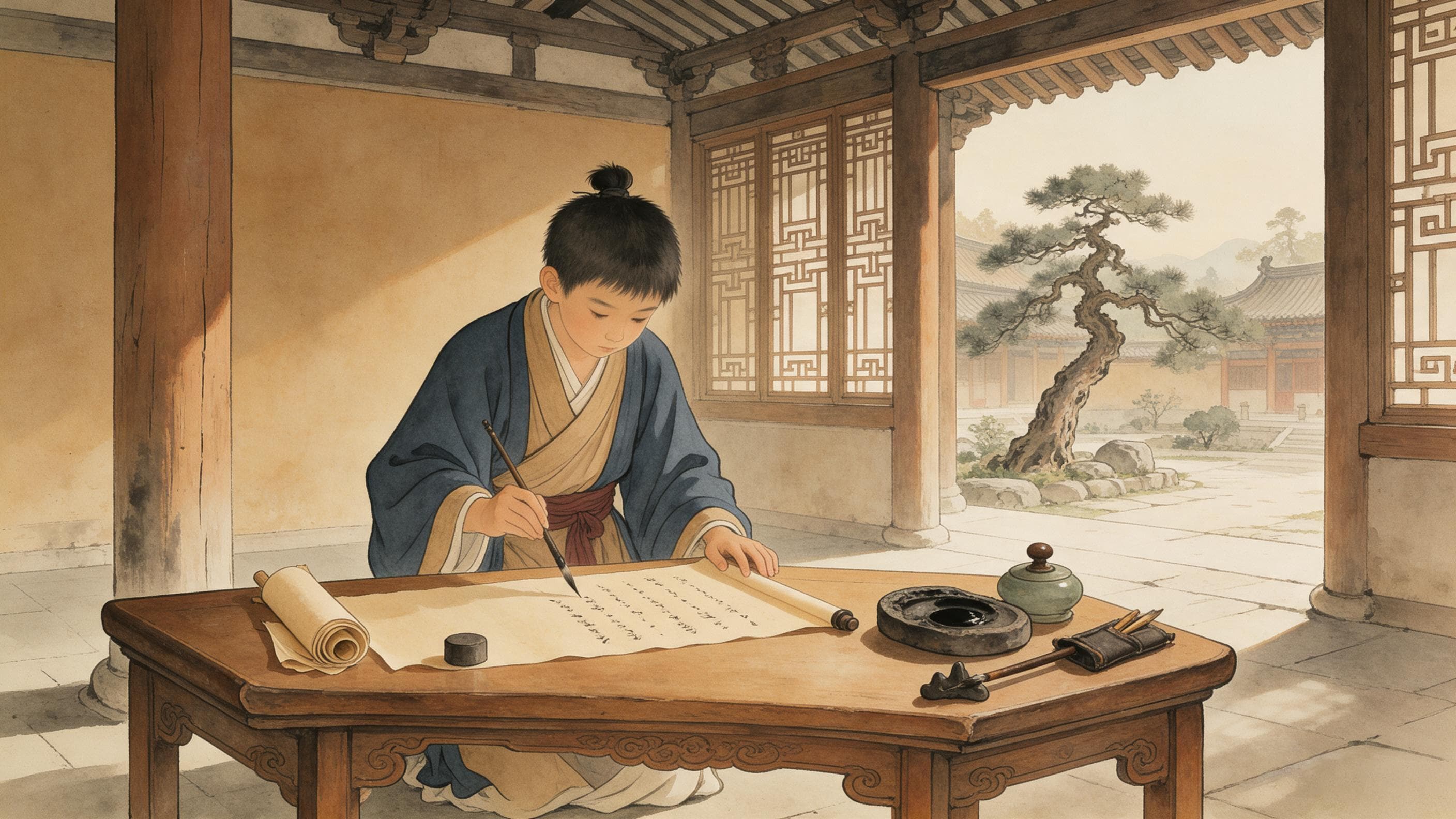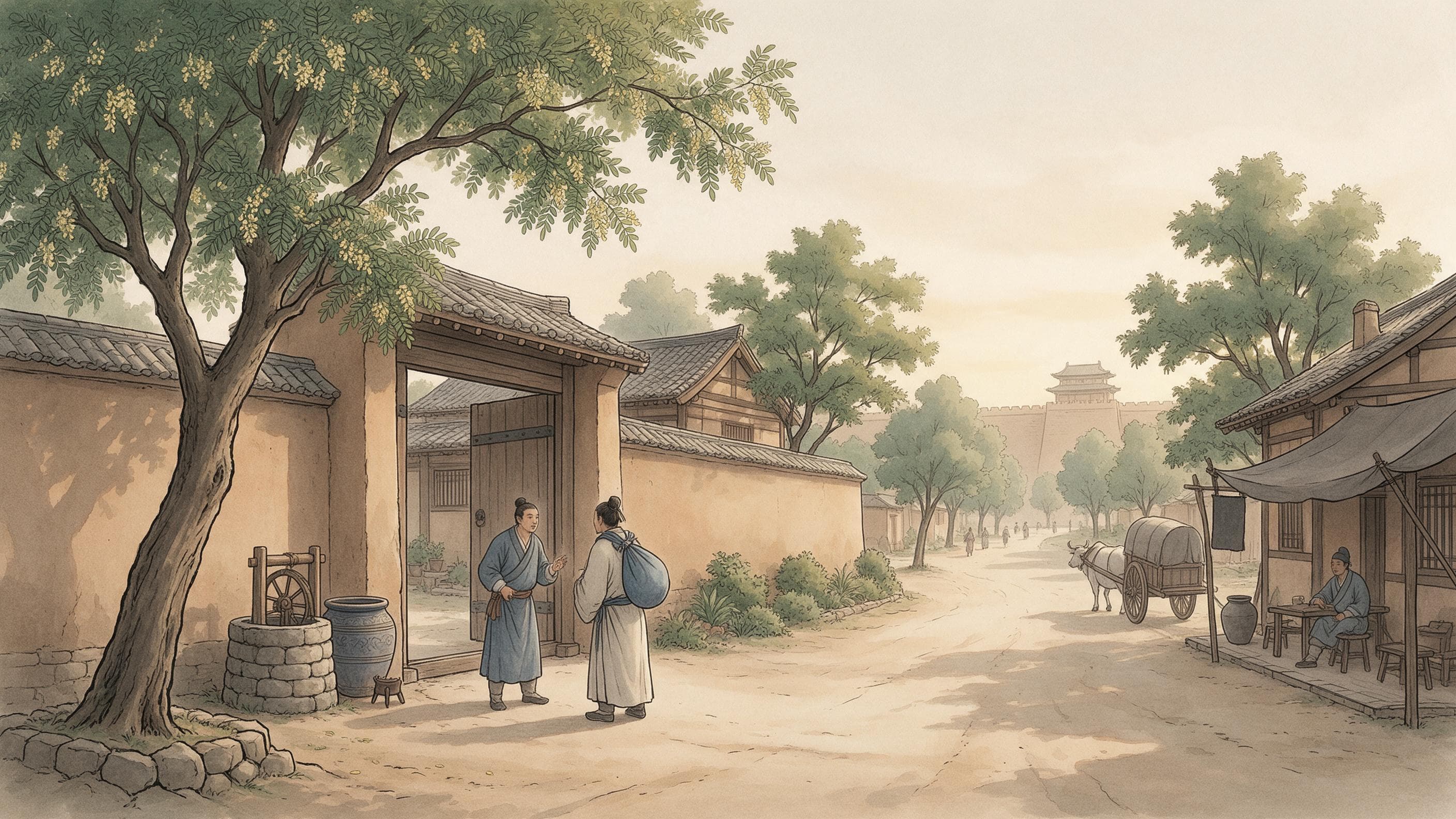
The line is famous and usually mistranslated. When the young Bai Juyi reached the capital and took his poems to the critic Gu Kuang, Gu looked at the name and said — in the earliest version, from the late-Tang anecdote collection Youxian Guchui — “Rice is dear just now; living here is not easy either.” A later version, in Tang Zhiyan, sharpens it: “In Chang'an all things are dear; living here is no easy matter.” Four characters were eventually extracted and turned into a proverb, Chang'an ju, da bu yi. For a thousand years readers have heard a complaint about rent. Neither text mentions rent: one says rice, the other says everything.
The story itself is probably invented. Wei Jingbo laid out the case in 2023: the anecdote first appears decades after Bai's death; Gu Kuang was in Chang'an only from 787 to the spring of 789, when Bai was in the south, so the two were never in the same place; neither man's surviving writings mention the other; the official biographies tell a vaguer version without the joke. His conclusion is that the encounter was “fabricated by busybodies of the late Tang.” He adds a second point: the fabrication carries true information — that educated men did arrive in the capital poor and unconnected. Bai's own letter says he had no kinsman at court and no acquaintance among the great; his poem on arriving ends, “late I reach Chang'an, with no host.” What none of this supplies is a rent. No surviving source states what a house or a room in Chang'an cost to rent. What follows is what the sources do say.
A city laid out as a grid
According to Xu Song's compilation of Tang material, the outer city measured 18 li 115 paces east-west and 15 li 175 paces north-south, 67 li around, with a wall 1 zhang 8 chi high. Inside, fourteen streets ran north-south and eleven east-west; between them lay 108 wards — 54 under Wannian county east of the central avenue, 54 under Chang'an county west of it, with the two markets taking two wards each. The central avenue, Zhuque Gate street, was 100 paces wide. The wards were not equal: the first east of the avenue was 350 paces across, the second 450, the next three 650, and the same on the west side. Quoting an older map, Xu Song adds that the 36 wards south of the imperial city had two gates each, while the 74 flanking it had four, every ward with a cross street running out to its gates.
That grid is the first fact about living there: a house stood inside a named, measured rectangle. What the grid does not say is how many people lived in a ward, how many rooms a house had, or who owned what. The gazetteer lists famous residences, monasteries and offices, ward by ward — who lived where, not how many lived there.
Houses, mansions and rented rooms
The vocabulary is worth separating. A zhai (宅) is a house; a di (第) usually a grander one, often granted by the throne. A lüguan (旅馆) or lüshe (旅舍) is an inn or lodging house — not a hotel, and usually a private establishment inside a ward rather than a building on a main road. Renting has its own words: jiuwu (僦屋), jiuju (僦居), jiaju (假居), linzhai (赁宅). Wang Jian's poem “Written on the Peonies of a Rented House” is the cleanest evidence that renting was ordinary: “Renting a house brought flowers in abundance; when they first opened I feared a haunt.” The poem names no city and no price; it is evidence for the verb, not for the market.
Who rented? The clearest case is institutional. The provincial representatives who came for the annual audience had no residence: “the chaozhao envoys had no mansion in the capital and generally rented houses, living mixed in with merchants; in the seventeenth year of Zhenguan (643) the court first ordered offices built for them.” In 777 those offices were renamed jinzou yuan, provincial liaison offices, one of them in Wuben ward — which also held a lodging house where, in the Guangde era, a visitor from Shu named Li Wan “rented lodging in this ward.” In Jing'an ward an inscription records a man dying at the ward's lodging house; in Xingdao ward the inn appears in anecdotes, with a provincial clerk staying there and a candidate “renting a place”; in Changxing ward Duan Chengshi notes that in the Yuanhe era he was lodging temporarily, next to a shop selling biluo pastries. Renting was ordinary enough to be background in a ghost story.
The ward under the ground
Since 2022 the ward has also been dug. In 2022 and 2023 archaeologists worked a plot in Lianhu district, Xi'an, identified as lying slightly south-west of the centre of the Tang ward of Buzheng — originally Longzheng, renamed to avoid the personal name of Emperor Xuanzong. They found a north-south street, L1, its earliest surface 10.8 metres wide and its latest 11.1, matching the standard width of a ward's main cross street. Sixty-seven metres west ran a second road, L2, judged a lane inside the ward. Between them were two compounds enclosed by rammed-earth walls, built side by side, the second better preserved. There were wells and water vats, a brick-lined storage pit, ceramic drainage pipes; among the finds a stone bodhisattva, a pottery pagoda and an incised stone seat. The report gives no compound area, no room dimensions and no identification of the occupants — so neither does this article.
Empty ground and expensive ground
The gazetteer also records where the city gave out. South of the Xing Shan monastery, four wards ran to the outer wall “with almost no mansions; now and then someone lived there, but cooking smoke did not connect, and ploughing, sowing and field boundaries ran on.” Farmland inside the wall. At the other end, a notice quoted by Xu Song preserves Du Mu's family house in Anren ward, built at the end of the Kaiyuan era, “with thirty rooms and no more”; at the end of the Yuanhe era it was lost to repay interest on a debt, and the family moved — “in eight years we moved ten times, with nowhere to return.” One purchase price also survives, in Du Mu's account of Shen Chuanshi, who “acquired a mansion in Kaihua ward for three million cash”: one figure, one official, one source — not a market price, and still not a rent.
What the record does not contain
The bottom of the file is empty: no rent, no lease, no deposit, no landlord, no household count per ward, and except Du Mu's thirty rooms no room count at all. The Dunhuang rental contracts do name rents, but they belong to the Tibetan and Guiyi Army periods and to another city; they cannot be carried into Chang'an. Nor can the novels be used as institutions — Xu Song himself, noting a story that in 720 a whole ward in Xingdao “sank overnight into a pond, swallowing five hundred households,” adds that it appears in no other book and is “not to be believed.” What is left is a city of 108 measured rectangles, a vocabulary of houses and rented rooms, one excavated lane, and a proverb about rice that later readers turned into a proverb about rent.
Sources & further reading
- 徐松《唐两京城坊考》卷二·西京外郭城(清人辑唐史料,维基文库) — Outer city and its 108 wards, four gates and cross streets, Zhuque Gate street 100 paces wide, ward sizes 350/450/650 paces; inns and lodging houses in Xingdao, Wuben, Changxing and Jing'an wards; chaozhao envoys renting among merchants until offices were built in 643; Du Mu's thirty-room family house and Shen Chuanshi's three million cash purchase.
- 魏景波〈再议「长安居,大不易」〉,《中国社会科学报》2023-12-08(光明网转载) — The two versions of the anecdote — Yanxian Guchui's “rice is dear, living is not easy” and Tang Zhiyan's “all things in Chang'an are dear”; the author's conclusion that the Bai Juyi–Gu Kuang encounter was likely a late-Tang fabrication, and that the fabricated story still carries true information about poor scholars in the capital.
- 〈隋唐长安城布政坊遗址考古成果公布〉,央视新闻 2026-03-21(光明网转载) — Buzheng ward excavation, 2022–2023: cross street L1 10.8–11.1 m wide, lane L2 about 67 m west, two rammed-earth walled compounds, wells and water vats, brick storage pit, ceramic drains; the report gives no compound area, room dimensions or occupant identity.
- 王建〈题所赁宅牡丹花〉,《全唐诗》卷二百九十九(维基文库) — “Renting a house brought flowers in abundance”: a poem that treats renting as ordinary. It names no city and no price, so it is evidence for the vocabulary of renting, not for Chang'an rents.