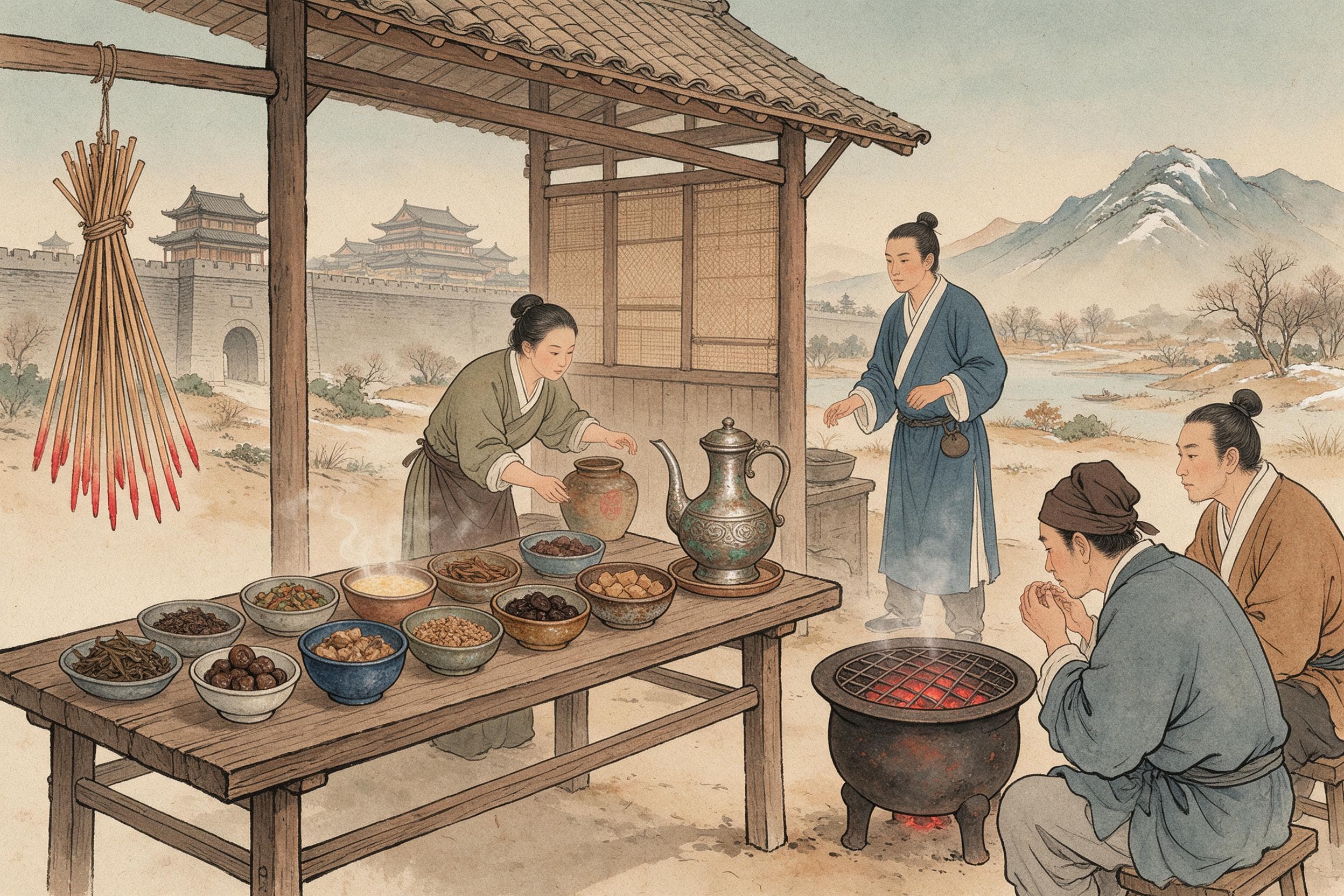
Outside the Changhe Gate of the capital, on the main road, stood an eating house people called the Zhang Shoumei house. Ordinarily it sold fish and meat 随需而供, whatever a customer wanted; but at each festival 每节则专卖一物, it sold one thing only. The whole capital gathered there (遍京辐凑), and the place had a nickname: the 浇店. Tao Gu copied its list in the Qingyi Lu: New Year's 元阳脔, the Lantern Festival's 油画明珠, the Seventh Day's 六一菜, the fifteenth of the second month's 涅槃兜, the third of the third's 手里行厨, Cold Food's 冬凌粥, the eighth of the fourth's 指天馂馅, the Double Fifth's 如意圆, midsummer's 绿荷包子, the spring and autumn sacrifices' 辣鸡脔, the Seventh Night's 摩睺罗饭, the Ghost Festival's 盂兰饼餤, Mid-Autumn's 玩月羹, the Double Ninth's 米锦, the winter solstice's 宜盘, the twelfth-month 腊日's 萱草面, and the eighth of the twelfth month's 法王料斗. Seventeen festivals, one dish apiece.
A menu arranged by the calendar
What matters is the arrangement: not by cuisine, not by price, but by date. The text gives names, with a short note on a few — the Lantern Festival dish is glossed as oiled rice, the Double Ninth one as a cake — while others, like 涅槃兜, 摩睺罗饭 and 宜盘, remain only names whose exact sense is not settled. So this article copies the names and the book's one-line explanations, and does not turn them into recipes: ingredients, methods and tastes are not in the material and are not invented. Nor does the book explain the nickname 浇店. The phrase 遍京辐凑 does tell us one thing: this was a famous house in the capital, not a roadside stall.
The winter run
The back half of the list falls in winter: the solstice's 宜盘, the 腊日's 萱草面, the Laba bowl, and New Year's 元阳脔 — four dates close together, one continuous season of buying. Another entry, 回汤武库, makes the household side of that season concrete: 季冬既大寒,可以停食物,家家多方鸠集羊、豕、牛、鹿、兔、鴿、鱼、鹅百珍之众,预期十日而办造,至正旦日方成,以品目多者为上 — in the deep cold, when food could be kept, families collected every kind of meat, prepared for ten days, and finished the dish on New Year's morning, the number of ingredients being the measure of honour; the custom, the book says, prevailed in the Qin and Long regions. The shop sold one thing; the household made a hundred. Both ways of keeping a festival sit in the same book.
The year grain cost gold
One entry pulls the festival trade back to earth: 唐末,天降奇祸,兵革遍海内,时多饥俭……粒食价逾金璧。通衢有饭肆偶开,榜诸门曰:『货剥皮丹,每服只卖三千。』服,以碗言也 — at the end of the Tang, with war everywhere and famine, grain cost more than gold and jade; a rice shop on the main road hung a notice: 'Skin-peeling elixir for sale, three thousand a dose' — a dose, the text says, meaning a bowl. Two things must be said. This is an extreme record of Tang-end famine, from the years of the warlord Qin Zongquan, not the normal Five Dynasties; and its use here is to give an order of magnitude for prices, not to sensationalise, so the passage is quoted and not elaborated, and no grim picture is drawn. Set it beside Zhang Shoumei's calendar: a famous house selling by the festival, and a year when a bowl of grain cost as much as jade.
The other cabinet: fire sticks and black suns
The book records more than food. A few items from its chapter on implements fill in the other half of daily life. The 火寸: 夜中有急,苦于作灯之缓。有智者批杉条,染硫黄,置之待用,一与火遇,得燄穗然。既神之,呼『引光奴』,今遂有货者,易名『火寸』 — for a sudden need at night, when making a lamp was too slow, someone split slips of fir, dipped them in sulphur and kept them ready; a touch of fire and they flared. People thought it wonderful, called it the 'light-bringer', and now there are those who sell it, under the name 'fire inch'. A small commodity already. The 黑太阳: fine charcoal ground to powder, kneaded with rice gruel, packed into a round iron mould and hammered fifty or seventy times (運鐵面鎚實擊五七十下), dried in the shade; in hard cold, a dozen in the brazier burn through the night. The 五位瓶: from the Tongguang to the Kaivun eras it was common, made of silver and copper, three feet tall, straight as a tube, with a fitted lid and a lip for pouring; 春日郊行,家家用之 — on spring outings every household used one. And there is the 黑金社: the students of White Deer Grotto on Mount Lu 每冬寒,醵金市烏薪為禦冬備 — pooled money each winter to buy black firewood, and held a 'felt-stove gathering' on the first of the tenth month. The 方便囊, too: late-Tang princes competed in making travelling pouches of heavy brocade, holding clothes, comb and mirror, incense and medicine, and writing tablets.
What this book can and cannot be used for
First, its nature. Tao Gu was an early Song man who 虽入宋,实五代旧人 — entered Song but belonged to the Five Dynasties; the book collects 唐及五代新颖之语, arranges them by category with a note on each, and its entries are anecdotes, names and curiosities. So write 'according to Tao Gu', not 'a field survey of the Five Dynasties'. The number of chapters is disputed — the Siku summary says thirty-seven, the Wikisource text lists thirty-five — so only 三十余门, thirty-odd, is safe here. Second, the bias is plain: Zhang Shoumei's is a famous capital house, Wei Juyuan's banquet account belongs to a chancellor, Sun Chengyou was a relative of the Wuyue royal house. None of this is commoner daily life; for ordinary people one can only say that such seasonal foods were sold in the capital market, and mark it as inference. Third, keep the periods apart: Wei Juyuan's 烧尾食账 belongs to the Jinglong era of Tang Zhongzong, and Xie Feng's Food Classic to the Northern Qi — neither is Five Dynasties, and neither is counted in the list here. Fourth, which city's Changhe Gate this was, the text never says: Luoyang and Bianjing both had gates of that name, and 遍京辐凑 only says 'the capital', so this article writes only 'outside the capital's Changhe Gate'.
The line between what is documented and what is not is clear by now. Documented: that in the Five Dynasties a capital eating house could trade by the festival calendar, pushing one dish at each date and drawing the city; that the solstice-to-New-Year stretch was a continuous season of buying and household preparation, with families assembling a hundred-ingredient dish over ten days; that in a Tang-end famine a bowl of grain once sold for three thousand cash; and that the chapter on implements shows a range of small, concrete objects — fire sticks, charcoal cakes, tall wine bottles, travelling pouches — some of them already on sale. Not documented: the ingredients and methods of those dishes, the shop's prices, what an ordinary family actually ate at festivals, or how large Zhang Shoumei's business was. One plain question remains: across those seventeen dates, how many could an ordinary household afford? The book gives no answer — only 遍京辐凑, enough people to make a crowd.
Sources & further reading
- 陶谷《清异录》(维基文库本,附四库提要) — 宋初陶谷撰,「虽入宋,实五代旧人」,书「皆采摭唐及五代新颖之语,分门标题,各为标题而注事实缘起于下」;四库提要称三十七门,维基文库本实列三十五门,故正文写「三十余门」;馔羞门、器具门为本文主要依据
- 陶谷《清异录·馔羞门》(维基文库) — 张手美家「阊阖门外,通衢有食肆……每节则专卖一物,遍京辐凑,号曰浇店」,列元日阳脔至上元、寒食、七夕、中秋、重九、冬至、腊日、腊八十七目;回汤武库;剥皮丹「每服只卖三千」;韦巨源烧尾食账(唐)、谢讽食经(北齐)
- 陶谷《清异录·器具门》(维基文库) — 火寸(杉条染硫黄,初名引光奴,「今遂有货者」);五位瓶(同光至开运盛行,银铜为之,高三尺,春日郊行家家用之);黑太阳炭饼制法;黑金社与氊炉会;方便囊