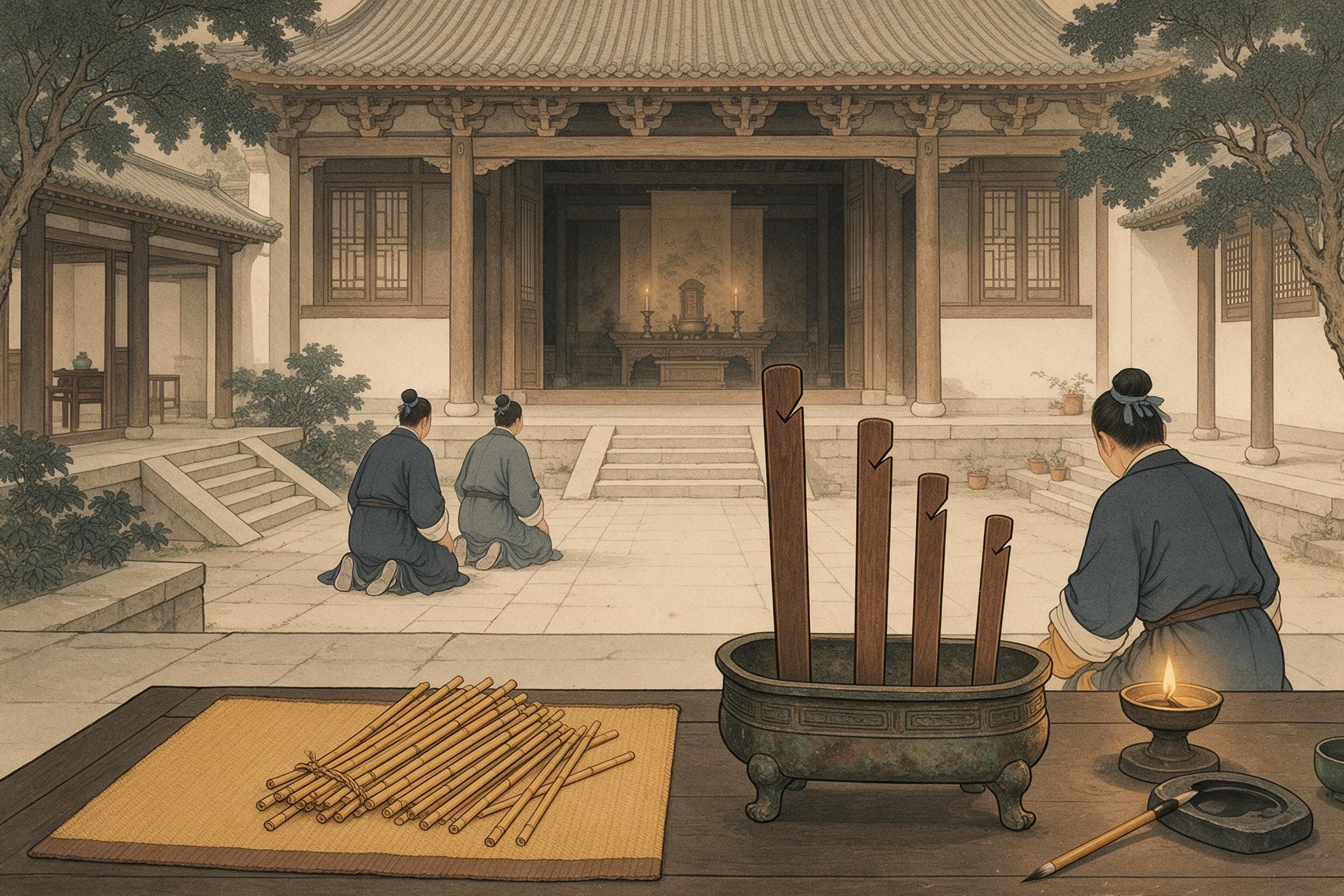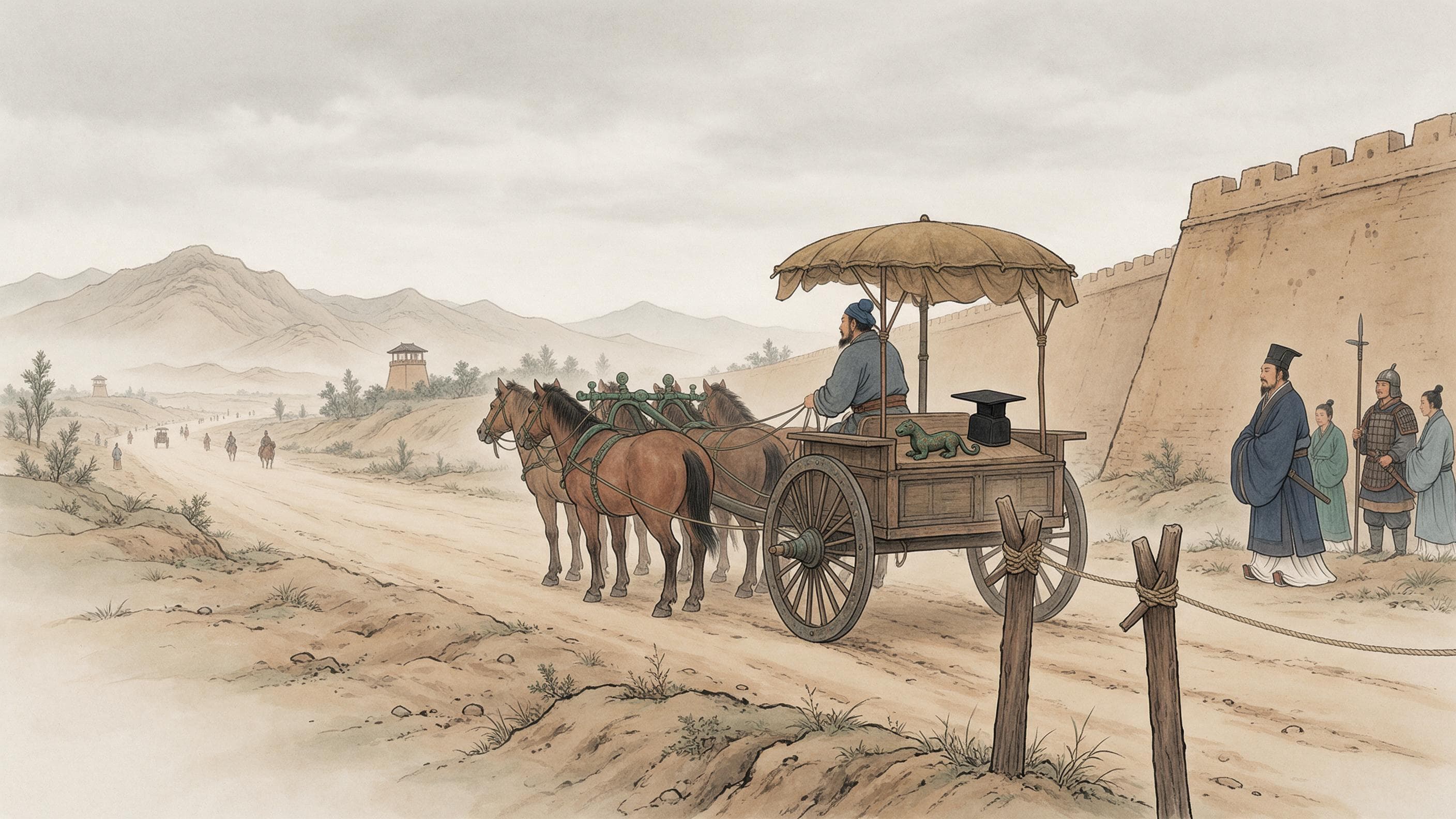
A tally and a law officer's cap, both six cun. A carriage, six chi. A pace, six chi. A team of six horses. That is the whole inventory in the Shiji chapter on the First Emperor, and the only place in the two sources used here where six is attached to anything. The sentence does not say which part of the carriage is six chi, how a cap is measured, or whose carriage is meant. A few lines earlier it has six kings brought to justice; a few lines later, thirty-six commanderies and twelve bronze figures. Six sits on the page beside twelve and thirty-six, and the page makes nothing of it.
Where it stands matters. In the twenty-sixth year Qin took the last of the warring states; the king took the title 皇帝, and posthumous names were abolished on the argument that a son should not judge a father. Then, without a break, the chapter turns to the five virtues. So six arrives not as an edict or a stele of its own but in the middle of a story told by a historian looking back — and the paragraph opens with 推, to work out, to deduce.
One: the sentence, and where the number sits
The passage in full: 始皇推終始五德之傳,以為周得火德,秦代周德,從所不勝。方今水德之始,改年始,朝賀皆自十月朔。衣服旄旌節旗皆上黑。數以六為紀,符、法冠皆六寸,而輿六尺,六尺為步,乘六馬。更名河曰德水,以為水德之始。剛毅戾深,事皆決於法,刻削毋仁恩和義,然後合五德之數。 In order: a deduction about the five virtues; a year beginning in the tenth month; black for clothes and insignia; the number six with four examples; a new name for the river; a closing sentence on severity of law.
The four examples sit in the middle, at an exact position. Before them, the deduction, the year and the colour; after them, the river and the harshness. The five characters that introduce them, 數以六為紀, are never defined. What follows is the only list offered as evidence for them — and it is four lines long.
Two: four things and one number
- 符、法冠皆六寸 — the tally and the law cap, both six cun. The chapter gives the names and no shape: whether 符 is a token of office, a tally of command or a passport, nothing on this page decides, and 法冠 is a name alone. Each has a number and no form.
- 輿六尺 — the carriage, six chi. Whether that is width, length or some other part, the sentence does not say, and gives no ordinary carriage for comparison.
- 六尺為步 — the pace, six chi. The one item of the four that relates two units to each other instead of attaching a number to an object. Cun, chi and the pace are kept here as the text keeps them, with no modern equivalent given.
- 乘六馬 — six horses to a team. Whose carriage, whether six was the emperor's allowance or the ordinary team, what other drivers used: not stated.
One item covers a pair of personal objects (the tally and the law cap), one describes the vehicle a person rode in, one fixes a unit of distance, one gives a team of six horses. It is an odd selection for a programme said to have brought the empire's measures under one rule: four places where a writer could hang a number on something familiar, rather than a system. The chapter's own summary of standardization comes a little further on and is equally short: 一法度衡石丈尺。車同軌。書同文字. The conversion tables behind that sentence belong to the article on Qin's standard measures; this one stays with the six.
Three: water, and the missing therefore
The deduction is compressed: 推終始五德之傳, the succession of the five virtues handed down; 以為周得火德, taking it that Zhou held fire; 秦代周德,從所不勝, that Qin replaced Zhou's virtue, following what it did not overcome. Those last four characters are not unpacked anywhere in the chapter, and this text carries no commentary to unpack them. Nor does it name a person or a book behind the scheme: on these two pages the succession of virtues has no stated origin.
The word the paragraph never writes is 故, therefore; it never says water's number is six. Water virtue, tenth month, black, six — an order, not a cause. The one causal word in the passage comes at the end and attaches elsewhere — 剛毅戾深,事皆決於法,刻削毋仁恩和義,然後合五德之數, hard and harsh, deciding all by law, only then did it fit the number of the five virtues. What earns the 然後 is the severity of the law, not the number. To read it as saying Qin chose six because it claimed water, a reader must supply the missing term. The second source makes that harder, because it arranges the same row of virtues differently. The Hanshu treatise puts Zhou at wood — 武王……水生木,故為木德,天下號曰周室 — and Han at fire, 木生火, with Qin filed between them: 秦以水德,在周、漢木火之間. The Shiji has Zhou at fire, and Qin replacing Zhou's virtue by 從所不勝, four characters it does not unpack. The two books do not agree on Zhou's virtue, so the chain is not a datum they share. They are set side by side here; which sequence is right is not decided.
Four: the tenth month, black, and a river
The rest names things a person would notice. 改年始,朝賀皆自十月朔: the year began anew and the congratulations of the court ran from the first day of the tenth month. 衣服旄旌節旗皆上黑: clothes and the several standards took black as the upper colour — four kinds of insignia listed, none described. 更名河曰德水: the river became Virtue Water. The chapter writes 河, not Yellow River, and records no proclamation. Set the Hanshu paragraph on the same reform beside it. It has the tenth month, 以十月為正, and the colour, 色上黑. It has no six; no tally, cap, carriage, pace or horses; no new name for the river. It is the more guarded of the two: 戰國擾攘,秦兼天下,未皇暇也,亦頗推五勝 — the warring states were in confusion, Qin swallowed the empire and had no leisure, and only rather pushed the five conquests. 未皇暇, no leisure; 亦頗, only somewhat; 五勝, conquests, where the Shiji says 五德, virtues. What it adds instead is a sequel: 漢興……襲秦正朔, when Han arose it carried over Qin's first day of the year — the calendar-reform article's business; one line here, because the tenth month outlived the dynasty that chose it.
Five: what the paragraph leaves out
- Units are not converted. Cun, chi and the pace stay as written; no length for a Qin chi is given, and the table of units belongs to the article on standard measures.
- 符 is not expanded. Whether the word means a token of office, a tally of command or a passport, these pages do not say, and this article does not guess.
- The scheme has no origin here. The passage says the five virtues were transmitted; it names no teacher, no text, and neither page supplies one.
- Other sixes on the page are not merged in. 六王 in the emperor's speech, 六合 and 六國 in the inscriptions, the thirty-six commanderies, the twelve bronze figures: words and other numbers, not parts of this rule.
- The Hanshu volume has sixes of its own — a counting rod six cun long, a pitch pipe six cun long glossed 六者,所以含陽之施. Pitch and calendar theory, not Qin's cap and tally.
- No verdict is offered: the chapter's only causal clause runs from harsh law to fitting the number, and this article does not reverse it.
What the paragraph leaves is a short list: a cap, a tally, a carriage, a pace, a team. It does not say what a six-cun cap looked like, or who sat behind six horses. It says that someone once wrote six into a list of ordinary things, and that the list was short enough to read in one breath.
Related reading:Tao Qian's Resignation: Five Dou of Rice, a Field of Millet, and One Piece of Prose · Twelve Scrolls, 118 Chapters: How an Acupuncture Classic Was Assembled · Ice: Cut in Winter, Given Out in Summer, and Used to Bathe the Dead
Sources & further reading
- 司马迁《史记》卷六〈秦始皇本纪〉(维基文库本,未与点校本复核) — The core passage: 始皇推終始五德之傳,以為周得火德,秦代周德,從所不勝。方今水德之始,改年始,朝賀皆自十月朔。衣服旄旌節旗皆上黑。數以六為紀,符、法冠皆六寸,而輿六尺,六尺為步,乘六馬。更名河曰德水,以為水德之始。剛毅戾深,事皆決於法,刻削毋仁恩和義,然後合五德之數。A few lines later, the same chapter: 六王咸伏其辜 (in the emperor's own speech); 分天下以為三十六郡; 收天下兵……金人十二,重各千石; 一法度衡石丈尺。車同軌。書同文字. The word 六 occurs forty times on the page, mostly inside regnal years, and also in 六王, 六國, 六合 and 六親; twelve and thirty-six stand beside it in the same stretch of narrative. The chapter names no person and no book behind the succession of virtues, and it does not gloss 從所不勝.
- 班固《汉书》卷二十一〈律历志〉(维基文库本,未与点校本复核) — The treatise's account of the same reform: 戰國擾攘,秦兼天下,未皇暇也,亦頗推五勝,而自以為獲水德,乃以十月為正,色上黑。漢興,方綱紀大基,庶事草創,襲秦正朔。以北平侯張蒼言,用顓頊曆. No number six, no tally, cap, carriage, pace or horses, and no new name for the river. The 世經 section arranges the virtues differently from the Shiji: 武王書經牧誓武王伐商紂。水生木,故為木德。天下號曰周室 … 漢高祖皇帝,著紀,伐秦繼周。木生火,故為火德。天下號曰漢 … 秦以水德,在周、漢木火之間. The sixes in this volume belong to the pitch-and-calendar theory: the counting rods 徑一分,長六寸,二百七十一枚而成六觚; 林鐘……律長六寸, glossed 六者,所以含陽之施,楙之於六合之內,令剛柔有體也. Neither this page nor the Shiji chapter gives an earlier source for the succession of virtues.