Put two numbers side by side and the difference shows. One counts a country's horses: 'horses reached more than two million.' The other counts one horse: 'the head is the king, it should be square; the eye is the chancellor, it should be bright; the spine is the general, it should be strong; the belly and flanks are the city wall, they should be stretched; the four legs are the magistrate, they should be long.' The first is a pasture account in a history; the second is a mnemonic in a farming manual.
The Pasture West of the River
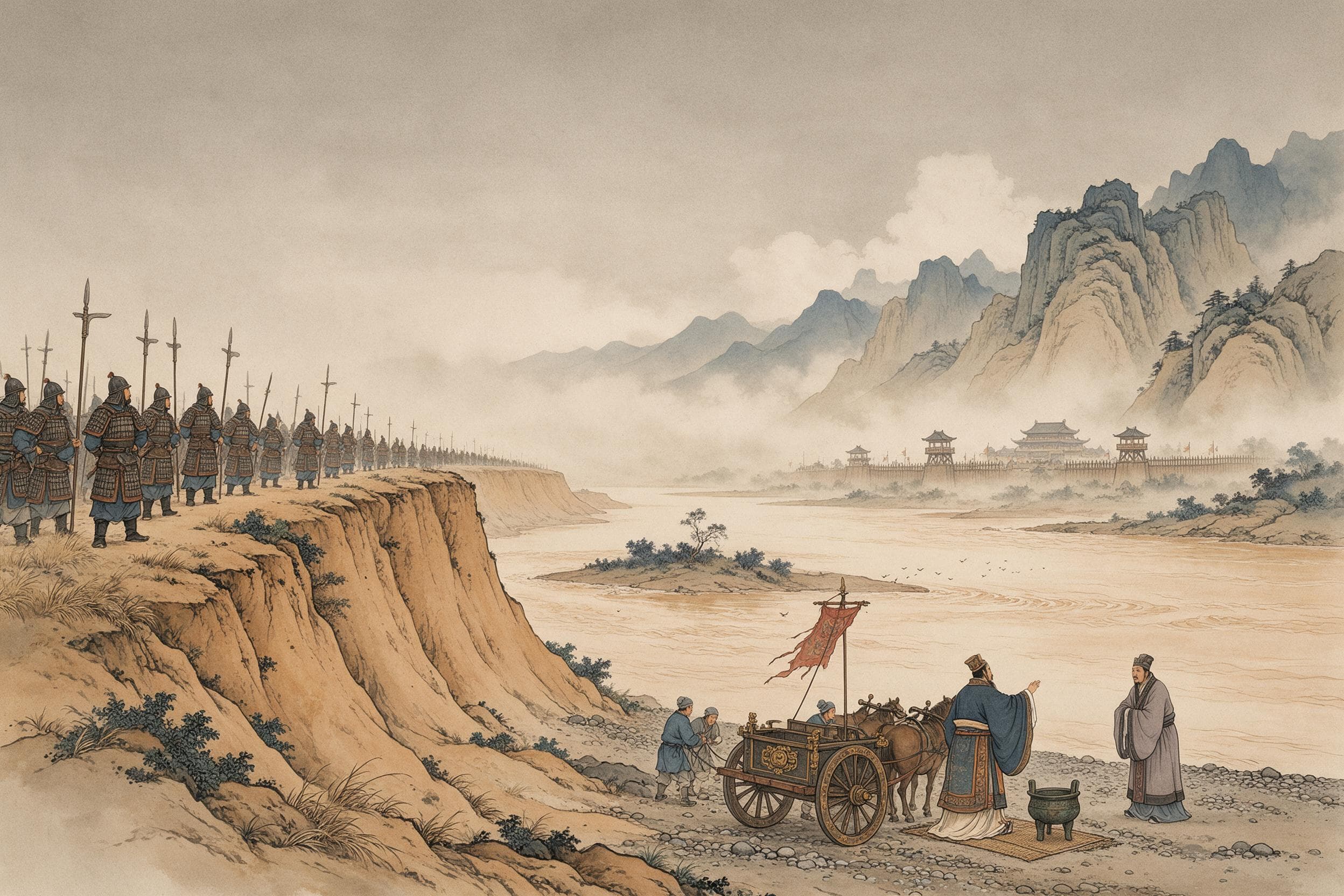
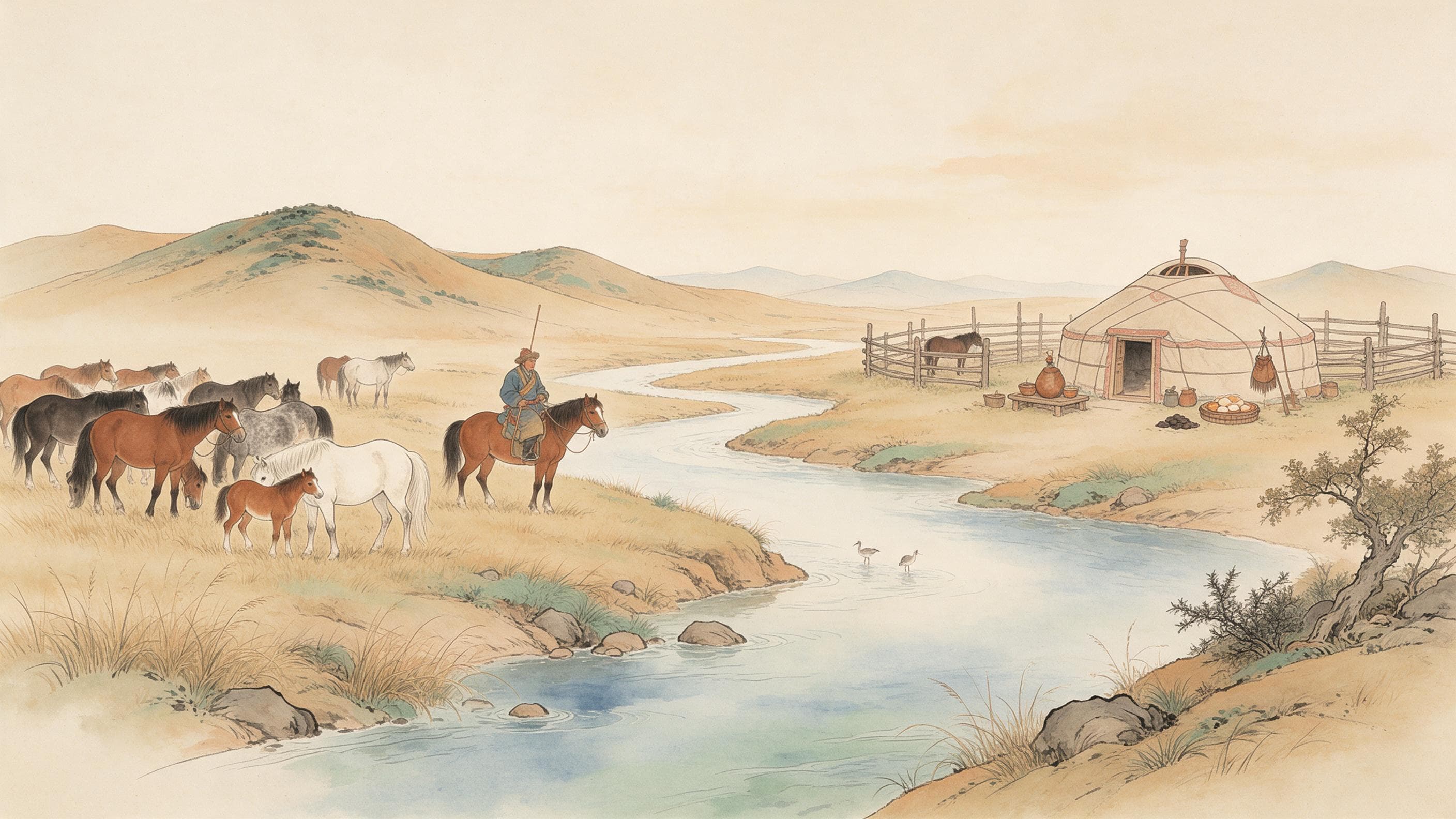
The Wei shu's treatise on food and money takes two sentences: 'When Emperor Shizu pacified Tongwan and settled Qin and Long, because the grass and water west of the Yellow River were good he made it pasture land. The herds multiplied: horses reached more than two million, camels nearly half that, cattle and sheep beyond counting' (以河西水草善,乃以為牧地…馬至二百餘萬匹). This is what the record says, not a modern census.
The passage continues with later history: under Emperor Gaozu a pasture was also made at Heyang, 'constantly holding a hundred thousand army horses against alarms at the capital'; every year horses were moved from the western pasture to Bingzhou, gradually southward, 'so that they might grow used to the water and soil and not die'; and the western herds 'multiplied the more'. The last sentence is decline: after the Zhengguang era, with the realm in disorder, the herds were 'stolen and plundered by the various bandits'. Increase and plunder sit in the same paragraph.
Three cautions follow. The 'more than two million' belongs to the western pasture only, not to the whole realm; the camels' 'nearly half' and the 'beyond counting' of cattle and sheep are rough figures on a different scale; and the 'hundred thousand army horses' at Heyang are a standing garrison, not part of the same total, so they cannot be added. Where exactly 'west of the River' lay, and how far the pasture ran, is disputed; this article draws no map.
Reading the Register
What can be read from the passage: the pasture was state land, which is why a historian could count its herds; horses are counted by head, camels by 'nearly half', cattle and sheep by 'beyond counting', so different animals were registered to different precision; and the herds were moved each year, which means this was not a fenced stud but grazing land that followed water and grass — the move south was to keep horses from dying as they changed climate.
What cannot be read: an exact herd in any one year, since 'multiplied' describes a process, not a survey; horses per household, since no population is matched to the figure; or the empire's horse policy, since this is one pasture with another at Heyang. And the number itself needs the words 'as recorded' — it is what the historian wrote, not a receipt sent to the court.
How to Keep One Horse
The sixth chapter of the Qimin yaoshu is on oxen, horses, donkeys and mules, and its opening states the principle: 'Drive oxen and ride horses by measuring their strength; feed and water them warm or cold according to their nature — and if they do not grow fat and multiply, there is no such case' (服牛乘馬,量其力能;寒溫飲飼,適其天性). Then the mnemonic for judging a horse — square head, bright eye, strong spine, stretched flanks, long legs — and the rule: 'in judging a horse, first remove the three weaknesses and the five jades, then judge the rest' (先除三羸五駑). The three weaknesses are a big head on a thin neck, a weak spine over a big belly, thin shins above big hooves; the five jades are a big head with slack ears, a long neck that will not bend, short above and long below, big hips with short ribs, shallow hips with thin thighs. Remove those, and judge what is left.
Feeding is more concrete still: 'in food there are three kinds of hay; in drinking there are three times' (食有三芻,飲有三時). The hays are bad, middle and good — 'give bad hay when the horse is hungry and good hay when it is full, draw it on to eat, and if it always eats its fill it will always grow fat'; the three drinks are 'morning drink, little; midday drink, until the chest is satisfied; evening, drink to the full'. And 'turn it out once in ten days, let it stretch and gallop', so that the horse hardens.
Even illness has recipes: for a throat swelling that will kill, 'wrap a knife with a cun of blade showing and pierce the throat; when it breaks it heals'; for black sweat, burn horse dung and human hair and smoke the nostrils; for heat, boiled beans and hot rice; for sweat-chill, fermented beans steeped in good wine poured into the mouth; for mange, realgar and hair fried in pig fat. The practical layer of the manual goes to that level of detail.
Two Layers of Evidence
The register and the manual are two kinds of material. One records a state pasture's herds; the other records how to judge and doctor a single horse. Neither proves the other: two million horses do not imply a horse in every household, and the manual says nothing about the scale of the pasture. A number needs 'as recorded'; a technique can simply be followed. That is the difference between the two texts.
There is a further layer: in both pages the horse is strength and product. The history asks how many there were and whether they were enough for war; the manual asks how to judge one, feed it, cure it. One is the state's account, the other a herdsman's craft — and only together do they show what stands behind 'more than two million': countless particular horses that had to get through winter, change their water and soil, and be treated for a swollen throat.
What Is Not Here
No area or boundary for the pasture (disputed, and no map drawn here); no yearly increase or death rate; no ratio of state to private herds; no horse prices; no method behind the 'more than two million'. Neither page has them. So this article writes one pasture record and one manual, not the whole of Northern Wei horse administration.
A number and a craft: on one side 'horses reached more than two million', on the other 'the head is the king, the eye is the chancellor'. The first needs 'as recorded'; the second can be followed directly. Keep the two voices apart — one is an official writing up an account, the other is a herdsman teaching an apprentice.
Related reading:A Square Li Divided Nine Ways: Mencius's Well-Field on Paper · Nine Provinces, Two Inventories: The Tribute List of the Yugong · Ten Gravest Crimes: Reading the Bei Qi Code Through the Sui History
Sources & further reading
- 《魏书》卷一百一十·食货志(北齐魏收撰;维基文库本,未与点校本复核) — The register passage, to be quoted as what the history records. After Emperor Shizu pacified Tongwan and settled Qin and Long, 'because the grass and water west of the Yellow River were good, he made it pasture land. The herds multiplied: horses reached more than two million, camels nearly half that, cattle and sheep beyond counting' (以河西水草善,乃以為牧地。畜產滋息,馬至二百餘萬匹,橐駝將半之,牛羊則無數). It then records that under Emperor Gaozu a pasture was also made at Heyang, 'constantly holding a hundred thousand army horses against alarms at the capital', and that every year horses were moved from the western pasture to Bingzhou, gradually southward, 'so that they might grow used to the water and soil and not die'; the western herds then 'multiplied the more'. Finally: after Zhengguang, with the realm in disorder, they were 'stolen and plundered by the various bandits'. The passage gives no boundaries for the pasture, no rate of increase and no price.
- 《齐民要术》卷第六·养牛马驴骡第五十六(北魏贾思勰撰;维基文库本,未与点校本复核) — The practical manual, a different kind of text. It opens: 'Drive oxen and ride horses by measuring their strength; feed and water them warm or cold according to their nature — and if they do not grow fat and multiply, there is no such case' (服牛乘馬,量其力能;寒溫飲飼,適其天性). On judging a horse: 'the head is the king, it should be square; the eye is the chancellor, it should be bright; the spine is the general, it should be strong; the belly and flanks are the city wall, they should be stretched; the four legs are the magistrate, they should be long' (頭為王…四下為令). The method first rejects 'three weaknesses' and 'five jades' (三羸五駑) — a big head with a thin neck, a weak spine with a big belly, thin shins with big hooves; a big head with slack ears, a long neck that does not bend, short above and long below, big hips with short ribs, shallow hips with thin thighs — and judges the rest. On feeding: 'food has three kinds of hay, drink has three times' (食有三芻,飲有三時): bad, middle and good hay, with good hay given when hungry and bad when full; morning drink little, midday drink until the chest is satisfied, evening drink to the full. It also gives remedies: for a swollen throat, a knife blade laid bare an inch and thrust into the throat; for black sweat, burning horse dung and human hair under the nose; for heat, boiled beans and hot rice; for sweat-chill, fermented beans steeped in good wine poured into the mouth; for mange, realgar and hair fried in pig fat.