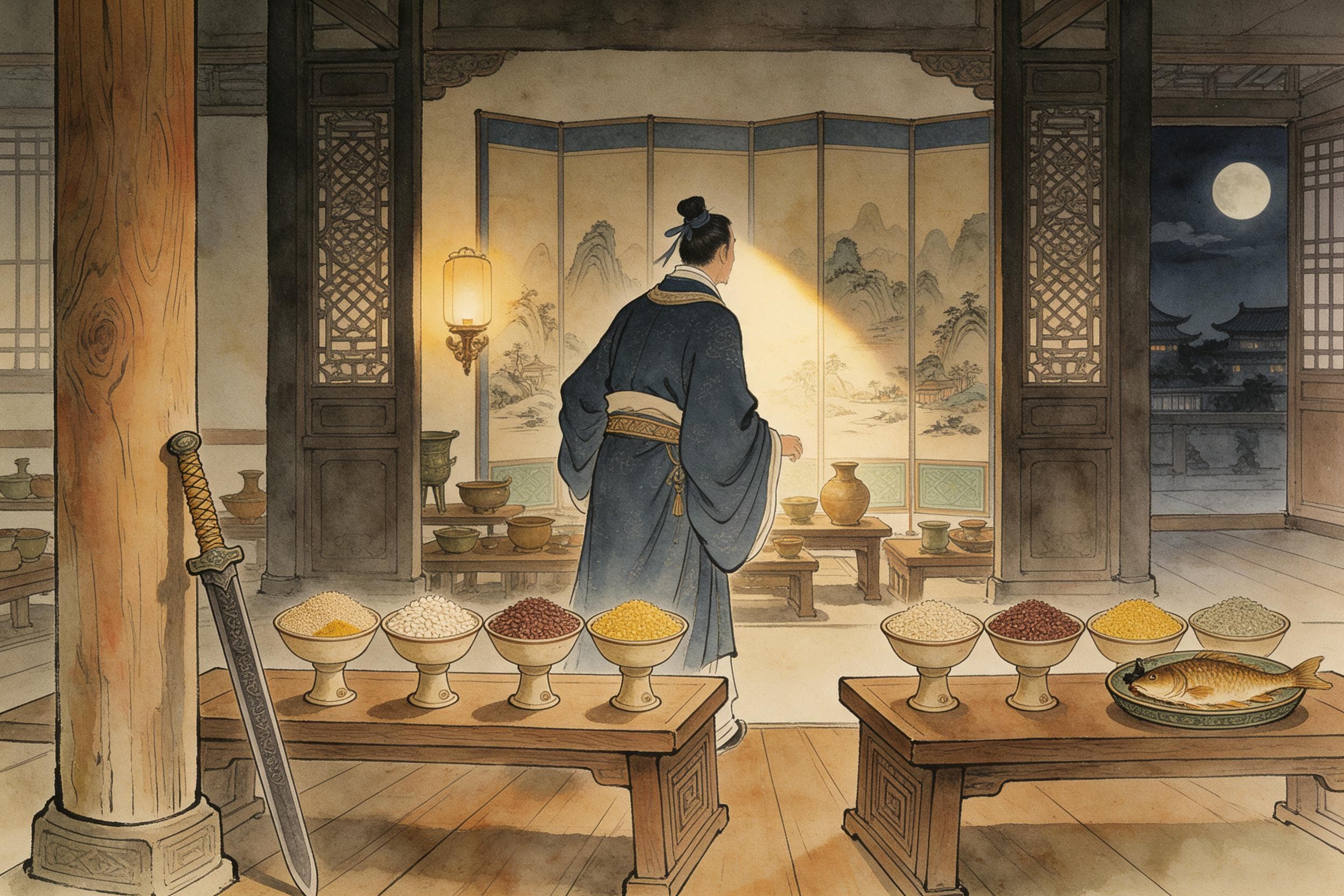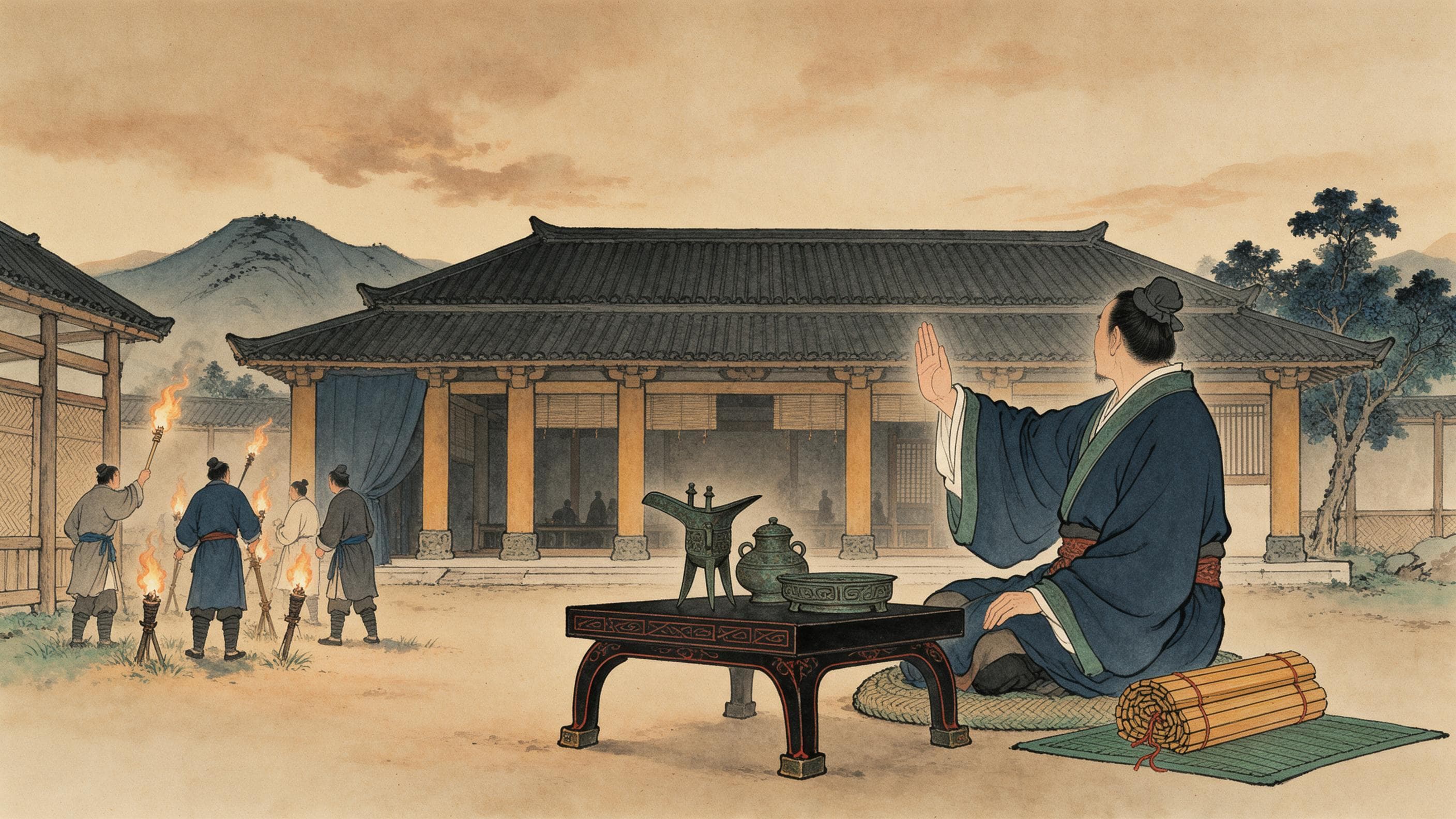
The ruler of Qi was enjoying his wine. His guest, a nobleman who had fled Chen, had been drinking with him, and when evening came the duke gave the order that the party continue by torchlight. The guest declined. 'I divined for the day,' he said, 'but I did not divine for the night. I dare not.'
The Day Was Divined
That is the whole exchange as the Zuo zhuan records it, in the twenty-second year of Duke Zhuang of Lu (672 BCE): an offer, a refusal, a reason. No omen is quoted, no hexagram, no verse. What the record keeps is a divination made that day for the daylight, and a guest who treated the limits of the question as the limits of his evening. The chronicler adds a gentleman's verdict, about manners rather than omens: wine exists to complete a rite, and to carry the drinking into excess is not right; to complete a rite with one's ruler without being drawn into excess is benevolence.
The guest was Chen Wan, a son of the ruling house of Chen, who had come to Qi that spring after the heir was killed. Duke Huan offered him a chief ministership; he refused, in a set speech: a wandering servant has gained much if forgiven and allowed to serve; a high seat would only invite slander. He quoted a poem — tall carriages, a bow that summons a man; would he not go? He feared his friends. The duke made him officer of works instead. Two refusals in one year, of office and of a long night; only the second is explained.
The Child, the Zhou Historian and the Book
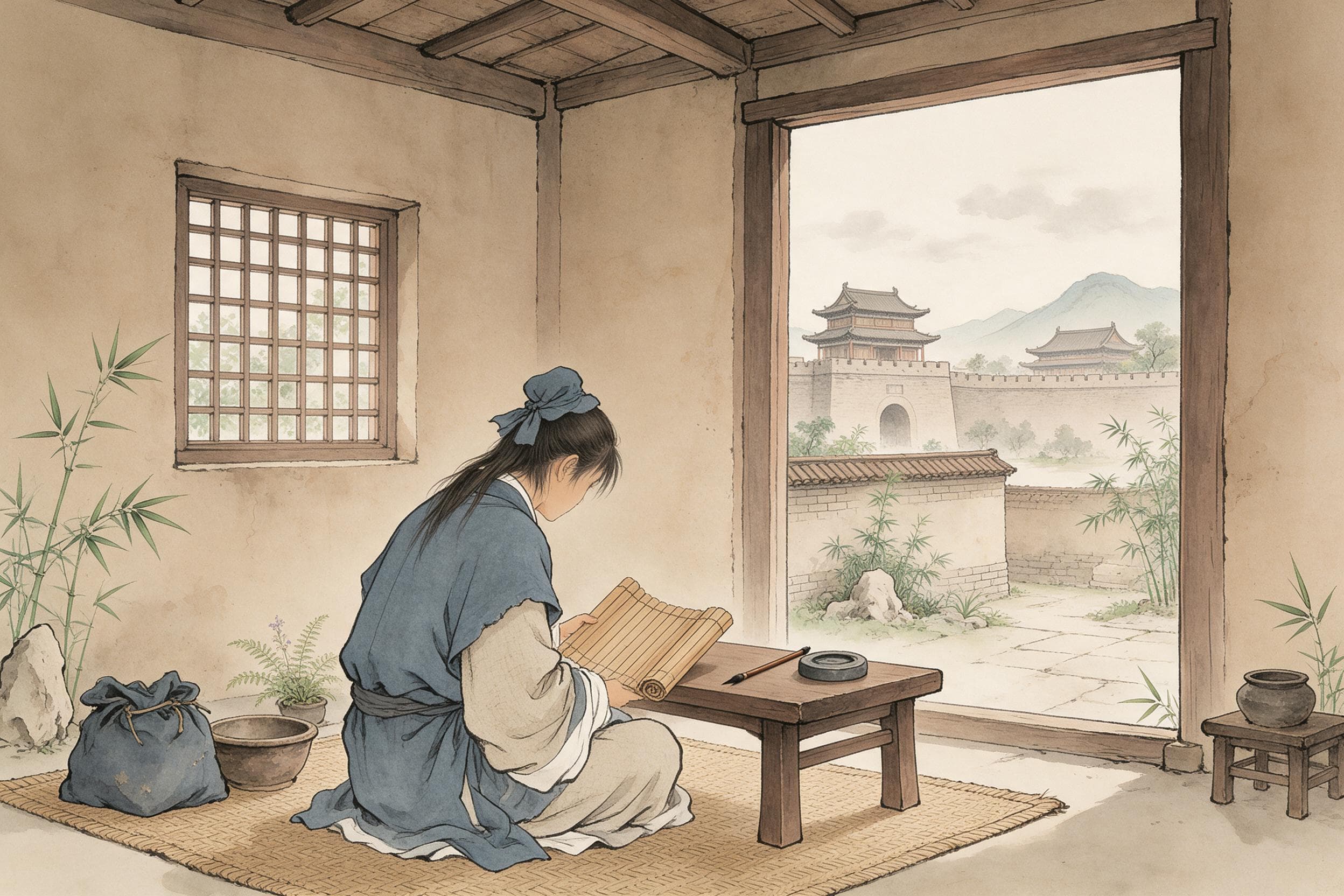
Long before that, the same man had been the subject of a different kind of question. The Zuo zhuan goes back to his childhood in Chen. A historian from the Zhou court came to the Marquis of Chen bringing the Zhou Changes, and the Marquis had him perform a 筮 (shi) — the book-based divination — and the result was recorded as 遇《观》之《否》: he encountered Guan, changing to Pi. That is all the record keeps of it: two hexagram names, and a book that travelled in the hands of a specialist.
The interpretation that follows is a chain of identifications, and the text does not name its speaker. It starts from a line: 'The light of the state is observed; it is fitting to be a guest of the king.' The reading breaks it into pieces: Kun is earth; Xun is wind; Qian is heaven. 'Wind made heaven above earth: that is a mountain.' A mountain has timber, lit by heaven's light, and so stands on earth; a courtyard of a hundred gifts, jade and silk offered up, completes the beauty of heaven and earth — hence the line. Then the verdict: he will have a state in Chen's place — not here but in another state; not in this man but in his descendants; and if in another state, with the Jiang clan, whose ancestor was the Great Mountain, mountain and peak matched to heaven and no two things great at once. When Chen declines, this line will flourish.
The chapter then does what the omens cannot do for themselves: it reports the outcome. At the first fall of Chen, Chen Huanzi began to be great in Qi; at its second fall, Chengzi took the government. No date is given, and none is needed. This is a story told from the far side of its fulfilment: a boy's divination is quoted because, generations later, a family out of Chen took the government of Qi. That is how the book's predictions survive — they are written up after the event, so the ones on record are never wrong. It does not follow that nobody consulted a diviner, only that the cases kept are the winning ones.
A Verse for a Marriage
One more divination belongs to the same man, and earlier still. 'Originally,' the text says, the Yi family divined about giving a wife to Jingzhong, Chen Wan's courtesy name. It does not say who performed it, only who read it: 'his wife interpreted it.' The answer was auspicious, and arrived as a verse — the phoenix flies, its call harmonious; the descendants of Gui will be reared among the Jiang; five generations and they will flourish, ranked with the chief ministers; after eight generations, none will be their equal. Divination here is not a yes or a no: it is a small poem with a family's future inside it, and reading it is a skill a wife can hold.
So one year's record holds three questions and two methods. A marriage: 卜 (bu). A child's prospects: 筮. Whether a drinking party may run past dark: 卜 again. In the first, a wife reads the answer; in the second, a Zhou historian; in the third, the guest says 'I divined for the day' — first person, performed for himself, with no book and no specialist in sight. The two words stay apart throughout; which to use, and in what order, the chronicle never says. The rule belongs to another book, and to the great affairs of a state.
The Book the Historian Carried
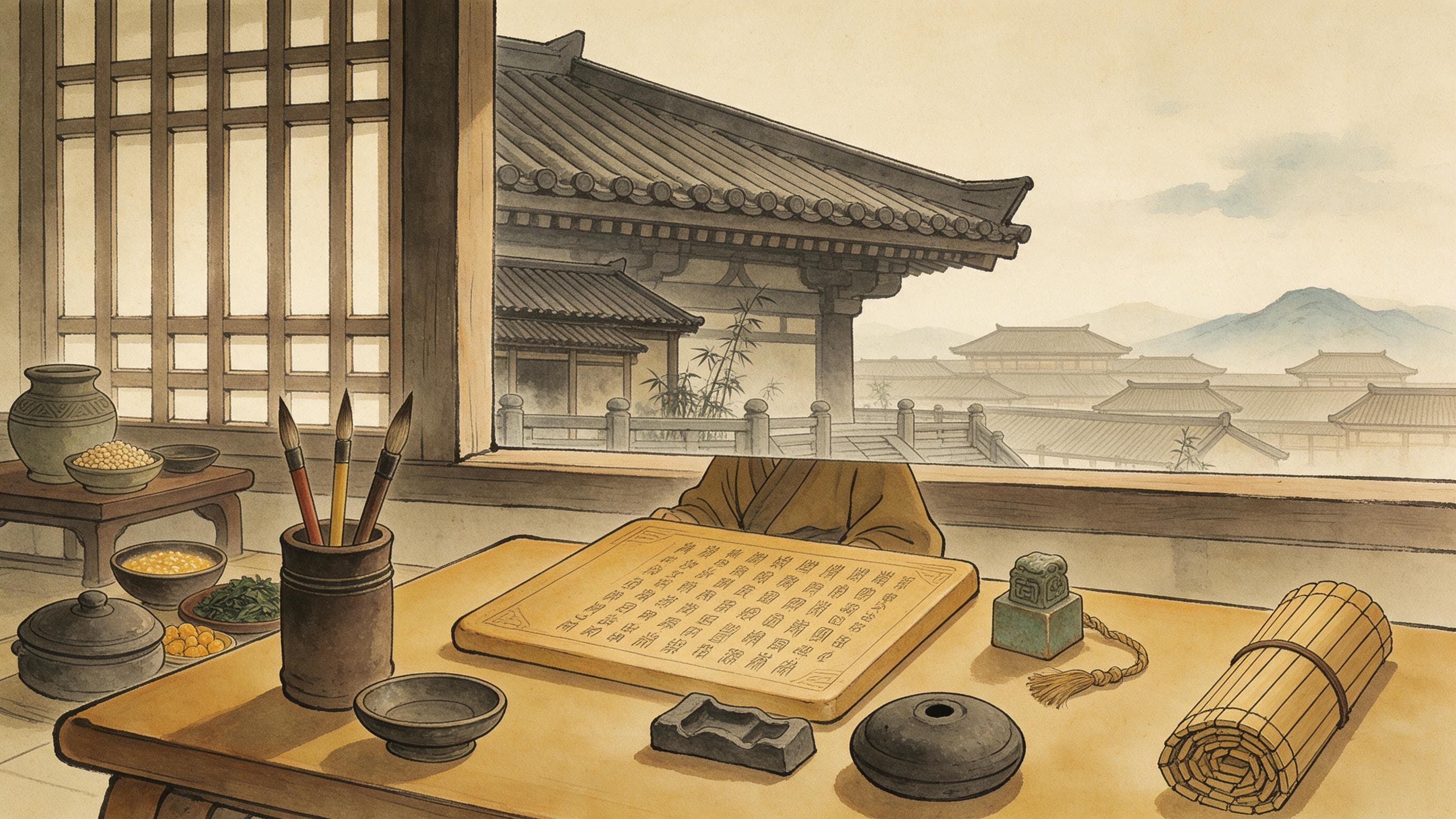
What kind of book was in that historian's hands? The surviving pages of the Changes show its shape. Take the first hexagram, Qian. It opens with four words: 'Greatly penetrating; fitting to be steadfast.' Then six lines: a dragon submerged, do not act; a dragon appearing in the field, fitting to see the great man; the noble man toiling all day, watchful at night, in danger but without blame; a dragon leaping in the deep, without blame; a dragon flying in heaven, fitting to see the great man; a dragon that overreaches, there will be regret. A seventh line, 'use of nine', adds a flock of dragons with no head, auspicious. A book is a set of such units: one judgment, six texts; the diviner's work is to land on one and say what it means.
The page also shows that the book is not one voice. After the lines come the 彖 and the 象 — judgment and image, 'as heaven moves with strength, the noble man strengthens himself without rest' — and then the 文言, which reads the opening four words as four virtues and puts the explanation in the mouth of the Master. These explain the lines and stand after them. The layers are visible on the page; their dates are not. What a reader can see is a short divination core and a long commentary; by the time the page took its present form, the book was to be studied, not only consulted.
What These Pages Do Not Show
Neither page here records an operation. The Zuo zhuan gives a verse, a chain of trigrams and a verdict, and never says what was heated, what was counted, who read the answer, or which method came first. The ritual manual supplies all of that and does not contradict the chronicle, because it is a different kind of book. In the Zhou li's spring offices divination is a bureau: a grand diviner, diviners, turtle keepers, an officer who supplies and blows alight the burning sticks, a reader of omens, and shi diviners who hold the three versions of the Changes. Turtles are taken in autumn and prepared in spring. And the order is stated: 'for the great affairs of the state, divine by stalks first, then by shell' (凡国之大事,先筮而后卜). The signs are read by rank — ruler, officers, scribe, diviner. That is a design for an office, not a record of a day. The chronicle keeps the words, the manual keeps the order, and neither keeps a result.
Related reading:How the Zhou Talked About Shang Drinking: Orders, Exceptions, and an Explanation · One Script for the Empire: A Decree and an Explanation Three Centuries Later · Oaths on Jade Slips: The Houma Covenant Texts
Sources & further reading
- 《春秋左氏传·庄公》(相传左丘明撰,春秋末至战国成书;维基文库本,未与点校本复核) — A year-by-year narrative of Lu from 722 to 481 BCE; the chapters for Duke Zhuang are compiled under each year. Under the twenty-second year it tells three divination stories about one man, Chen Wan (Jingzhong), a son of the ruling house of Chen who fled to Qi: the Yi family divined about marrying a daughter to him and 'his wife read it' (其妻占之), producing a rhymed verse about a phoenix, the descendants of Gui, 'five generations' and 'eight generations'; as a boy in Chen he was the subject of a 筮 performed by a historian of Zhou who had come to the Marquis of Chen with the Zhou Changes, giving 遇《观》之《否》 and an interpretation built from Kun (earth), Xun (wind) and Qian (heaven); and as Duke Huan of Qi's guest he refused to drink past dark because 'I divined for the day, but not for the night'. The year also records the killing of the Chen heir, Chen Wan's flight, his refusal of a chief ministership and his appointment as officer of works (工正). The chapter never describes how either divination was performed, gives no apparatus, no hexagram table and no rule for choosing between 卜 and 筮, and closes the hexagram story by reporting, generations later, that Chen Huanzi became great in Qi and Chengzi took its government.
- 《周易·乾》(卦爻辞战国至汉逐步定型,彖、象、文言为解释层;维基文库本,未与点校本复核) — The received text of the Changes, first hexagram: the judgment 元亨。利贞。, six line texts from 潜龙勿用 to 亢龙有悔, an extra 'use of nine' line, and then the commentarial layers 彖曰, 象曰 ('as heaven moves with strength, the noble man strengthens himself without rest') and 文言曰, which reads the opening four words as four virtues and speaks in the voice of the Master. The page shows the layers but gives no dates for them, and contains nothing about how a divination was carried out, no apparatus and no table of the other hexagrams.
- 《周礼·春官宗伯》(作者与成书年代有争议;维基文库本,未与点校本复核) — The ritual manual's divination bureau, and the order the chronicle never gives: the 筮人 'holds the three Changes' (Lianshan, Guizang, Zhouyi) and 'for the great affairs of the state, divines by stalks first and by shell afterwards' (凡国之大事,先筮而后卜); the 占人 divides the signs — 'the ruler reads the body, the great officers the colour, the scribe the ink, the diviner the cracks'; the 龟人 takes turtles in autumn and prepares them in spring; the 菙氏 supplies the burning material and, at a divination, 'takes bright fire to the 燋 and blows the 焌契 alight'. This is an ideal design for an office, not a record of any actual divination, and it is not the same genre as the Zuo zhuan's narrated cases.